|
시장보고서
상품코드
1721557
원격 마이크로그리드 시장 기회, 성장 촉진요인, 산업 동향 분석 및 예측(2025-2034년)Remote Microgrid Market Opportunity, Growth Drivers, Industry Trend Analysis, and Forecast 2025 - 2034 |
||||||

세계의 원격 마이크로그리드 시장은 2024년 94억 달러로 평가되었고 CAGR 18.7%를 나타내 2034년에는 553억 달러에 이를 것으로 예측됩니다. 이러한 시스템은 특히 송전망의 고장에 취약한 지역이나 중앙 집권적인 연결이 부족한 지역에서 탄력적인 에너지 인프라로서 기능합니다.

게다가 비정상적인 기상과 자연재해로 인해 기존의 송전망과 독립적으로 기능하는 에너지 시스템의 필요성이 높아지고 있습니다. 태양열 발전, 풍력 터빈 및 축전지 통합은 시스템의 신뢰성과 성능을 더욱 향상시키고 시장 확대를 가속화하고 있습니다.
| 시장 범위 | |
|---|---|
| 시작 연도 | 2024년 |
| 예측 연도 | 2025-2034년 |
| 시작 금액 | 94억 달러 |
| 예측 금액 | 553억 달러 |
| CAGR | 18.7% |
에너지 액세스의 개선과 온실 효과 가스 배출량의 삭감을 목표로 하는 정부의 대처가 원격지 마이크로그리드 도입의 주된 추진력이 되고 있습니다. 국제기구는 장기적이고 지속 가능한 경제 발전을 촉진하기 위해 분산형 에너지 시스템에 많은 투자를 실시했습니다.
원격 마이크로그리드 시장의 AC 분야는 원격지에서의 신뢰성이 높고 통합이 용이한 전력 솔루션에 대한 수요가 증가함에 따라 2025년부터 2034년까지 연평균 복합 성장률(CAGR) 18.5%를 나타낼 것으로 예측됩니다. AC 마이크로그리드는 기존 인프라와 원활하게 통합되어 장거리 전송이 가능합니다.
시장은 디젤 발전기, 천연가스, 태양광발전(PV), 열전병급(CHP), 기타 등 전원별로 구분됩니다. 디젤 발전기는 태양열 발전 및 풍력 발전 시스템과 함께 작동하여 연료 효율을 높이고 특히 재생 가능 자원에 대한 액세스가 불안정하거나 제한된 곳에서 지속적인 전력 공급을 보장합니다.
북미는 2024년 세계 시장 점유율의 33%를 차지했으며 미국 시장 규모는 25억 달러였습니다. 연방 정부가 그리드 회복력과 에너지 분산화에 대한 투자를 강화하는 가운데 시장은 꾸준히 성장하고 있습니다.
세계의 원격 마이크로그리드 시장 주요 기업는 Caterpillar, ABB, FlexGen Power Systems, HOMER Energy, Piller Power Systems, General Electric, PG& Holdings 등입니다. 이 회사는 마이크로그리드 시스템의 효율성, 적응성 및 확장 성을 향상시키기 위해 기술 혁신, 전략적 제휴 및 연구 개발 투자에 주력하고 있습니다.
목차
제1장 조사 방법과 범위
제2장 주요 요약
제3장 업계 인사이트
- 업계 에코시스템
- 규제 상황
- 업계에 미치는 영향요인
- 성장 촉진요인
- 업계의 잠재적 위험 및 과제
- 성장 가능성 분석
- Porter's Five Forces 분석
- 공급기업의 협상력
- 구매자의 협상력
- 신규 진입업자의 위협
- 대체품의 위협
- PESTEL 분석
제4장 경쟁 구도
- 서론
- 전략적 대시보드
- 혁신 및 지속가능성 전망
제5장 시장 규모와 예측 : 연결성별(2021-2034년)
- 주요 동향
- 그리드 연결
- 오프 그리드
제6장 시장 규모와 예측 : 전원별(2021-2034년)
- 주요 동향
- 디젤 발전기
- 천연가스
- 태양열 발전
- CHP
- 기타
제7장 시장 규모와 예측 : 저장 장치별(2021-2034년)
- 주요 동향
- 리튬 이온
- 납축 전지
- 플로우 배터리
- 플라이휠
- 기타
제8장 시장 규모와 예측 : 그리드 유형별(2021-2034년)
- 주요 동향
- AC
- DC
- 하이브리드
제9장 시장 규모와 예측 : 지역별(2021-2034년)
- 주요 동향
- 북미
- 미국
- 캐나다
- 멕시코
- 유럽
- 독일
- 프랑스
- 영국
- 러시아
- 스페인
- 이탈리아
- 덴마크
- 아시아태평양
- 중국
- 일본
- 한국
- 인도
- 호주
- 말레이시아
- 인도네시아
- 중동 및 아프리카
- 사우디아라비아
- 아랍에미리트(UAE)
- 남아프리카
- 이란
- 나이지리아
- 라틴아메리카
- 브라질
- 아르헨티나
- 칠레
제10장 기업 프로파일
- ABB
- Caterpillar
- FlexGen Power Systems
- General Electric
- HOMER Energy
- Piller Power Systems
- PG&E
- Saft
- Schneider Electric
- Stellar Energy
- Siemens
- Victron Energy
- Yanmar Holdings
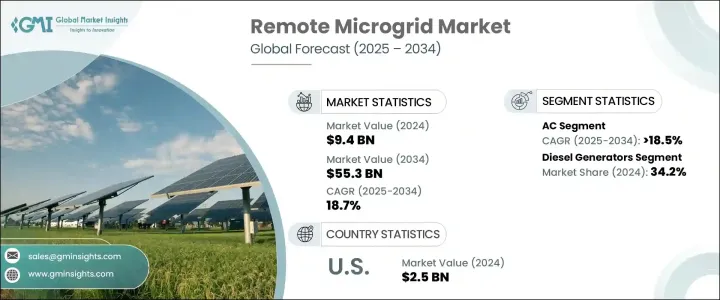
The Global Remote Microgrid Market was valued at USD 9.4 billion in 2024 and is projected to grow at a CAGR of 18.7% to reach USD 55.3 billion by 2034. This growth reflects the rising demand for sustainable, decentralized power solutions across remote and off-grid regions globally. As more nations emphasize clean energy transitions, microgrids are becoming central to rural electrification strategies. These systems serve as resilient energy infrastructures, especially in areas vulnerable to grid failures or lacking centralized connectivity. The growing need for climate-resilient and emission-reducing power systems is pushing governments and private organizations to prioritize investments in remote microgrid technologies.
Additionally, extreme weather conditions and natural disasters have intensified the need for energy systems that can function independently of the traditional grid. Remote microgrids not only fulfill that requirement but also improve energy reliability, empower rural economies, and support essential services like telecommunications, healthcare, and education in isolated regions. The integration of solar PV, wind turbines, and battery storage is further enhancing system reliability and performance, thereby accelerating market expansion. These systems are also being adopted by industries and military bases operating in remote or off-grid locations where continuous, high-quality power is essential.
| Market Scope | |
|---|---|
| Start Year | 2024 |
| Forecast Year | 2025-2034 |
| Start Value | $9.4 billion |
| Forecast Value | $55.3 Billion |
| CAGR | 18.7% |
Government initiatives aimed at improving energy access and cutting down on greenhouse gas emissions are major drivers for the adoption of remote microgrids. With growing energy demands from rural communities that lack access to centralized grids, off-grid electrification has become a top priority. Governments and global organizations are investing heavily in decentralized energy systems to foster long-term, sustainable economic development. The continued advancements in renewable energy technologies, such as solar and wind, are further driving the adoption of remote microgrids, making them more efficient, cost-effective, and reliable.
The AC segment in the remote microgrid market is anticipated to grow at a CAGR of 18.5% between 2025 and 2034 due to increasing demand for reliable and easily integrated power solutions in remote areas. AC microgrids seamlessly integrate with existing infrastructure and are capable of transmitting electricity across longer distances. Their compatibility with various energy sources and ability to handle high power loads make them an ideal solution for isolated regions seeking to strengthen energy independence and resilience.
The market is segmented by power sources, including diesel generators, natural gas, solar photovoltaics (PV), combined heat and power (CHP), and others. Diesel generators held a 34.2% share in 2024, primarily because of their reliability in supporting renewable-based systems. By operating alongside solar and wind systems, diesel generators enhance fuel efficiency and ensure continuous power supply, especially in locations with unstable or limited access to renewable resources.
North America accounted for 33% of the global market share in 2024, with the U.S. valued at USD 2.5 billion. The market is growing steadily as the federal government ramps up investments in grid resiliency and energy decentralization. Remote microgrids are emerging as critical infrastructure to support sustainability goals, especially in underserved and geographically challenging regions.
Key players in the Global Remote Microgrid Market include Caterpillar, ABB, FlexGen Power Systems, HOMER Energy, Piller Power Systems, General Electric, PG&E, Saft, Stellar Energy, Siemens, Schneider Electric, Victron Energy, and Yanmar Holdings. These companies are focusing on technological innovation, strategic collaborations, and R&D investments to improve the efficiency, adaptability, and scalability of their microgrid systems.
Table of Contents
Chapter 1 Methodology & Scope
- 1.1 Research design
- 1.2 Base estimates & calculations
- 1.3 Forecast calculation
- 1.4 Primary research & validation
- 1.4.1 Primary sources
- 1.4.2 Data mining sources
- 1.5 Market definitions
Chapter 2 Executive Summary
- 2.1 Industry synopsis, 2021 - 2034
Chapter 3 Industry Insights
- 3.1 Industry ecosystem
- 3.2 Regulatory landscape
- 3.3 Industry impact forces
- 3.3.1 Growth drivers
- 3.3.2 Industry pitfalls & challenges
- 3.4 Growth potential analysis
- 3.5 Porter's analysis
- 3.5.1 Bargaining power of suppliers
- 3.5.2 Bargaining power of buyers
- 3.5.3 Threat of new entrants
- 3.5.4 Threat of substitutes
- 3.6 PESTEL analysis
Chapter 4 Competitive landscape, 2024
- 4.1 Introduction
- 4.2 Strategic dashboard
- 4.3 Innovation & sustainability landscape
Chapter 5 Market Size and Forecast, By Connectivity, 2021 - 2034(USD Billion & MW)
- 5.1 Key trends
- 5.2 Grid connected
- 5.3 Off grid
Chapter 6 Market Size and Forecast, By Power Source, 2021 - 2034(USD Billion & MW)
- 6.1 Key trends
- 6.2 Diesel generators
- 6.3 Natural gas
- 6.4 Solar PV
- 6.5 CHP
- 6.6 Others
Chapter 7 Market Size and Forecast, By Storage Device, 2021 - 2034(USD Billion & MW)
- 7.1 Key trends
- 7.2 Lithium-ion
- 7.3 Lead acid
- 7.4 Flow battery
- 7.5 Flywheels
- 7.6 Others
Chapter 8 Market Size and Forecast, By Grid Type, 2021 - 2034(USD Billion & MW)
- 8.1 Key trends
- 8.2 AC
- 8.3 DC
- 8.4 Hybrid
Chapter 9 Market Size and Forecast, By Region, 2021 - 2034(USD Billion & MW)
- 9.1 Key trends
- 9.2 North America
- 9.2.1 U.S.
- 9.2.2 Canada
- 9.2.3 Mexico
- 9.3 Europe
- 9.3.1 Germany
- 9.3.2 France
- 9.3.3 UK
- 9.3.4 Russia
- 9.3.5 Spain
- 9.3.6 Italy
- 9.3.7 Denmark
- 9.4 Asia Pacific
- 9.4.1 China
- 9.4.2 Japan
- 9.4.3 South Korea
- 9.4.4 India
- 9.4.5 Australia
- 9.4.6 Malaysia
- 9.4.7 Indonesia
- 9.5 Middle East and Africa
- 9.5.1 Saudi Arabia
- 9.5.2 UAE
- 9.5.3 South Africa
- 9.5.4 Iran
- 9.5.5 Nigeria
- 9.6 Latin America
- 9.6.1 Brazil
- 9.6.2 Argentina
- 9.6.3 Chile
Chapter 10 Company Profiles
- 10.1 ABB
- 10.2 Caterpillar
- 10.3 FlexGen Power Systems
- 10.4 General Electric
- 10.5 HOMER Energy
- 10.6 Piller Power Systems
- 10.7 PG&E
- 10.8 Saft
- 10.9 Schneider Electric
- 10.10 Stellar Energy
- 10.11 Siemens
- 10.12 Victron Energy
- 10.13 Yanmar Holdings