|
시장보고서
상품코드
1721619
여객 페리 시장 기회, 성장 촉진요인, 산업 동향 분석 및 예측(2025-2034년)Passenger Ferries Market Opportunity, Growth Drivers, Industry Trend Analysis, and Forecast 2025 - 2034 |
||||||

세계의 여객 페리 시장은 2024년 153억 달러로 평가되었고 CAGR 6.2%를 나타내 2034년에는 272억 달러에 이를 것으로 예측됩니다. 수요가 증가함에 따라 승객 페리는 견고한 육상 운송 인프라가 없는 섬, 해안 도시 및 고립된 지역 간의 원활한 연결성을 제공합니다. 사람의 이동과 화물의 이동을 모두 촉진하는 그 능력은 관민 양부문으로부터의 투자 증가를 촉진하고 있습니다. 정부 및 페리 운항회사는 관광, 지역의 연결성, 지속 가능한 수송 솔루션을 지원하는 프로젝트를 우선하고 있습니다.
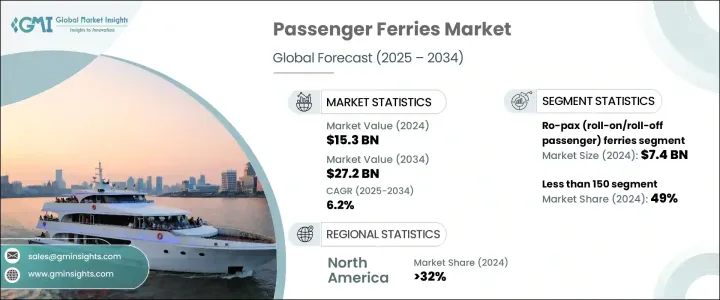
페리 유형별 주요 부문에서는 Ro-Pax(롤온/롤오프 여객) 페리가 2024년 시장 규모 74억 달러로 시장을 독점했습니다. 적합합니다. 한 번의 여행으로 여행자와 철도 화물을 모두 다룰 수 있기 때문에 관광과 무역을 지원할 수 있습니다. 선박을 근대화하기 위한 노력이 환경 규제에 따라 운항 비용을 낮추고 있습니다.
| 시장 범위 | |
|---|---|
| 시작 연도 | 2024년 |
| 예측 연도 | 2025-2034년 |
| 시작 금액 | 153억 달러 |
| 예측 금액 | 272억 달러 |
| CAGR | 6.2% |
정원별로는 150명 미만의 페리가 2024년 시장 점유율의 49%를 차지했습니다. 사이즈가 작기 때문에 단시간에 접어 운항에 적합하고, 도시의 통근객이나 현지의 관광객에게 매력적입니다. 운송을 모색하는 중, 소용량의 페리는 비용효과가 높고, 연료 효율이 높은 대체 수단으로서 채용되고 있습니다.
기술면에서 신뢰성과 확립된 인프라가 주된 이유로, 디젤식 페리가 2024년에도 우세를 유지했습니다. 페리는 항속 거리가 길고 연료 보급의 필요성이 적은 등 운항상의 이점이 있으며, 엄격한 해양 환경에서의 장거리 항행에 이상적입니다.
북미는 2024년 32% 이상의 최대 지역 점유율을 차지했으며, 미국이 페리 인프라와 보다 깨끗한 해상 운송 시스템에 대한 전략적 투자를 통해 지역 확대를 주도하고 있습니다.
여객 페리 시장 주요 기업(BC Ferries, Stena Line, Brittany Ferries 등)은 녹색기술과 선대전화를 통해 성장을 추진하고 있습니다. 그리고 실시간 추적 기술을 채택하고 있습니다. 항만 당국과의 협력이나 정부 자금에의 액세스는 운항 규모를 확대해 서비스 품질을 유지하는 노력을 한층 더 추진하고 있습니다.
목차
제1장 조사 방법과 범위
제2장 주요 요약
제3장 업계 인사이트
- 생태계 분석
- 공급자의 상황
- 제조업체
- 서비스 제공업체
- 기술 공급자
- 최종 용도
- 트럼프 정권에 의한 관세에 대한 영향
- 무역에 미치는 영향
- 무역량의 혼란
- 보복 조치
- 업계에 미치는 영향
- 주요 원재료의 가격 변동
- 공급망 재구성
- 최종 시장에의 가격 전달
- 주요 원재료의 가격 변동
- 전략적인 업계 대응
- 공급망 재구성
- 가격 설정 및 제품 전략
- 무역에 미치는 영향
- 이익률 분석
- 코스트 내역 분석
- 기술 및 혁신 전망
- 주요 뉴스와 대처
- 규제 상황
- 영향요인
- 성장 촉진요인
- 수상 교통 솔루션의 도시 통합
- 해상 관광과 레저 여행의 확대
- 지속 가능한 해상 수송에 대한 정부의 지원
- 페리의 설계와 효율에 있어서 기술적 진보
- 업계의 잠재적 위험 및 과제
- 높은 운영 비용과 연료 의존
- 계절적인 수요 변동과 경로의 실현 가능성 문제
- 성장 촉진요인
- 성장 가능성 분석
- Porter's Five Forces 분석
- PESTEL 분석
제4장 경쟁 구도
- 서론
- 기업의 시장 점유율 분석
- 경쟁 포지셔닝 매트릭스
- 전략적 전망 매트릭스
제5장 시장 추계·예측 : 페리별(2021-2034년)
- 주요 동향
- Ro-pax(롤 온/롤 오프 여객) 페리
- 고속 페리
- 크루즈 페리
제6장 시장 추계·예측 : 용량별(2021-2034년)
- 주요 동향
- 150 미만
- 150-400
- 400 이상
제7장 시장 추계·예측 : 차량별(2021-2034년)
- 주요 동향
- 기존 디젤 페리
- 전기 및 하이브리드 페리
- LNG 연료 페리
제8장 시장 추계·예측 : 지역별(2021-2034년)
- 주요 동향
- 북미
- 미국
- 캐나다
- 유럽
- 영국
- 독일
- 프랑스
- 스페인
- 이탈리아
- 러시아
- 북유럽 국가
- 아시아태평양
- 중국
- 인도
- 일본
- 한국
- 호주
- 동남아시아
- 라틴아메리카
- 브라질
- 아르헨티나
- 멕시코
- 중동 및 아프리카
- 아랍에미리트(UAE)
- 남아프리카
- 사우디아라비아
제9장 기업 프로파일
- Austal
- BC Ferries
- Blue Star Ferries
- Brittany Ferries
- Corsica Ferries
- Damen Shipyards Group
- DFDS Seaways
- Fjord1 ASA
- Grimaldi Lines
- Hornblower Cruises &Events
- Incat
- Irish Ferries
- Jadrolinija
- Meyer Werft
- Minoan Lines
- NY Waterway
- P&O Ferries
- Stena Line
- Tallink Grupp
- Washington State Ferries
The Global Passenger Ferries Market was valued at USD 15.3 billion in 2024 and is estimated to grow at a CAGR of 6.2% to reach USD 27.2 billion by 2034. This upward trend stems from the increasing demand for efficient and flexible transport options in densely populated and geographically scattered regions. Passenger ferries offer seamless connectivity between island territories, coastal cities, and isolated communities that often lack robust land transport infrastructure. Their ability to facilitate both human and cargo movement has encouraged rising investments from both public and private sectors. Governments and ferry operators are prioritizing projects that support tourism, regional connectivity, and sustainable transport solutions. The push toward green mobility, especially through electric and hybrid ferry models, is unlocking new opportunities for long-term growth across the maritime transport sector.
Among the key segments by ferry type, Ro-Pax (roll-on/roll-off passenger) ferries dominated the market with a value of USD 7.4 billion in 2024. These vessels allow passengers and vehicles to travel simultaneously, making them ideal for routes with limited road access. The capability to handle both travelers and rolling cargo in a single trip supports tourism and trade. Operators are steadily expanding their fleets and upgrading ports to boost coverage across high-traffic maritime corridors. The growing preference for travel methods that support personal vehicle transport at tourist spots is further driving adoption. Ro-Pax ferries combine comfort with utility, making them a favored choice for weekend travelers and logistics operators alike. Efforts to modernize these vessels with fuel-efficient engines, hybrid propulsion systems, and aerodynamic hulls are driving down operational costs while aligning with environmental regulations. This shift is also attracting eco-conscious consumers and commercial clients, with green financing playing a pivotal role in fleet modernization initiatives worldwide.
| Market Scope | |
|---|---|
| Start Year | 2024 |
| Forecast Year | 2025-2034 |
| Start Value | $15.3 Billion |
| Forecast Value | $27.2 Billion |
| CAGR | 6.2% |
By capacity, ferries accommodating fewer than 150 passengers accounted for 49% of the market share in 2024. These compact vessels serve urban waterfronts and narrow inland waterways where larger ferries cannot operate efficiently. Their smaller size makes them suitable for quick turnaround operations, appealing to city commuters and local tourists. As urban areas explore water-based transport to reduce road congestion, small-capacity ferries are being adopted as cost-effective, fuel-efficient alternatives. The demand for these ferries is further supported by innovations such as electric propulsion systems, lightweight construction materials, and automated onboard technology. This makes them viable for frequent short-distance operations while keeping maintenance costs low and reducing emissions.
In terms of technology, diesel-powered ferries continued to dominate in 2024, largely due to their reliability and established infrastructure. They remain a preferred option across long-distance and high-load routes, especially in regions where advanced energy alternatives are still emerging. Diesel ferries offer operational advantages such as longer range and minimal refueling needs, making them ideal for extended trips in challenging marine environments. Despite the shift toward cleaner technologies, many operators continue to rely on diesel vessels for their durability, easy maintenance, and cost-effectiveness.
North America held the largest regional market share at over 32% in 2024, with the United States leading the regional expansion through strategic investments in ferry infrastructure and cleaner maritime transport systems.
Leading companies in the passenger ferries market-such as BC Ferries, Stena Line, and Brittany Ferries-are driving growth through green technology and fleet electrification. These players are investing in hybrid propulsion systems and alternative fuels to meet evolving environmental regulations. To enhance customer experience and operational efficiency, operators are expanding route networks, upgrading onboard amenities, and adopting digital ticketing and real-time tracking technologies. Collaborations with port authorities and access to government funding further support their efforts to scale operations and maintain service quality. In this competitive and fragmented industry, innovation and sustainability remain key strategies for long-term success and regional expansion.
Table of Contents
Chapter 1 Methodology & Scope
- 1.1 Research design
- 1.1.1 Research approach
- 1.1.2 Data collection methods
- 1.2 Base estimates and calculations
- 1.2.1 Base year calculation
- 1.2.2 Key trends for market estimates
- 1.3 Forecast model
- 1.4 Primary research & validation
- 1.4.1 Primary sources
- 1.4.2 Data mining sources
- 1.5 Market definitions
Chapter 2 Executive Summary
- 2.1 Industry 3600 synopsis, 2021 - 2034
Chapter 3 Industry Insights
- 3.1 Industry ecosystem analysis
- 3.2 Supplier landscape
- 3.2.1 Manufacturers
- 3.2.2 Service provider
- 3.2.3 Technology provider
- 3.2.4 End use
- 3.3 Impact of trump administration tariffs
- 3.3.1 Impact on trade
- 3.3.1.1 Trade volume disruptions
- 3.3.1.2 Retaliatory measures
- 3.3.2 Impact on the Industry
- 3.3.2.1 Price volatility in key materials
- 3.3.2.1.1 Supply chain restructuring
- 3.3.2.1.2 Price transmission to end markets
- 3.3.2.1 Price volatility in key materials
- 3.3.3 Strategic industry responses
- 3.3.3.1 Supply chain reconfiguration
- 3.3.3.2 Pricing and product strategies
- 3.3.1 Impact on trade
- 3.4 Profit margin analysis
- 3.5 Cost breakdown analysis
- 3.6 Technology & innovation landscape
- 3.7 Key news & initiatives
- 3.8 Regulatory landscape
- 3.9 Impact forces
- 3.9.1 Growth drivers
- 3.9.1.1 Urban integration of water-based transit solutions
- 3.9.1.2 Expansion of maritime tourism and leisure travel
- 3.9.1.3 Government support for sustainable marine transport
- 3.9.1.4 Technological advancements in ferry design and efficiency
- 3.9.2 Industry pitfalls & challenges
- 3.9.2.1 High operating costs and fuel dependency
- 3.9.2.2 Seasonal demand fluctuations and route viability issues
- 3.9.1 Growth drivers
- 3.10 Growth potential analysis
- 3.11 Porter’s analysis
- 3.12 PESTEL analysis
Chapter 4 Competitive Landscape, 2024
- 4.1 Introduction
- 4.2 Company market share analysis
- 4.3 Competitive positioning matrix
- 4.4 Strategic outlook matrix
Chapter 5 Market Estimates & Forecast, By Ferry, 2021 - 2034 ($Mn & Fleet Size)
- 5.1 Key trends
- 5.2 Ro-pax (roll-on/roll-off passenger) ferries
- 5.3 High-speed ferries
- 5.4 Cruise ferries
Chapter 6 Market Estimates & Forecast, By Capacity, 2021 - 2034 ($Mn & Fleet Size)
- 6.1 Key trends
- 6.2 Less than 150
- 6.3 150 - 400
- 6.4 More than 400
Chapter 7 Market Estimates & Forecast, By Vehicle, 2021 - 2034 ($Mn & Fleet Size)
- 7.1 Key trends
- 7.2 Conventional diesel-powered ferries
- 7.3 Electric & hybrid ferries
- 7.4 LNG powered ferries
Chapter 8 Market Estimates & Forecast, By Region, 2021 - 2034 ($Mn & Fleet Size)
- 8.1 Key trends
- 8.2 North America
- 8.2.1 U.S.
- 8.2.2 Canada
- 8.3 Europe
- 8.3.1 UK
- 8.3.2 Germany
- 8.3.3 France
- 8.3.4 Spain
- 8.3.5 Italy
- 8.3.6 Russia
- 8.3.7 Nordics
- 8.4 Asia Pacific
- 8.4.1 China
- 8.4.2 India
- 8.4.3 Japan
- 8.4.4 South Korea
- 8.4.5 Australia
- 8.4.6 Southeast Asia
- 8.5 Latin America
- 8.5.1 Brazil
- 8.5.2 Argentina
- 8.5.3 Mexico
- 8.6 MEA
- 8.6.1 UAE
- 8.6.2 South Africa
- 8.6.3 Saudi Arabia
Chapter 9 Company Profiles
- 9.1 Austal
- 9.2 BC Ferries
- 9.3 Blue Star Ferries
- 9.4 Brittany Ferries
- 9.5 Corsica Ferries
- 9.6 Damen Shipyards Group
- 9.7 DFDS Seaways
- 9.8 Fjord1 ASA
- 9.9 Grimaldi Lines
- 9.10 Hornblower Cruises & Events
- 9.11 Incat
- 9.12 Irish Ferries
- 9.13 Jadrolinija
- 9.14 Meyer Werft
- 9.15 Minoan Lines
- 9.16 NY Waterway
- 9.17 P&O Ferries
- 9.18 Stena Line
- 9.19 Tallink Grupp
- 9.20 Washington State Ferries