|
시장보고서
상품코드
1740783
알루미나 정제 시장 기회, 성장 촉진 요인, 산업 동향 분석, 예측(2025-2034년)Alumina Refining Market Opportunity, Growth Drivers, Industry Trend Analysis, and Forecast 2025 - 2034 |
||||||

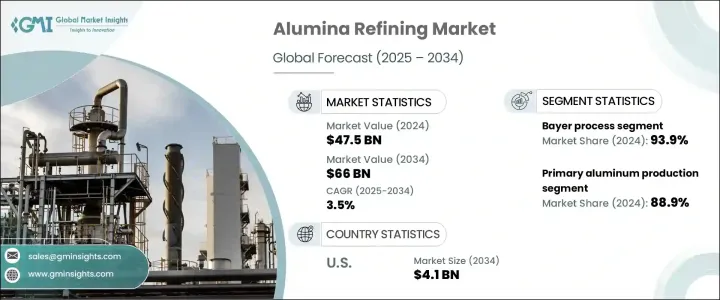
알루미나 정제 세계 시장 규모는 2024년에 475억 달러로 평가되었고, CAGR 3.5%로, 2034년에는 660억 달러에 이를 것으로 추정됩니다.
이 성장은 주로 알루미늄 생산에서 중요한 전구물질인 1차 알루미늄 수요 증가로 인한 것입니다. 연비 항공기 및 기타 운송 기술도 알루미늄에 크게 의존하고 있으며 알루미늄 제련에 사용되는 주원료인 제련 등급 알루미나(SGA)의 필요성을 높이고 있습니다.
기술의 진보도, 알루미나 정제 시장에 박차를 가하는 중요한 요인의 하나입니다. 환경 규제를 완화하고 전반적인 생산성을 높일 수 있습니다.
| 시장 범위 | |
|---|---|
| 시작 연도 | 2024년 |
| 예측 연도 | 2025-2034년 |
| 시작 금액 | 475억 달러 |
| 예측 금액 | 660억 달러 |
| CAGR | 3.5% |
알루미나 정제에서는 바이엘 제법이 여전히 주류이며 세계 시장의 93.9%라는 경이적인 점유율을 차지하고 있습니다. 또한 안정적인 고품질의 알루미나를 생산하기 때문에 대규모 조업에 최적입니다. 또한 바이엘 제법은 에너지 절약 기기나 고급 배기 가스 규제 등의 기술적 업그레이드에 적합하기 때문에 기업은 대규모 인프라 개수를 필요로 하지 않고 조업을 근대화할 수 있습니다.
시장은 알루미나 품위에 의해 더욱 세분화되어 제련소 등급 알루미나(SGA)가 87.7%로 큰 점유율을 차지하고 있습니다. 특히 자동차와 항공우주 분야에서 경량 소재 수요가 높아짐에 따라 SGA 수요는 계속 높아지고 있습니다.
미국의 알루미나 정제 시장은 2024년에는 세계 시장의 17.8%를 차지했으며 23억 달러의 매출을 올렸습니다. 이 전략은 시장 확대를 가속화하고 있습니다. 자동차, 항공우주 및 재생 가능 에너지와 같은 분야에서 알루미늄 수요가 증가함에 따라 미국의 알루미나 정제 산업의 성장을 더욱 강화하고 있습니다.
세계 알루미나 정제 업계의 주요 기업으로는 Rio Tinto, Aluminum Corporation of China(CHALCO), RUSAL, Norsk Hydro ASA, Alcoa Corporation 등이 있습니다. 이러한 기업은 기술의 진보나 현지 생산의 강화에 투자하는 것으로, 세계의 존재감을 강화하고 있습니다. 또, 주요 부문에 있어서의 알루미늄 수요 증가에 대응하기 위해, 정제 프로세스에도 전략적으로 투자하고 있습니다.
목차
제1장 조사 방법과 범위
제2장 주요 요약
제3장 업계 인사이트
- 생태계 분석
- 밸류체인에 영향을 주는 요인
- 이익률 분석
- 혁신
- 장래의 전망
- 제조업자
- 리셀러
- 공급자의 상황
- 이익률 분석
- 주요 뉴스와 대처
- 규제 상황
- 영향요인
- 1차 알루미늄의 세계 수요 증가
- 신흥 경제의 급속한 산업화
- 자동차 및 항공우주부문 확대
- 전자기기 및 반도체 소비량 증가
- 고순도 알루미나(HPA) 수요 증가
- 정제 공정에서의 기술적 진보
- 업계의 잠재적 위험 및 과제
- 높은 에너지 강도와 그에 따른 비용
- 적니처분에 관한 환경규제
- 보크사이트공급과 가격의 변동
- 트럼프 정권에 의한 관세에 대한 영향
- 무역에 미치는 영향
- 무역량의 혼란
- 보복 조치
- 업계에 미치는 영향
- 공급측의 영향(원재료)
- 주요 원재료의 가격 변동
- 공급망 재구성
- 생산 비용에 미치는 영향
- 수요측의 영향(판매가격)
- 최종 시장에의 가격 전달
- 시장 점유율 동향
- 소비자의 반응 패턴
- 공급측의 영향(원재료)
- 영향을 받는 주요 기업
- 전략적인 업계 대응
- 공급망 재구성
- 가격 설정 및 제품 전략
- 정책관여
- 전망과 향후 검토 사항
- 무역에 미치는 영향
- 무역 통계(HS코드)
- 주요 수출국
- 주요 수입국
참고: 위의 무역 통계는 주요 국가에 대해서만 제공됩니다.
- 성장 가능성 분석
- Porter's Five Forces 분석
- PESTEL 분석
제4장 경쟁 구도
- 소개
- 기업의 시장 점유율 분석
- 경쟁 포지셔닝 매트릭스
- 전략적 전망 매트릭스
제5장 시장 추정 및 예측 : 정제 프로세스별, 2021-2034년
- 주요 동향
- 바이엘법
- 바이엘 소결법
- 기타 대체 프로세스
제6장 시장 추정 및 예측 : 그레이드별, 2021-2034년
- 주요 동향
- 제련 등급 알루미나(SGA)
- 화학 등급 알루미나(CGA)
- 촉매 등급 알루미나
- 연마 등급 알루미나
- 내화 등급 알루미나
- 고순도 알루미나(HPA)
제7장 시장 추정 및 예측 : 용도별, 2021-2034년
- 주요 동향
- 1차 알루미늄 생산
- 세라믹·내화물
- 촉매·흡착제
- 유리 제조
- 연마제
- 기타
제8장 시장 추정 및 예측 : 지역별, 2021-2034년
- 주요 동향
- 북미
- 미국
- 캐나다
- 유럽
- 독일
- 영국
- 프랑스
- 스페인
- 이탈리아
- 아시아태평양
- 중국
- 인도
- 일본
- 호주
- 한국
- 라틴아메리카
- 브라질
- 멕시코
- 아르헨티나
- 중동 및 아프리카
- 사우디아라비아
- 남아프리카
- 아랍에미리트(UAE)
제9장 기업 프로파일
- Alcoa Corporation
- Rio Tinto
- RUSAL(United Company RUSAL Plc)
- Norsk Hydro ASA
- South32 Limited
- China Hongqiao Group Limited
- Alba(Aluminium Bahrain BSC)
- Emirates Global Aluminium(EGA)
- Vedanta Limited
- East Hope Group
The Global Alumina Refining Market was valued at USD 47.5 billion in 2024 and is estimated to grow at a CAGR of 3.5% to reach USD 66 billion by 2034. This growth is primarily driven by the increasing demand for primary aluminum, which is a critical precursor in aluminum production. As industries like automotive, aerospace, and construction continue to expand, the need for aluminum has surged. Particularly in the electric vehicle (EV) sector, lightweight materials that promote fuel efficiency are in high demand. Fuel-efficient aircraft and other transportation technologies also heavily rely on aluminum, driving the need for smelter-grade alumina (SGA), the main feedstock used in aluminum smelting. The shift toward renewable energy and electric vehicles is accelerating the demand for aluminum and, consequently, alumina refining.
Technological advancements are another key factor fueling the alumina refining market. Innovations like energy-efficient kilns, improvements in the Bayer process, and the integration of renewable energy sources are all contributing to more sustainable and cost-effective alumina production. These technological developments allow companies to reduce operational costs, comply with environmental regulations, and boost overall productivity. With environmental standards becoming more stringent, companies are increasingly adopting these cutting-edge technologies to remain competitive. This positions them to capitalize on the growing global demand for aluminum while minimizing environmental impact.
| Market Scope | |
|---|---|
| Start Year | 2024 |
| Forecast Year | 2025-2034 |
| Start Value | $47.5 Billion |
| Forecast Value | $66 Billion |
| CAGR | 3.5% |
The Bayer process remains the dominant method in alumina refining, commanding an impressive 93.9% share of the global market. Its widespread use is due to its efficiency, particularly for extracting alumina from premium-grade bauxite. This method is perfect for large-scale operations as it produces consistent, high-quality alumina with minimal waste. Moreover, the Bayer process aligns well with technological upgrades, such as energy-saving equipment and advanced emission controls, allowing companies to modernize their operations without needing significant infrastructure overhauls.
The market is further segmented by alumina grade, with smelter-grade alumina (SGA) taking the lion's share at 87.7%. This grade is essential for aluminum smelting and is the most commonly used type across various industries, including transportation, construction, packaging, and electronics. As the demand for lightweight materials grows, especially in the automotive and aerospace sectors, SGA continues to be in high demand. The automotive industry, in particular, is a significant driver of this growth as the need for fuel-efficient and electric vehicles, which rely on aluminum for their components, escalates.
The U.S. alumina refining market accounted for 17.8% of the global market in 2024, generating USD 2.3 billion. A major contributor to this growth is the U.S. government's push for boosting domestic aluminum production and reducing dependence on imports. Policies aimed at strengthening local supply chains and expanding domestic refining capabilities have accelerated the market's expansion. Rising demand for aluminum in sectors such as automotive, aerospace, and renewable energy has further supported the growth of the U.S. alumina refining industry. This trend is expected to continue as both industrial demand and governmental policies fuel further market development in the coming years.
Major players in the Global Alumina Refining Industry include Rio Tinto, Aluminum Corporation of China (CHALCO), RUSAL, Norsk Hydro ASA, and Alcoa Corporation. These companies are strengthening their global presence by investing in technological advancements and local production enhancements. They are also strategically investing in refining processes to meet the rising demand for aluminum in key sectors. Their forward-thinking strategies enable them to remain competitive in a rapidly growing market while addressing the rising need for aluminum and its alloys across industries.
Table of Contents
Chapter 1 Methodology & Scope
- 1.1 Market scope & definition
- 1.2 Base estimates & calculations
- 1.3 Forecast calculation
- 1.4 Data sources
- 1.4.1 Primary
- 1.4.2 Secondary
- 1.4.2.1 Paid sources
- 1.4.2.2 Public sources
- 1.5 Primary research and validation
- 1.5.1 Primary sources
- 1.5.2 Data mining sources
Chapter 2 Executive Summary
- 2.1 Industry synopsis, 2021 - 2034
Chapter 3 Industry Insights
- 3.1 Industry ecosystem analysis
- 3.1.1 Factor affecting the value chain
- 3.1.2 Profit margin analysis
- 3.1.3 Disruptions
- 3.1.4 Future outlook
- 3.1.5 Manufacturers
- 3.1.6 Distributors
- 3.2 Supplier landscape
- 3.3 Profit margin analysis
- 3.4 Key news & initiatives
- 3.5 Regulatory landscape
- 3.6 Impact forces
- 3.6.1.1 Rising global demand for primary aluminum
- 3.6.1.2 Rapid industrialization in emerging economies
- 3.6.1.3 Expansion of automotive and aerospace sectors
- 3.6.1.4 Growing consumption of electronics and semiconductors
- 3.6.1.5 Increase in demand for high-purity alumina (HPA)
- 3.6.1.6 Technological advancements in refining processes
- 3.6.2 Industry pitfalls & challenges
- 3.6.2.1 High energy intensity and associated costs
- 3.6.2.2 Environmental regulations on red mud disposal
- 3.6.2.3 Volatility in bauxite supply and pricing
- 3.7 Trump administration tariffs
- 3.7.1 Impact on trade
- 3.7.1.1 Trade volume disruptions
- 3.7.1.2 Retaliatory measures
- 3.7.2 Impact on the industry
- 3.7.2.1 Supply-side impact (raw materials)
- 3.7.2.1.1 Price volatility in key materials
- 3.7.2.1.2 Supply chain restructuring
- 3.7.2.1.3 Production cost implications
- 3.7.2.2 Demand-side impact (selling price)
- 3.7.2.2.1 Price transmission to end markets
- 3.7.2.2.2 Market share dynamics
- 3.7.2.2.3 Consumer response patterns
- 3.7.2.1 Supply-side impact (raw materials)
- 3.7.3 Key companies impacted
- 3.7.4 Strategic industry responses
- 3.7.4.1 Supply chain reconfiguration
- 3.7.4.2 Pricing and product strategies
- 3.7.4.3 Policy engagement
- 3.7.5 Outlook and future considerations
- 3.7.1 Impact on trade
- 3.8 Trade statistics (HS code)
- 3.8.1 Major exporting countries
- 3.8.1.1 Country 1
- 3.8.1.2 Country 2
- 3.8.1.3 Country 3
- 3.8.2 Major importing countries
- 3.8.2.1 Country 1
- 3.8.2.2 Country 2
- 3.8.2.3 Country 3
- 3.8.1 Major exporting countries
Note: the above trade statistics will be provided for key countries only.
- 3.9 Growth potential analysis
- 3.10 Porter's analysis
- 3.11 PESTEL analysis
Chapter 4 Competitive Landscape, 2024
- 4.1 Introduction
- 4.2 Company market share analysis
- 4.3 Competitive positioning matrix
- 4.4 Strategic outlook matrix
Chapter 5 Market Estimates and Forecast, By Refining Process Type, 2021 - 2034 (USD Billion) (Kilo Tons)
- 5.1 Key trends
- 5.2 Bayer process
- 5.3 Combined bayer-sinter process
- 5.4 Other alternative processes
Chapter 6 Market Estimates and Forecast, By Grade, 2021 - 2034 (USD Billion) (Kilo Tons)
- 6.1 Key trends
- 6.2 Smelter grade alumina (SGA)
- 6.3 Chemical grade alumina (CGA)
- 6.4 Catalyst-grade alumina
- 6.5 Abrasive-grade alumina
- 6.6 Refractory-grade alumina
- 6.7 High-purity alumina (HPA)
Chapter 7 Market Estimates and Forecast, By Application, 2021 - 2034 (USD Billion) (Kilo Tons)
- 7.1 Key trends
- 7.2 Primary aluminum production
- 7.3 Ceramics & refractories
- 7.4 Catalysts & adsorbents
- 7.5 Glass manufacturing
- 7.6 Abrasives
- 7.7 Others
Chapter 8 Market Estimates and Forecast, By Region, 2021 - 2034 (USD Billion) (Kilo Tons)
- 8.1 Key trends
- 8.2 North America
- 8.2.1 U.S.
- 8.2.2 Canada
- 8.3 Europe
- 8.3.1 Germany
- 8.3.2 UK
- 8.3.3 France
- 8.3.4 Spain
- 8.3.5 Italy
- 8.4 Asia Pacific
- 8.4.1 China
- 8.4.2 India
- 8.4.3 Japan
- 8.4.4 Australia
- 8.4.5 South Korea
- 8.5 Latin America
- 8.5.1 Brazil
- 8.5.2 Mexico
- 8.5.3 Argentina
- 8.6 Middle East and Africa
- 8.6.1 Saudi Arabia
- 8.6.2 South Africa
- 8.6.3 UAE
Chapter 9 Company Profiles
- 9.1 Alcoa Corporation
- 9.2 Rio Tinto
- 9.3 RUSAL (United Company RUSAL Plc)
- 9.4 Norsk Hydro ASA
- 9.5 South32 Limited
- 9.6 China Hongqiao Group Limited
- 9.7 Alba (Aluminium Bahrain B.S.C.)
- 9.8 Emirates Global Aluminium (EGA)
- 9.9 Vedanta Limited
- 9.10 East Hope Group