|
시장보고서
상품코드
1740828
액체 포장기 시장 : 기회, 성장 촉진요인, 산업 동향 분석, 예측(2025-2034년)Liquid Packaging Equipment Market Opportunity, Growth Drivers, Industry Trend Analysis, and Forecast 2025 - 2034 |
||||||

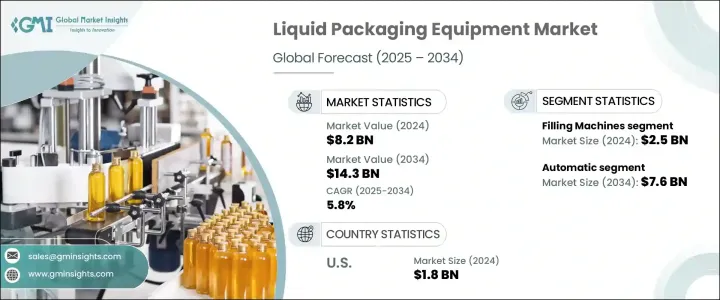
세계의 액체 포장기 시장 규모는 2024년 82억 달러로, 2034년까지 CAGR 5.8%로 성장해 143억 달러에 이를 것으로 추정됩니다.
세계 많은 사람들이 도시 지역으로 이주하여 보다 바쁜 라이프스타일을 경험함에 따라 음식 및 음료 소비의 편의성에 대한 요구가 급증하고 있습니다.
소비자가 액체 제품에 대해 더 높은 품질, 더 긴 보존 기간, 보다 안전한 패키징을 요구하고 있기 때문에 제조업체는 첨단 패키징 기술에 대한 투자를 늘리고 있습니다. 패키징 환경에는 눈에 띄는 변혁이 일어나고 있습니다. 이 지속적인 시프트는 장기적인 시장 성장을 자극해, 섹터를 넘은 새로운 시장 개척의 기회를 만들어 낼 것으로 기대되고 있습니다.
| 시장 범위 | |
|---|---|
| 시작 연도 | 2024년 |
| 예측 연도 | 2025-2034년 |
| 시작 금액 | 82억 달러 |
| 예측 금액 | 143억 달러 |
| CAGR | 5.8% |
기계 유형별로 시장을 분석하면 충전기 분야가 크게 이끌고 있습니다. 서보 구동 시스템과 같은 기술 혁신은 충전 정밀도를 높이고 조작의 다운 타임과 코스트를 삭감하는 것으로, 조작의 합리화에 도움이 되고 있습니다.
기술적 측면에서 자동 액체 포장 시스템은 시장 성장의 최전선에 있습니다. 인더스트리 4.0의 중심인 IoT나 AI등의 자동화 기술의 통합은 포장 업무의 관리 방법을 변화시키고 있습니다.
용도별로는 식음료 부문이 최대 시장 점유율을 차지하고 있어 예측 기간 중에도 계속 우위를 차지할 것으로 예측됩니다. 세계의 식습관의 변화와 소비자의 라이프 스타일이 바빠짐에 따라, 액체 포장기는 안전하고 효율적이고 컴플라이언스에 준거한 식품 가공을 서포트하며, 특히 EU와 북미 등 지역에서는 식품안전에 관한 법률이 엄격하고, 기업은 컴플라이언스를 유지하고 브랜드의 평판을 지키기 위해 기기의 업그레이드를 촉구하고 있습니다.
지역별로는 미국이 세계 시장의 주요 기업로서 두드러지며, 2024년에는 약 18억 달러의 수익에 공헌합니다. 이는 식품 및 식품 제조업체의 견고한 기반과 산업 자동화에 대한 강한 주력에 힘입어 북미 최대의 공헌국으로서의 이 나라의 지위는 포장기계에의 다액의 투자와 스마트 기술의 지속적인 채용에 의해 더욱 강조되고 있습니다.
액체 포장 장비 시장의 선도 기업은 제품 제공과 경쟁력을 강화하기 위해 혁신, 전략적 인수 및 신흥 시장 진출에 점점 더 많은 노력을 기울이고 있습니다.
목차
제1장 조사 방법과 범위
제2장 주요 요약
제3장 업계 인사이트
- 생태계 분석
- 밸류체인에 영향을 주는 요인
- 이익률 분석
- 혁신
- 미래의 전망
- 제조업자
- 리셀러
- 소매업체
- 트럼프 정권의 관세 분석
- 무역에 미치는 영향
- 무역량의 혼란
- 보복 조치
- 무역에 미치는 영향
- 업계에 미치는 영향
- 공급측의 영향(원재료)
- 주요 원재료의 가격 변동
- 공급망 재구성
- 생산 비용에 미치는 영향
- 수요측의 영향(판매가격)
- 최종 시장에의 가격 전달
- 시장 점유율 동향
- 소비자의 반응 패턴
- 영향을 받는 주요 기업
- 전략적인 업계 대응
- 공급망 재구성
- 가격 설정 및 제품 전략
- 정책관여
- 전망과 향후 검토 사항
- 전략적인 업계 대응
- 공급망 재구성
- 가격 설정 및 제품 전략
- 정책관여
- 전망과 향후 검토 사항
- 영향요인
- 성장 촉진요인
- 제조업에서의 자동화 수요 증가
- 인건비 상승과 숙련노동자 부족
- ROI 향상과 운영 유연성
- 정부의 지원적인 대처와 인더스트리 4.0의 도입
- 업계의 잠재적 위험 및 과제
- 초기 통합 및 높은 도입 비용
- 안전에 관한 우려와 규제 준수 기준
- 성장 촉진요인
- 기술과 혁신의 상황
- 무역 분석
- 성장 가능성 분석
- 규제 상황
- 가격 분석
- Porter's Five Forces 분석
- PESTEL 분석
제4장 경쟁 구도
- 소개
- 기업의 시장 점유율 분석
- 경쟁 포지셔닝 매트릭스
- 전략적 전망 매트릭스
제5장 시장 추계 및 예측 : 기종별, 2021-2034년
- 주요 동향
- 봉투 충전 씰링기
- 충전기
- 캡핑 머신
- 라벨링 머신
- 기타
제6장 시장 추계 및 예측 : 기술별, 2021-2034년
- 주요 동향
- 자동
- 반자동
- 수동
제7장 시장 추계 및 예측 : 포장 형태별, 2021-2034년
- 주요 동향
- 병
- 파우치
- 판지
- 캔
- 기타
제8장 시장 추계 및 예측 : 용도별, 2021-2034년
- 주요 동향
- 식품 및 음료
- 의약품
- 화장품
- 화학약품
- 기타
제9장 시장 추계 및 예측 : 유통채널별, 2021-2034년
- 주요 동향
- 직접
- 간접
제10장 시장 추계 및 예측 : 지역별, 2021-2034년
- 주요 동향
- 북미
- 미국
- 캐나다
- 유럽
- 독일
- 영국
- 프랑스
- 이탈리아
- 스페인
- 아시아태평양
- 중국
- 인도
- 일본
- 한국
- 호주
- 라틴아메리카
- 브라질
- 멕시코
- 중동 및 아프리카
- 사우디아라비아
- 아랍에미리트(UAE)
- 남아프리카
제11장 기업 프로파일
- Accutek Packaging Equipment Companies, Inc.
- Adelphi Group
- Barry-Wehmiller Companies, Inc.
- Coesia SpA
- Ecolean AB
- Fuji Machinery Co.,Ltd.
- GEA Group AG
- IMA Group
- JBT Corporation
- KHS GmbH
- Krones AG
- ProMach Inc.
- Serac Group
- SIG Combibloc Group AG
- Tetra Pak International SA
The Global Liquid Packaging Equipment Market was valued at USD 8.2 billion in 2024 and is estimated to grow at a CAGR of 5.8% to reach USD 14.3 billion by 2034, driven by the rising demand for packaged beverages and ready-to-drink liquid food products. As more people around the world migrate to urban areas and experience busier lifestyles, the need for convenience in food and beverage consumption has surged. This shift is propelling the expansion of the liquid packaging equipment industry, particularly as manufacturers continue to respond to evolving consumer expectations and regulatory standards.
With consumers demanding higher quality, longer shelf life, and safer packaging for liquid products, manufacturers are investing more heavily in advanced technologies. Packaging solutions are not only expected to preserve product integrity but also to align with growing sustainability goals. There's a visible transformation in the packaging landscape, where innovation and eco-conscious practices are gaining prominence. This ongoing shift is expected to stimulate long-term market growth and create new opportunities for development across sectors. Increased spending on sustainable packaging materials and systems is also influencing product design and consumer acceptance, leading to higher sales and a more competitive industry landscape.
| Market Scope | |
|---|---|
| Start Year | 2024 |
| Forecast Year | 2025-2034 |
| Start Value | $8.2 Billion |
| Forecast Value | $14.3 Billion |
| CAGR | 5.8% |
When analyzing the market based on machine type, the filling machines segment leads significantly. It was valued at approximately USD 2.5 billion in 2024 and is expected to grow at a CAGR of 6.4% through 2034. Filling machines are essential in ensuring precision and efficiency in liquid packaging, which makes them indispensable to operations across various industries. Their dominance is further reinforced by their role in minimizing waste and enhancing productivity. Innovations like servo-driven systems have helped streamline operations by increasing filling accuracy and reducing operational downtime and costs. As demand for aseptic fillers continues to grow-particularly in the food and beverage sector-this machine type is poised to maintain its lead over the forecast period.
From a technology standpoint, automatic liquid packaging systems are at the forefront of market growth. Representing a 52.5% share of the market in 2024, the automatic segment is projected to reach USD 7.6 billion by 2034. These systems are being adopted at a rapid pace due to their ability to improve production efficiency, reduce labor dependence, and support real-time quality control. The integration of automation technologies such as IoT and AI-central to Industry 4.0-is transforming the way packaging operations are managed. Through data-driven maintenance and monitoring, companies can reduce downtime, streamline output, and maintain higher quality standards, which adds a significant competitive advantage.
In terms of application, the food and beverages sector holds the largest market share and is expected to continue dominating throughout the forecast period. This segment's growth is attributed to the increasing popularity of packaged and ready-to-consume products, such as dairy-based drinks and flavored beverages. As global dietary habits shift and consumer lifestyles become more hectic, liquid packaging equipment plays a crucial role in supporting safe, efficient, and compliant food processing. Strict food safety laws, especially in regions like the EU and North America, are pushing companies to upgrade their equipment to maintain compliance and protect brand reputation. The market is also seeing a rise in demand for eco-friendly packaging systems that support the use of sustainable materials, helping food and beverage producers align with environmental regulations and consumer expectations.
Regionally, the United States stands out as a major player in the global market, contributing around USD 1.8 billion in revenue in 2024. The US market is forecasted to grow at a CAGR of 6.6% through 2034, supported by its robust base of food and beverage manufacturers and a strong focus on industrial automation. The country's position as the largest contributor in North America is further highlighted by its substantial investment in packaging machinery and ongoing adoption of smart technologies.
Leading players in the liquid packaging equipment market are increasingly focusing on innovation, strategic acquisitions, and expansion into emerging markets to enhance their product offerings and competitiveness. Many companies are prioritizing sustainable solutions, investing in biodegradable and recyclable packaging formats, and integrating AI-powered technologies to deliver more intelligent packaging systems. These developments are helping manufacturers meet evolving customer demands while improving operational efficiency and reducing their environmental footprint.
Table of Contents
Chapter 1 Methodology & Scope
- 1.1 Market scope & definition
- 1.2 Base estimates & calculations
- 1.3 Forecast parameters
- 1.4 Data sources
- 1.4.1 Primary
- 1.4.2 Secondary
- 1.4.2.1 Paid sources
- 1.4.2.2 Public sources
Chapter 2 Executive Summary
- 2.1 Industry 3600 synopsis, 2018 - 2034
Chapter 3 Industry Insights
- 3.1 Industry ecosystem analysis
- 3.1.1 Factors affecting the value chain
- 3.1.2 Profit margin analysis
- 3.1.3 Disruptions
- 3.1.4 Future outlook
- 3.1.5 Manufacturers
- 3.1.6 Distributors
- 3.1.7 Retailers
- 3.2 Trump administration tariffs analysis
- 3.2.1 Impact on trade
- 3.2.1.1 Trade volume disruptions
- 3.2.1.2 Retaliatory measures
- 3.2.1 Impact on trade
- 3.3 Impact on the industry
- 3.3.1 Supply-side impact (raw materials)
- 3.3.2 Price volatility in key materials
- 3.3.3 Supply chain restructuring
- 3.3.4 Production cost implications
- 3.3.5 Demand-side impact (selling price)
- 3.3.6 Price transmission to end markets
- 3.3.7 Market share dynamics
- 3.3.8 Consumer response patterns
- 3.3.9 Key companies impacted
- 3.4 Strategic industry responses
- 3.4.1 Supply chain reconfiguration
- 3.4.2 Pricing and product strategies
- 3.4.3 Policy engagement
- 3.5 Outlook and future considerations
- 3.6 Strategic industry responses
- 3.6.1 Supply chain reconfiguration
- 3.6.2 Pricing and product strategies
- 3.6.3 Policy engagement
- 3.7 Outlook and future considerations
- 3.8 Impact forces
- 3.8.1 Growth drivers
- 3.8.1.1 Rising demand for automation in manufacturing
- 3.8.1.2 Increasing labor costs and skilled labor shortages
- 3.8.1.3 Enhanced ROI and flexibility in operations
- 3.8.1.4 Supportive government initiatives and industry 4.0 adoption
- 3.8.2 Industry pitfalls & challenges
- 3.8.2.1 High initial integration and deployment costs
- 3.8.2.2 Safety concerns and regulatory compliance standards
- 3.8.1 Growth drivers
- 3.9 Technology & innovation landscape
- 3.10 Trade analysis
- 3.11 Growth potential analysis
- 3.12 Regulatory landscape
- 3.13 Pricing analysis
- 3.14 Porter's analysis
- 3.15 PESTEL analysis
Chapter 4 Competitive Landscape, 2024
- 4.1 Introduction
- 4.2 Company market share analysis
- 4.3 Competitive positioning matrix
- 4.4 Strategic outlook matrix
Chapter 5 Market Estimates & Forecast, By Machine Type, 2021 – 2034, (USD Billion)(Thousand Units)
- 5.1 Key trends
- 5.2 Form-fill-seal machines
- 5.3 Filling machines
- 5.4 Capping machines
- 5.5 Labeling machines
- 5.6 Others
Chapter 6 Market Estimates & Forecast, By Technology, 2021 – 2034, (USD Billion)(Thousand Units)
- 6.1 Key trends
- 6.2 Automatic
- 6.3 Semi-automatic
- 6.4 Manual
Chapter 7 Market Estimates & Forecast, By Packaging Type, 2021 – 2034, (USD Billion)(Thousand Units)
- 7.1 Key trends
- 7.2 Bottles
- 7.3 Pouches
- 7.4 Cartons
- 7.5 Cans
- 7.6 Others
Chapter 8 Market Estimates & Forecast, By Application, 2021 – 2034, (USD Billion)(Thousand Units)
- 8.1 Key trends
- 8.2 Food & beverages
- 8.3 Pharmaceuticals
- 8.4 Cosmetics
- 8.5 Chemicals
- 8.6 Others
Chapter 9 Market Estimates & Forecast, By Distribution Channel, 2021 – 2034, (USD Billion)(Thousand Units)
- 9.1 Key trends
- 9.2 Direct
- 9.3 Indirect
Chapter 10 Market Estimates & Forecast, By Region, 2021 – 2034, (USD Billion)(Thousand Units)
- 10.1 Key trends
- 10.2 North America
- 10.2.1 U.S.
- 10.2.2 Canada
- 10.3 Europe
- 10.3.1 Germany
- 10.3.2 UK
- 10.3.3 France
- 10.3.4 Italy
- 10.3.5 Spain
- 10.4 Asia Pacific
- 10.4.1 China
- 10.4.2 India
- 10.4.3 Japan
- 10.4.4 South Korea
- 10.4.5 Australia
- 10.5 Latin America
- 10.5.1 Brazil
- 10.5.2 Mexico
- 10.6 MEA
- 10.6.1 Saudi Arabia
- 10.6.2 UAE
- 10.6.3 South Africa
Chapter 11 Company Profiles
- 11.1 Accutek Packaging Equipment Companies, Inc.
- 11.2 Adelphi Group
- 11.3 Barry-Wehmiller Companies, Inc.
- 11.4 Coesia S.p.A.
- 11.5 Ecolean AB
- 11.6 Fuji Machinery Co., Ltd.
- 11.7 GEA Group AG
- 11.8 IMA Group
- 11.9 JBT Corporation
- 11.10 KHS GmbH
- 11.11 Krones AG
- 11.12 ProMach Inc.
- 11.13 Serac Group
- 11.14 SIG Combibloc Group AG
- 11.15 Tetra Pak International S.A.