|
시장보고서
상품코드
1740919
허셉틴 시장 : 시장 기회, 성장 촉진요인, 산업 동향 분석 및 예측(2025-2034년)Herceptin Market Opportunity, Growth Drivers, Industry Trend Analysis, and Forecast 2025 - 2034 |
||||||

세계의 허셉틴 시장은 2024년에는 33억 달러로 평가되었고, 2034년에는 55억 달러에 이를 것으로 추정되며, CAGR 5.4%로 성장할 전망입니다.
허셉틴 또는 트라스투주맙은 종양 성장을 촉진하는 HER2 단백질의 과발현으로 특징지어지는 하위 유형인 HER2 양성 유방암의 초석 치료제로 남아 있습니다. 유방암은 전 세계적으로 가장 흔하게 진단되는 암 중 하나로, 허셉틴과 같은 표적 치료제에 대한 수요가 급격히 증가하고 있습니다. 정밀 의학에 대한 관심이 높아지고 전 세계적으로 첨단 암 치료에 대한 접근성이 확대되면서 시장 성장이 크게 촉진되고 있습니다. 또한 조기 암 발견에 대한 인식이 높아지고, 검진 프로그램이 개선되고, 표적 치료법을 개선하기 위한 지속적인 R&D 노력이 허셉틴 시장의 성장세를 견인하고 있습니다. 의료 투자 증가, 보험 적용 범위 확대, 기존 화학 요법보다 생물학적 제제에 대한 환자 선호도 증가는 시장 확대를 더욱 뒷받침하고 있습니다. 특히 규제 승인이 빨라지고 여러 지역에서 의료 접근성이 향상됨에 따라 신흥 경제국에서도 허셉틴과 그 바이오시밀러에 대한 막대한 기회가 창출되고 있습니다.

단일 클론 항체인 허셉틴은 HER2 단백질을 정확하게 표적하고 차단하여 암세포의 성장과 전이 능력을 방해합니다. 허셉틴은 HER2 신호를 방해함으로써 종양 진행을 늦추고 특히 공격적이고 기존 치료법에 잘 반응하지 않는 것으로 알려진 HER2 양성 유방암의 생존율을 크게 향상시킵니다. 허셉틴은 많은 환자에게 생명줄이 되어 기존 치료법이 부족한 곳에서 더 나은 임상 결과를 제공합니다.
| 시장 범위 | |
|---|---|
| 시작 연도 | 2024년 |
| 예측 연도 | 2025-2034년 |
| 시작 금액 | 33억 달러 |
| 예측 금액 | 55억 달러 |
| CAGR | 5.4% |
허셉틴 시장의 바이오시밀러 부문은 2024년 17억 달러의 매출을 기록했으며 2034년까지 5.6%의 연평균 성장률(CAGR)로 성장할 것으로 예상됩니다. 특히 오리지널 생물학적 제제의 높은 비용으로 인해 환자 접근성이 제한되는 지역에서 비슷한 임상적 효능을 가진 바이오시밀러가 생명을 구하는 치료제의 접근성을 높이고 있습니다. 여러 트라스투주맙 바이오시밀러가 승인을 받고 글로벌 브랜드로 시장에 출시됨에 따라 저렴한 대체 의약품의 가용성이 크게 증가하여 전 세계 더 많은 환자에게 혜택이 돌아갈 것으로 예상됩니다.
허셉틴 시장은 크게 유방암과 위암으로 나뉩니다. 유방암은 2024년에 가장 큰 점유율을 차지하며 전체 매출의 60% 이상을 차지했습니다. 특히 여성들 사이에서 유방암 유병률이 증가함에 따라 HER2 양성 환자의 생존 기간을 연장하고 재발률을 낮추는 것으로 입증된 허셉틴에 대한 수요가 계속 증가하고 있습니다.
미국의 허셉틴 시장은 견고한 건강 관리 시스템, 암에 대한 높은 의식, 표적 요법의 강력한 도입에 힘입어 2034년까지 22억 달러에 달할 것으로 예측됩니다.
경쟁 구도를 형성하는 주요 기업은 Dr. Reddy's Laboratories, Amgen, AryoGen Pharmed, Biocon, Celltrion Healthcare, Genentech, Mylan NV, Pfizer, Shanghai Henlius Biotech, Samsung Bioepis, Sandoz 등이 있습니다. 이들 기업은 연구, 바이오시밀러 출시, 신흥 시장 진출, 환자 지원 전략 강화에 막대한 투자를 통해 치료 성과와 시장 입지를 강화하고 있습니다.
목차
제1장 조사 방법과 범위
제2장 주요 요약
제3장 업계 인사이트
- 생태계 분석
- 업계에 미치는 영향요인
- 성장 촉진요인
- HER2 양성 유방암 발생률 상승
- 표적암 치료에 대한 의식 향상
- 바이오시밀러의 채택 증가
- 약물 전달 시스템의 기술 발전
- 업계의 잠재적 위험 및 과제
- 치료에 따른 부작용
- 엄격한 규제 시나리오
- 성장 촉진요인
- 성장 가능성 분석
- 규제 상황
- 트럼프 정권에 의한 관세에 대한 영향
- 무역에 미치는 영향
- 무역량의 혼란
- 보복 조치
- 업계에 미치는 영향
- 공급측의 영향(원자재)
- 주요 원자재의 가격 변동
- 공급망 재구성
- 생산 비용에 미치는 영향
- 수요측의 영향(판매가격)
- 최종 시장에의 가격 전달
- 시장 점유율 동향
- 소비자의 반응 패턴
- 공급측의 영향(원자재)
- 영향을 받는 주요 기업
- 전략적인 업계 대응
- 공급망 재구성
- 가격 설정 및 제품 전략
- 정책관여
- 전망과 향후 검토 사항
- 무역에 미치는 영향
- 기술적 상황
- 갭 분석
- Porter's Five Forces 분석
- PESTEL 분석
제4장 경쟁 구도
- 소개
- 기업의 시장 점유율 분석
- 기업 매트릭스 분석
- 주요 시장 기업의 경쟁 분석
- 경쟁 포지셔닝 매트릭스
- 전략 대시보드
제5장 시장 추계 및 예측 : 제품별(2021-2034년)
- 주요 동향
- 생물학적 제제
- 바이오시밀러
제6장 시장 추계 및 예측 : 용도별(2021-2034년)
- 주요 동향
- 유방암
- 위암
제7장 시장 추계 및 예측 : 투여 경로별(2021-2034년)
- 주요 동향
- 정맥내
- 피하
제8장 시장 추계 및 예측 : 유통 채널별(2021-2034년)
- 주요 동향
- 병원 약국
- 전문 약국
- 온라인 약국
제9장 시장 추계 및 예측 : 지역별(2021-2034년)
- 주요 동향
- 북미
- 미국
- 캐나다
- 유럽
- 독일
- 영국
- 프랑스
- 스페인
- 이탈리아
- 네덜란드
- 아시아태평양
- 중국
- 인도
- 일본
- 호주
- 한국
- 라틴아메리카
- 브라질
- 멕시코
- 아르헨티나
- 중동 및 아프리카
- 사우디아라비아
- 남아프리카
- 아랍에미리트(UAE)
제10장 기업 프로파일
- Amgen
- AryoGen Pharmed
- Biocon
- Celltrion Healthcare
- Dr. Reddy’s Laboratories
- Genentech
- Mylan NV
- Pfizer
- Samsung Bioepis
- Sandoz
- Shanghai Henlius Biotech
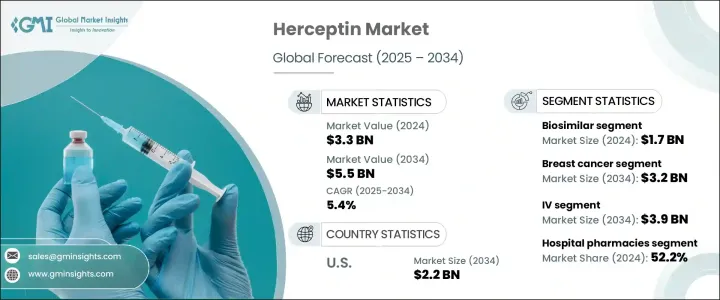
The Global Herceptin Market was valued at USD 3.3 billion in 2024 and is estimated to grow at a CAGR of 5.4% to reach USD 5.5 billion by 2034. Herceptin, or trastuzumab, remains a cornerstone therapy for HER2-positive breast cancer, a subtype marked by the overexpression of the HER2 protein that accelerates tumor growth. As breast cancer continues to rank among the most commonly diagnosed cancers worldwide, the demand for targeted therapies like Herceptin is rising sharply. The increasing focus on precision medicine, along with expanding access to advanced cancer care globally, is significantly boosting market growth. Moreover, the heightened awareness around early cancer detection, improved screening programs, and continuous R&D efforts to refine targeted therapies are collectively driving momentum in the Herceptin landscape. Rising healthcare investments, expanding insurance coverage, and growing patient preference for biologics over traditional chemotherapy are further supporting market expansion. Emerging economies are also stepping up, creating vast opportunities for Herceptin and its biosimilars, particularly as regulatory approvals become faster and healthcare access improves across regions.
Herceptin, a monoclonal antibody, precisely targets and blocks the HER2 protein, disrupting the cancer cell's ability to grow and spread. By interfering with HER2 signaling, Herceptin slows tumor progression and significantly improves survival rates, particularly in HER2-positive breast cancer, which is known for its aggressive behavior and poor response to conventional therapies. For many patients, Herceptin offers a lifeline, delivering better clinical outcomes where traditional treatments fall short.
| Market Scope | |
|---|---|
| Start Year | 2024 |
| Forecast Year | 2025-2034 |
| Start Value | $3.3 Billion |
| Forecast Value | $5.5 Billion |
| CAGR | 5.4% |
The biosimilars segment of the Herceptin market accounted for USD 1.7 billion in revenue in 2024 and is estimated to grow at a CAGR of 5.6% through 2034. Biosimilars with comparable clinical efficacy are making life-saving treatments more accessible, especially in regions where the high cost of original biologics limits patient access. As multiple trastuzumab biosimilars gain approval and enter the market under global brands, the availability of affordable alternatives is expected to rise substantially, benefiting a larger pool of patients worldwide.
The Herceptin market is primarily divided between breast cancer and gastric cancer applications. Breast cancer held the largest share in 2024, generating over 60% of total revenue. The rising prevalence of breast cancer, especially among women, continues to drive demand for Herceptin, given its proven ability to extend survival and reduce recurrence rates for HER2-positive patients.
The U.S. Herceptin Market is forecasted to reach USD 2.2 billion by 2034, supported by a robust healthcare system, high levels of cancer awareness, and strong adoption of targeted therapies.
Leading players shaping the competitive landscape include Dr. Reddy's Laboratories, Amgen, AryoGen Pharmed, Biocon, Celltrion Healthcare, Genentech, Mylan N.V., Pfizer, Shanghai Henlius Biotech, Samsung Bioepis, and Sandoz. These companies are investing heavily in research, launching biosimilars, expanding into emerging markets, and strengthening patient support initiatives to enhance treatment outcomes and market presence.
Table of Contents
Chapter 1 Methodology and Scope
- 1.1 Market scope and definitions
- 1.2 Research design
- 1.2.1 Research approach
- 1.2.2 Data collection methods
- 1.3 Base estimates and calculations
- 1.3.1 Base year calculation
- 1.3.2 Key trends for market estimation
- 1.4 Forecast model
- 1.5 Primary research and validation
- 1.5.1 Primary sources
- 1.5.2 Data mining sources
Chapter 2 Executive Summary
- 2.1 Industry 3600 synopsis
Chapter 3 Industry Insights
- 3.1 Industry ecosystem analysis
- 3.2 Industry impact forces
- 3.2.1 Growth drivers
- 3.2.1.1 Rising incidence of HER2-positive breast cancer
- 3.2.1.2 Increasing awareness of targeted cancer therapies
- 3.2.1.3 Growing adoption of biosimilars
- 3.2.1.4 Technological advancement in drug delivery system
- 3.2.2 Industry pitfalls and challenges
- 3.2.2.1 Side effects associated with treatment
- 3.2.2.2 Stringent regulatory scenario
- 3.2.1 Growth drivers
- 3.3 Growth potential analysis
- 3.4 Regulatory landscape
- 3.5 Trump administration tariffs
- 3.5.1 Impact on trade
- 3.5.1.1 Trade volume disruptions
- 3.5.1.2 Retaliatory measures
- 3.5.2 Impact on the Industry
- 3.5.2.1 Supply-side impact (raw materials)
- 3.5.2.1.1 Price volatility in key materials
- 3.5.2.1.2 Supply chain restructuring
- 3.5.2.1.3 Production cost implications
- 3.5.2.2 Demand-side impact (selling price)
- 3.5.2.2.1 Price transmission to end markets
- 3.5.2.2.2 Market share dynamics
- 3.5.2.2.3 Consumer response patterns
- 3.5.2.1 Supply-side impact (raw materials)
- 3.5.3 Key companies impacted
- 3.5.4 Strategic industry responses
- 3.5.4.1 Supply chain reconfiguration
- 3.5.4.2 Pricing and product strategies
- 3.5.4.3 Policy engagement
- 3.5.5 Outlook and future considerations
- 3.5.1 Impact on trade
- 3.6 Technological landscape
- 3.7 Gap analysis
- 3.8 Porter's analysis
- 3.9 PESTEL analysis
Chapter 4 Competitive Landscape, 2024
- 4.1 Introduction
- 4.2 Company market share analysis
- 4.3 Company matrix analysis
- 4.4 Competitive analysis of major market players
- 4.5 Competitive positioning matrix
- 4.6 Strategy dashboard
Chapter 5 Market Estimates and Forecast, By Product, 2021 – 2034 ($ Mn)
- 5.1 Key trends
- 5.2 Biologic
- 5.3 Biosimilars
Chapter 6 Market Estimates and Forecast, By Application, 2021 – 2034 ($ Mn)
- 6.1 Key trends
- 6.2 Breast cancer
- 6.3 Stomach/gastric cancer
Chapter 7 Market Estimates and Forecast, By Route of Administration, 2021 – 2034 ($ Mn)
- 7.1 Key trends
- 7.2 Intravenous
- 7.3 Subcutaneous
Chapter 8 Market Estimates and Forecast, By Distribution Channel, 2021 – 2034 ($ Mn)
- 8.1 Key trends
- 8.2 Hospitals pharmacies
- 8.3 Specialty pharmacies
- 8.4 Online pharmacies
Chapter 9 Market Estimates and Forecast, By Region, 2021 – 2034 ($ Mn)
- 9.1 Key trends
- 9.2 North America
- 9.2.1 U.S.
- 9.2.2 Canada
- 9.3 Europe
- 9.3.1 Germany
- 9.3.2 UK
- 9.3.3 France
- 9.3.4 Spain
- 9.3.5 Italy
- 9.3.6 Netherlands
- 9.4 Asia Pacific
- 9.4.1 China
- 9.4.2 India
- 9.4.3 Japan
- 9.4.4 Australia
- 9.4.5 South Korea
- 9.5 Latin America
- 9.5.1 Brazil
- 9.5.2 Mexico
- 9.5.3 Argentina
- 9.6 Middle East and Africa
- 9.6.1 Saudi Arabia
- 9.6.2 South Africa
- 9.6.3 UAE
Chapter 10 Company Profiles
- 10.1 Amgen
- 10.2 AryoGen Pharmed
- 10.3 Biocon
- 10.4 Celltrion Healthcare
- 10.5 Dr. Reddy’s Laboratories
- 10.6 Genentech
- 10.7 Mylan N.V.
- 10.8 Pfizer
- 10.9 Samsung Bioepis
- 10.10 Sandoz
- 10.11 Shanghai Henlius Biotech