|
시장보고서
상품코드
1750348
협동 제조 로봇 시장 : 시장 기회, 성장 촉진요인, 산업 동향 분석, 예측(2025-2034년)Collaborative Manufacturing Robots Market Opportunity, Growth Drivers, Industry Trend Analysis, and Forecast 2025 - 2034 |
||||||

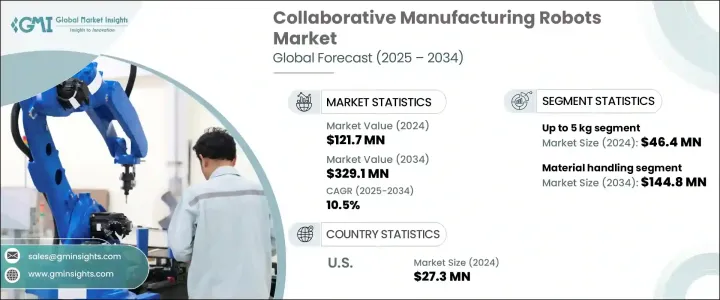
세계의 협동 제조 로봇 시장은 2024년에는 1억 2,170만 달러로 평가되었고, CAGR 10.5%로 성장할 전망이며, 2034년에는 3억 2,910만 달러에 이를 것으로 예측되고 있습니다.
이러한 변화는 특히 중소기업(SME) 사이에서 유연하고 확장 가능한 자동화 솔루션에 대한 요구가 높아지고 있음을 배경으로 하고 있습니다. 중소기업(SME)에서는 다액의 선행투자를 필요로 하지 않는 자동화 수단으로서 비용대비 효과가 높은 프로그래머블 협동 로봇(cobot)의 도입이 진행되고 있습니다. 경영 자원이 한정되어 있는 중소기업에 있어서, 이러한 로봇은 설비 투자를 억제하면서 생산성을 향상시키는 이상적인 솔루션입니다.
기존의 워크플로우에 원활하게 통합할 수 있고 다양한 작업에 유연하게 대응할 수 있는 코봇은 경쟁력을 유지하고자 하는 중소기업에게 매력적인 선택입니다. 이러한 로봇은 반복적, 단조로움 또는 육체적으로 부담스러운 작업을 처리할 수 있으며, 인간 노동자는 더 복잡하고 창의적이거나 의사결정의 책임에 집중할 수 있습니다. 정형 업무를 자동화함으로써 코봇은 업무 워크플로우를 개선하고 휴먼 오류를 줄이며 일관된 아웃풋을 확보하는 데 도움이 됩니다. 이 시프트는 작업의 속도와 정밀도를 높일 뿐만 아니라, 종업원의 신체적 부담을 경감시켜, 직장에서의 부상이나 피로의 위험을 줄입니다. 그 결과 기업은 보다 열성적인 직원에게 보다 높은 생산성 수준을 유지할 수 있습니다.
| 시장 범위 | |
|---|---|
| 시작 연도 | 2024년 |
| 예측 연도 | 2025-2034년 |
| 시작 금액 | 1억 2,170만 달러 |
| 예측 금액 | 3억 2,910만 달러 |
| CAGR | 10.5% |
시장은 페이로드 용량에 따라 5kg까지, 5-10kg, 10-25kg, 25kg 이상의 카테고리로 구분됩니다. 2024년 5kg까지 부문은 4,640만 달러를 창출하였고, 2034년까지 CAGR 9.6%로 성장할 것으로 예상됩니다. 이 카테고리의 코봇은 조립, 픽앤플레이스, 테스트 등 경량 작업이 일반적인 전자기기나 제약 등 정밀함이 요구되는 산업에서 선호되고 있습니다. 또한 컴팩트한 설계를 위해 공간에 제약이 있는 환경에도 최적이며 유연한 자동화 솔루션을 제공합니다. 보다 작은 페이로드를 정확하게 다루는 코봇의 능력은 비용 대비 효과가 높고 신뢰성이 높은 자동화 옵션을 원하는 중소기업에 귀중한 존재가 되고 있습니다.
자재 관리 분야는 2024년에 41.5%의 점유율을 차지하였고, 물류와 창고 관리에 있어서의 효율화의 중요성이 높아지게 되어, 2034년에는 1억 4,480만 달러에 이를 것으로 예상되고 있습니다. 코봇은 자재 관리에서 매우 효과적인 것으로 증명되었으며, 상품 분류, 포장, 파레타이징, 운송 등의 작업을 빠르고 정확하게 수행합니다. 산업계가 공급망 최적화 및 인건비 절감에 노력하는 가운데, 코봇은 이러한 중요한 기능을 자동화하기 위한 중요한 도구로 간주됩니다. 자재 관리에 있어서 코봇에 대한 수요는, 정밀도, 스피드, 인간의 근처에서 작업할 수 있는 것이 중요한 산업에서 특히 강해지고 있습니다.
미국의 협동 제조 로봇 시장 규모는 2024년 2,730만 달러로 평가되었고, 2034년까지 연평균 복합 성장률(CAGR) 11%를 보일 것으로 예측됩니다. 제조업에서 물류까지 다양한 산업에서 자동화가 강력하게 추진되고 있기 때문에 미국은 협동 로봇의 주요 시장이 되고 있습니다. 디지털화의 경향이 강해지고, 보다 스마트하고 유연한 제조 시스템에 대한 요구가 높아지고 있으므로, 향후에도 코봇에 대한 수요는 높아질 것으로 생각됩니다.
세계의 협동 제조 로봇 업계의 유명 기업은 ABB Robotics, AUBO Robotics, Doosan Robotics, FANUC Corporation, KUKA Robotics, Rethink Robotics, Staubli Robotics, Techman Robot, Universal Robots, Yaskawa Electric Corporation 등이 있습니다. 협동 제조 로봇 시장에서 기업은 기술 혁신과 확대를 통해 시장에서의 지위를 높이는 데 주력하고 있습니다. 주요 전략에는 지속적인 제품 개발, 인수, 파트너십 등이 있습니다. Universal Robots이나 ABB Robotics와 같은 기업은 효율성과 유연성을 향상시키는 새로운 기능을 도입하기 위해 연구 개발에 많은 투자를 하고 있습니다. 또, Yaskawa Electric Corporation나 KUKA Robotics와 같은 기업은, 가반 중량을 늘려, 통합 능력을 높인 코봇을 개발하는 것으로, 제품 라인 업을 강화하고 있습니다. 업계 대기업과의 전략적 제휴나 판매망의 확대도, 특히 자동화의 도입이 가속하고 있는 신흥 시장에서의 시장 침투를 높이기 위해서 이용되고 있습니다.
목차
제1장 조사 방법 및 범위
제2장 주요 요약
제3장 업계 인사이트
- 생태계 분석
- 밸류체인에 영향을 주는 요인
- 이익률 분석
- 혁신
- 장래의 전망
- 제조업자
- 리셀러
- 소매업체
- 트럼프 정권의 관세 분석
- 무역에 미치는 영향
- 무역량의 혼란
- 보복 조치
- 무역에 미치는 영향
- 업계에 미치는 영향
- 공급측의 영향(원재료)
- 주요 원재료의 가격 변동
- 공급망 재구성
- 생산 비용에 미치는 영향
- 수요측의 영향(판매가격)
- 최종 시장에 대한 가격 전달
- 시장 점유율 동향
- 소비자의 반응 패턴
- 영향을 받는 주요 기업
- 전략적인 업계 대응
- 공급망 재구성
- 가격 설정 및 제품 전략
- 정책관여
- 전망 및 향후 검토 사항
- 전략적인 업계 대응
- 공급망 재구성
- 가격 설정 및 제품 전략
- 정책관여
- 전망 및 향후 검토 사항
- 영향요인
- 성장 촉진요인
- 제조업에서의 자동화 수요 증가
- 인건비 상승 및 숙련노동자 부족
- ROI 향상 및 운영 유연성
- 정부의 지원적인 대처 및 인더스트리 4.0의 도입
- 업계의 잠재적 위험 및 과제
- 높은 초기 통합 및 도입 비용
- 안전에 관한 우려 및 규제 준수 기준
- 성장 촉진요인
- 기술 및 혁신의 상황
- 소비자 구매 행동 분석
- 인구 동향
- 구매결정에 영향을 미치는 요인
- 소비자 제품의 채용
- 우선 유통 채널
- 성장 가능성 분석
- 규제 상황
- 가격 분석
- Porter's Five Forces 분석
- PESTEL 분석
제4장 경쟁 구도
- 서문
- 기업의 시장 점유율 분석
- 경쟁 포지셔닝 매트릭스
- 전략적 전망 매트릭스
제5장 시장 추계 및 예측 : 페이로드 용량별(2021-2034년)
- 주요 동향
- 최대 5kg
- 5-10kg
- 10-25kg
- 25kg 이상
제6장 시장 추계 및 예측 : 컴포넌트별(2021-2034년)
- 주요 동향
- 하드웨어
- 소프트웨어
제7장 시장 추계 및 예측 : 모빌리티별(2021-2034년)
- 주요 동향
- 거치형
- 모바일
제8장 시장 추계 및 예측 : 최종 용도별(2021-2034년)
- 주요 동향
- 대기업
- 중소기업
제9장 시장 추계 및 예측 : 용도별(2021-2034년)
- 주요 동향
- 자재관리
- 조립 및 분해
- 용접 및 납땜
- 디스펜서
- 처리
- 기타
제10장 시장 추계 및 예측 : 지역별(2021-2034년)
- 주요 동향
- 북미
- 미국
- 캐나다
- 유럽
- 독일
- 영국
- 프랑스
- 이탈리아
- 스페인
- 아시아태평양
- 중국
- 인도
- 일본
- 한국
- 호주
- 라틴아메리카
- 브라질
- 멕시코
- 중동 및 아프리카
- 사우디아라비아
- 아랍에미리트(UAE)
- 남아프리카
제11장 기업 프로파일
- ABB Robotics
- AUBO Robotics
- Doosan Robotics
- FANUC Corporation
- KUKA Robotics
- Rethink Robotics
- Staubli Robotics
- Techman Robot
- Universal Robots
- Yaskawa Electric Corporation
The Global Collaborative Manufacturing Robots Market was valued at USD 121.7 million in 2024 and is estimated to grow at a CAGR of 10.5% to reach USD 329.1 million by 2034, driven by the rise in automation across various industries, which enhances both productivity and safety by working alongside humans. This shift is driven by the increasing need for flexible, scalable automation solutions, especially among small and medium-sized enterprises (SMEs). Small and medium-sized enterprises (SMEs) are increasingly adopting cost-effective programmable collaborative robots (cobots) as a means of automation without requiring a significant upfront investment. With their limited resources, SME find these robots an ideal solution to enhance productivity while keeping capital expenditure low.
The ability of cobots to seamlessly integrate into existing workflows and their flexibility in handling various tasks make them an attractive option for smaller businesses looking to stay competitive. These robots can handle tasks that are repetitive, monotonous, or physically taxing, freeing up human workers to concentrate on more complex, creative, or decision-making responsibilities. By automating routine functions, cobots help improve operational workflows, reduce human error, and ensure consistent output. This shift not only enhances the speed and precision of tasks but also reduces the physical strain on employees, lowering the risk of workplace injuries and fatigue. As a result, businesses can maintain higher productivity levels with a more engaged workforce.
| Market Scope | |
|---|---|
| Start Year | 2024 |
| Forecast Year | 2025-2034 |
| Start Value | $121.7 Million |
| Forecast Value | $329.1 Million |
| CAGR | 10.5% |
The market is segmented by payload capacity into categories such as up to 5 kg, 5-10 kg, 10-25 kg, and more than 25 kg. In 2024, the up-to-5 kg segment generated USD 46.4 million and is expected to grow at a CAGR of 9.6% by 2034. Cobots in this category are favored in industries requiring precision, such as electronics and pharmaceuticals, where lightweight tasks like assembly, pick-and-place, and testing are common. Their compact design also makes them ideal for space-constrained environments, offering flexible automation solutions. The ability of cobots to handle smaller payloads with precision makes them invaluable to SME seeking cost-effective and reliable automation options.
The material handling segment held a 41.5% share in 2024, and it is expected to reach USD 144.8 million by 2034, driven by the growing importance of efficiency in logistics and warehousing. Cobots have proven to be highly effective in material handling, performing tasks such as sorting, packing, palletizing, and transporting goods with speed and accuracy. As industries strive to optimize their supply chains and reduce labor costs, cobots are seen as a key tool in automating these critical functions. The demand for cobots in material handling is particularly strong in industries where precision, speed, and the ability to operate near human workers are crucial.
United States Collaborative Manufacturing Robots Market generated USD 27.3 million in 2024 and is expected to grow at a CAGR of 11% through 2034, driven by the robust construction industry, along with the widespread adoption of automation technologies. The strong push toward automation across a variety of industries, from manufacturing to logistics and beyond, has made the U.S. a prime market for collaborative robots. The increasing trend of digitalization and the need for smarter, more flexible manufacturing systems will continue to drive demand for cobots in the years ahead.
Prominent companies in the Global Collaborative Manufacturing Robots Industry include ABB Robotics, AUBO Robotics, Doosan Robotics, FANUC Corporation, KUKA Robotics, Rethink Robotics, Staubli Robotics, Techman Robot, Universal Robots, and Yaskawa Electric Corporation. In the collaborative manufacturing robots market, companies are focusing on enhancing their market position through innovation and expansion. Key strategies include continuous product development, acquisitions, and partnerships. Firms like Universal Robots and ABB Robotics are investing heavily in R&D to introduce new features that improve efficiency and flexibility. Others, such as Yaskawa Electric Corporation and KUKA Robotics, are enhancing their product offerings by developing cobots with increased payload capacities and greater integration capabilities. Strategic collaborations with industry leaders and expanding distribution networks are also being used to increase market penetration, especially in emerging markets where automation adoption is accelerating.
Table of Contents
Chapter 1 Methodology & Scope
- 1.1 Market scope & definition
- 1.2 Base estimates & calculations
- 1.3 Forecast parameters
- 1.4 Data sources
- 1.4.1 Primary
- 1.4.2 Secondary
- 1.4.2.1 Paid sources
- 1.4.2.2 Public sources
Chapter 2 Executive Summary
- 2.1 Industry 3600 synopsis, 2018 - 2034
Chapter 3 Industry Insights
- 3.1 Industry ecosystem analysis
- 3.1.1 Factors affecting the value chain
- 3.1.2 Profit margin analysis
- 3.1.3 Disruptions
- 3.1.4 Future outlook
- 3.1.5 Manufacturers
- 3.1.6 Distributors
- 3.1.7 Retailers
- 3.2 Trump administration tariffs analysis
- 3.2.1 Impact on trade
- 3.2.1.1 Trade volume disruptions
- 3.2.1.2 Retaliatory measures
- 3.2.1 Impact on trade
- 3.3 Impact on the industry
- 3.3.1 Supply-side impact (raw materials)
- 3.3.2 Price volatility in key materials
- 3.3.3 Supply chain restructuring
- 3.3.4 Production cost implications
- 3.3.5 Demand-side impact (selling price)
- 3.3.6 Price transmission to end markets
- 3.3.7 Market share dynamics
- 3.3.8 Consumer response patterns
- 3.3.9 Key companies impacted
- 3.4 Strategic industry responses
- 3.4.1 Supply chain reconfiguration
- 3.4.2 Pricing and product strategies
- 3.4.3 Policy engagement
- 3.5 Outlook and future considerations
- 3.6 Strategic industry responses
- 3.6.1 Supply chain reconfiguration
- 3.6.2 Pricing and product strategies
- 3.6.3 Policy engagement
- 3.7 Outlook and future considerations
- 3.8 Impact forces
- 3.8.1 Growth drivers
- 3.8.1.1 Rising demand for automation in manufacturing
- 3.8.1.2 Increasing labor costs and skilled labor shortages
- 3.8.1.3 Enhanced ROI and flexibility in operations
- 3.8.1.4 Supportive government initiatives and Industry 4.0 adoption
- 3.8.2 Industry pitfalls & challenges
- 3.8.2.1 High initial integration and deployment costs
- 3.8.2.2 Safety concerns and regulatory compliance standards
- 3.8.1 Growth drivers
- 3.9 Technology & innovation landscape
- 3.10 Consumer buying behavior analysis
- 3.10.1 Demographic trends
- 3.10.2 Factors affecting buying decision
- 3.10.3 Consumer product adoption
- 3.10.4 Preferred distribution channel
- 3.11 Growth potential analysis
- 3.12 Regulatory landscape
- 3.13 Pricing analysis
- 3.14 Porter's analysis
- 3.15 PESTEL analysis
Chapter 4 Competitive Landscape, 2024
- 4.1 Introduction
- 4.2 Company market share analysis
- 4.3 Competitive positioning matrix
- 4.4 Strategic outlook matrix
Chapter 5 Market Estimates & Forecast, By Payload, 2021 – 2034, (USD Billion)(Thousand Units)
- 5.1 Key trends
- 5.2 Up to 5 kg
- 5.3 5-10 kg
- 5.4 10-25 kg
- 5.5 More than 25 kg
Chapter 6 Market Estimates & Forecast, By Component, 2021 – 2034, (USD Billion)(Thousand Units)
- 6.1 Key trends
- 6.2 Hardware
- 6.3 Software
Chapter 7 Market Estimates & Forecast, By Mobility, 2021 – 2034, (USD Billion)(Thousand Units)
- 7.1 Key trends
- 7.2 Stationary
- 7.3 Mobile
Chapter 8 Market Estimates & Forecast, By End Use, 2021 – 2034, (USD Billion)(Thousand Units)
- 8.1 Key trends
- 8.2 Large enterprises
- 8.3 Small & medium enterprises (SME)
Chapter 9 Market Estimates & Forecast, By Application, 2021 – 2034, (USD Billion)(Thousand Units)
- 9.1 Key trends
- 9.2 Material handling
- 9.3 Assembling & dissembling
- 9.4 Welding & soldering
- 9.5 Dispensing
- 9.6 Processing
- 9.7 Others
Chapter 10 Market Estimates & Forecast, By Region, 2021 – 2034, (USD Billion)(Thousand Units)
- 10.1 Key trends
- 10.2 North America
- 10.2.1 U.S.
- 10.2.2 Canada
- 10.3 Europe
- 10.3.1 Germany
- 10.3.2 UK
- 10.3.3 France
- 10.3.4 Italy
- 10.3.5 Spain
- 10.4 Asia Pacific
- 10.4.1 China
- 10.4.2 India
- 10.4.3 Japan
- 10.4.4 South Korea
- 10.4.5 Australia
- 10.5 Latin America
- 10.5.1 Brazil
- 10.5.2 Mexico
- 10.6 MEA
- 10.6.1 Saudi Arabia
- 10.6.2 UAE
- 10.6.3 South Africa
Chapter 11 Company Profiles (Business Overview, Financial Data, Product Landscape, Strategic Outlook, SWOT Analysis)
- 11.1 ABB Robotics
- 11.2 AUBO Robotics
- 11.3 Doosan Robotics
- 11.4 FANUC Corporation
- 11.5 KUKA Robotics
- 11.6 Rethink Robotics
- 11.7 Staubli Robotics
- 11.8 Techman Robot
- 11.9 Universal Robots
- 11.10 Yaskawa Electric Corporation