|
시장보고서
상품코드
1750487
접이식 튜브 포장 시장 : 기회, 성장 촉진요인, 산업 동향 분석 및 예측(2025-2034년)Collapsible Tubes Packaging Market Opportunity, Growth Drivers, Industry Trend Analysis, and Forecast 2025 - 2034 |
||||||

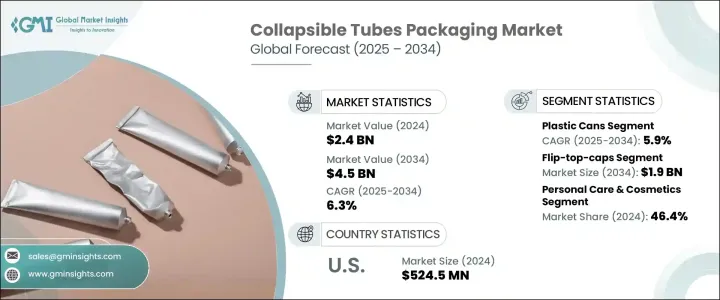
세계의 접이식 튜브 포장 시장은 2024년에는 24억 달러로 평가되었고 도시화 및 소비자 라이프 스타일의 진화와 함께 퍼스널케어 및 화장품 부문의 확장에 힘입어 2034년에는 45억 달러에 이를 것으로 추정되고,CAGR 6.3%로 성장할 전망입니다.
이러한 산업이 계속 발전함에 따라 편의성, 지속 가능성, 비용 효율성을 제공하는 포장 솔루션에 대한 수요가 증가하고 있습니다. 특히 고령 인구층에서 일반 의약품(OTC)의 사용이 증가함에 따라 제품의 안전성, 용량 정확성, 사용자 친화적 기능을 보장하는 포장 솔루션에 대한 수요가 급증하고 있습니다.
소비자들이 건강에 대한 인식이 높아지고 특히 고령층에서 자가 치료를 선호함에 따라, 제약 제조업체들은 사용 편의성, 정확한 투여량, 긴 유통기한을 지원하는 포장 솔루션에 집중하고 있습니다. 약물의 효능을 유지하고 오염을 방지하는 접이식 튜브는 제약 제품과 퍼스널케어 제품 모두에 신뢰성, 비용 효율성, 위생성을 제공하는 옵션으로 인기를 얻고 있습니다. 이러한 변화는 소비자의 선호뿐만 아니라 제품의 안전성과 추적성에 대한 규제 당국의 강조에 의해 촉진되고 있습니다. 제조업체들은 제품을 보호할 뿐 아니라 사용자 경험을 향상시키는 포장 솔루션을 점점 더 많이 찾고 있으며, 이는 여러 산업에서 접을 수 있는 튜브의 채택이 증가하는 데 기여하고 있습니다.
| 시장 범위 | |
|---|---|
| 시작 연도 | 2024년 |
| 예측 연도 | 2025-2034년 |
| 시작금액 | 24억 달러 |
| 예측 금액 | 45억 달러 |
| CAGR | 6.3% |
시장은 재료 유형에 따라 플라스틱, 알루미늄 및 기타 범주로 분류되며, 플라스틱 튜브는 2034년까지 연평균 5.9%의 성장률을 보일 것으로 예상됩니다. 플라스틱 튜브는 저렴한 가격, 가벼운 특성 및 디자인 유연성으로 인해 수요가 높습니다. 또한, 재활용이 가능한 플라스틱 소재에 대한 선호도가 높아지는 것은 특히 퍼스널케어 및 의약품 포장 분야에서 지속 가능성 노력과도 부합합니다. 기업들이 환경 기준을 충족하고 점점 더 친환경에 민감한 소비자들의 요구에 부응하기 위해 노력함에 따라, 소비 후 재활용(PCR) 플라스틱의 사용도 증가하고 있습니다.
시장의 마개 유형 부문에는 플립탑 캡, 노즐 마개 및 스크류 캡이 포함됩니다. 플립탑 캡 부문은 2034년까지 19억 달러에 달할 것으로 예상됩니다. 이 캡은 사용하기 쉬운 디자인으로, 특히 퍼스널케어 용품 및 세면 용품에서 쉽고 위생적으로 제품을 사용할 수 있어 선호됩니다. 소비자들은 한 손으로 조작할 수 있고 편리한 플립탑 캡을 선호하기 때문에 바쁜 생활에 이상적입니다. 또한, 이러한 캡의 디자인은 제품 차별화를 개선하고 진열 매력을 높이기 위해 진화하고 있으며, 이는 시장에서 인기가 더욱 촉진되고 있습니다.
미국의 접이식 튜브 포장 시장은 소비자의 편리하고 친환경적인 포장에 대한 수요에 힘입어 2024년에 5억 2,450만 달러로 평가되었습니다. 많은 브랜드들이 지속 가능한 포장 솔루션에 대한 증가하는 요구를 충족하기 위해 생분해성 및 재활용 가능한 튜브 개발에 집중하고 있습니다. 특히 퍼스널케어 및 제약 산업에서 온라인 소매 및 고급 포장 미학으로의 전환도 미국 시장의 성장에 기여하고 있습니다.
세계의 접이식 튜브 포장 시장의 주요 기업으로는 Berry Global, Albea Group, Linhardt Group, EPL, Montebello Packaging 등이 있습니다. 이들 기업은 혁신과 지속 가능한 솔루션을 통해 시장 경쟁력을 유지하기 위해 노력하고 있습니다. 시장 점유율을 강화하기 위해 기업들은 생분해성 플라스틱과 소비 후 재활용 소재를 제품에 도입하는 데 집중하고 있습니다. 브랜드들은 접이식 튜브의 품질과 맞춤형 옵션을 개선하기 위해 고급 제조 기술을 도입하는 데 투자하고 있습니다. 이는 퍼스널케어, 화장품, 제약 산업 등 특정 산업의 요구사항을 충족시키기 위함입니다. 또한 기업들은 소비자에게 향상된 기능성과 매력을 제공하기 위해 혁신적인 캡 유형과 디자인을 탐구 중입니다.
목차
제1장 조사 방법과 범위
제2장 주요 요약
제3장 업계 인사이트
- 생태계 분석
- 트럼프 정권의 관세 분석
- 무역에 미치는 영향
- 무역량의 혼란
- 보복 조치
- 업계에 미치는 영향
- 공급측의 영향(원자재)
- 주요 원자재의 가격 변동
- 공급망 재구성
- 생산 비용에 미치는 영향
- 수요측의 영향(판매가격)
- 최종 시장에의 가격 전달
- 시장 점유율 동향
- 소비자의 반응 패턴
- 공급측의 영향(원자재)
- 영향을 받는 주요 기업
- 전략적인 업계 대응
- 공급망 재구성
- 가격 설정 및 제품 전략
- 정책관여
- 전망과 향후 검토 사항
- 무역에 미치는 영향
- 업계에 미치는 영향요인
- 성장 촉진요인
- 퍼스널케어 및 화장품 산업의 성장
- 제약업계 확대
- 식품 및 영양보조식품 분야에서의 채택 증가
- 급속한 도시화와 변화하는 소비자 생활 방식
- 전자상거래 성장으로 인한 내구성과 방수 포장 수요 증가
- 업계의 잠재적 위험 및 과제
- 원자재 가격의 변동
- 다층 및 라미네이트 튜브의 재활용성 제한
- 성장 촉진요인
- 성장 가능성 분석
- 규제 상황
- 기술의 상황
- 장래 시장 동향
- 갭 분석
- Porter's Five Forces 분석
- PESTEL 분석
제4장 경쟁 구도
- 소개
- 기업의 시장 점유율 분석
- 주요 시장 기업의 경쟁 분석
- 경쟁 포지셔닝 매트릭스
- 전략 대시보드
제5장 시장 추계 및 예측 : 재료별(2021-2034년)
- 주요 동향
- 플라스틱
- 폴리에틸렌(PE)
- 고밀도 폴리에틸렌(HDPE)
- 저밀도 폴리에틸렌(LDPE)
- 폴리프로필렌(PP)
- 다층 라미네이트(EVOH 기반 튜브 등)
- 폴리에틸렌(PE)
- 알루미늄
- 기타
제6장 시장 추계 및 예측 : 마개 유형별(2021-2034년)
- 주요 동향
- 플립탑 캡
- 노즐 마개
- 스크류 캡
제7장 시장 추계 및 예측 : 최종 이용 산업별(2021-2034년)
- 주요 동향
- 퍼스널케어 및 화장품
- 제약
- 식품 및 음료
- 기타
제8장 시장 추계 및 예측 : 지역별(2021-2034년)
- 주요 동향
- 북미
- 미국
- 캐나다
- 유럽
- 독일
- 영국
- 프랑스
- 스페인
- 이탈리아
- 네덜란드
- 아시아태평양
- 중국
- 인도
- 일본
- 호주
- 한국
- 라틴아메리카
- 브라질
- 멕시코
- 아르헨티나
- 중동 및 아프리카
- 사우디아라비아
- 남아프리카
- 아랍에미리트(UAE)
제9장 기업 프로파일
- Albea Group
- Alltub
- Amcor
- Antilla
- Apackaging Group
- Berry Global
- CTL-TH Packaging
- EPL
- Hoffmann Neopac
- Huhtamaki
- Kaufman Container
- KimPai Tuba
- Linhardt Group
- Montebello Packaging
- Norden Machinery
- Perfektup Ambalaj
- Pirlo Holding
- Sona Extrusion
- Tubex Aluminium Tubes
The Global Collapsible Tubes Packaging Market was valued at USD 2.4 billion in 2024 and is estimated to grow at a CAGR of 6.3% to reach USD 4.5 billion by 2034, driven by the expansion of the personal care and cosmetics sectors, coupled with increasing urbanization and evolving consumer lifestyles. As these industries continue to evolve, the need for packaging solutions that offer convenience, sustainability, and cost-effectiveness has gained traction. The increasing use of over-the-counter (OTC) medications, especially among aging populations, has led to a surge in demand for packaging that ensures product integrity, dosing accuracy, and user-friendly features.
As consumers become more health-conscious and prefer self-medication, especially in older age groups, pharmaceutical manufacturers are focusing on packaging solutions that support ease of use, precise dosing, and long shelf life. Collapsible tubes, with their ability to maintain medication's effectiveness and prevent contamination, are gaining popularity as they offer a reliable, cost-effective, and hygienic option for both pharmaceuticals and personal care products. This shift is not only driven by consumer preference but also by the regulatory emphasis on safety and traceability of products. Manufacturers are increasingly looking for packaging solutions that not only protect the product but also enhance the user experience, contributing to the growing adoption of collapsible tubes across multiple industries.
| Market Scope | |
|---|---|
| Start Year | 2024 |
| Forecast Year | 2025-2034 |
| Start Value | $2.4 Billion |
| Forecast Value | $4.5 Billion |
| CAGR | 6.3% |
The market is segmented by material type into plastic, aluminum, and other categories, with plastic tubes projected to grow at a CAGR of 5.9% by 2034. Plastic tubes are in high demand due to their affordability, lightweight nature, and design flexibility. Moreover, the growing preference for recyclable plastic materials aligns with sustainability efforts, particularly in personal care and pharmaceutical packaging. The use of post-consumer recycled (PCR) plastics is also gaining momentum as companies seek to meet environmental standards and cater to increasingly eco-conscious consumers.
The closure type segment of the market includes flip-top caps, nozzle closures, and screw caps. Flip-top caps segment is expected to reach USD 1.9 billion by 2034. These caps are favored for their user-friendly design, which allows for easy, hygienic dispensing, especially in personal care and toiletry products. Consumers prefer flip-top caps for their one-handed operation and convenience, making them ideal for busy lifestyles. Additionally, the design of these caps is evolving to improve product differentiation and enhance shelf appeal, further driving their popularity in the market.
United States Collapsible Tubes Packaging Market was valued at USD 524.5 million in 2024 driven by consumer demand for convenient, eco-friendly packaging. Many brands are focusing on developing biodegradable and recyclable tubes to meet the growing need for sustainable packaging solutions. The shift towards online retail and premium packaging aesthetics, particularly in the personal care and pharmaceutical industries, is also contributing to the growth of the market in the U.S.
Some of the leading companies in the Global Collapsible Tubes Packaging Market include Berry Global, Albea Group, Linhardt Group, EPL, and Montebello Packaging. These companies are focusing on innovation and sustainable solutions to maintain their competitive edge in the market. To strengthen their market presence, companies are focusing on incorporating eco-friendly materials like biodegradable plastics and post-consumer recycled content into their products. Brands are also investing in advanced manufacturing techniques to improve the quality and customization options of collapsible tubes, ensuring that they meet the specific needs of industries such as personal care, cosmetics, and pharmaceuticals. Additionally, companies are exploring innovative closure types and designs to offer enhanced functionality and appeal to consumers.
Table of Contents
Chapter 1 Methodology and Scope
- 1.1 Market scope and definitions
- 1.2 Research design
- 1.2.1 Research approach
- 1.2.2 Data collection methods
- 1.3 Base estimates and calculations
- 1.3.1 Base year calculation
- 1.3.2 Key trends for market estimation
- 1.4 Forecast model
- 1.5 Primary research and validation
- 1.5.1 Primary sources
- 1.5.2 Data mining sources
Chapter 2 Executive Summary
- 2.1 Industry 360° synopsis
Chapter 3 Industry Insights
- 3.1 Industry ecosystem analysis
- 3.2 Trump administration tariffs analysis
- 3.2.1 Impact on trade
- 3.2.1.1 Trade volume disruptions
- 3.2.1.2 Retaliatory measures
- 3.2.2 Impact on the industry
- 3.2.2.1 Supply-side impact (raw materials)
- 3.2.2.1.1 Price volatility in key materials
- 3.2.2.1.2 Supply chain restructuring
- 3.2.2.1.3 Production cost implications
- 3.2.2.2 Demand-side impact (selling price)
- 3.2.2.2.1 Price transmission to end markets
- 3.2.2.2.2 Market share dynamics
- 3.2.2.2.3 Consumer response patterns
- 3.2.2.1 Supply-side impact (raw materials)
- 3.2.3 Key companies impacted
- 3.2.4 Strategic industry responses
- 3.2.4.1.1 Supply chain reconfiguration
- 3.2.4.1.2 Pricing and product strategies
- 3.2.4.1.3 Policy engagement
- 3.2.5 Outlook and future considerations
- 3.2.1 Impact on trade
- 3.3 Industry impact forces
- 3.3.1 Growth drivers
- 3.3.1.1 Growth in personal care and cosmetic industry
- 3.3.1.2 Expansion of the pharmaceutical industry
- 3.3.1.3 Increased adoption in the food and nutraceutical sectors
- 3.3.1.4 Rapid urbanization and changing consumer lifestyles
- 3.3.1.5 E-commerce growth fueling demand for durable and leak-proof packaging
- 3.3.2 Industry pitfalls and challenges
- 3.3.2.1 Fluctuations in raw material prices
- 3.3.2.2 Limited recyclability of multi-layer and laminated tubes
- 3.3.1 Growth drivers
- 3.4 Growth potential analysis
- 3.5 Regulatory landscape
- 3.6 Technology landscape
- 3.7 Future market trends
- 3.8 Gap analysis
- 3.9 Porter's analysis
- 3.10 PESTEL analysis
Chapter 4 Competitive Landscape, 2024
- 4.1 Introduction
- 4.2 Company market share analysis
- 4.3 Competitive analysis of major market players
- 4.4 Competitive positioning matrix
- 4.5 Strategy dashboard
Chapter 5 Market Estimates & Forecast, By Material Type, 2021-2034 (USD Million & Kilo Tons)
- 5.1 Key trends
- 5.2 Plastic
- 5.2.1 Polyethylene (PE)
- 5.2.1.1 High-density polyethylene (HDPE)
- 5.2.1.2 low-density polyethylene (LDPE)
- 5.2.2 Polypropylene (PP)
- 5.2.3 Multi-layer laminates (e.g., EVOH-based tubes)
- 5.2.1 Polyethylene (PE)
- 5.3 Aluminum
- 5.4 Others
Chapter 6 Market Estimates & Forecast, By Closure Type, 2021-2034 (USD Million & Kilo Tons)
- 6.1 Key trends
- 6.2 Flip-top caps
- 6.3 Nozzle closures
- 6.4 Screw caps
Chapter 7 Market Estimates & Forecast, By End Use Industry, 2021-2034 (USD Million & Kilo Tons)
- 7.1 Key trends
- 7.2 Personal care & cosmetics
- 7.3 Pharmaceuticals
- 7.4 Food & beverage
- 7.5 Others
Chapter 8 Market Estimates and Forecast, By Region, 2021 – 2034 (USD Million & Kilo Tons)
- 8.1 Key trends
- 8.2 North America
- 8.2.1 U.S.
- 8.2.2 Canada
- 8.3 Europe
- 8.3.1 Germany
- 8.3.2 UK
- 8.3.3 France
- 8.3.4 Spain
- 8.3.5 Italy
- 8.3.6 Netherlands
- 8.4 Asia Pacific
- 8.4.1 China
- 8.4.2 India
- 8.4.3 Japan
- 8.4.4 Australia
- 8.4.5 South Korea
- 8.5 Latin America
- 8.5.1 Brazil
- 8.5.2 Mexico
- 8.5.3 Argentina
- 8.6 Middle East and Africa
- 8.6.1 Saudi Arabia
- 8.6.2 South Africa
- 8.6.3 UAE
Chapter 9 Company Profiles
- 9.1 Albea Group
- 9.2 Alltub
- 9.3 Amcor
- 9.4 Antilla
- 9.5 Apackaging Group
- 9.6 Berry Global
- 9.7 CTL-TH Packaging
- 9.8 EPL
- 9.9 Hoffmann Neopac
- 9.10 Huhtamaki
- 9.11 Kaufman Container
- 9.12 KimPai Tuba
- 9.13 Linhardt Group
- 9.14 Montebello Packaging
- 9.15 Norden Machinery
- 9.16 Perfektup Ambalaj
- 9.17 Pirlo Holding
- 9.18 Sona Extrusion
- 9.19 Tubex Aluminium Tubes