|
시장보고서
상품코드
1750509
레이더 흡수재(RAM) 시장 : 시장 기회, 성장 촉진요인, 산업 동향 분석, 예측(2025-2034년)Radar Absorbing Materials Market Opportunity, Growth Drivers, Industry Trend Analysis, and Forecast 2025 - 2034 |
||||||

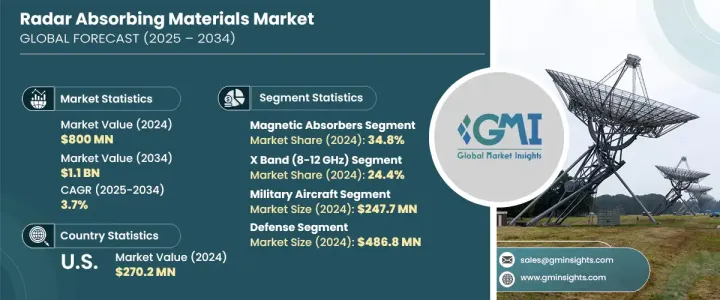
세계의 레이더 흡수재 시장은 2024년에는 8억 달러로 평가되었고, 방위비 및 세계 긴장 증가로 인해 CAGR 3.7%로 성장할 전망이며, 2034년에는 11억 달러에 이를 것으로 추정되고 있습니다.
현대의 방위 기술, 특히 스텔스 기술은 레이더 감지를 최소화하는 재료 수요를 밀어 올리고 있습니다. 군사 분야뿐만 아니라 민간 분야에서도 레이더 단면적 시그니처 저감을 목표로 하는 움직임이 활발해지고 있으며, RAM 재료는 선진 시스템에 필수적인 요소가 되고 있습니다. 특히 그래핀이나 탄소나노튜브와 같은 첨단 재료에서는 열적 및 기계적 성능을 향상시킨 경량 복합재료에 이목이 집중되고 있어 기술 혁신의 원동력이 되고 있습니다.
제조업체는 경량으로 높은 내구성을 유지하면서 보다 넓은 주파수 대역에서 뛰어난 성능을 발휘하는 다기능 RAM에 투자하고 있습니다. 또한 기존 RAM에 사용되는 화학 조성에 대한 우려가 높아짐에 따라 환경적으로 안전한 대체품 개발도 진행되고 있습니다. 한편, 학술 기관과 방위 파트너십은 연구 협력을 통해 발견 사이클을 가속화하고 있습니다. 기존 기업도 신규 진입 기업도 비용 효율이 높은 솔루션을 창출하고 독점적인 군사 플랫폼뿐만 아니라 보다 광범위한 상업 용도로의 적용을 확대할 필요가 있습니다.
| 시장 범위 | |
|---|---|
| 시작 연도 | 2024년 |
| 예측 연도 | 2025-2034년 |
| 시작 금액 | 8억 달러 |
| 예측 금액 | 11억 달러 |
| CAGR | 3.7% |
다양한 주파수 대역 중 X 대역은 2024년에 1억 9,500만 달러를 차지했으며, 2034년까지 연평균 복합 성장률(CAGR) 4.7%를 보일 것으로 예측됩니다. 이 대역은 항공기 및 무인 플랫폼 추적, 기상 레이더 및 조준 시스템에서 중요한 역할을 하기 때문에 여전히 높은 관련성을 유지하고 있습니다. L밴드나 S밴드와 같은 다른 주파수 대역은 해군과 공중 감시에서 인기를 끌고 있으며, C밴드는 항공 교통과 지상 관제 시스템에서 계속 중요한 역할을 담당하고 있습니다. 특정 주파수 대역용으로 조정된 레이더 흡수 재료는 각 영역에서 최적의 스텔스 능력을 달성하기 위해 필수적입니다.
용도별로 군용기는 2024년에 2억 4,770만 달러를 창출했으며, CAGR 4.3%로 성장할 전망입니다. 스텔스 대응 항공기는 특히 제공권이 장래의 전투 전략을 지배하기 위해서, RAM의 주요 소비자로 남아 있습니다. 해군의 함선도, 상부 구조나 중요한 시스템을 마스킹하기 위해서 이러한 재료를 배치하고 있으며, 육상 차량 및 이동식 명령어 플랫폼은 레이더가 많은 환경에서 검출되지 않고 작동하기 위해 RAM을 점점 더 통합하고 있습니다.
미국의 레이더 흡수재 2024년 시장 규모는 2억 7,020만 달러로 평가되었으며, 강력한 방위 산업과 고도의 연구개발 활동에 힘입고 있습니다. 기술 혁신은 군사 플랫폼에서 사용될 뿐만 아니라 자율항법, 통신 인프라, 항공 우주 차폐 등 민간 기술로도 이행하고 있습니다. 기업은 고주파 흡수 재료를 자동차 센서나 차세대 통신 기기에 포함시키고 있습니다.
시장 점유율을 확대하기 위해 SLTL 그룹, 서브, 마이크로 머그, 3M 등의 기업은 재료의 혁신과 주파수의 범용성을 중심으로 한 전략을 채용하고 있습니다. 하이브리드 복합 재료, 메타물질, 유전체 구조에 투자하여 멀티 플랫폼의 수요에 부응하고 있습니다. 방위 기관과의 협력, 지속 가능한 제조의 중시, 비용의 최적화는 장기적인 경쟁상 위치설정의 중심입니다.
목차
제1장 조사 방법 및 범위
제2장 주요 요약
제3장 업계 인사이트
- 생태계 분석
- 밸류체인에 영향을 주는 요인
- 이익률 분석
- 혁신
- 장래의 전망
- 제조업자
- 리셀러
- 트럼프 정권에 의한 관세에 대한 영향
- 무역에 미치는 영향
- 무역량의 혼란
- 보복조치
- 업계에 미치는 영향
- 공급측의 영향(원재료)
- 주요 원재료의 가격 변동
- 공급망 구조
- 생산 비용에 미치는 영향
- 공급측의 영향(원재료)
- 수요측의 영향(판매가격)
- 최종 시장에 대한 가격 전달
- 시장 점유율 동향
- 소비자의 반응 패턴
- 영향을 받는 주요 기업
- 전략적인 업계 대응
- 공급망 재구성
- 가격 설정 및 제품 전략
- 정책관여
- 전망 및 향후 검토 사항
- 무역에 미치는 영향
- 무역 통계(HS 코드) 참고 : 위의 무역 통계는 주요 국가에 대해서만 제공됩니다
- 주요 수출국(2021-2024년)
- 주요 수입국(2021-2024년)
- 공급자의 상황
- 이익률 분석
- 주요 뉴스 및 대처
- 규제 상황
- 영향요인
- 성장 촉진요인
- 방위비 증가 및 스텔스 기술의 채용
- 재료과학의 기술 진보
- 무인 항공기(UAV) 및 드론의 확대
- 소비자용 및 자동차용 레이더 시스템에 RAM 통합
- 업계의 잠재적 위험 및 과제
- 높은 제조 비용 및 복잡한 생산 공정
- 환경 및 내구성에 대한 우려
- 성장 촉진요인
- 시장 기회
- 성장 가능성 분석
- 규제 틀 분석
- REACH 및 ROHS 규정
- 수출관리규제
- 환경 컴플라이언스 요건
- 취급 및 처리에 관한 안전기준
- 기술의 상황
- 현재의 기술 동향
- 신흥기술
- 연구개발 이니셔티브 및 혁신 파이프라인
- 특허 분석
- Porter's Five Forces 분석
- PESTEL 분석
제4장 경쟁 구도
- 서문
- 시장 점유율 분석
- 전략적 틀
- 합병 및 인수
- 합작투자 및 콜라보레이션
- 신제품 개발
- 확대 전략
- 경쟁 벤치마킹
- 벤더 상황
- 경쟁 포지셔닝 매트릭스
- 전략적 대시보드
- 특허 분석 및 혁신평가
- 신규 참가자 시장 진출 전략
- 조사 개발 집약도 분석
제5장 시장 추계 및 예측 : 재질별(2021-2034년)
- 주요 동향
- 자기 흡수 장치
- 페라이트
- 카르보닐철
- 기타
- 유전체 흡수체
- 탄소계 재료
- 전도성 폴리머
- 기타
- 하이브리드 흡수체
- 자성 유전체 복합재료
- 다층 구조
- 기타
- 임피던스 정합 재료
- 메타물질 흡수체
- 주파수 선택 표면
- 기타
제6장 시장 추계 및 예측 : 형태별(2021-2034년)
- 주요 동향
- 코팅 및 페인트
- 스프레이 코팅
- 브러시 도포 코팅
- 기타
- 시트 및 필름
- 폼 및 벌집
- 타일 및 패널
- 성형 부품
- 기타
제7장 시장 추계 및 예측 : 주파수 범위별(2021-2034년)
- 주요 동향
- 저주파(1 GHZ 미만)
- L&s 밴드(1-4GHz)
- C-band(4-8GHz)
- X-band(8-12GHz)
- 훗, k&kka 밴드(12-40 GHz)
- 밀리미터파(40 GHz 초과)
- 광대역(복수의 주파수 범위)
제8장 시장 추계 및 예측 : 용도별(2021-2034년)
- 주요 동향
- 군용기
- 전투기
- 폭격기
- 무인 항공기(UAV)
- 기타
- 해군 함정
- 수상함정
- 잠수함
- 기타
- 지상 차량 및 시스템
- 장갑차량
- 이동식 레이더 시스템
- 기타
- 미사일 및 발사물
- 고정설비
- 지휘 센터
- 레이더 시설
- 기타
- 민간 용도
- EMI/RFI 실드
- 통신
- 무향실
- 기타
- 기타
제9장 시장 추계 및 예측 : 최종 이용 산업별(2021-2034년)
- 주요 동향
- 방위
- 공군
- 해군
- 군
- 기타
- 항공우주
- 군사 항공우주
- 민간 항공우주
- 우주 용도
- 일렉트로닉스 및 통신
- 자동차
- 연구 및 학술
- 기타
제10장 시장 추계 및 예측 : 지역별(2021-2034년)
- 주요 동향
- 북미
- 미국
- 캐나다
- 유럽
- 영국
- 독일
- 프랑스
- 이탈리아
- 스페인
- 기타 유럽
- 아시아태평양
- 중국
- 인도
- 일본
- 한국
- 호주
- 기타 아시아태평양
- 라틴아메리카
- 브라질
- 멕시코
- 아르헨티나
- 기타 라틴아메리카
- 중동 및 아프리카
- 남아프리카
- 사우디아라비아
- 아랍에미리트(UAE)
- 기타 중동 및 아프리카
제11장 기업 프로파일
- 3M
- L3Harris Technologies
- Laird Technologies
- MAJR Products
- Micromag
- Saab
- Sltl Group
- Soliani Emc
- Thales
- Trelleborg
- Wittenburggroup
The Global Radar Absorbing Materials Market was valued at USD 800 million in 2024 and is estimated to grow at a CAGR of 3.7% to reach USD 1.1 billion by 2034 due to defense spending and rising tensions around the globe. Modern defense technologies, particularly in stealth, have pushed demand for materials that minimize radar detection. With both military and increasingly civilian sectors looking to reduce radar cross-section signatures, RAM materials are becoming an integral part of advanced systems. The ongoing focus on lightweight composites with enhanced thermal and mechanical performance drives innovations, especially with advanced materials like graphene and carbon nanotubes.
Manufacturers are investing in multi-functional RAM that delivers superior performance across broader frequency bands, while maintaining low weight and high durability. Environmentally safer alternatives are also under development, responding to growing concerns around chemical compositions used in traditional RAM. Meanwhile, academic institutions and defense partnerships accelerate discovery cycles through research collaborations. Established companies and new players face pressure to produce cost-effective solutions to expand their applicability beyond exclusive military platforms and into broader commercial uses.
| Market Scope | |
|---|---|
| Start Year | 2024 |
| Forecast Year | 2025-2034 |
| Start Value | $800 Million |
| Forecast Value | $1.1 Billion |
| CAGR | 3.7% |
Among the various frequency bands, the X band accounted for USD 195 million in 2024 and is projected to grow at a 4.7% CAGR through 2034. This band remains highly relevant due to its critical role in tracking, weather radar, and targeting systems in airborne and unmanned platforms. Other frequency ranges, such as the L and S bands, are gaining traction in naval and airborne surveillance, while C band usage continues to hold importance in air traffic and ground control systems. Radar-absorbing materials tailored for specific frequency operations are essential in achieving optimal stealth capabilities across domains.
In terms of application, military aircraft generated USD 247.7 million in 2024, expected to grow at a CAGR of 4.3%. Stealth-enabled aircraft remain key consumers of RAM, particularly as air superiority continues to dominate future combat strategies. Naval ships also deploy these materials to mask superstructures and critical systems, while land-based vehicles and mobile command platforms are increasingly integrating RAM to operate undetected in radar-heavy environments.
United States Radar Absorbing Materials Market stood at USD 270.2 million in 2024, supported by a strong defense industry and advanced R&D activities. Innovations are not only being used in military platforms but are also transitioning into civilian technologies such as autonomous navigation, telecom infrastructure, and aerospace shielding. Companies are integrating high-frequency absorbing materials into automotive sensors and next-gen communication devices.
To boost market share, companies like SLTL Group, Saab, Micromag, and 3M are adopting strategies centered on material innovation and frequency versatility. They invest in hybrid composites, metamaterials, and dielectric structures to meet multi-platform demands. Collaborations with defense bodies, emphasis on sustainable manufacturing, and cost optimization remain central to their long-term competitive positioning.
Table of Contents
Chapter 1 Methodology & Scope
- 1.1 Market scope & definitions
- 1.2 Base estimates & calculations
- 1.3 Forecast calculations
- 1.4 Data sources
- 1.4.1 Primary
- 1.4.2 Secondary
- 1.4.2.1 Paid sources
- 1.4.2.2 Public sources
Chapter 2 Executive Summary
- 2.1 Industry synopsis, 2021-2034
Chapter 3 Industry Insights
- 3.1 Industry ecosystem analysis
- 3.1.1 Factor affecting the value chain
- 3.1.2 Profit margin analysis
- 3.1.3 Disruptions
- 3.1.4 Future outlook
- 3.1.5 Manufacturers
- 3.1.6 Distributors
- 3.2 Trump administration tariffs
- 3.2.1 Impact on trade
- 3.2.1.1 Trade volume disruptions
- 3.2.1.2 Retaliatory measures
- 3.2.2 Impact on the industry
- 3.2.2.1 Supply-side impact (raw materials)
- 3.2.2.1.1 Price volatility in key materials
- 3.2.2.1.2 Supply chain structure
- 3.2.2.1.3 Production cost implications
- 3.2.2.1 Supply-side impact (raw materials)
- 3.2.3 Demand-side impact (selling price)
- 3.2.3.1 Price transmission to end markets
- 3.2.3.2 Market share dynamics
- 3.2.3.3 Consumer response patterns
- 3.2.4 Key companies impacted
- 3.2.5 Strategic industry responses
- 3.2.5.1 Supply chain reconfiguration
- 3.2.5.2 Pricing and product strategies
- 3.2.5.3 Policy engagement
- 3.2.6 Outlook and future considerations
- 3.2.1 Impact on trade
- 3.3 Trade statistics (HS code) Note: the above trade statistics will be provided for key countries only.
- 3.3.1 Major exporting countries, 2021-2024 (kilo tons)
- 3.3.2 Major importing countries, 2021-2024 (kilo tons)
- 3.4 Supplier landscape
- 3.5 Profit margin analysis
- 3.6 Key news & initiatives
- 3.7 Regulatory landscape
- 3.8 Impact forces
- 3.8.1 Growth drivers
- 3.8.1.1 Rising defense expenditures and stealth technology adoption
- 3.8.1.2 Technological advancements in material science
- 3.8.1.3 Expansion of unmanned aerial vehicles (UAVS) and drones
- 3.8.1.4 Integration of RAM in civilian and automotive radar systems
- 3.8.2 Industry pitfalls & challenges
- 3.8.2.1 High manufacturing costs and complex production processes
- 3.8.2.2 Environmental and durability concerns
- 3.8.1 Growth drivers
- 3.9 Market opportunities
- 3.10 Growth potential analysis
- 3.11 Regulatory framework analysis
- 3.11.1 Reach and ROHS regulations
- 3.11.2 Export control regulations
- 3.11.3 Environmental compliance requirements
- 3.11.4 Safety standards for handling and processing
- 3.12 Technology landscape
- 3.12.1 Current technological trends
- 3.12.2 Emerging technologies
- 3.12.3 R&D initiatives and innovation pipeline
- 3.12.4 Patent analysis
- 3.13 Porter's analysis
- 3.14 PESTEL analysis
Chapter 4 Competitive Landscape, 2024
- 4.1 Introduction
- 4.2 Market share analysis
- 4.2.1 Strategic Framework
- 4.2.2 Mergers & acquisitions
- 4.2.3 Joint ventures & collaborations
- 4.2.4 New product developments
- 4.2.5 Expansion strategies
- 4.3 Competitive benchmarking
- 4.4 Vendor landscape
- 4.5 Competitive positioning matrix
- 4.6 Strategic dashboard
- 4.7 Patent analysis & innovation assessment
- 4.8 Market entry strategies for new players
- 4.9 Research & development intensity analysis
Chapter 5 Market Estimates & Forecast, By Material Type, 2021-2034 (USD Million) (Kilo Tons)
- 5.1 Key trends
- 5.2 Magnetic absorbers
- 5.2.1 Ferrites
- 5.2.2 Carbonyl iron
- 5.2.3 Others
- 5.3 Dielectric absorbers
- 5.3.1 Carbon-based materials
- 5.3.2 Conductive polymers
- 5.3.3 Others
- 5.4 Hybrid absorbers
- 5.4.1 Magnetic-dielectric composites
- 5.4.2 Multilayer structures
- 5.4.3 Others
- 5.5 Impedance matching materials
- 5.6 Metamaterial absorbers
- 5.7 Frequency selective surfaces
- 5.8 Others
Chapter 6 Market Estimates & Forecast, By Form, 2021-2034 (USD Million) (Kilo Tons)
- 6.1 Key trends
- 6.1.1 Coatings & paints
- 6.1.2 Sprayable coatings
- 6.1.3 Brush-applied coatings
- 6.1.4 Others
- 6.2 Sheets & films
- 6.3 Foams & honeycombs
- 6.4 Tiles & panels
- 6.5 Molded components
- 6.6 Others
Chapter 7 Market Estimates & Forecast, By Frequency Range, 2021-2034 (USD Million) (Kilo Tons)
- 7.1 Key trends
- 7.2 Low frequency (< 1 GHZ)
- 7.3 L & s bands (1-4 GHz)
- 7.4 C band (4-8 GHz)
- 7.5 X band (8-12 GHz)
- 7.6 Ku, k & ka bands (12-40 GHz)
- 7.7 Millimeter wave (> 40 GHz)
- 7.8 Broadband (multiple frequency ranges)
Chapter 8 Market Estimates & Forecast, By Application, 2021-2034 (USD Million) (Kilo Tons)
- 8.1 Key trends
- 8.2 Military aircraft
- 8.2.1 Combat aircraft
- 8.2.2 Bombers
- 8.2.3 Unmanned aerial vehicles (UAVS)
- 8.2.4 Others
- 8.3 Naval vessels
- 8.3.1 Surface ships
- 8.3.2 Submarines
- 8.3.3 Others
- 8.4 Ground vehicles & systems
- 8.4.1 Armoured vehicles
- 8.4.2 Mobile radar systems
- 8.4.3 Others
- 8.5 Missiles & projectiles
- 8.6 Fixed installations
- 8.6.1 Command centers
- 8.6.2 Radar facilities
- 8.6.3 Others
- 8.7 Civilian applications
- 8.7.1 EMI/RFI shielding
- 8.7.2 Telecommunications
- 8.7.3 Anechoic chambers
- 8.7.4 Others
- 8.8 Others
Chapter 9 Market Estimates & Forecast, By End Use Industry, 2021-2034 (USD Million) (Kilo Tons)
- 9.1 Key trends
- 9.2 Defense
- 9.2.1 Air Force
- 9.2.2 Navy
- 9.2.3 Army
- 9.2.4 Others
- 9.3 Aerospace
- 9.3.1 Military aerospace
- 9.3.2 Commercial aerospace
- 9.3.3 Space applications
- 9.4 Electronics & telecommunications
- 9.5 Automotive
- 9.6 Research & academia
- 9.7 Others
Chapter 10 Market Estimates & Forecast, By Region, 2021-2034 (USD Million) (Kilo Tons)
- 10.1 Key trends
- 10.2 North America
- 10.2.1 U.S.
- 10.2.2 Canada
- 10.3 Europe
- 10.3.1 UK
- 10.3.2 Germany
- 10.3.3 France
- 10.3.4 Italy
- 10.3.5 Spain
- 10.3.6 Rest of Europe
- 10.4 Asia Pacific
- 10.4.1 China
- 10.4.2 India
- 10.4.3 Japan
- 10.4.4 South Korea
- 10.4.5 Australia
- 10.4.6 Rest of Asia Pacific
- 10.5 Latin America
- 10.5.1 Brazil
- 10.5.2 Mexico
- 10.5.3 Argentina
- 10.5.4 Rest of Latin America
- 10.6 MEA
- 10.6.1 South Africa
- 10.6.2 Saudi Arabia
- 10.6.3 UAE
- 10.6.4 Rest of Middle East and Africa
Chapter 11 Company Profiles
- 11.1 3M
- 11.2 L3Harris Technologies
- 11.3 Laird Technologies
- 11.4 MAJR Products
- 11.5 Micromag
- 11.6 Saab
- 11.7 Sltl Group
- 11.8 Soliani Emc
- 11.9 Thales
- 11.10 Trelleborg
- 11.11 Wittenburggroup