
|
시장보고서
상품코드
1750521
RF 아이솔레이터 시장 : 시장 기회, 성장 촉진요인, 산업 동향 분석, 예측(2025-2034년)RF Isolator Market Opportunity, Growth Drivers, Industry Trend Analysis, and Forecast 2025 - 2034 |
||||||

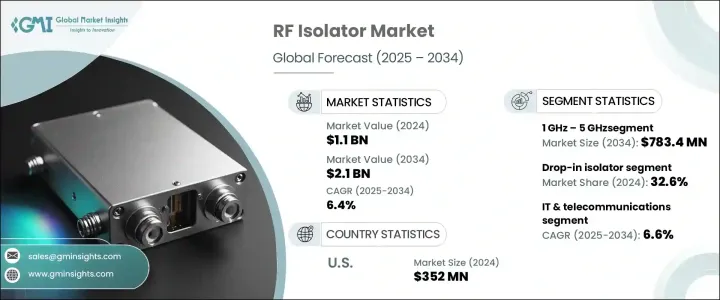
세계의 RF 아이솔레이터 시장 규모는 2024년에 11억 달러로 평가되었고, 데이터센터 및 클라우드 인프라의 급속한 확대, 항공우주 및 방위 기술의 사용 증가에 따라 CAGR 6.4%로 성장할 전망이며, 2034년에는 21억 달러에 이를 것으로 예측되고 있습니다.
RF 아이솔레이터는 신호 반사를 방지하여 신호 무결성과 시스템 신뢰성을 보장하는 데 중요한 역할을 하며, 이는 고주파 및 가혹한 환경에서 필수적입니다. 시장의 성장은 최신 레이더 시스템, 안전한 통신 및 전자전 기술에 대한 투자 증가로도 지원됩니다. 국방의 현대화가 세계에서 가속화되고 있는 가운데, 고도로 신뢰성 높은 RF 부품의 요구는 앞으로도 계속될 것으로 예측됩니다.
그러나 RF 아이솔레이터 산업은 통상법 301조를 포함한 미국 법에 따라 부과된 무역관세에 따른 과제에 직면하고 있습니다. 이러한 관세는 아이솔레이터와 마이크로파 관련 재료를 포함한 RF 부품 공급망에 영향을 미치고 제조업체의 비용을 증가시켰습니다. 그 결과 미국 기업은 가격 변동과 공급망의 혼란에 따른 영향을 줄이기 위해 조달 전략과 현지 생산 옵션을 재검토해야 했습니다. 이러한 과제에도 불구하고, RF 아이솔레이터 수요는 특히 상용 무선 네트워크 및 방위 시스템에서 견조하게 변화하고 있습니다.
| 시장 범위 | |
|---|---|
| 시작 연도 | 2024년 |
| 예측 연도 | 2025-2034년 |
| 시작 금액 | 11억 달러 |
| 예측 금액 | 21억 달러 |
| CAGR | 6.4% |
마이크로 스트립 아이솔레이터 시장은 커다란 성장을 이루고 있으며, 2034년에는 5억 1,940만 달러에 이를 것으로 예측되고 있습니다. 마이크로 스트립 아이솔레이터는 인쇄회로기판(PCB)과의 통합이 용이한 콤팩트하고 플랫한 설계로 최신 무선주파수(RF) 회로의 주요 부품이 되고 있습니다. 이 때문에 다양한 무선 기술에 응용하는 데 이상적입니다. 마이크로 스트립 아이솔레이터의 채용이 증가하고 있는 배경에는, 전자 부품의 소형화가 진행되어 최신 시스템에서 고밀도 회로 설계가 증가하고 있는 것이 있습니다. 마이크로 스트립 아이솔레이터는 사물인터넷(IoT) 가젯이나 고도의 5G 인프라 등 크기, 효율, 신뢰성이 중요한 기기에서 특히 위력을 발휘합니다.
게다가 1GHz-5GHz의 주파수 대역에서 동작하는 RF 아이솔레이터 시장은 2034년까지 7억 8,340만 달러에 달할 것으로 예상되어 크게 성장할 전망입니다. 이 성장의 주된 요인은 모바일 네트워크, 와이파이 시스템, 블루투스 기술의 확대입니다. 사물인터넷(IoT)을 통해 세계가 보다 연결되고 5G 네트워크 전개가 전 세계적으로 진행됨에 따라 이 특정 주파수 대역의 RF 아이솔레이터 수요는 증가합니다. 이러한 아이솔레이터는 신호의 완전성을 유지하고 간섭을 저감하며 기기간의 신뢰성 높은 통신을 확보하는 데 중요한 역할을 하고 있으며, 이는 가전, 스마트홈, 모바일 통신 등 상호 접속이 진행되는 세계에서는 매우 중요합니다.
미국의 RF 아이솔레이터 2024년 시장 규모는 3억 5,200만 달러로 평가되었습니다. 이 나라에서는 방위, 위성통신, 선진 항공우주 기술의 개발에 대한 투자가 RF 아이솔레이터 수요에 박차를 가하고 있습니다. 또한 5G 인프라의 급속한 전개 및 군사적 용도에서 레이더와 통신 시스템에 대한 의존도가 높아지는 것이 성장을 촉진하는 주요인이 되고 있습니다. 미국에서 대기업 RF 부품 제조업체의 강한 존재감 및 충실한 연구 개발 투자가 시장의 성장 궤도를 한층 더 뒷받침하고 있습니다.
세계의 RF 아이솔레이터 업계의 주요 기업은 Deewave Electronics, DiTom Microwave, Smiths Interconnect, Renaissance Electronics & Communications, JQL Electronics 등이 있습니다. 이러한 기업은 제품 포트폴리오의 확대, 기술 혁신에 주력, 주요 업계 기업과의 제휴 등의 전략을 채용하여 시장에서의 존재감을 강화하고 있습니다. RF 아이솔레이터 기업은, 시장에서의 지위를 높이기 위해, 고밀도 용도에 적합한, 보다 소형으로 효율적인 부품에 대한 수요 고조에 대응하는 제품 혁신에 주력하고 있습니다. 특히 주파수 범위 및 최신 통신 시스템과의 통합 등 분야에서, 제품의 성능을 향상시키기 위한 연구 개발에 고액의 투자를 실시하고 있습니다. 주요 기술 기업과의 전략적 파트너십도 시장 확대에 일조하고 있습니다.
목차
제1장 조사 방법 및 범위
제2장 주요 요약
제3장 업계 인사이트
- 생태계 분석
- 트럼프 정권의 관세 분석
- 무역에 미치는 영향
- 무역량의 혼란
- 보복 조치
- 업계에 미치는 영향
- 공급측의 영향(원재료)
- 주요 원재료의 가격 변동
- 공급망 재구성
- 생산 비용에 미치는 영향
- 수요측의 영향(판매가격)
- 최종 시장에 대한 가격 전달
- 시장 점유율 동향
- 소비자의 반응 패턴
- 공급측의 영향(원재료)
- 영향을 받는 주요 기업
- 전략적인 업계 대응
- 공급망 재구성
- 가격 설정 및 제품 전략
- 정책관여
- 전망 및 향후 검토 사항
- 무역에 미치는 영향
- 업계에 미치는 영향요인
- 성장 촉진요인
- 세계 통신 서비스 확대
- 데이터센터 및 클라우드 인프라 급증
- 위성 통신 시스템의 도입 확대
- 가전제품 및 스마트 디바이스의 성장
- 항공우주 및 방위 용도의 확대
- 업계의 잠재적 위험 및 과제
- 고급 RF 아이솔레이터 부품의 고비용
- 특정 용도에서 제한되는 동작 주파수 범위
- 성장 촉진요인
- 성장 가능성 분석
- 규제 상황
- 기술의 상황
- 장래 시장 동향
- 갭 분석
- Porter's Five Forces 분석
- PESTEL 분석
제4장 경쟁 구도
- 서문
- 기업의 시장 점유율 분석
- 주요 시장 기업의 경쟁 분석
- 경쟁 포지셔닝 매트릭스
- 전략 대시보드
제5장 시장 추계 및 예측 : 유형별(2021-2034년)
- 주요 동향
- 드롭 인 아이솔레이터
- 마이크로 스트립 아이솔레이터
- 동축 아이솔레이터
- 표면 실장 아이솔레이터
- 기타
제6장 시장 추계 및 예측 : 주파수 범위별(2021-2034년)
- 주요 동향
- 최대 1GHz
- 1GHz-5GHz
- 5GHz-10GHz
- 10GHz 이상
제7장 시장 추계 및 예측 : 최종 이용 산업별(2021-2034년)
- 주요 동향
- IT 및 통신
- 군 및 방위
- 의료 및 헬스케어
- 가전
- 기타
제8장 시장 추계 및 예측 : 지역별(2021-2034년)
- 주요 동향
- 북미
- 미국
- 캐나다
- 유럽
- 독일
- 영국
- 프랑스
- 스페인
- 이탈리아
- 네덜란드
- 아시아태평양
- 중국
- 인도
- 일본
- 호주
- 한국
- 라틴아메리카
- 브라질
- 멕시코
- 아르헨티나
- 중동 및 아프리카
- 사우디아라비아
- 남아프리카
- 아랍에미리트(UAE)
제9장 기업 프로파일
- Deewave Electronics
- DiTom Microwave
- ETL Systems
- Fairview Microwave
- JQL Electronics
- MECA Electronics
- Microwave Communications Laboratories
- Molex
- Nova Microwave
- Pasternack
- Renaissance Electronics and Communications
- Smiths Interconnect
- Sonoma Scientific
- UIY
- UTE Microwave
The Global RF Isolator Market was valued at USD 1.1 billion in 2024 and is estimated to grow at a CAGR of 6.4% to reach USD 2.1 billion by 2034, driven by the rapid expansion of data centers and cloud infrastructure, as well as the rising use of aerospace and defense technologies. RF isolators play a crucial role in ensuring signal integrity and system reliability by preventing signal reflection, which is vital in high-frequency, harsh environments. The market growth is also supported by rising investments in modern radar systems, secure communications, and electronic warfare technologies. The need for advanced and reliable RF components is expected to continue as defense modernization accelerates worldwide.
However, the RF isolator industry has faced challenges due to trade tariffs imposed under U.S. legislation, including Section 301 of the Trade Act. These tariffs affected the supply chain for RF components, including isolators and microwave-related materials, increasing costs for manufacturers. As a result, U.S. companies have had to reconsider their sourcing strategies and local production options to mitigate the impact of price fluctuations and supply chain disruptions. Despite these challenges, the demand for RF isolators remains robust, particularly in commercial wireless networks and defense systems.
| Market Scope | |
|---|---|
| Start Year | 2024 |
| Forecast Year | 2025-2034 |
| Start Value | $1.1 Billion |
| Forecast Value | $2.1 Billion |
| CAGR | 6.4% |
The microstrip isolator market is experiencing significant growth, with forecasts suggesting it will reach USD 519.4 million by 2034. Microstrip isolators are becoming a key component in modern radio frequency (RF) circuits due to their compact, flat design, which allows for easy integration with printed circuit boards (PCBs). This makes them ideal for applications in a variety of wireless technologies. Their growing adoption can be attributed to the increasing miniaturization of electronic components and the rise of high-density circuit designs in modern systems. Microstrip isolators are particularly valuable in devices such as Internet of Things (IoT) gadgets and advanced 5G infrastructure, where size, efficiency, and reliability are critical.
Additionally, the RF isolator market operating in the 1 GHz to 5 GHz frequency range is poised to grow significantly, with projections indicating a value of USD 783.4 million by 2034. This growth is primarily driven by the expansion of mobile networks, Wi-Fi systems, and Bluetooth technologies. As the world becomes more connected through the Internet of Things (IoT) and the rollout of 5G networks continues globally, the demand for RF isolators in this specific frequency range is set to rise. These isolators play an essential role in maintaining the integrity of signals, reducing interference, and ensuring reliable communication between devices, which is critical in the increasingly interconnected world of consumer electronics, smart homes, and mobile communication.
United States RF Isolator Market was valued at USD 352 million in 2024. The country's investments in defense, satellite communication, and the development of advanced aerospace technologies have spurred demand for RF isolators. Additionally, the rapid deployment of 5G infrastructure and the increasing reliance on radar and communication systems in military applications are key factors driving growth. The strong presence of leading RF component manufacturers in the U.S. and substantial R&D investments further support the market's growth trajectory.
Major players in the Global RF Isolator Industry include Deewave Electronics, DiTom Microwave, Smiths Interconnect, Renaissance Electronics & Communications, and JQL Electronics. These companies are adopting strategies such as expanding product portfolios, focusing on innovation, and collaborating with key industry players to strengthen their market presence. To enhance their market position, RF isolator companies are focusing on product innovation to meet the growing demand for smaller, more efficient components suitable for high-density applications. They are investing heavily in research and development to improve the performance of their products, particularly in areas such as frequency range and integration with modern communication systems. Strategic partnerships with leading technology companies are also helping to expand market reach.
Table of Contents
Chapter 1 Methodology and Scope
- 1.1 Market scope and definitions
- 1.2 Research design
- 1.2.1 Research approach
- 1.2.2 Data collection methods
- 1.3 Base estimates and calculations
- 1.3.1 Base year calculation
- 1.3.2 Key trends for market estimation
- 1.4 Forecast model
- 1.5 Primary research and validation
- 1.5.1 Primary sources
- 1.5.2 Data mining sources
Chapter 2 Executive Summary
- 2.1 Industry 360° synopsis
Chapter 3 Industry Insights
- 3.1 Industry ecosystem analysis
- 3.2 Trump administration tariffs analysis
- 3.2.1 Impact on trade
- 3.2.1.1 Trade volume disruptions
- 3.2.1.2 Retaliatory measures
- 3.2.2 Impact on the industry
- 3.2.2.1 Supply-side impact (raw materials)
- 3.2.2.1.1 Price volatility in key materials
- 3.2.2.1.2 Supply chain restructuring
- 3.2.2.1.3 Production cost implications
- 3.2.2.2 Demand-side impact (selling price)
- 3.2.2.2.1 Price transmission to end markets
- 3.2.2.2.2 Market share dynamics
- 3.2.2.2.3 Consumer response patterns
- 3.2.2.1 Supply-side impact (raw materials)
- 3.2.3 Key companies impacted
- 3.2.4 Strategic industry responses
- 3.2.4.1.1 Supply chain reconfiguration
- 3.2.4.1.2 Pricing and product strategies
- 3.2.4.1.3 Policy engagement
- 3.2.5 Outlook and future considerations
- 3.2.1 Impact on trade
- 3.3 Industry impact forces
- 3.3.1 Growth drivers
- 3.3.1.1 Expansion of global communication services
- 3.3.1.2 Proliferation of data centers and cloud infrastructure
- 3.3.1.3 Increasing deployment of satellite communication systems
- 3.3.1.4 Growth in consumer electronics and smart devices
- 3.3.1.5 Expansion of aerospace and defense applications
- 3.3.2 Industry pitfalls and challenges
- 3.3.2.1 High cost of advanced RF isolator components
- 3.3.2.2 Limited operating frequency range in certain applications
- 3.3.1 Growth drivers
- 3.4 Growth potential analysis
- 3.5 Regulatory landscape
- 3.6 Technology landscape
- 3.7 Future market trends
- 3.8 Gap analysis
- 3.9 Porter's analysis
- 3.10 PESTEL analysis
Chapter 4 Competitive Landscape, 2024
- 4.1 Introduction
- 4.2 Company market share analysis
- 4.3 Competitive analysis of major market players
- 4.4 Competitive positioning matrix
- 4.5 Strategy dashboard
Chapter 5 Market Estimates & Forecast, By Type, 2021-2034 (USD Billion & units)
- 5.1 Key trends
- 5.2 Drop-in isolator
- 5.3 Microstrip isolator
- 5.4 Co-axial isolator
- 5.5 Surface mount isolator
- 5.6 Others
Chapter 6 Market Estimates & Forecast, By Frequency Range, 2021-2034 (USD Billion & units)
- 6.1 Key trends
- 6.2 Up to 1 GHz
- 6.3 1 GHz – 5 GHz
- 6.4 5 GHz – 10 GHz
- 6.5 Above 10 GHz
Chapter 7 Market Estimates & Forecast, By End Use Industry, 2021-2034 (USD Billion & units)
- 7.1 Key trends
- 7.2 IT & telecommunications
- 7.3 Military & defense
- 7.4 Medical & healthcare
- 7.5 Consumer electronics
- 7.6 Others
Chapter 8 Market Estimates and Forecast, By Region, 2021 – 2034 (USD Billion & units)
- 8.1 Key trends
- 8.2 North America
- 8.2.1 U.S.
- 8.2.2 Canada
- 8.3 Europe
- 8.3.1 Germany
- 8.3.2 UK
- 8.3.3 France
- 8.3.4 Spain
- 8.3.5 Italy
- 8.3.6 Netherlands
- 8.4 Asia Pacific
- 8.4.1 China
- 8.4.2 India
- 8.4.3 Japan
- 8.4.4 Australia
- 8.4.5 South Korea
- 8.5 Latin America
- 8.5.1 Brazil
- 8.5.2 Mexico
- 8.5.3 Argentina
- 8.6 Middle East and Africa
- 8.6.1 Saudi Arabia
- 8.6.2 South Africa
- 8.6.3 UAE
Chapter 9 Company Profiles
- 9.1 Deewave Electronics
- 9.2 DiTom Microwave
- 9.3 ETL Systems
- 9.4 Fairview Microwave
- 9.5 JQL Electronics
- 9.6 MECA Electronics
- 9.7 Microwave Communications Laboratories
- 9.8 Molex
- 9.9 Nova Microwave
- 9.10 Pasternack
- 9.11 Renaissance Electronics and Communications
- 9.12 Smiths Interconnect
- 9.13 Sonoma Scientific
- 9.14 UIY
- 9.15 UTE Microwave