|
시장보고서
상품코드
1750530
로즈힙 추출물 시장 : 기회, 성장 촉진요인, 산업 동향 분석 및 예측(2025-2034년)Rosehip Extract Market Opportunity, Growth Drivers, Industry Trend Analysis, and Forecast 2025 - 2034 |
||||||

세계의 로즈힙 추출물 시장은 2024년에 3억 9,790만 달러로 평가되었고, 클린 라벨, 식물 유래, 천연 유래 성분에 대한 소비자 선호 증가로 2034년까지는 7억 920만 달러에 이를 것으로 추정되며, CAGR 6%로 성장할 전망입니다.
로즈힙 추출물은 야생 장미 식물의 열매에서 추출되며, 비타민 C, 폴리페놀, 카로티노이드, 지방산 등 필수 영양소가 풍부합니다. 그 광범위한 기능성으로 인해 식품 및 음료, 제약, 화장품, 건강보조식품 등 다양한 산업 분야에서 인기를 얻고 있습니다. 전 세계적으로 웰니스와 예방 건강에 대한 관심이 증가함에 따라, 로즈힙 추출물의 자연적인 항산화 및 항염증 성분이 제조업체와 소비자 모두로부터 점점 더 많은 관심을 받고 있습니다.

영양보조식품 분야에서 로즈힙 추출물의 사용이 널리 확산되고 있는 것은 면역력 강화와 관절 건강 개선을 원하는 소비자들, 특히 만성 질환을 앓고 있는 소비자들에 의해 촉진되고 있습니다. 또한, 천연 미용 제품에 대한 전 세계적 수요에 부합하는 피부 개선 효과로 인해 화장품 분야에서도 그 인기가 계속 높아지고 있습니다. 로즈힙 추출물은 노화 방지 및 미백에 효과적인 크림, 오일, 세럼에 자주 사용됩니다. 식품 및 음료 제조업체는 신맛과 높은 영양 가치를 이유로 차, 스낵, 기능성 음료에 추출물을 함유하고 있습니다. 이 분야 기업들은 소비자 신뢰를 강화하기 위해 지속 가능하고 유기농 원료 조달 방법을 활용하고 있습니다.
| 시장 범위 | |
|---|---|
| 시작 연도 | 2024년 |
| 예측 연도 | 2025년-2034년 |
| 시작금액 | 3억 9,790만 달러 |
| 예측 금액 | 7억920만 달러 |
| CAGR | 6% |
로사카니나는 2024년에는 1억 9,790만 달러에 달할 것으로 예상되며, 여전히 시장을 독점하고 있습니다. 강력한 항산화 작용과 비타민 풍부한 성분으로 건강 보조제 및 화장품 제형에 적합합니다. 추출물의 항염증 효과는 통증 완화 및 관절 관리 제품을 대상으로 한 사용을 더욱 촉진합니다. Rosa canina는 광범위한 공급 가능성과 글로벌 안전 규격 준수 덕분에 제조업체의 선호 종으로 자리 잡았습니다.
로사 루고사 분야는 영양분이 부족하고 염분 함량이 높은 토양에서도 잘 자랄 수 있는 특성으로 인해 2024년에 7,340만 달러의 매출을 올렸으며, 특히 농업 조건이 어려운 지역에서 지속 가능한 재배를 위한 매력적인 작물로 자리매김했습니다. 이러한 독특한 적응력은 신뢰할 수 있는 공급망을 유지하면서 환경에 미치는 영향을 줄이려는 생산자들에 의해 점점 더 인정받고 있습니다. 로사 루고사 추출물은 피부 건강을 유지하고 산화 스트레스를 퇴치하는 데 필수적인 페놀 화합물, 필수 지방산, 비타민 A 및 C가 고농도로 함유되어 있어 특히 높은 가치를 인정받고 있습니다.
미국의 로즈힙 추출물 시장은 2024년에 6,750만 달러의 매출을 올렸습니다. 식물성 스킨케어 및 건강 증진 보충제에 대한 소비자의 관심이 이 지역의 시장을 계속 촉진하고 있습니다. 로즈힙 추출물은 비타민 C와 항산화제가 고농축되어 있어 피부 건강과 면역력 강화에 특히 인기가 높으며, 웰빙 및 미용 카테고리에서 최고의 성분으로 자리매김하고 있습니다.
경쟁의 미래를 주도할 주요 기업으로는 Dohler GmbH, Bio-Botanica Inc., Martin Bauer Group, Sabinsa Corporation, Frutarom(IFF) 등이 있습니다. 이들 기업은 시장 입지를 강화하기 위해 여러 가지 전략을 채택하고 있습니다. 선도 기업들은 생물학적 활성을 유지하면서 환경 의식 소비자에게 어필하기 위해 청정 추출 방법을 투자하고 있습니다. 많은 기업이 유기농 인증과 친환경 라벨링을 추구해 변화하는 소비자 선호도에 대응하고 있습니다. 일부는 지역 농가와의 파트너십을 통해 추적 가능하고 지속 가능한 원료 공급을 확보하는 한편, 다른 기업은 맞춤형 제품 포뮬러로 신흥 시장에 진출하고 있습니다. 적용 분야에서의 혁신, 특히 뷰티와 웰니스 분야는 제품 차별화와 장기적 성장을 위한 핵심 전략으로 남아 있습니다.
목차
제1장 조사 방법과 범위
제2장 주요 요약
제3장 업계 인사이트
- 시장 소개
- 업계 밸류체인 분석
- 원자재 조달 및 조달
- 가공 및 제조
- 포장과 배송
- 소매와 소비자에의 액세스
- 기술의 상황
- 가공 기술
- 보존 방법
- 포장의 혁신
- 신흥기술
- 시장 역학
- 시장 성장 촉진요인
- 기능성 식품 및 기능성 영양제에 대한 천연 및 식물성 보충제의 수요 증가
- 로즈힙 추출물의 항산화 및 항염증 효능에 대한 소비자의 인식 제고
- 화장품에 대한 수요를 촉진하는 클린 라벨 및 유기농 개인 위생 용품의 트렌드 확대
- 시장 성장 억제요인
- 원료 로즈힙의 계절적 공급 불안정성과 품질의 일관성 부족
- 유기농 및 지속 가능한 농법과 관련된 높은 생산 비용
- 신흥 시장에서는 합성 대체품에 비해 소비자의 인지도가 한정적
- 시장 기회
- 천연 및 유기농 스킨케어 제품에 대한 수요 증가
- 영양 보조 식품에서의 로즈힙 추출물 인기 상승
- 기능성 음료에서의 로즈힙 추출물의 사용 확대
- 시장 성장 촉진요인
- PESTEL 분석
- Porter's Five Forces 분석
- 규제 프레임워크과 기준
- 세계의 규제
- 지역의 규제 상황
- 건강 강조 표시 규제
- 라벨 요건
- 규제가 시장 성장에 미치는 영향
- COVID-19의 영향 분석
- 소비자 행동 분석
- 소비자의 인구통계
- 구입 패턴
- 선호 요인
- 건강에 관한 인식과 의식
- 지속가능성과 환경 측면
- 지속 가능한 조달 관행
- 친환경 포장에 대한 노력
- 폐기물 삭감 전략
- 카본 풋 프린트의 고려
- 트럼프 정권의 관세 분석
- 무역에 미치는 영향
- 무역량의 혼란
- 보복 조치
- 업계에 미치는 영향
- 공급측의 영향(원자재)
- 주요 원자재의 가격 변동
- 공급망 재구성
- 생산 비용에 미치는 영향
- 수요측의 영향(판매가격)
- 최종 시장에의 가격 전달
- 시장 점유율 동향
- 소비자의 반응 패턴
- 영향을 받는 주요 기업
- 전략적인 업계 대응
- 공급망 재구성
- 가격 설정 및 제품 전략
- 정책관여
- 무역 통계(HS 코드) 참고 : 위의 무역 통계는 주요 국가에 대해서만 제공됩니다
- 주요 수출국(2021-2024년)
- 미국
- 일본
- 한국
- 주요 수입국(2021-2024년)
- 인도
- 러시아
- 미국
- 주요 수출국(2021-2024년)
- 공급측의 영향(원자재)
- 무역에 미치는 영향
제4장 경쟁 구도
- 소개
- 시장 점유율 분석
- 주요 기업이 채택한 주요 전략
- 합병과 인수
- 파트너십 및 협업
- 제품 발매와 혁신
- 확대의 대처
- 경쟁 벤치마킹
- 전략적 포지셔닝 매트릭스
- 경쟁 대시보드
- 신흥 기업의 분석
- 투자분석과 자금조달 시나리오
제5장 시장 추계 및 예측 : 소스별(2021-2034년)
- 주요 동향
- 로사 카니나(개 장미)
- 로사 루고사(루고사 장미)
- 로사 모스카타(사향 장미)
- 로사 다마스케나(다마스쿠스 장미)
- 기타 장미과 식물
제6장 시장 추계 및 예측 : 추출 방법별(2021-2034년)
- 주요 동향
- 용매 추출
- 알코올 추출
- 물 알코올 추출
- 기타 용매 추출법
- 콜드 프레스
- 초임계 CO2 추출
- 물 추출
- 기타 추출 방법
제7장 시장 추계 및 예측 : 형태별(2021-2034년)
- 주요 동향
- 기존
- 유기농
- 야생
제8장 시장 추계 및 예측 : 용도별(2021-2034년)
- 주요 동향
- 영양보조식품
- 캡슐 및 정제
- 분말
- 액체 보충제
- 기타 보충
- 식품 및 음료
- 기능성 식품
- 음료
- 차 및 허브티
- 잼 및 보존 식품
- 기타 식품 용도
- 화장품 및 퍼스널케어
- 스킨케어
- 헤어 케어
- 기타 화장품 용도
- 의약품
- 국소
- 경구
- 기타 의약품 용도
- 동물사료
- 기타 용도
제9장 시장 추계 및 예측 : 유통 채널별(2021-2034년)
- 주요 동향
- B2B 및 직접 판매
- 제조업자
- 제형업체
- 계약 제조업자
- 전문점
- 건강식품점
- 약국 및 드럭스토어
- 슈퍼마켓 및 대형 슈퍼마켓
- 온라인 소매
- 기타 소매 채널
- 기타 유통 채널
제10장 시장 추계 및 예측 : 지역별(2021-2034년)
- 주요 동향
- 북미
- 미국
- 캐나다
- 유럽
- 독일
- 영국
- 프랑스
- 스페인
- 이탈리아
- 러시아
- 아시아태평양
- 중국
- 인도
- 일본
- 호주
- 한국
- 라틴아메리카
- 브라질
- 멕시코
- 아르헨티나
- 중동 및 아프리카
- 사우디아라비아
- 남아프리카
- 아랍에미리트(UAE)
제11장 기업 프로파일
- A. Vogel AG
- Afriplex(Pty) Ltd.
- Alchem International Pvt. Ltd.
- Arjuna Natural Pvt. Ltd.
- Bio-Botanica Inc.
- Bioriginal Food & Science Corp.
- Carrubba Inc.
- Changsha Staherb Natural Ingredients Co.,Ltd.
- Dohler GmbH
- Frutarom Industries Ltd.(IFF)
- Hangzhou Greensky Biological Tech Co.,Ltd.
- Herbal Creations
- Hunan Nutramax Inc.
- Indena SpA
- Kosmea Pty Ltd.
- Lehvoss Nutrition
- Martin Bauer Group
- Naturalin Bio-Resources Co.,Ltd.
- Naturex SA(Givaudan)
- Nutra Green Biotechnology Co.,Ltd.
- Organic Herb Inc.
- Panacea Phytoextracts Pvt. Ltd.
- Rosehip Vital Pty Ltd.
- Sabinsa Corporation
- Shaanxi Jintai Biological Engineering Co., Ltd.
- Synthite Industries Ltd.
- Trilogy Natural Products
- Vantage Specialty Ingredients
- Vidya Herbs Pvt. Ltd.
- Xi'an B-Thriving I/E Co.,Ltd.
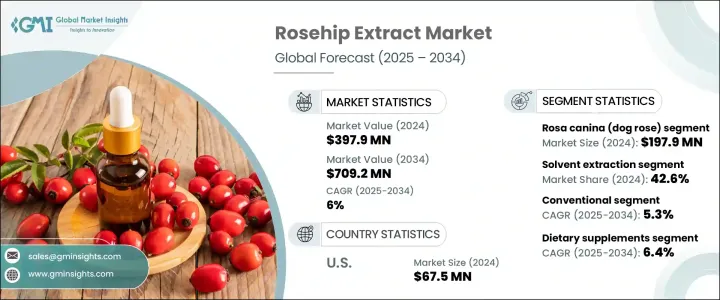
The Global Rosehip Extract Market was valued at USD 397.9 million in 2024 and is estimated to grow at a CAGR of 6% to reach USD 709.2 million by 2034, driven by the growing consumer preference for clean-label, plant-based, and naturally derived ingredients. Rosehip extract, sourced from the fruit of wild rose plants, is rich in essential nutrients including vitamin C, polyphenols, carotenoids, and fatty acids. Its broad functionality has made it popular in various industries such as food and beverages, pharmaceuticals, cosmetics, and dietary supplements. With rising global interest in wellness and preventive health, rosehip extract's natural antioxidant and anti-inflammatory properties are becoming increasingly sought after by both manufacturers and consumers.
Its widespread use in the nutraceutical sector is driven by consumers seeking immunity support and joint health relief, especially those with chronic conditions. Additionally, its appeal in cosmetics continues to rise due to its skin-enhancing benefits that align with the global demand for natural beauty products. Rosehip extract is frequently infused into creams, oils, and serums that cater to anti-aging and brightening needs. Food and beverage producers incorporate the extract into teas, snacks, and functional drinks, drawn to its tangy flavor and high nutrient value. Companies in this space use sustainable and organic sourcing methods to strengthen consumer trust.
| Market Scope | |
|---|---|
| Start Year | 2024 |
| Forecast Year | 2025-2034 |
| Start Value | $397.9 Million |
| Forecast Value | $709.2 Million |
| CAGR | 6% |
Rosa canina remains the dominant species in the market, with an estimated value of USD 197.9 million in 2024. Its potent antioxidant and vitamin-rich profile makes it ideal for health supplements and cosmetic formulations. The extract's anti-inflammatory effects further boost its usage in products targeting pain relief and joint care. Rosa canina's commercial appeal is amplified by its widespread availability and compliance with global safety regulations, making it a preferred choice for manufacturers.
Rosa rugosa segment generated USD 73.4 million in 2024 due to its ability to flourish in nutrient-poor and high-salinity soils, making it an attractive crop for sustainable cultivation, especially in regions with challenging agricultural conditions. This unique adaptability is increasingly recognized by producers aiming to reduce environmental impact while maintaining a reliable supply chain. The extract from Rosa rugosa is especially valued for its high concentration of phenolic compounds, essential fatty acids, and vitamins A and C, critical for maintaining skin health and combating oxidative stress.
United States Rosehip Extract Market generated USD 67.5 million in 2024. Consumer interest in botanical-based skincare and health-enhancing supplements continues to drive the market in the region. Rosehip extract's high concentration of vitamin C and antioxidants makes it particularly popular for addressing skin health and immunity needs, positioning it as a top ingredient in wellness and beauty categories.
Key players shaping the competitive landscape include Dohler GmbH, Bio-Botanica Inc., Martin Bauer Group, Sabinsa Corporation, and Frutarom (IFF). These companies are adopting several strategies to reinforce their market presence. Leading firms invest in clean extraction methods to retain bioactivity while appealing to environmentally conscious consumers. Many are pursuing organic certifications and eco-friendly labeling to meet evolving consumer preferences. Some are forming partnerships with local growers to ensure traceable and sustainable sourcing, while others are expanding into emerging markets with tailored product formulations. Innovation in application areas-especially in beauty and wellness remains a core focus for product differentiation and long-term growth.
Table of Contents
Chapter 1 Methodology and Scope
- 1.1 Market scope and definition
- 1.2 Base estimates and calculations
- 1.3 Forecast calculation
- 1.4 Data sources
- 1.4.1 Primary
- 1.4.2 Secondary
- 1.4.2.1 Paid sources
- 1.4.2.2 Public sources
- 1.5 Primary research and validation
- 1.5.1 Primary sources
- 1.5.2 Data mining sources
Chapter 2 Executive Summary
- 2.1 Market snapshot
- 2.2 Global market overview
- 2.3 Key industry highlights
- 2.4 Regional insights
- 2.5 Investment scenario
- 2.6 Competitive landscape overview
- 2.7 Future market outlook
Chapter 3 Industry Insights
- 3.1 Market introduction
- 3.2 Industry value chain analysis
- 3.2.1 Raw material sourcing and procurement
- 3.2.2 Processing and manufacturing
- 3.2.3 Packaging and distribution
- 3.2.4 Retail and consumer access
- 3.3 Technology landscape
- 3.3.1 Processing technologies
- 3.3.2 Preservation methods
- 3.3.3 Packaging innovations
- 3.3.4 Emerging technologies
- 3.4 Market dynamics
- 3.4.1 Market drivers
- 3.4.1.1 Rising demand for natural and plant-based supplements in functional foods and nutraceuticals
- 3.4.1.2 Growing consumer awareness about the antioxidant and anti-inflammatory benefits of rosehip extract.
- 3.4.1.3 Expanding clean-label and organic personal care product trends fueling cosmetic applications.
- 3.4.2 Market restraints
- 3.4.2.1 Seasonal availability and inconsistent quality of raw rosehip supply.
- 3.4.2.2 High production costs associated with organic and sustainable farming practices.
- 3.4.2.3 Limited consumer awareness in emerging markets compared to synthetic alternatives.
- 3.4.3 Market opportunities
- 3.4.3.1 Rising demand for natural and organic skincare products
- 3.4.3.2 Growing popularity of rosehip extract in dietary supplements
- 3.4.3.3 Expanding use of rosehip extract in functional beverages
- 3.4.1 Market drivers
- 3.5 Pestle analysis
- 3.6 Porter's five forces analysis
- 3.7 Regulatory framework and standards
- 3.7.1 Global regulations
- 3.7.2 Regional regulatory landscape
- 3.7.3 Health claim regulations
- 3.7.4 Labeling requirements
- 3.7.5 Impact of regulations on market growth
- 3.8 Covid-19 impact analysis
- 3.9 Consumer behavior analysis
- 3.9.1 Consumer demographics
- 3.9.2 Purchase patterns
- 3.9.3 Preference factors
- 3.9.4 Health perception and awareness
- 3.10 Sustainability and environmental aspects
- 3.10.1 Sustainable sourcing practices
- 3.10.2 Eco-friendly packaging initiatives
- 3.10.3 Waste reduction strategies
- 3.10.4 Carbon footprint considerations
- 3.11 Trump administration tariff analysis
- 3.11.1 Impact on trade
- 3.11.1.1 Trade volume disruptions
- 3.11.1.2 Retaliatory measures
- 3.11.2 Impact on the industry
- 3.11.2.1 Supply-side impact (raw materials)
- 3.11.2.1.1 Price volatility in key materials
- 3.11.2.1.2 Supply chain restructuring
- 3.11.2.1.3 Production cost implications
- 3.11.2.2 Demand-side impact (selling price)
- 3.11.2.2.1 Price transmission to end markets
- 3.11.2.2.2 Market share dynamics
- 3.11.2.2.3 Consumer response patterns
- 3.11.2.3 Key companies impacted
- 3.11.2.4 Strategic industry responses
- 3.11.2.5 Supply chain reconfiguration
- 3.11.2.6 Pricing and product strategies
- 3.11.2.7 Policy engagement
- 3.11.2.8 Trade Statistics (HS Code) Note: the above trade statistics will be provided for key countries only.
- 3.11.2.8.1 Major Exporting Countries, 2021-2024 (USD Bn)
- 3.11.2.8.1.1 U.S.
- 3.11.2.8.1.2 Japan
- 3.11.2.8.1.3 South Korea
- 3.11.2.8.2 Major Importing Countries, 2021-2024 (USD Bn)
- 3.11.2.8.2.1 India
- 3.11.2.8.2.2 Russia
- 3.11.2.8.2.3 U.S.
- 3.11.2.8.1 Major Exporting Countries, 2021-2024 (USD Bn)
- 3.11.2.1 Supply-side impact (raw materials)
- 3.11.1 Impact on trade
Chapter 4 Competitive Landscape, 2024
- 4.1 Introduction
- 4.2 Market share analysis
- 4.3 Key strategies adopted by major players
- 4.3.1 Mergers and acquisitions
- 4.3.2 Partnerships and collaborations
- 4.3.3 Product launches and innovations
- 4.3.4 Expansion initiatives
- 4.4 Competitive benchmarking
- 4.5 Strategic positioning matrix
- 4.6 Competitive dashboard
- 4.7 Emerging players analysis
- 4.8 Investment analysis and funding scenario
Chapter 5 Market Estimates and Forecast, By Source, 2021 - 2034 (USD Million) (Kilo Tons)
- 5.1 Key trends
- 5.2 Rosa canina (dog rose)
- 5.3 Rosa rugosa (rugosa rose)
- 5.4 Rosa moschata (musk rose)
- 5.5 Rosa damascena (damask rose)
- 5.6 Other rosa species
Chapter 6 Market Estimates and Forecast, By Extraction Method 2021 - 2034 (USD Million) (Kilo Tons)
- 6.1 Key trends
- 6.2 Solvent extraction
- 6.2.1 Alcohol extraction
- 6.2.2 Hydroalcoholic extraction
- 6.2.3 Other solvent extraction methods
- 6.3 Cold pressing
- 6.4 Supercritical co2 extraction
- 6.5 Water extraction
- 6.6 Other extraction methods
Chapter 7 Market Estimates and Forecast, By Form, 2021 - 2034 (USD Million) (Kilo Tons)
- 7.1 Key trends
- 7.2 Conventional
- 7.3 Organic
- 7.4 Wild-harvested
Chapter 8 Market Estimates and Forecast, By Application, 2021 - 2034 (USD Million) (Kilo Tons)
- 8.1 Key trends
- 8.2 Dietary supplements
- 8.2.1 Capsules & tablets
- 8.2.2 Powders
- 8.2.3 Liquid supplements
- 8.2.4 Other supplement forms
- 8.3 Food & beverages
- 8.3.1 Functional foods
- 8.3.2 Beverages
- 8.3.3 Tea & infusions
- 8.3.4 Jams & preserves
- 8.3.5 Other food applications
- 8.4 Cosmetics & personal care
- 8.4.1 Skincare
- 8.4.2 Haircare
- 8.4.3 Other cosmetic applications
- 8.5 Pharmaceuticals
- 8.5.1 Topical preparations
- 8.5.2 Oral preparations
- 8.5.3 Other pharmaceutical applications
- 8.6 Animal feed
- 8.7 Other applications
Chapter 9 Market Estimates and Forecast, By Distribution Channel, 2021 - 2034 (USD Million) (Kilo Tons)
- 9.1 Key trends
- 9.2 B2B/direct sales
- 9.2.1 Manufacturers
- 9.2.2 Formulators
- 9.2.3 Contract manufacturers
- 9.3 Specialty stores
- 9.3.1 Health food stores
- 9.3.2 Pharmacies & drug stores
- 9.3.3 Supermarkets & hypermarkets
- 9.3.4 Online retail
- 9.3.5 Other retail channels
- 9.4 Other distribution channels
Chapter 10 Market Estimates and Forecast, By Region, 2021 - 2034 (USD Million) (Kilo Tons)
- 10.1 Key trends
- 10.2 North America
- 10.2.1 U.S.
- 10.2.2 Canada
- 10.3 Europe
- 10.3.1 Germany
- 10.3.2 UK
- 10.3.3 France
- 10.3.4 Spain
- 10.3.5 Italy
- 10.3.6 Russia
- 10.4 Asia Pacific
- 10.4.1 China
- 10.4.2 India
- 10.4.3 Japan
- 10.4.4 Australia
- 10.4.5 South Korea
- 10.5 Latin America
- 10.5.1 Brazil
- 10.5.2 Mexico
- 10.5.3 Argentina
- 10.6 Middle East and Africa
- 10.6.1 Saudi Arabia
- 10.6.2 South Africa
- 10.6.3 UAE
Chapter 11 Company Profiles
- 11.1 A. Vogel AG
- 11.2 Afriplex (Pty) Ltd.
- 11.3 Alchem International Pvt. Ltd.
- 11.4 Arjuna Natural Pvt. Ltd.
- 11.5 Bio-Botanica Inc.
- 11.6 Bioriginal Food & Science Corp.
- 11.7 Carrubba Inc.
- 11.8 Changsha Staherb Natural Ingredients Co., Ltd.
- 11.9 Dohler GmbH
- 11.10 Frutarom Industries Ltd. (IFF)
- 11.11 Hangzhou Greensky Biological Tech Co., Ltd.
- 11.12 Herbal Creations
- 11.13 Hunan Nutramax Inc.
- 11.14 Indena S.p.A.
- 11.15 Kosmea Pty Ltd.
- 11.16 Lehvoss Nutrition
- 11.17 Martin Bauer Group
- 11.18 Naturalin Bio-Resources Co., Ltd.
- 11.19 Naturex S.A. (Givaudan)
- 11.20 Nutra Green Biotechnology Co., Ltd.
- 11.21 Organic Herb Inc.
- 11.22 Panacea Phytoextracts Pvt. Ltd.
- 11.23 Rosehip Vital Pty Ltd.
- 11.24 Sabinsa Corporation
- 11.25 Shaanxi Jintai Biological Engineering Co., Ltd.
- 11.26 Synthite Industries Ltd.
- 11.27 Trilogy Natural Products
- 11.28 Vantage Specialty Ingredients
- 11.29 Vidya Herbs Pvt. Ltd.
- 11.30 Xi'an B-Thriving I/E Co., Ltd.