


|
시장보고서
상품코드
1755204
이륜차 물류 시장 : 기회, 성장 촉진 요인, 산업 동향 분석, 예측(2025-2034년)Two-Wheeler in Logistics Market Opportunity, Growth Drivers, Industry Trend Analysis, and Forecast 2025 - 2034 |
||||||

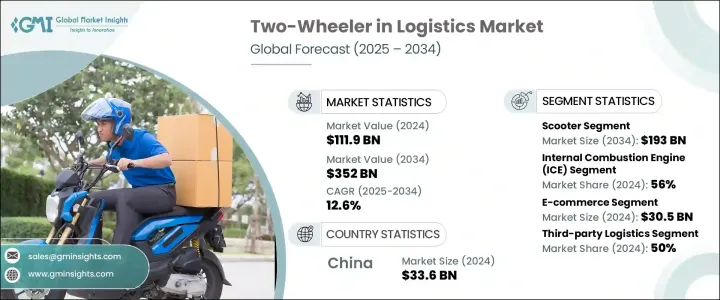
세계 이륜차 물류 시장은 2024년에 1,119억 달러로 평가되었으며, 전자상거래의 급증과 효율적인 라스트원 마일 딜리버리 솔루션에 대한 수요 증가로 CAGR 12.6%로 성장하여 2034년에는 3,520억 달러에 이를 것으로 추정되고 있습니다.
오토바이, 스쿠터, 전동 자전거 등의 이륜차는 저렴한 가격, 조종성, 혼잡한 시가지를 이동하는 능력으로 도시 물류에서 빠르게 인기를 끌고 있습니다. 신속하고 비용 효율적인 배송에 대한 수요는 이산화탄소 배출량을 줄이기 위해 이륜차, 특히 전동 모델의 사용을 장려하는 세계 각국의 정부 이니셔티브에 의해 지원됩니다. 이러한 요인으로 인해 이륜차는 특히 교통 정체로 인해 기존 배송 차량이 크게 지연될 수 있는 대도시 지역에서 빠르고 신뢰할 수 있는 배송에 대한 기대치를 높일 수 있는 중요한 요소가 되었습니다.
이에 따라 이 업계에서는 비용을 절감하고 환경에 미치는 영향을 최소화하면서 배달 속도를 향상시키도록 설계된 보다 지속 가능하고 효율적인 운송 솔루션으로의 전환이 현저해지고 있습니다. 뿐만 아니라 전기자동차(EV), 드론, 고급 루트 최적화 소프트웨어 등 친환경적이고 혁신적인 대안에 주목을 받고 있습니다.
| 시장 범위 | |
|---|---|
| 시작 연도 | 2024년 |
| 예측 연도 | 2025-2034년 |
| 시작 금액 | 1,119억 달러 |
| 예측 금액 | 3,520억 달러 |
| CAGR | 12.6% |
스쿠터 분야가 가장 큰 시장 점유율을 차지하고 2024년에는 43%를 차지하고 2034년에는 1,930억 달러 시장 규모에 이를 것으로 예측됩니다. 스쿠터는 비용 효율성, 사용 편의성, 교통 체증을 극복할 수 있는 능력으로 매우 선호되기 때문에 혼잡한 도심 지역에서 단거리 배송에 이상적입니다.
내연기관(ICE) 부문은 2024년 시점에서도 56%의 점유율로 시장을 선도하고 있으며, 2034년까지의 CAGR은 9.3%를 나타낼 전망입니다. 초기 비용이 낮기 때문에 여전히 인기가 높습니다. 전기자동차는 특히 라스트 원 마일의 배송으로 인기를 끌고 있지만, 특히 e-모빌리티가 아직 개발 도상의 지역에서는 충전 인프라가 한정되어 있다는 과제에 직면하고 있습니다.
중국의 물류에 있어서의 이륜차 2024년 시장 점유율은 23%로 압도적이었습니다. 친환경 에너지 차량과 지속 가능한 도시 이동성을 촉진하는 정부 프로그램이 이러한 추세를 더욱 가속화하고 있습니다. 보다 깨끗하고 효율적인 운송 솔루션의 추진은 도시와 농촌 지역에서 신속하고 신뢰할 수있는 물류 서비스에 대한 요구가 증가하고 있습니다.
세계 물류에서 이륜차 시장의 주요 기업으로는 Flipkart, Meituan, Yulu, La Poste, DoorDash 등이 있어, 모두 도시형 배송 서비스의 미래를 형성하는데 있어 매우 중요한 역할을 하고 있습니다. 도입 확대에 주력하고 있습니다. 각 사는 지방 정부와 전략적 파트너십을 맺고, 인센티브를 이용하고, 운영 코스트를 삭감하고 있습니다. 또한 기업은 물류 인프라를 최적화해, 차량 관리 능력을 강화해, 신 시장에의 지리적 범위를 확장하고 있습니다.
목차
제1장 조사 방법과 범위
제2장 주요 요약
제3장 업계 인사이트
- 생태계 분석
- 공급자의 상황
- 자동차 제조업체
- 물류 기술 공급자
- 인프라 제공업체
- 제3자물류
- 공유 모빌리티 플랫폼
- 최종 용도
- 이익률 분석
- 공급자의 상황
- 트럼프 정권에 의한 관세에 대한 영향
- 무역에 미치는 영향
- 무역량의 혼란
- 보복 조치
- 업계에 미치는 영향
- 공급측의 영향(원재료)
- 주요 원재료의 가격 변동
- 공급망 재구성
- 생산 비용에 미치는 영향
- 수요측의 영향(판매가격)
- 최종 시장에의 가격 전달
- 시장 점유율 동향
- 소비자의 반응 패턴
- 공급측의 영향(원재료)
- 전략적인 업계 대응
- 공급망 재구성
- 무역에 미치는 영향
- 가격 설정 및 제품 전략
- 기술과 혁신의 상황
- 자율 기능과 스마트 커넥티비티
- ADAS(선진 운전 지원 시스템)(ADAS)
- 회생 브레이크 기술
- 고급 제어 시스템과 안전 메커니즘
- 특허 분석
- 총소유비용(TCO) 분석
- 취득 비용
- 인프라 비용
- 운영 비용
- 유지보수 비용
- 수명과 폐기 비용
- 규제 상황
- 배출기준과 환경규제
- 정부의 대처와 보조금
- 도시교통정책
- 안전기준과 컴플라이언스
- 이용 사례
- 주요 뉴스와 대처
- 영향요인
- 성장 촉진요인
- 전기자동차 기술의 진보
- 텔레매틱스와 IoT 솔루션의 통합
- 개량된 경량 소재
- 강화된 안전성과 자동화 기능
- 업계의 잠재적 위험 및 과제
- 배터리 제한 및 항속 거리에 대한 우려
- 유지보수 및 내구성 문제
- 성장 촉진요인
- 성장 가능성 분석
- Porter's Five Forces 분석
- PESTEL 분석
- 지속가능성 분석
제4장 경쟁 구도
- 소개
- 기업의 시장 점유율 분석
- 경쟁 포지셔닝 매트릭스
- 전략적 전망 매트릭스
제5장 시장 추정 및 예측 : 차량별, 2021년-2034년
- 주요 동향
- 오토바이
- 원부
- 모펫
제6장 시장 추정 및 예측 : 추진력별, 2021년-2034년
- 주요 동향
- 내연기관(ICE)
- 최대 100CC
- 100-200CC
- 200CC 이상
- 전기자동차(EV)
- 최대 5kWh
- 5-10kWh
- 10kWh 이상
- 하이브리드 자동차
제7장 시장 추정 및 예측 : 서비스별, 2021년-2034년
- 주요 동향
- 택배우편 및 소포 서비스
- 전자상거래 물류
- 마지막 마일 배송
- 반품 관리
- 온디맨드 배송
- 식품배달서비스
- 소비자용 딜리버리 레스토랑
- 클라우드 키친 배달
- 식사 키트 배달 서비스
- 식료품 배달
- 온디맨드 식료품 배달
- 식료품의 정기 배달
- 대량의 식료품의 배달
- 의약품 배송
- 처방약 배달
- 시판약(OTC)의 배달
- 의료기기 및 의료용품의 배송
- 기타
제8장 시장추정 및 예측 : 소유권별, 2021년-2034년
- 주요 동향
- 제3자물류
- 사내 물류
- 공유 모빌리티 플랫폼
제9장 시장 추정 및 예측 : 지역별, 2021년-2034년
- 북미
- 미국
- 캐나다
- 유럽
- 영국
- 독일
- 프랑스
- 이탈리아
- 스페인
- 우크라이나
- 러시아
- 아시아태평양
- 중국
- 인도
- 일본
- 호주
- 한국
- 동남아시아
- 라틴아메리카
- 브라질
- 멕시코
- 아르헨티나
- 칠레
- 중동 및 아프리카
- 남아프리카
- 사우디아라비아
- 아랍에미리트(UAE)
제10장 기업 프로파일
- Alibaba
- Allcargo Logistics
- Amazon
- Aramex
- Borzo
- Correos
- Deliveroo
- DHL
- DoorDash
- Getir
- J&T Express
- Kerry Logistics
- La Poste
- Meituan
- Poste Italiane
- PostNL
- Swiggy
- Uber Eats
- Walmart
- Yulu
The Global Two-Wheeler in Logistics Market was valued at USD 111.9 billion in 2024 and is estimated to grow at a CAGR of 12.6% to reach USD 352 billion by 2034, driven by the surge in e-commerce and the increasing demand for efficient last-mile delivery solutions. Two-wheeled vehicles, such as motorcycles, scooters, and electric bikes, are rapidly gaining popularity in urban logistics due to their affordability, maneuverability, and ability to navigate crowded city streets. The demand for quick, cost-effective delivery is also supported by government initiatives worldwide, which are encouraging the use of two-wheelers, particularly electric models, to reduce carbon emissions. These factors have made two-wheelers a crucial component in meeting the growing expectations for fast, reliable deliveries, particularly in metropolitan areas where traffic congestion can significantly delay traditional delivery vehicles.
In response, the sector is experiencing a notable shift toward more sustainable and efficient transportation solutions designed to improve delivery speed while reducing costs and minimizing environmental impact. As businesses face increasing pressure to meet customer demands for faster deliveries, especially in e-commerce, they are turning to innovative, eco-friendly alternatives such as electric vehicles (EVs), drones, and advanced route optimization software. These solutions cut down on fuel consumption and greenhouse gas emissions, contributing to long-term cost savings by reducing operational expenses, including fuel and maintenance costs.
| Market Scope | |
|---|---|
| Start Year | 2024 |
| Forecast Year | 2025-2034 |
| Start Value | $111.9 Billion |
| Forecast Value | $352 Billion |
| CAGR | 12.6% |
The scooter segment holds the largest market share, accounting for 43% in 2024, and is expected to generate USD 193 billion by 2034. Scooters are highly favored for their cost-efficiency, ease of use, and ability to maneuver through traffic, making them ideal for short-distance deliveries in congested urban areas. With low maintenance cost and high fuel efficiency, scooters dominate logistics in emerging markets, especially in regions where government incentives support fuel-efficient solutions.
The Internal Combustion Engine (ICE) segment still leads the market with a 56% share in 2024 and is forecast to grow at a CAGR of 9.3% through 2034. Despite the rise in electric two-wheelers, ICE vehicles remain popular due to their established infrastructure and lower initial costs. While electric vehicles are gaining traction, particularly for last-mile delivery, they face challenges related to limited charging infrastructure, especially in regions where e-mobility is still developing.
China Two-Wheeler in Logistics Market held a dominant share of 23% in 2024. The rapid growth of e-commerce giants has spurred significant demand for two-wheeled vehicles in key cities, such as Beijing and Shanghai. Government programs that promote green energy vehicles and sustainable urban mobility are further accelerating this trend. The ongoing push for cleaner, more efficient transportation solutions align with the growing need for fast, reliable logistics services in urban and rural areas.
Some of the leading players in the Global Two-Wheeler in Logistics Market include companies like Flipkart, Meituan, Yulu, La Poste, and DoorDash, who are all playing pivotal roles in shaping the future of urban delivery services. To strengthen their position in the two-wheeler logistics market, companies are focusing on increasing the adoption of electric and fuel-efficient two-wheelers to meet the demand for sustainable urban mobility. They are forming strategic partnerships with local governments to access incentives and reduce operational costs. Additionally, companies are optimizing their logistics infrastructure, enhancing fleet management capabilities, and expanding their geographic reach to new markets.
Table of Contents
Chapter 1 Methodology & Scope
- 1.1 Research design
- 1.1.1 Research approach
- 1.1.2 Data collection methods
- 1.2 Base estimates & calculations
- 1.2.1 Base year calculation
- 1.2.2 Key trends for market estimation
- 1.3 Forecast model
- 1.4 Primary research and validation
- 1.4.1 Primary sources
- 1.4.2 Data mining sources
- 1.5 Market scope & definition
Chapter 2 Executive Summary
- 2.1 Industry synopsis, 2021 - 2034
Chapter 3 Industry Insights
- 3.1 Industry ecosystem analysis
- 3.1.1 Supplier landscape
- 3.1.1.1 Vehicle Manufacturers
- 3.1.1.2 Logistics Technology Providers
- 3.1.1.3 Infrastructure providers
- 3.1.1.4 Third-party logistics
- 3.1.1.5 Shared mobility platforms
- 3.1.1.6 End use
- 3.1.2 Profit margin analysis
- 3.1.1 Supplier landscape
- 3.2 Impact of Trump administration tariffs
- 3.2.1 Impact on trade
- 3.2.1.1 Trade volume disruptions
- 3.2.1.2 Retaliatory measures
- 3.2.2 Impact on industry
- 3.2.2.1 Supply-side impact (raw materials)
- 3.2.2.1.1 Price volatility in key materials
- 3.2.2.1.2 Supply chain restructuring
- 3.2.2.1.3 Production cost implications
- 3.2.2.2 Demand-side impact (selling price)
- 3.2.2.2.1 Price transmission to end markets
- 3.2.2.2.2 Market share dynamics
- 3.2.2.2.3 Consumer response patterns
- 3.2.2.1 Supply-side impact (raw materials)
- 3.2.3 Strategic industry responses
- 3.2.3.1 Supply chain reconfiguration
- 3.2.1 Impact on trade
- 3.3 Pricing and product strategies
- 3.4 Technology & innovation landscape
- 3.4.1 Autonomous features and smart connectivity
- 3.4.2 Advanced driver assistance systems (ADAS)
- 3.4.3 Regenerative braking technologies
- 3.4.4 Advanced control systems and safety mechanisms
- 3.5 Patent analysis
- 3.6 Total Cost of Ownership (TCO) analysis
- 3.6.1 Acquisition Cost
- 3.6.2 Infrastructure Costs
- 3.6.3 Operational Costs
- 3.6.4 Maintenance Costs
- 3.6.5 End-of-Life and Disposal Costs
- 3.7 Regulatory landscape
- 3.7.1 Emission Standards and Environmental Regulations
- 3.7.2 Government Initiatives and Subsidies
- 3.7.3 Urban Transport Policies
- 3.7.4 Safety Standards and Compliance
- 3.8 Use cases
- 3.9 Key news & initiatives
- 3.10 Impact on forces
- 3.10.1 Growth drivers
- 3.10.1.1 Advancements in electric vehicle technology
- 3.10.1.2 Integration of telematics and IoT solutions
- 3.10.1.3 Improved lightweight materials
- 3.10.1.4 Enhanced safety and automation features
- 3.10.2 Industry pitfalls & challenges
- 3.10.2.1 Battery limitations and range concerns
- 3.10.2.2 Maintenance and durability issue
- 3.10.1 Growth drivers
- 3.11 Growth potential analysis
- 3.12 Porter's analysis
- 3.13 PESTEL analysis
- 3.14 Sustainability analysis
Chapter 4 Competitive Landscape, 2024
- 4.1 Introduction
- 4.2 Company market share analysis
- 4.3 Competitive positioning matrix
- 4.4 Strategic outlook matrix
Chapter 5 Market Estimates & Forecast, By Vehicle, 2021 - 2034 ($Bn)
- 5.1 Key trends
- 5.2 Motorcycles
- 5.3 Scooters
- 5.4 Moped
Chapter 6 Market Estimates & Forecast, By Propulsion, 2021 - 2034 ($Bn)
- 6.1 Key trends
- 6.2 Internal Combustion Engine (ICE)
- 6.2.1 Up to 100 CC
- 6.2.2 100-200 CC
- 6.2.3 Above 200 CC
- 6.3 Electric Vehicles (EV)
- 6.3.1 Up to 5 kWh
- 6.3.2 5-10 kWh
- 6.3.3 Above 10 kWh
- 6.4 Hybrid Vehicles
Chapter 7 Market Estimates & Forecast, By Service, 2021 - 2034 ($Bn)
- 7.1 Key trends
- 7.2 Courier & parcel services
- 7.3 E-commerce logistics
- 7.3.1 Last-mile delivery
- 7.3.2 Return management
- 7.3.3 On-demand delivery
- 7.4 Food delivery services
- 7.4.1 Restaurant for consumer delivery
- 7.4.2 Cloud kitchen deliveries
- 7.4.3 Meal kit delivery services
- 7.5 Grocery delivery
- 7.5.1 On-demand grocery delivery
- 7.5.2 Scheduled grocery delivery
- 7.5.3 Bulk grocery delivery
- 7.6 Pharmaceutical delivery
- 7.6.1 Prescription medicines delivery
- 7.6.2 Over the counter (OTC) medicine delivery
- 7.6.3 Medical equipment & supplies delivery
- 7.7 Others
Chapter 8 Market Estimates & Forecast, By Ownership, 2021 - 2034 ($Bn)
- 8.1 Key trends
- 8.2 Third-party logistics
- 8.3 In-house logistics
- 8.4 Shared mobility platforms
Chapter 9 Market Estimates & Forecast, By Region, 2021 - 2034 ($Bn)
- 9.1 North America
- 9.1.1 U.S.
- 9.1.2 Canada
- 9.2 Europe
- 9.2.1 UK
- 9.2.2 Germany
- 9.2.3 France
- 9.2.4 Italy
- 9.2.5 Spain
- 9.2.6 Ukraine
- 9.2.7 Russia
- 9.3 Asia Pacific
- 9.3.1 China
- 9.3.2 India
- 9.3.3 Japan
- 9.3.4 Australia
- 9.3.5 South Korea
- 9.3.6 Southeast Asia
- 9.4 Latin America
- 9.4.1 Brazil
- 9.4.2 Mexico
- 9.4.3 Argentina
- 9.4.4 Chile
- 9.5 MEA
- 9.5.1 South Africa
- 9.5.2 Saudi Arabia
- 9.5.3 UAE
Chapter 10 Company Profiles
- 10.1 Alibaba
- 10.2 Allcargo Logistics
- 10.3 Amazon
- 10.4 Aramex
- 10.5 Borzo
- 10.6 Correos
- 10.7 Deliveroo
- 10.8 DHL
- 10.9 DoorDash
- 10.10 Getir
- 10.11 J&T Express
- 10.12 Kerry Logistics
- 10.13 La Poste
- 10.14 Meituan
- 10.15 Poste Italiane
- 10.16 PostNL
- 10.17 Swiggy
- 10.18 Uber Eats
- 10.19 Walmart
- 10.20 Yulu


