|
시장보고서
상품코드
1766172
3D 편직기 시장 기회, 성장 촉진요인, 산업 동향 분석, 예측(2025-2034년)3D Knitting Machines Market Opportunity, Growth Drivers, Industry Trend Analysis, and Forecast 2025 - 2034 |
||||||

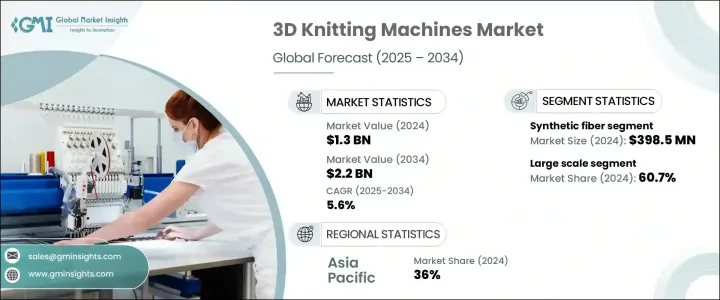
세계의 3D 편직기 시장은 2024년에는 13억 달러로 평가되었고, 2034년에는 22억 달러에 이르며, CAGR은 5.6%를 나타낼 것으로 전망됩니다.
이 성장은 자동화의 상승, 지속 가능한 생산 방법으로의 이동, 개인화된 온디맨드 패션에 대한 소비자의 관심 증가에 크게 기여하고 있습니다. 패션, 스포츠웨어, 의료용 텍스타일, 자동차 인테리어 등의 산업에서 급증하고 있습니다.
아시아태평양과 유럽은 최첨단 기술 도입과 대규모 산업 투자로 주도하고 있는 반면, 북미는 섬유 제조의 환경 친화적인 혁신에 대한 노력을 꾸준히 진행하고 있습니다. 이 지역에서는 탄소 실적 감소, 폐기물 최소화, 전체 생산 공정에서 재생가능 소재의 사용 등 지속 가능한 실천을 우선하는 경향이 커지고 있습니다. 북미 제조업체는 보다 엄격한 환경 규제와 지속 가능한 제품에 대한 소비자 수요 증가에 대응하기 위해 그린 테크놀러지과 보다 깨끗한 에너지원을 도입하고 있습니다. 이 변화는 환경에 대한 책임을 높일 뿐만 아니라 새로운 시장 기회를 개척하고 북미를 보다 지속 가능하고 윤리적인 섬유 생산을 목표로 하는 세계의 움직임의 중요한 지역으로 자리매김하고 있습니다.
| 시장 범위 | |
|---|---|
| 시작 연도 | 2024년 |
| 예측 연도 | 2025-2034년 |
| 시작 금액 | 13억 달러 |
| 예측 금액 | 22억 달러 |
| CAGR | 5.6% |
2024년 합성섬유 부문은 3억 9,850만 달러를 창출했습니다. 폴리에스테르, 나일론 및 아크릴을 포함한 이러한 섬유는 높은 내구성과 내마모성을 갖추고 있으며 스포츠웨어, 아우터웨어 및 성능 의류에 사용하기에 이상적입니다. 합성 소재는 면과 모직과 같은 천연 소재보다 비용 효율적이며 대량 생산에 적합합니다. 흡습 발산성, 신축성, 속건성 등의 특성은 액티브웨어 산업에서 높은 평가를 받고 있으며, 섬유 용도 전체에 걸쳐 지속적인 수요를 견인하고 있습니다.
대규모 생산 부문은 비용을 최소화하면서 대량 생산을 지원하는 능력으로 2024년에는 60.7%의 점유율을 차지했습니다. 우타 제조업체의 능력에 의해 세계 브랜드나 산업계의 고객으로부터의 대량 주문을 효율적으로 해낼 수 있습니다.
아시아태평양의 3D 편직기 시장은 36%의 점유율을 차지했으며, 2024년에는 4억 7,540만 달러를 창출했습니다. 베트남, 일본, 한국을 포함한 국가들은 스마트 제조의 추진에 크게 관여하고 있으며, AI나 로봇 공학과 같은 기술을 섬유 부문에 통합하고 있습니다.
3D 편직기 시장 주요 기업은 Brother Industries, Shima Seiki, Karl Mayer, Stoll, Santoni, Steiger, Groz-Beckert, Zhejiang Tongtai Intelligent Technology Co Ltd, Tongxiang Qianglong Machinery Co Ltd, Jiangsu Gomor Textile Technolog Ltd 등이 있습니다. 시장 포지션을 강화하기 위해 3D 편직기 업계의 선도 기업은 몇 가지 주요 전략에 주력하고 있습니다. 각 회사는 또한 고객이 3D 니팅 시스템을 보다 효율적으로 도입할 수 있도록 맞춤형 솔루션과 교육 프로그램을 제공합니다.
목차
제1장 조사 방법과 범위
제2장 주요 요약
제3장 업계 인사이트
- 생태계 분석
- 공급자의 상황
- 이익률
- 각 단계에서의 부가가치
- 밸류체인에 영향을 주는 요인
- 업계에 미치는 영향요인
- 성장 촉진요인
- 패션과 스포츠웨어 수요 증가
- 지속 가능한 제조 방법의 채용
- 자동화의 진보
- 업계의 잠재적 위험 및 과제
- 높은 초기 투자 비용
- 숙련노동력의 필요성
- 기회
- 공급망 최적화
- 성장 촉진요인
- 성장 가능성 분석
- 향후 시장 동향
- 기술과 혁신의 상황
- 현재의 기술 동향
- 신흥기술
- 가격 동향
- 지역별
- 소재별
- 규제 상황
- 표준 및 규정 준수 요건
- 지역 규제 틀
- 인증기준
- Porter's Five Forces 분석
- PESTEL 분석
제4장 경쟁 구도
- 서론
- 기업의 시장 점유율 분석
- 지역별
- 북미
- 유럽
- 아시아태평양
- 지역별
- 기업 매트릭스 분석
- 주요 시장 기업의 경쟁 분석
- 경쟁 포지셔닝 매트릭스
- 주요 발전
- 합병과 인수
- 파트너십 및 협업
- 신제품 발매
- 확장 계획
제5장 시장 추정·예측 : 재료별(2021-2034년)
- 주요 동향
- 합성 섬유
- 면
- 울
- 엘라스토머
- 기타
제6장 시장 추정·예측 : 생산 능력별(2021-2034년)
- 주요 동향
- 소규모 및 중규모
- 대규모
제7장 시장 추정·예측 : 용도별(2021-2034년)
- 주요 동향
- 의류 및 패션
- 의료용 섬유
- 자동차
- 스포츠 및 아웃도어 장비
- 산업용 섬유
- 신발
- 기타
제8장 시장 추정·예측 : 유통 채널별(2021-2034년)
- 주요 동향
- 직접 판매
- 간접 판매
제9장 시장 추정·예측 : 지역별(2021-2034년)
- 주요 동향
- 북미
- 미국
- 캐나다
- 유럽
- 독일
- 영국
- 프랑스
- 스페인
- 이탈리아
- 아시아태평양
- 중국
- 일본
- 인도
- 호주
- 한국
- 라틴아메리카
- 브라질
- 멕시코
- 아르헨티나
- 중동 및 아프리카
- 남아프리카
- 사우디아라비아
- 아랍에미리트(UAE)
제10장 기업 프로파일
- Brother Industries
- Groz-Beckert
- Jiangsu Gomor Textile Technology Co Ltd
- Karl Mayer
- Santoni
- Shima Seiki
- Steiger
- Stoll
- Tongxiang Qianglong Machinery Co Ltd
- Zhejiang Tongtai Intelligent Technology Co Ltd
The Global 3D Knitting Machines Market was valued at USD 1.3 billion in 2024 and is estimated to grow at a CAGR of 5.6% to reach USD 2.2 billion by 2034. This growth is largely attributed to the rise of automation, the shift toward sustainable production methods, and increasing consumer interest in personalized and on-demand fashion. These machines produce entire garments directly from yarn using computer programming, significantly minimizing waste, material usage, and production steps. Their application has surged across industries such as fashion, sportswear, medical textiles, and automotive interiors. On-demand manufacturing and zero-waste production are pushing both emerging and established brands to upgrade their capabilities with smart systems. The incorporation of AI, robotics, and IoT further enhances the accuracy and efficiency of these machines.
While Asia-Pacific and Europe continue to lead in adopting cutting-edge technologies and making substantial industrial investments, North America is steadily advancing its dedication to eco-friendly innovation in textile manufacturing. This region is increasingly prioritizing sustainable practices, such as reducing carbon footprints, minimizing waste, and using renewable materials throughout the production process. North American manufacturers are integrating green technologies and cleaner energy sources, aiming to meet stricter environmental regulations and growing consumer demand for sustainable products. This shift not only enhances environmental responsibility but also opens new market opportunities, positioning North America as a key player in the global movement toward more sustainable and ethical textile production.
| Market Scope | |
|---|---|
| Start Year | 2024 |
| Forecast Year | 2025-2034 |
| Start Value | $1.3 Billion |
| Forecast Value | $2.2 Billion |
| CAGR | 5.6% |
In 2024, the synthetic fibers segment generated USD 398.5 million. These fibers, including polyester, nylon, and acrylic, offer high durability and resistance to wear, making them ideal for use in sportswear, outerwear, and performance apparel. In addition to their strength, synthetic materials are more cost-effective than natural alternatives like cotton or wool, making them suitable for large-scale production. Their moisture-wicking, elasticity, and fast-drying properties are highly valued in the activewear industry, driving continued demand across textile applications.
The large-scale production segment held a 60.7% share in 2024, due to its ability to support high-volume output while minimizing costs. These manufacturers benefit from economies of scale and have the capital to invest in sophisticated 3D knitting equipment and skilled professionals. Their capabilities allow them to fulfill bulk orders for global brands and industrial clients efficiently. In contrast, small-scale producers often face financial and logistical challenges in adopting such advanced machinery, from procurement to operation and maintenance.
Asia Pacific 3D Knitting Machines Market held a 36% share and generated USD 475.4 million in 2024. The region's dominance is fueled by its strong textile manufacturing base and ongoing investments in automation and digital infrastructure. Countries including China, India, Vietnam, Japan, and South Korea are heavily involved in advancing smart manufacturing and integrating technologies like AI and robotics into their textile sectors. These developments are enhancing production capabilities and accelerating the region's adoption of 3D knitting systems.
Leading companies in the 3D Knitting Machines Market include Brother Industries, Shima Seiki, Karl Mayer, Stoll, Santoni, Steiger, Groz-Beckert, Zhejiang Tongtai Intelligent Technology Co Ltd, Tongxiang Qianglong Machinery Co Ltd, and Jiangsu Gomor Textile Technology Co Ltd. To strengthen their market position, major players in the 3D knitting machines industry are focusing on several key strategies. These include continuous R&D investments to improve machine precision, integration of smart technologies like AI and IoT to enable real-time control and error reduction, and expansion into emerging textile markets through strategic partnerships. Companies are also offering tailored solutions and training programs to help clients adopt 3D knitting systems more efficiently. Moreover, many are actively promoting sustainable production benefits, aligning their offerings with industry trends toward circular fashion and reduced waste.
Table of Contents
Chapter 1 Methodology and Scope
- 1.1 Market scope and definition
- 1.2 Research design
- 1.2.1 Research approach
- 1.2.2 Data collection methods
- 1.3 Data mining sources
- 1.3.1 Global
- 1.3.2 Regional/country
- 1.4 Base estimates and calculations
- 1.4.1 Base year calculation
- 1.4.2 Key trends for market estimation
- 1.5 Primary research and validation
- 1.5.1 Primary sources
- 1.6 Forecast model
- 1.7 Research assumptions and limitations
Chapter 2 Executive Summary
- 2.1 Industry 3600 synopsis
- 2.2 Key market trends
- 2.2.1 Regional
- 2.2.2 Material
- 2.2.3 Application
- 2.3 CXO perspectives: strategic imperatives
- 2.3.1 Key decision points for industry executives
- 2.3.2 Critical success factors for market players
- 2.4 Future outlook and strategic recommendations
Chapter 3 Industry Insights
- 3.1 Industry ecosystem analysis
- 3.1.1 Supplier landscape
- 3.1.2 Profit margin
- 3.1.3 Value addition at each stage
- 3.1.4 Factor affecting the value chain
- 3.2 Industry impact forces
- 3.2.1 Growth drivers
- 3.2.1.1 Rising demand for fashion and sportswear
- 3.2.1.2 Adoption of sustainable manufacturing practices
- 3.2.1.3 Advancements in automation
- 3.2.2 Industry pitfalls & challenges
- 3.2.2.1 High initial investment costs
- 3.2.2.2 Requirement of skilled workforce
- 3.2.3 Opportunities
- 3.2.4 Supply chain optimization
- 3.2.1 Growth drivers
- 3.3 Growth potential analysis
- 3.4 Future market trends
- 3.5 Technology and innovation landscape
- 3.5.1 Current technological trends
- 3.5.2 Emerging technologies
- 3.6 Price trends
- 3.6.1 By region
- 3.6.2 By material
- 3.7 Regulatory landscape
- 3.7.1 Standards and compliance requirements
- 3.7.2 Regional regulatory frameworks
- 3.7.3 Certification standards
- 3.8 Porter's analysis
- 3.9 PESTEL analysis
Chapter 4 Competitive Landscape, 2024
- 4.1 Introduction
- 4.2 Company market share analysis
- 4.2.1 By region
- 4.2.1.1 North America
- 4.2.1.2 Europe
- 4.2.1.3 Asia Pacific
- 4.2.1 By region
- 4.3 Company matrix analysis
- 4.4 Competitive analysis of major market players
- 4.5 Competitive positioning matrix
- 4.6 Key developments
- 4.6.1 Mergers & acquisitions
- 4.6.2 Partnerships & collaborations
- 4.6.3 New product launches
- 4.6.4 Expansion plans
Chapter 5 Market Estimates and Forecast, By Material, 2021 - 2034 (USD Bn) (Thousand Units)
- 5.1 Key trends
- 5.2 Synthetic fiber
- 5.3 Cotton
- 5.4 Wool
- 5.5 Elastomers
- 5.6 Others
Chapter 6 Market Estimates and Forecast, By Production Capacity, 2021 - 2034 (USD Bn) (Thousand Units)
- 6.1 Key trends
- 6.2 Small and med-scale
- 6.3 Large scale
Chapter 7 Market Estimates and Forecast, By Application, 2021 - 2034 (USD Bn) (Thousand Units)
- 7.1 Key trends
- 7.2 Apparel & fashion
- 7.3 Medical textiles
- 7.4 Automotive
- 7.5 Sports and outdoor gear
- 7.6 Industrial textiles
- 7.7 Footwear
- 7.8 Others
Chapter 8 Market Estimates and Forecast, By Distribution Channel, 2021 - 2034 (USD Bn) (Thousand Units)
- 8.1 Key trends
- 8.2 Direct sales
- 8.3 Indirect sales
Chapter 9 Market Estimates and Forecast, By Region, 2021 - 2034 (USD Bn) (Thousand Units)
- 9.1 Key trends
- 9.2 North America
- 9.2.1 U.S.
- 9.2.2 Canada
- 9.3 Europe
- 9.3.1 Germany
- 9.3.2 UK
- 9.3.3 France
- 9.3.4 Spain
- 9.3.5 Italy
- 9.4 Asia Pacific
- 9.4.1 China
- 9.4.2 Japan
- 9.4.3 India
- 9.4.4 Australia
- 9.4.5 South Korea
- 9.5 Latin America
- 9.5.1 Brazil
- 9.5.2 Mexico
- 9.5.3 Argentina
- 9.6 Middle East and Africa
- 9.6.1 South Africa
- 9.6.2 Saudi Arabia
- 9.6.3 UAE
Chapter 10 Company Profiles
- 10.1 Brother Industries
- 10.2 Groz-Beckert
- 10.3 Jiangsu Gomor Textile Technology Co Ltd
- 10.4 Karl Mayer
- 10.5 Santoni
- 10.6 Shima Seiki
- 10.7 Steiger
- 10.8 Stoll
- 10.9 Tongxiang Qianglong Machinery Co Ltd
- 10.10 Zhejiang Tongtai Intelligent Technology Co Ltd