|
시장보고서
상품코드
1766257
홍역, 볼거리, 풍진 백신 시장 : 기회, 성장 촉진요인, 산업 동향 분석, 예측(2025-2034년)Measles, Mumps, Rubella Vaccine Market Opportunity, Growth Drivers, Industry Trend Analysis, and Forecast 2025 - 2034 |
||||||

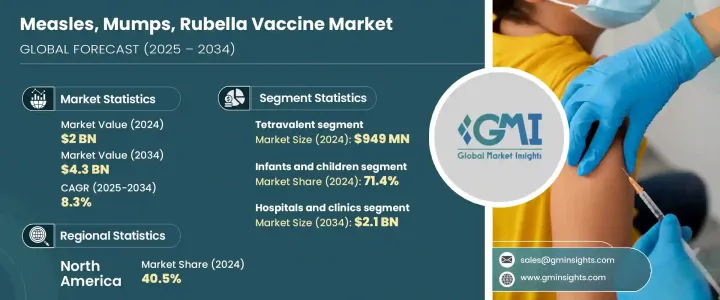
세계의 홍역, 볼거리, 풍진 백신 시장 규모는 2024년 20억 달러였고, CAGR 8.3%로 성장해, 2034년까지 43억 달러에 이를 것으로 추정됩니다.
이 시장 확대의 배경에는 소아 예방 접종의 중요성 증가, 전염병 유행 증가, 세계 보건 활동의 확산 등 몇 가지 요인이 포함됩니다. 또한, 집단 면역 달성을 목적으로 한 집단 예방접종에 대한 정부 투자 증가가 특히 신흥국 시장을 크게 밀어 올리고 있습니다.
콜드체인 인프라에 대한 의존을 경감하는 혼합 백신이나 내열성 백신의 이용이 가능하게 된 것으로, 원격지에서의 백신 입수가 용이하게 되어, 전체적인 유효성이 향상하고 있습니다. 또한, 신흥국에서의 출생율의 상승, MMR 백신의 정기 접종화에 의해 시장의 타겟층이 확대하고 있습니다.
| 시장 범위 | |
|---|---|
| 시작 연도 | 2024년 |
| 예측 연도 | 2025-2034년 |
| 시작 금액 | 20억 달러 |
| 예측 금액 | 43억 달러 |
| CAGR | 8.3% |
4가 백신의 2024년 시장 규모는 9억 4,900만 달러였습니다. 홍역과 풍진뿐만 아니라 수두에도 대응할 수 있어, MMRV 제제 수요가 높아지고 있습니다. 콜드체인 로지스틱스의 개선이나 WHO와 같은 국제 보건 기관의 지원도, 4가 백신의 채용 확대에 기여하고 있으며, 이 분야는 시장 확대의 주요 촉진요인이 되고 있습니다.
병원 및 진료소 부문은 2034년까지 21억 달러에 이를 것으로 예측됩니다. 보관과 배송을 실시하기 위해, 도시에서도 준도시에서도 백신 투여의 중요한 거점이 되고 있습니다. 또한, 감염병 유행시에는 많은 나라가 집단 예방접종 프로그램의 주요 거점으로서 병원을 의지로 하기 위해, 이 부문 시장 점유율은 한층 더 높아집니다.
미국의 홍역, 볼거리, 풍진 백신 2024년 시장 규모는 7억 2,610만 달러였습니다. 백신 접종의 주저로 인해 때때로 좌절하는 경우도 있지만, 소아과의 백신 접종율은 여전히 높아, 이것은 정부 자금, 통제된 가격 설정, Vaccines for Children(VFC)과 같은 프로그램에 의해 지원되고 있습니다.
세계의 홍역, 볼거리, 풍진 백신 시장에서 기업이 채용하고 있는 주된 전략에는 환자의 컴플라이언스를 향상시키기 위해, 혼합 백신이나 적은 투여 횟수로 끝나는 백신의 개발 등, 백신 투여에 있어서의 기술적 진보를 활용하는 것이 포함됩니다. 국제보건기구나 정부와의 강력한 협력 체제를 확립하는 것으로, 충분한 서비스를 받지 않은 지역에도 백신이 닿게 하는 것에도 주력하고 있습니다. 또한, 연구 개발에 투자해, 감염증에 대한 폭넓은 방어를 제공하는 보다 새롭고 효과적인 백신 제제를 도입하는 것으로, 시장에서의 존재감과 장기적인 지속가능성을 높이고 있습니다.
목차
제1장 조사 방법과 범위
제2장 주요 요약
제3장 업계 인사이트
- 생태계 분석
- 공급자의 상황
- 각 단계에서의 부가가치
- 밸류체인에 영향을 주는 요인
- 업계에 미치는 영향요인
- 성장 촉진요인
- 국가 예방 접종 프로그램에 의한 예방 접종율의 향상
- 신흥 경제 국가에서 소아 인구 증가
- 백신의 처방과 생산 효율의 진보
- 업계의 잠재적 위험 및 과제
- 엄격한 규제 승인 프로세스
- 원격지에서의 백신 접근의 제한
- 시장 기회
- 백신 배포를 위한 관민 파트너십 확대
- 주사 부담을 경감하기 위한 혼합 백신 수요 증가
- 성장 촉진요인
- 성장 가능성 분석
- 규제 상황
- 북미
- 유럽
- 아시아태평양
- Porter's Five Forces 분석
- PESTEL 분석
- 기술과 혁신의 상황
- 현재의 기술 동향
- 신흥기술
- 가격 동향
- 지역별
- 백신유형별
- 미래 시장 동향
- 기술과 혁신의 상황
- 현재의 기술 동향
- 신흥기술
- 무역 통계(HS코드)
- 주요 수입국
- 주요 수출국
제4장 경쟁 구도
- 소개
- 기업의 시장 점유율 분석
- 기업 매트릭스 분석
- 주요 시장 기업의 경쟁 분석
- 경쟁 포지셔닝 매트릭스
- 주요 발전
- 합병인수
- 파트너십 및 협업
- 신제품 발매
- 확장 계획
제5장 시장 추계 및 예측 : 백신유형별, 2021-2034년
- 주요 동향
- 1가
- 3가(혼합 MMR)
- 4가
제6장 시장 추계 및 예측 : 대상 인구별, 2021-2034년
- 주요 동향
- 영유아
- 성인
제7장 시장 추계 및 예측 : 최종 용도별, 2021-2034년
- 주요 동향
- 병원 및 진료소
- 정부 및 공공위생 프로그램
- 기타 최종 용도
제8장 시장 추계 및 예측 : 지역별, 2021-2034년
- 주요 동향
- 북미
- 미국
- 캐나다
- 유럽
- 독일
- 영국
- 프랑스
- 스페인
- 이탈리아
- 네덜란드
- 아시아태평양
- 중국
- 일본
- 인도
- 호주
- 한국
- 라틴아메리카
- 브라질
- 멕시코
- 아르헨티나
- 중동 및 아프리카
- 남아프리카
- 사우디아라비아
- 아랍에미리트(UAE)
제9장 기업 프로파일
- Actiza Pharmaceutical Pvt. Ltd.
- Beijing Institute of Biological Products
- Biological E
- GSK
- Merck
- Minhai Bio
- Sanofi
- Serum Institute of India
- Shanghai Institute of Biological Products
- Sinovac
- Zydus Life Science
The Global Measles, Mumps, Rubella Vaccine Market was valued at USD 2 billion in 2024 and is estimated to grow at a CAGR of 8.3% to reach USD 4.3 billion by 2034. This expansion can be attributed to several factors, including the growing emphasis on childhood immunization, a rise in outbreaks, and widespread global health initiatives. The issue remains pressing in lower-middle-income nations, where limited resources and inadequate funding necessitate targeted vaccination programs. Furthermore, the increasing government investment in mass vaccination drives aimed at achieving herd immunity is significantly boosting the market, especially in developing regions.
The availability of combination vaccines and thermostable vaccines, which reduce dependence on cold-chain infrastructure, is enhancing vaccine accessibility in remote areas, improving overall efficacy. Rising vaccination awareness, better healthcare infrastructure, and more inclusive national immunization programs are contributing to higher immunization rates globally. Additionally, the increasing birth rates in emerging economies and the integration of MMR vaccines into routine vaccination schedules are expanding the market's target demographic. The ongoing development of enhanced trivalent and quadrivalent vaccines, designed for better disease control, is further supporting market growth.
| Market Scope | |
|---|---|
| Start Year | 2024 |
| Forecast Year | 2025-2034 |
| Start Value | $2 Billion |
| Forecast Value | $4.3 Billion |
| CAGR | 8.3% |
The tetravalent segment was valued at USD 949 million in 2024. Tetravalent vaccines, which combine multiple vaccinations into one shot, are gaining popularity as they simplify vaccination schedules and improve compliance, particularly in children. These vaccines are now being integrated into national immunization programs worldwide, both in developed and emerging economies, as they offer broader protection and are easier to administer. Their ability to address not only measles and rubella but also varicella, is driving demand for MMRV formulations. Improved cold-chain logistics and support from global health organizations like the WHO are also contributing to the increased adoption of tetravalent vaccines globally, making this segment a key driver of market expansion.
The hospitals and clinics segment is projected to reach USD 2.1 billion by 2034. Hospitals and clinics maintain a dominant role in the MMR vaccine market, largely due to their involvement in immunization campaigns and the range of pediatric services they offer. These healthcare facilities are key centers for vaccine administration in both urban and semi-urban areas, thanks to their well-established cold chain infrastructure and skilled personnel who ensure proper storage and delivery of vaccines. Moreover, during epidemic outbreaks, many nations rely on hospitals as primary hubs for mass immunization programs, further boosting this segment's market share. The expanding number of primary healthcare centers and increasing public-private partnerships in emerging markets also contribute to the growth of this segment.
United States Measles, Mumps, Rubella Vaccine Market was valued at USD 726.1 million in 2024. While the market is mature and heavily regulated, it is still driven by public health recommendations, school immunization mandates, and campaigns responding to localized outbreaks. Although vaccine hesitancy has caused occasional setbacks, pediatric vaccination rates remain high, supported by government funding, controlled pricing, and programs like Vaccines for Children (VFC). The U.S. also continues to play a leading role in vaccine development and exportation, reinforcing its influence on global immunization efforts.
Key strategies adopted by companies in the Global Measles, Mumps, Rubella Vaccine Market include leveraging technological advancements in vaccine delivery, such as the development of combination vaccines and those requiring fewer doses, to increase patient compliance. They also focus on improving accessibility through enhanced cold-chain infrastructure and establishing strong collaborations with global health organizations and governments to ensure vaccines reach underserved regions. Moreover, they invest in research and development to introduce newer, more effective vaccine formulations that provide broader protection against infectious diseases, enhancing both their market presence and long-term sustainability.
Table of Contents
Chapter 1 Methodology and Scope
- 1.1 Market scope and definition
- 1.2 Research design
- 1.2.1 Research approach
- 1.2.2 Data collection methods
- 1.3 Data mining sources
- 1.3.1 Global
- 1.3.2 Regional/Country
- 1.4 Base estimates and calculations
- 1.4.1 Base year calculation
- 1.4.2 Key trends for market estimation
- 1.5 Primary research and validation
- 1.5.1 Primary sources
- 1.6 Forecast model
- 1.7 Research assumptions and limitations
Chapter 2 Executive Summary
- 2.1 Industry 3600 synopsis
- 2.2 Key market trends
- 2.2.1 Regional
- 2.2.2 Vaccines type
- 2.2.3 Targeted population
- 2.2.4 End use
- 2.3 CXO perspectives: Strategic imperatives
- 2.3.1 Key decision points for industry executives
- 2.3.2 Critical success factors for market players
- 2.4 Future outlook and strategic recommendations
Chapter 3 Industry Insights
- 3.1 Industry ecosystem analysis
- 3.1.1 Supplier landscape
- 3.1.2 Value addition at each stage
- 3.1.3 Factor affecting the value chain
- 3.2 Industry impact forces
- 3.2.1 Growth drivers
- 3.2.1.1 Rising immunization coverage through national vaccination programs
- 3.2.1.2 Increasing pediatric population in developing economies
- 3.2.1.3 Advancements in vaccine formulation and production efficiency
- 3.2.2 Industry pitfalls and challenges
- 3.2.2.1 Stringent regulatory approval processes
- 3.2.2.2 Limited access to vaccines in remote regions
- 3.2.3 Market opportunities
- 3.2.3.1 Expanding public-private partnerships for vaccine distribution
- 3.2.3.2 Growing demand for combination vaccines to reduce injection burden
- 3.2.1 Growth drivers
- 3.3 Growth potential analysis
- 3.4 Regulatory landscape
- 3.4.1 North America
- 3.4.2 Europe
- 3.4.3 Asia Pacific
- 3.5 Porter's analysis
- 3.6 PESTEL analysis
- 3.7 Technology and innovation landscape
- 3.7.1 Current technological trends
- 3.7.2 Emerging technologies
- 3.8 Price trends
- 3.8.1 By region
- 3.8.2 By vaccines type
- 3.9 Future market trends
- 3.10 Technology and innovation landscape
- 3.10.1 Current technological trends
- 3.10.2 Emerging technologies
- 3.11 Trade statistics (HS code)
- 3.11.1 Major importing countries
- 3.11.2 Major exporting countries
Chapter 4 Competitive Landscape, 2024
- 4.1 Introduction
- 4.2 Company market share analysis
- 4.3 Company matrix analysis
- 4.4 Competitive analysis of major market players
- 4.5 Competitive positioning matrix
- 4.6 Key developments
- 4.6.1 Mergers and acquisitions
- 4.6.2 Partnerships and collaborations
- 4.6.3 New product launches
- 4.6.4 Expansion plans
Chapter 5 Market Estimates and Forecast, By Vaccines Type, 2021-2034 ($ Mn)
- 5.1 Key trends
- 5.2 Monovalent
- 5.3 Trivalent (combined MMR)
- 5.4 Tetravalent
Chapter 6 Market Estimates and Forecast, By Targeted Population, 2021-2034 ($ Mn)
- 6.1 Key trends
- 6.2 Infants and children
- 6.3 Adults
Chapter 7 Market Estimates and Forecast, By End Use, 2021-2034 ($ Mn)
- 7.1 Key trends
- 7.2 Hospitals and clinics
- 7.3 Government and public health programs
- 7.4 Other end use
Chapter 8 Market Estimates and Forecast, By Region, 2021-2034 ($ Mn)
- 8.1 Key trends
- 8.2 North America
- 8.2.1 U.S.
- 8.2.2 Canada
- 8.3 Europe
- 8.3.1 Germany
- 8.3.2 UK
- 8.3.3 France
- 8.3.4 Spain
- 8.3.5 Italy
- 8.3.6 Netherlands
- 8.4 Asia Pacific
- 8.4.1 China
- 8.4.2 Japan
- 8.4.3 India
- 8.4.4 Australia
- 8.4.5 South Korea
- 8.5 Latin America
- 8.5.1 Brazil
- 8.5.2 Mexico
- 8.5.3 Argentina
- 8.6 Middle East and Africa
- 8.6.1 South Africa
- 8.6.2 Saudi Arabia
- 8.6.3 UAE
Chapter 9 Company Profiles
- 9.1 Actiza Pharmaceutical Pvt. Ltd.
- 9.2 Beijing Institute of Biological Products
- 9.3 Biological E
- 9.4 GSK
- 9.5 Merck
- 9.6 Minhai Bio
- 9.7 Sanofi
- 9.8 Serum Institute of India
- 9.9 Shanghai Institute of Biological Products
- 9.10 Sinovac
- 9.11 Zydus Life Science