

|
시장보고서
상품코드
1766341
비타민 원료 시장 : 기회, 성장 촉진요인, 산업 동향 분석 및 예측(2025-2034년)Vitamin Ingredients Market Opportunity, Growth Drivers, Industry Trend Analysis, and Forecast 2025 - 2034 |
||||||

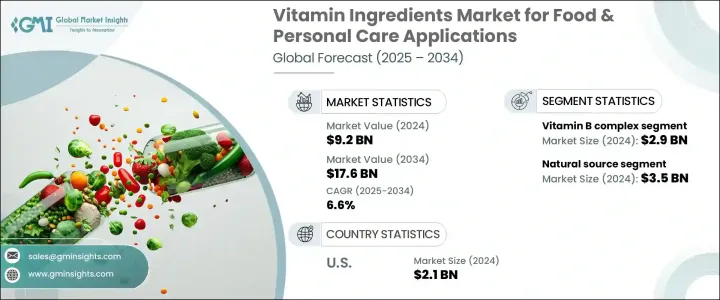
세계의 비타민 원료 시장은 2024년 92억 달러로 평가되었고 2034년에는 176억 달러에 이를 것으로 예측되며, CAGR 6.6%로 성장할 전망입니다. 이러한 성장은 주로 건강, 영양 및 웰빙에 대한 소비자의 관심이 증가함에 따라 촉진되고 있습니다. 사람들이 예방 의료 및 식단 개선에 대해 더욱 적극적인 태도를 보임에 따라 전 세계적으로 큰 변화가 일어나고 있으며, 이로 인해 비타민이 풍부한 제품에 대한 수요가 증가하고 있습니다. 미량 영양소 결핍 및 생활 습관 관련 건강 문제가 증가함에 따라 강화 식품 및 음료, 보충제, 기능성 개인 위생 용품이 인기를 끌고 있습니다.
비타민은 시리얼, 스낵, 유제품, 음료와 같은 식품에 점점 더 많이 통합되고 있으며, 퍼스널 케어 브랜드는 노화 방지, 보습, 환경 보호 효과에 대한 수요를 충족하기 위해 스킨케어 및 헤어케어 제형에 비타민을 함유하고 있습니다. 이러한 여러 부문에 걸친 이중 적용은 시장 채택을 가속화하고 있습니다. 퍼스널 케어 분야에서 비타민은 특히 세럼, 로션, 샴푸에 항염, 미백, 회복 효과를 제공하는 활성 성분으로 사용됩니다. 소비자의 클린 라벨, 식물 유래 성분, 기능성 건강 혜택에 대한 선호도가 증가함에 따라 비타민 성분의 채택은 섭취용 및 외용 제형 모두에서 더욱 확대되고 있습니다.
| 시장 범위 | |
|---|---|
| 시작 연도 | 2024년 |
| 예측 연도 | 2025-2034년 |
| 시작 금액 | 92억 달러 |
| 예측 금액 | 176억 달러 |
| CAGR | 6.6% |
비타민 B 복합체 부문은 2024년에 29억 달러를 차지했으며, 2034년까지 연평균 6.4%의 성장률을 보일 것으로 예상됩니다. 신진대사, 에너지 생산, 신경 기능 및 산전 관리에 필수적인 역할을 하는 것으로 알려진 이 카테고리에는 B1, B2, B3, B6, B9 및 B12와 같은 다양한 형태가 포함됩니다. 이러한 성분은 건강 보조 식품, 에너지 드링크 및 강화 식품에 널리 사용됩니다. 개인 위생 용품에서는 B3 및 B5와 같은 파생물이 피부 보습, 발적 감소, 전반적인 피부톤 개선 효과로 인기가 많습니다. 폭넓은 적용 가능성과 비용 효율성으로 인해 B 복합 비타민은 제조업체들이 선호하는 성분으로 남아 있습니다. 다목적성과 효능으로 인해 영양 및 화장품에 폭넓게 사용될 수 있어 비타민 성분 분야에서 입지를 강화하고 있습니다.
천연 원료 부문은 2024년에 35억 달러로 평가되었고, 2025년부터 2034년까지 연평균 6.5%의 성장률을 보이며 38.2%의 시장 점유율을 차지할 것으로 예상됩니다. 소비자들이 클린 라벨, 천연 유래, 식물성 성분을 선호하는 경향이 증가함에 따라 브랜드들은 제품 제형에 천연 비타민 원료를 사용하기 시작했습니다. 식물, 과일 및 채소에서 추출한 이러한 비타민은 더 안전하고, 더 효과적이며, 흡수율이 더 높다고 널리 알려져 있습니다. 투명성과 지속 가능성이 최우선으로 고려되는 식품 및 미용 분야의 프리미엄 카테고리에서 수요가 특히 높습니다. 비타민 C의 아세로라나 비타민 E의 해바라기 오일과 같은 천연 원료는 유기농 및 최소 가공 제형과 호환성이 뛰어나 윤리적이고 투명한 제품 개발을 추진하는 데 널리 사용되고 있습니다.
미국의 식품 및 퍼스널케어 용도의 비타민 원료 시장은 2024년에 21억 달러로 평가되었고, 2034년까지 연평균 6.4%의 성장률을 보일 것으로 예상됩니다. 미국에서는 예방 건강에 대한 소비자의 관심이 높아지고, 클린 라벨 제품에 대한 인식이 높아짐에 따라 수요가 계속 증가하고 있습니다. 선진 식품 및 미용 산업은 강력한 규제 지원 및 제품 제형 혁신과 함께 시장 확장을 촉진하는 주요 요인입니다. R&D 역량을 통해 기업들은 생체 이용률과 효능을 개선할 수 있으며, 당국이 발표한 영양소 강화 지침은 소비자의 신뢰를 높입니다. 비타민이 함유된 스킨케어 및 기능성 식품의 사용도 시장 성장에 기여하고 있습니다.
이 식품 및 퍼스널케어 용도의 주요 기업으로는 BASF, Glanbia, Bluestar Adisseo, Lonza Group 및 DSM N.V. 등이 있습니다. 이러한 기업들은 경쟁력을 유지하기 위해 혁신, 제품 개발 및 천연 성분 포트폴리오 확장에 주력하고 있습니다. 식품 및 개인 위생 용품용 비타민 성분 시장에서 입지를 강화하기 위해 주요 기업들은 다각적인 전략을 채택하고 있습니다. 여기에는 천연 및 클린 라벨 성분으로 제품 라인을 확장하고, 식품 및 미용 부문 전반에 걸쳐 전략적 파트너십을 구축하며, 성분의 생체 이용률과 안정성을 높이기 위해 R&D에 투자하는 것이 포함됩니다. 또한 기업들은 추적 가능한 원료 공급 및 지속 가능성 인증을 제공하여 소비자의 투명성 요구를 활용하고 있습니다. 또한, 기업들은 제품군을 다양화하고 고성장 부문을 공략하기 위해 산전 관리, 노화 피부, 비건 식단 등 틈새 건강 부문을 점점 더 많이 목표로 삼고 있습니다.
목차
제1장 조사 방법과 범위
제2장 주요 요약
- TAM 분석(2025-2034년)
- CXO 관점: 전략적 필수 사항
- 경영상의 의사결정 포인트
- 중요한 성공 요인
- 미래의 전망과 전략적 제안
제3장 산업 고찰
- 생태계 분석
- 공급자의 상황
- 이익률
- 각 단계에서의 부가가치
- 밸류체인에 영향을 주는 요인
- 혁신
- 산업에 미치는 영향요인
- 성장 촉진요인
- 강화 및 기능성 식품에 대한 소비자 수요 증가
- 개인 건강 및 웰빙에 대한 인식 제고
- 스킨케어 및 화장품 제형에 비타민의 적용 확대
- 영양소 강화 촉진에 대한 정부 정책
- 산업의 잠재적 리스크 및 과제
- 지역별 복잡한 규제
- 특정 비타민 제제의 안정성 및 유통 기한 문제
- 시장 기회
- 성장 촉진요인
- 성장 가능성 분석
- 규제 상황
- 북미
- 유럽
- 아시아태평양
- 라틴아메리카
- 중동 및 아프리카
- Porter's Five Forces 분석
- PESTEL 분석
- 가격 동향
- 지역별
- 비타민별
- 장래 시장 동향
- 기술과 혁신의 상황
- 현재의 기술 동향
- 신흥기술
- 특허 상황
- 무역 통계(HS코드)(참고 : 무역 통계는 주요 국가에서만 제공됨)
- 주요 수입국
- 주요 수출국
- 지속가능성과 환경 측면
- 지속 가능한 사례
- 폐기물 삭감 전략
- 생산에 있어서의 에너지 효율
- 친환경 활동
제4장 경쟁 구도
- 소개
- 기업의 시장 점유율 분석
- 지역별
- 북미
- 유럽
- 아시아태평양
- 라틴아메리카 항공
- 중동 및 아프리카
- 지역별
- 기업 매트릭스 분석
- 주요 시장 기업의 경쟁 분석
- 경쟁 포지셔닝 매트릭스
- 합병과 인수
- 파트너십 및 협업
- 신제품 발매
- 확대 계획
제5장 시장 추정 및 예측 : 비타민 유형별(2021-2034년)
- 주요 동향
- 비타민 A
- 비타민 B 복합체
- 비타민 B1(티아민)
- 비타민 B2(리보플라빈)
- 비타민 B3(니아신)
- 비타민 B5(판토텐산)
- 비타민 B6(피리독신)
- 비타민 B7(비오틴)
- 비타민 B9(엽산)
- 비타민 B12(코발라민)
- 비타민 C(아스코르브산)
- 비타민 D
- 비타민 D2(에르고칼시페롤)
- 비타민 D3(콜레칼시페롤)
- 비타민 E
- 비타민 K
제6장 시장 추정 및 예측 : 공급원별(2021-2034년)
- 주요 동향
- 천연
- 식물 유래
- 동물 유래
- 미생물
- 합성
- 반합성
제7장 시장 추정 및 예측 : 형태별(2021-2034년)
- 주요 동향
- 분말
- 액체
- 비드렛
- 캡슐
- 과립
- 기타
제8장 시장 추정 및 예측 : 용도별(2021-2034년)
- 주요 동향
- 식음료 용도
- 기능성 식품
- 강화 식품
- 유제품
- 베이커리 & 과자류
- 조식용 시리얼
- 유아용 조제 분유
- 기타
- 음료
- 기능성 음료
- 주스와 스무디
- 에너지 음료
- 기타
- 영양보조식품
- 동물사료
- 퍼스널케어 용도
- 스킨케어
- 안티 에이징 제품
- 보습제와 크림
- 자외선 차단제 제품
- 페이셜 세럼
- 기타
- 헤어 케어
- 샴푸 & 컨디셔너
- 헤어 오일 & 미용액
- 육모제
- 기타
- 색조 화장품
- 구강 케어
- 바디 케어
- 뉴트리코스메틱스
- 기타
- 스킨케어
제9장 시장 추정 및 예측 : 지역별(2021-2034년)
- 주요 동향
- 북미
- 미국
- 캐나다
- 유럽
- 영국
- 독일
- 프랑스
- 이탈리아
- 스페인
- 네덜란드
- 아시아태평양
- 중국
- 인도
- 일본
- 한국
- 호주
- 라틴아메리카
- 브라질
- 멕시코
- 아르헨티나
- 중동 및 아프리카
- 남아프리카
- 사우디아라비아
- 아랍에미리트(UAE)
제10장 기업 프로파일
- Adisseo(Bluestar Adisseo Company)
- Archer Daniels Midland Company(ADM)
- BASF SE
- DSM-Firmenich AG
- Eastman Chemical Company
- Fenchem BIoTek Ltd.
- Foodchem International Corporation
- Glanbia plc
- Kappa Bioscience AS
- Koninklijke DSM NV
- Lonza Group
- Lycored
- Nutraceutical Corporation
- Prinova Group LLC
- Sternchemie GmbH & Co. KG
- The Lubrizol Corporation
- Vertellus Holdings LLC
- Vitablend Nederland BV
- Vitalife Biosciences
- Zhejiang NHU Co., Ltd
The Global Vitamin Ingredients Market for Food and Personal Care Applications was valued at USD 9.2 billion in 2024 and is estimated to grow at a CAGR of 6.6% to reach USD 17.6 billion by 2034. This growth is primarily driven by increasing consumer attention toward health, nutrition, and well-being. A significant shift is occurring worldwide as people become more proactive about preventive healthcare and dietary enhancement, fueling the demand for vitamin-enriched products. Fortified foods and beverages, along with supplements and functional personal care items, are gaining momentum due to the rising prevalence of micronutrient deficiencies and lifestyle-related health issues.
Vitamins are increasingly being integrated into food products like cereals, snacks, dairy, and beverages, while personal care brands are embedding them in skincare and haircare formulations to cater to demands for anti-aging, hydration, and environmental protection benefits. This dual application across sectors is accelerating market adoption. In personal care, vitamins serve as active ingredients offering anti-inflammatory, brightening, and restorative properties, particularly in serums, lotions, and shampoos. Evolving consumer preferences toward clean labels, plant-derived ingredients, and functional health benefits further amplify the uptake of vitamin ingredients, both in ingestible and topical formulations.
| Market Scope | |
|---|---|
| Start Year | 2024 |
| Forecast Year | 2025-2034 |
| Start Value | $9.2 Billion |
| Forecast Value | $17.6 Billion |
| CAGR | 6.6% |
The vitamin B complex segment accounted for USD 2.9 billion in 2024 and is expected to grow at a CAGR of 6.4% through 2034. Known for its essential role in metabolism, energy production, neurological function, and prenatal care, this category includes various forms like B1, B2, B3, B6, B9, and B12. These ingredients are widely formulated in dietary supplements, energy drinks, and fortified foods. In personal care, derivatives such as B3 and B5 are popular for their ability to support skin hydration, reduce redness, and enhance overall skin tone. Due to their wide applicability and cost-effectiveness, B complex vitamins remain a preferred ingredient for manufacturers. Their versatility and efficacy make them ideal for a range of both nutritional and cosmetic applications, strengthening their footprint in the vitamin ingredients space.
The natural source segment was valued at USD 3.5 billion in 2024 and is projected to grow at a CAGR of 6.5% between 2025 and 2034, holding a 38.2% market share. A growing consumer preference for clean-label, naturally derived, and plant-based ingredients is pushing brands to use natural vitamin sources in product formulations. These vitamins, extracted from botanicals, fruits, and vegetables, are widely perceived as safer, more effective, and better absorbed. Demand is especially high in premium categories across food and beauty, where transparency and sustainability are top priorities. Natural sources such as acerola for vitamin C or sunflower oil for vitamin E are widely adopted for their compatibility with organic and minimally processed formulations, supporting the push toward ethical and transparent product development.
U.S. Vitamin Ingredients Market for Food & Personal Care Applications was valued at USD 2.1 billion in 2024 and is anticipated to grow at a 6.4% CAGR through 2034. In the U.S., increasing consumer focus on preventive health, coupled with rising awareness of clean-label products, continues to fuel demand. The advanced food and beauty industries, combined with strong regulatory support and innovation in product formulation, are key factors driving market expansion. R&D capabilities allow companies to improve bioavailability and efficacy, while nutrient fortification guidelines issued by authorities foster consumer trust. The use of vitamin-infused skincare and functional foods also contributes to market traction.
Key companies operating in this Vitamin Ingredients Market for Food & Personal Care Applications include BASF, Glanbia, Bluestar Adisseo, Lonza Group, and DSM N.V. These players are focusing on innovation, product development, and expanding their natural ingredient portfolios to stay competitive. To strengthen their presence in the vitamin ingredients market for food and personal care, leading companies are adopting multi-pronged strategies. These include expanding product lines with natural and clean-label ingredients, forming strategic partnerships across food and beauty sectors, and investing in R&D to enhance ingredient bioavailability and stability. Firms are also leveraging consumer demand for transparency by offering traceable sourcing and sustainability certifications. In addition, companies are increasingly targeting niche health segments like prenatal care, aging skin, and vegan diets to diversify their offerings and tap into high-growth categories.
Table of Contents
Chapter 1 Methodology & Scope
- 1.1 Market scope and definition
- 1.2 Research design
- 1.2.1 Research approach
- 1.2.2 Data collection methods
- 1.3 Data mining sources
- 1.3.1 Global
- 1.3.2 Regional/Country
- 1.4 Base estimates and calculations
- 1.4.1 Base year calculation
- 1.4.2 Key trends for market estimation
- 1.5 Primary research and validation
- 1.5.1 Primary sources
- 1.6 Forecast model
- 1.7 Research assumptions and limitations
Chapter 2 Executive Summary
- 2.1 Industry 360° synopsis
- 2.2 Key market trends
- 2.2.1.1 Regional
- 2.2.1.2 Vitamin type
- 2.2.1.3 Source
- 2.2.1.4 Form
- 2.2.1.5 Application
- 2.3 TAM analysis, 2025-2034
- 2.4 CXO perspectives: strategic imperatives
- 2.5 Executive decision points
- 2.6 Critical success factors
- 2.7 Future outlook and strategic recommendations
Chapter 3 Industry Insights
- 3.1 Industry ecosystem analysis
- 3.1.1 Supplier landscape
- 3.1.2 Profit margin
- 3.1.3 Value addition at each stage
- 3.1.4 Factor affecting the value chain
- 3.1.5 Disruptions
- 3.2 Industry impact forces
- 3.2.1 Growth drivers
- 3.2.1.1 Rising consumer demand for fortified and functional food products.
- 3.2.1.2 Increasing awareness of personal health and wellness.
- 3.2.1.3 Expanding application of vitamins in skincare and cosmetic formulations.
- 3.2.1.4 Government initiatives promoting nutrient fortification.
- 3.2.2 Industry pitfalls and challenges
- 3.2.2.1 Regulatory complexities across regions
- 3.2.2.2 Stability and shelf-life issues in certain vitamin formulations
- 3.2.3 Market opportunities
- 3.2.1 Growth drivers
- 3.3 Growth potential analysis
- 3.4 Regulatory landscape
- 3.4.1 North America
- 3.4.2 Europe
- 3.4.3 Asia pacific
- 3.4.4 Latin America
- 3.4.5 Middle east & Africa
- 3.5 Porter's analysis
- 3.6 Pestel analysis
- 3.6.1 Technology and innovation landscape
- 3.6.2 Current technological trends
- 3.6.3 Emerging technologies
- 3.7 Price trends
- 3.7.1 By region
- 3.7.2 By vitamin
- 3.8 Future market trends
- 3.9 Technology and innovation landscape
- 3.9.1 Current technological trends
- 3.9.2 Emerging technologies
- 3.10 Patent landscape
- 3.11 Trade statistics (HS code) (Note: the trade statistics will be provided for key countries only)
- 3.11.1 Major importing countries
- 3.11.2 Major exporting countries
- 3.12 Sustainability and environmental aspects
- 3.12.1 Sustainable practices
- 3.12.2 Waste reduction strategies
- 3.12.3 Energy efficiency in production
- 3.12.4 Eco-friendly initiatives
Chapter 4 Competitive Landscape, 2024
- 4.1 Introduction
- 4.2 Company market share analysis
- 4.2.1 By region
- 4.2.1.1 North America
- 4.2.1.2 Europe
- 4.2.1.3 Asia Pacific
- 4.2.1.4 LATAM
- 4.2.1.5 MEA
- 4.2.1 By region
- 4.3 Company matrix analysis
- 4.4 Competitive analysis of major market players
- 4.5 Competitive positioning matrix
- 4.6 Key developments
- 4.6.1 Mergers & acquisitions
- 4.6.2 Partnerships & collaborations
- 4.6.3 New Product Launches
- 4.6.4 Expansion plans
Chapter 5 Market Estimates & Forecast, By Vitamin Type, 2021-2034 (USD Billion) (Kilo Tons)
- 5.1 Key trends
- 5.2 Vitamin A
- 5.3 Vitamin B Complex
- 5.3.1 Vitamin B1 (Thiamine)
- 5.3.2 Vitamin B2 (Riboflavin)
- 5.3.3 Vitamin B3 (Niacin)
- 5.3.4 Vitamin B5 (Pantothenic Acid)
- 5.3.5 Vitamin B6 (Pyridoxine)
- 5.3.6 Vitamin B7 (Biotin)
- 5.3.7 Vitamin B9 (Folic Acid)
- 5.3.8 Vitamin B12 (Cobalamin)
- 5.4 Vitamin C (Ascorbic Acid)
- 5.5 Vitamin D
- 5.5.1 Vitamin D2 (Ergocalciferol)
- 5.5.2 Vitamin D3 (Cholecalciferol)
- 5.6 Vitamin E
- 5.7 Vitamin K
Chapter 6 Market Estimates & Forecast, By Source, 2021-2034 (USD Billion) (Kilo Tons)
- 6.1 Key trends
- 6.2 Natural
- 6.2.1 Plant-based
- 6.2.2 Animal-based
- 6.2.3 Microbial
- 6.3 Synthetic
- 6.4 Semi-synthetic
Chapter 7 Market Estimates & Forecast, By Form, 2021-2034 (USD Billion) (Kilo Tons)
- 7.1 Key trends
- 7.2 Powder
- 7.3 Liquid
- 7.4 Beadlets
- 7.5 Encapsulated
- 7.6 Granules
- 7.7 Others
Chapter 8 Market Estimates & Forecast, By Application, 2021-2034 (USD Billion) (Kilo Tons)
- 8.1 Key trends
- 8.2 Food & beverage applications
- 8.2.1 Functional foods
- 8.2.2 Fortified foods
- 8.2.2.1 Dairy products
- 8.2.2.2 Bakery & confectionery
- 8.2.2.3 Breakfast cereals
- 8.2.2.4 Infant formula
- 8.2.2.5 Others
- 8.2.3 Beverages
- 8.2.3.1 Functional drinks
- 8.2.3.2 Juices & smoothies
- 8.2.3.3 Energy drinks
- 8.2.3.4 Others
- 8.2.4 Dietary supplements
- 8.2.5 Animal feed
- 8.3 Personal care applications
- 8.3.1 Skincare
- 8.3.1.1 Anti-aging products
- 8.3.1.2 Moisturizers & creams
- 8.3.1.3 Sun care products
- 8.3.1.4 Facial serums
- 8.3.1.5 Others
- 8.3.2 Haircare
- 8.3.2.1 Shampoos & conditioners
- 8.3.2.2 Hair oils & serums
- 8.3.2.3 Hair growth products
- 8.3.2.4 Others
- 8.3.3 Color cosmetics
- 8.3.4 Oral care
- 8.3.5 Body care
- 8.3.6 Nutricosmetics
- 8.3.7 Others
- 8.3.1 Skincare
Chapter 9 Market Estimates & Forecast, By Region, 2021-2034 (USD Billion) (Kilo Tons)
- 9.1 Key trends
- 9.2 North America
- 9.2.1 U.S.
- 9.2.2 Canada
- 9.3 Europe
- 9.3.1 UK
- 9.3.2 Germany
- 9.3.3 France
- 9.3.4 Italy
- 9.3.5 Spain
- 9.3.6 Netherlands
- 9.4 Asia Pacific
- 9.4.1 China
- 9.4.2 India
- 9.4.3 Japan
- 9.4.4 South Korea
- 9.4.5 Australia
- 9.5 Latin America
- 9.5.1 Brazil
- 9.5.2 Mexico
- 9.5.3 Argentina
- 9.6 Middle East and Africa
- 9.6.1 South Africa
- 9.6.2 Saudi Arabia
- 9.6.3 UAE
Chapter 10 Company Profiles
- 10.1 Adisseo (Bluestar Adisseo Company)
- 10.2 Archer Daniels Midland Company (ADM)
- 10.3 BASF SE
- 10.4 DSM-Firmenich AG
- 10.5 Eastman Chemical Company
- 10.6 Fenchem Biotek Ltd.
- 10.7 Foodchem International Corporation
- 10.8 Glanbia plc
- 10.9 Kappa Bioscience AS
- 10.10 Koninklijke DSM N.V.
- 10.11 Lonza Group
- 10.12 Lycored
- 10.13 Nutraceutical Corporation
- 10.14 Prinova Group LLC
- 10.15 Sternchemie GmbH & Co. KG
- 10.16 The Lubrizol Corporation
- 10.17 Vertellus Holdings LLC
- 10.18 Vitablend Nederland B.V.
- 10.19 Vitalife Biosciences
- 10.20 Zhejiang NHU Co., Ltd


