|
시장보고서
상품코드
1782117
매스로드 비닐(MLV) 시장 : 시장 기회, 성장 촉진요인, 산업 동향 분석, 예측(2025-2034년)Mass-loaded Vinyl (MLV) Market Opportunity, Growth Drivers, Industry Trend Analysis, and Forecast 2025 - 2034 |
||||||

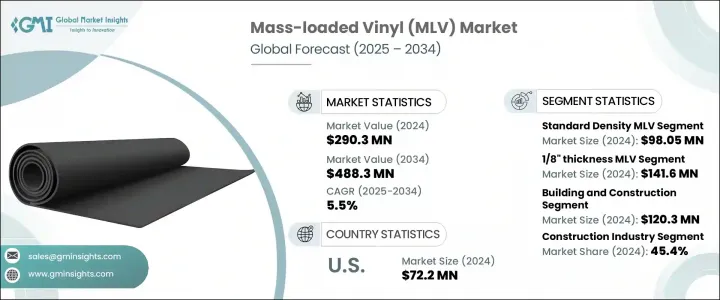
세계의 매스로드 비닐(MLV) 시장은 2024년에 2억 9,030만 달러로 평가되었고, CAGR 5.5%로 성장할 전망이며, 2034년에는 4억 8,830만 달러에 이를 것으로 예측됩니다.
도시화와 산업 활동의 수준 상승은 소음 공해 증가에 직접 기여하고 있으며, 이것이 효율적인 방음 솔루션의 필요성을 뒷받침하고 있습니다. MLV는 그 무해한 성질과 주택 및 상업 환경 모두에서 소리 전달을 저감하는 효과가 실증되고 있기 때문에 인기를 누리고 있습니다. 환경 소음이 건강과 웰니스에 미치는 영향에 대한 인식이 높아지면서 방음재에 대한 수요는 인프라와 건축 프로젝트 전체에서 계속해서 급증하고 있습니다. 게다가 지속 가능한 건설과 건축 규제에서 최신의 음향 컴플리언스가 보다 중시되게 되어, 다양한 분야에서 MLV의 채용이 진행되고 있습니다.
교육기관, 의료 빌딩, 집합 주택 개발 등의 시설에서 음향 성능 기준의 엄격화도 개발자에게 MLV 기반 제품을 선택하도록 촉구하고 있습니다. MLV는 범용성, 내구성, 시공성이 우수하기 때문에 특히 공간이 제한된 장소에서 개축 및 신축에 적합합니다. 인프라 투자가 확대되고 있는 신흥국에서는 수요가 급증하고 있습니다. 또, MLV의 사용은, 효과적인 소음 저감이 성능과 쾌적성에 불가결한 수송 거점이나 자동차 제조에서도 기세를 더하고 있습니다.
| 시장 범위 | |
|---|---|
| 시작 연도 | 2024년 |
| 예측 연도 | 2025-2034년 |
| 시작 금액 | 2억 9,030만 달러 |
| 예측 금액 | 4억 8,830만 달러 |
| CAGR | 5.5% |
2024년 표준밀도 MLV 분야는 9,805만 달러로 평가되었고, 2034년까지 연평균 복합 성장률(CAGR) 4.2%로 성장할 것으로 예측됩니다. 이 분야는 저렴한 가격과 이용가능성으로 기본 주택용 및 경상업용 방음 용도로 우위를 유지하고 있습니다. 그러나 시장의 동향은, 특히 헬스케어, 방위, 공업 제조 등, 정밀 공학적인 방음 대책을 필요로 하는 분야에서는, 맞춤형 솔루션으로 서서히 전환하고 있습니다. 더 높은 차음성이 필요하거나 중량 제한을 지켜야 하는 경우에는 고도의 복합 MLV나 특정 밀도가 요구되는 맞춤형 배합이 선호되고 있습니다.
건축 및 건설 분야는 2024년에 1억 2,030만 달러를 창출했고, 2025-2034년에는 CAGR 5.9%로 성장할 것으로 예측됩니다. MLV는 진화하는 소음 규제에 대한 적합성을 확보하고 실내 소리의 쾌적성을 높이기 위해 천장, 칸막이, 바닥 시스템에 자주 사용됩니다. MLV의 주 용도는 건축이지만 자동차 제조사들도 차량 내 정숙성을 높이고 외부 소음을 줄이기 위해 MLV 채택을 늘리고 있습니다. 홈 스튜디오, 게임룸, 소규모 오락 공간 등 소비자를 위한 용도는 개인이 저렴한 가격에 DIY에 적합한 소음 관리 선택지를 찾음에 따라 빠르게 확대되고 있습니다.
미국의 매스로드 비닐(MLV) 시장은 2024년 7,220만 달러로 평가되었고, 2025-2034년 연평균 복합 성장률(CAGR) 2.3%로 성장할 것으로 예측됩니다. 건축기준법의 엄격화, 주택 리모델링 증가, DIY 방음에 대한 열의 고조 등이 맞물려 시장 확대를 뒷받침하고 있습니다. 동시에, NVH(소음, 진동 및 승차감) 기준을 충족시키기 위한 자동차 내장 부품의 사용 증가도, 자동차 분야에서의 MLV 이용을 뒷받침하고 있습니다. 건설 부문의 회복 및 음향 품질에 대한 지출 증가가 맞물려 장기적인 전망은 밝습니다.
Technicon Acoustics, Soundproof Direct, Acoustical Surfaces, All Noise Control, Niko Coatings와 같은 선도 기업들은 세계 시장에서 적극적으로 경쟁하고 있습니다. MLV 업계에서의 위상을 강화하기 위해 주요 기업들은 요구에 맞춘 제품 개발, 다각화, 전략적 공급망 최적화에 주력하고 있습니다. 핵심 접근법에는 산업 기계, 의료 공간, 항공 우주 내장과 같은 특정 시장 틈새에 대응하는 다층 또는 복합 MLV 재료에 의한 포트폴리오 확대가 포함됩니다. 이들 기업은 또한 지속 가능성 목표에 따른 가볍고 친환경적인 솔루션을 제공하기 위해 연구개발에 투자하고 있습니다. 지리적 확대, 디지털 마케팅, 전자상거래 채널은 브랜드가 DIY 소비자에게 리치하는 데 도움이 되고 있으며, 건설 제조업체 및 자동차 제조업체와의 파트너십은 대량 생산 부문에서의 반복 비즈니스를 확실하게 하고 있습니다. 롤 사이즈나 도포 방법의 혁신 또한, 시장 도입의 개선 및 프로젝트 비용의 삭감에 중요한 역할을 하고 있습니다.
목차
제1장 조사 방법
- 시장의 범위 및 정의
- 조사 디자인
- 조사 접근
- 데이터 수집 방법
- 데이터 마이닝 소스
- 세계
- 지역 및 국가
- 기본 추정 및 계산
- 기준연도 계산
- 시장 예측의 주요 동향
- 1차 조사 및 검증
- 1차 정보
- 예측 모델
- 조사의 전제 및 한계
제2장 주요 요약
제3장 업계 인사이트
- 생태계 분석
- 공급자의 상황
- 이익률
- 각 단계에서의 부가가치
- 밸류체인에 영향을 주는 요인
- 혁신
- 업계에 미치는 영향요인
- 성장 촉진요인
- 업계의 잠재적 위험 및 과제
- 시장 기회
- 성장 가능성 분석
- 규제 상황
- 북미
- 유럽
- 아시아태평양
- 라틴아메리카
- 중동 및 아프리카
- Porter's Five Forces 분석
- PESTEL 분석
- 가격 동향
- 지역별
- 제품별
- 장래 시장 동향
- 기술 및 혁신의 상황
- 현재의 기술 동향
- 신흥 기술
- 특허 상황
- 무역 통계(HS코드)(참고 : 무역 통계는 주요 국가에서만 제공됨)
- 주요 수입국
- 주요 수출국
- 지속가능성 및 환경 측면
- 지속가능한 실천
- 폐기물 감축 전략
- 생산에서 에너지 효율
- 환경 친화적인 노력
- 탄소발자국의 고려
제4장 경쟁 구도
- 서문
- 기업의 시장 점유율 분석
- 지역별
- 북미
- 유럽
- 아시아태평양
- 라틴아메리카
- 중동 및 아프리카
- 지역별
- 기업 매트릭스 분석
- 주요 시장 기업의 경쟁 분석
- 경쟁 포지셔닝 매트릭스
- 주요 발전
- 합병 및 인수
- 파트너십 및 협업
- 신제품 발매
- 확장 계획
제5장 시장 추계 및 예측 : 제품 유형별(2021-2034년)
- 주요 동향
- 표준 밀도 MLV
- 1 파운드/평방 피트 MLV 제품
- 주택 용도
- 상용 용도
- 산업 용도
- 2 파운드/평방 피트 MLV 제품
- 고성능 용도
- 특수 산업 용도
- 프리미엄 주택 프로젝트
- 1 파운드/평방 피트 MLV 제품
- 커스텀 밀도 MLV
- 반 파운드 MLV 제품
- 고밀도 MLV(2 파운드/평방피트 초과)
- 용도 고유의 커스텀 처방
- 복합 MLV 제품
- 폼 안감 첨부 MLV
- 옷감 MLV
- 다층 복합 시스템
- 특수 MLV 제품
- 내화 MLV
- 자외선 내성 옥외용 MLV
- 항균 MLV
- 투명하고 장식적인 MLV
제6장 시장 추계 및 예측 : 두께별(2021-2034년)
- 주요 동향
- 1/16인치 두께 MLV
- 1/8인치 두께 MLV(표준)
- 1/4인치 두께 MLV
- 맞춤 두께 제품
제7장 시장 추계 및 예측 : 포맷 및 패키지별(2021-2034년)
- 주요 동향
- 롤 형식 제품
- 시트 형식의 제품
- 프리컷 및 커스텀 모양
- 점착제 부착 제품
제8장 시장 추계 및 예측 : 용도별(2021-2034년)
- 주요 동향
- 건축 및 건설
- 주택건설
- 단독 주택
- 집합 주택
- 개수 및 개축 프로젝트
- 상업건설
- 오피스 빌딩
- 의료시설
- 교육기관
- 접객와 엔터테인먼트
- 산업건설
- 제조 시설
- 데이터센터
- 실험실 및 청정실
- 주택건설
- 자동차 및 수송
- 승용차
- 고급차 및 프리미엄차
- 중급차 및 이코노미차
- 전기자동차 및 하이브리드 자동차
- 상용차
- 트럭 및 대형 차량
- 버스 및 대중교통기관
- 특수 차량 및 긴급 차량
- 해양 및 항공우주
- 선박 및 보트
- 항공기 및 항공우주 용도
- 철도 수송
- 승용차
- 산업 및 설비
- HVAC 시스템 및 덕트
- 발전기 및 컴프레서의 케이스
- 제조 장치의 소음 제어
- 발전 및 유틸리티 용도
- 소비자용 및 특수용도
- 홈 시어터 및 오디오 룸
- 녹음 스튜디오 및 음악 회장
- 가전제품 및 전자기기의 소음 제어
- 가설 및 휴대식 배리어
제9장 시장 추계 및 예측 : 최종 이용 산업별(2021-2034년)
- 주요 동향
- 건설 업계
- 주택건설 시장
- 상업건설 시장
- 인프라 및 유틸리티
- 개수 및 개축 시장
- 자동차 산업
- OEM 용도
- 애프터마켓 용도
- 전기자동차 부문
- 상용차 부문
- 공업 제조업
- 중장비 및 설비
- 공정산업
- 발전
- 석유 및 가스 산업
- 엔터테인먼트 및 미디어
- 녹음 및 방송 스튜디오
- 극장이나 공연 회장
- 홈 엔터테인먼트 시스템
- 게임 및 가상현실 용도
제10장 시장 추계 및 예측 : 지역별(2021-2034년)
- 주요 동향
- 북미
- 미국
- 캐나다
- 유럽
- 독일
- 영국
- 프랑스
- 이탈리아
- 스페인
- 기타 유럽
- 아시아태평양
- 중국
- 인도
- 일본
- 호주
- 한국
- 기타 아시아태평양
- 라틴아메리카
- 브라질
- 멕시코
- 아르헨티나
- 기타 라틴아메리카
- 중동 및 아프리카
- 사우디아라비아
- 남아프리카
- 아랍에미리트(UAE)
- 기타 중동 및 아프리카
제11장 기업 프로파일
- MLV Insulation
- Trademark Soundproofing
- Acoustic Barrier Factory
- Mass Loaded Vinyl Australia
- Niko Coatings
- Commercial Acoustics
- Soundproof Direct
- TotalMass MLV Barrier Store
- Acoustical Surfaces
- RPR Products
- All Noise Control
- Technicon Acoustics
- Acoustiguard
- Sound Acoustics Solutions
- MMT Acoustix
- Soundproofing Company
- Second Skin Audio
- ResoNix Sound Solutions
- Soundproofing MLV
- Buy Insulation Product Store
- 3M Company
- BASF SE
- The Dow Chemical Company
- Autoneum Holding AG
- Sumitomo Riko Company Limited
- Zhuzhou Times New Material Technology
- Huntsman Corporation
- Exxon Mobil Corporation
- Covestro AG
- Sika AG
- Owens Corning
- Saint-Gobain
- Knauf Insulation
- Rockwool International
- Johns Manville
- Armacell GmbH
- National Gypsum Company
- USG Corporation
- CertainTeed Corporation
- Guardian Building Products
- Venator Materials Corporation
- Sachtleben Chemie GmbH
- Huntsman Pigments and Additives
- Cimbar Performance Minerals
- Bausano &Figli SpA
- LANXESS AG
- Shin-Etsu Chemical Co., Ltd.
- Formosa Plastics Corporation
- Westlake Chemical Corporation
- INEOS Group Holdings SA
The Global Mass-loaded Vinyl (MLV) Market was valued at USD 290.3 million in 2024 and is estimated to grow at a CAGR of 5.5% to reach USD 488.3 million by 2034. Rising levels of urbanization and industrial activity are directly contributing to increased noise pollution, which in turn drives the need for efficient acoustic insulation solutions. MLV has gained popularity due to its non-toxic nature and its proven effectiveness in reducing sound transmission in both residential and commercial settings. As awareness grows around the impact of environmental noise on health and wellness, the demand for soundproofing materials continues to surge across infrastructure and architectural projects. In addition, a stronger emphasis on sustainable construction and modern acoustic compliance in building regulations further boosts MLV adoption across multiple sectors.
Tighter acoustic performance standards in facilities like educational institutions, medical buildings, and multi-unit housing developments are also prompting developers to choose MLV-based products. The material's versatility, durability, and ease of installation make it a preferred choice for renovations and new builds alike, particularly in space-restricted areas. Emerging economies with growing investments in infrastructure have shown a sharp rise in demand. MLV use is also gaining momentum in transportation hubs and automotive manufacturing, where effective noise reduction is critical to performance and comfort.
| Market Scope | |
|---|---|
| Start Year | 2024 |
| Forecast Year | 2025-2034 |
| Start Value | $290.3 Million |
| Forecast Value | $488.3 Million |
| CAGR | 5.5% |
In 2024, the standard density MLV segment was valued at USD 98.05 million and is projected to grow at a CAGR of 4.2% through 2034. This segment continues to dominate basic residential and light commercial soundproofing applications due to affordability and availability. However, market trends are shifting gradually toward customized solutions, particularly in sectors requiring precision-engineered sound control, such as healthcare, defense, and industrial manufacturing. Advanced composite MLVs and tailored formulations with specific density requirements are being preferred where higher sound isolation is essential or where weight limitations must be observed.
The building and construction segment generated USD 120.3 million in 2024 and is forecasted to grow at a CAGR of 5.9% during 2025-2034. MLV is frequently used in ceilings, partitions, and flooring systems to ensure compliance with evolving noise control regulations and to enhance indoor sound comfort. While its primary application remains in construction, automotive manufacturers are also increasingly adopting MLVs to elevate cabin quietness and reduce external noise. Consumer-facing applications like home studios, gaming rooms, and small entertainment spaces are expanding rapidly as individuals seek affordable and DIY-friendly noise management alternatives.
United States Mass-loaded Vinyl (MLV) Market was valued at USD 72.2 million in 2024 and is projected to grow at a CAGR of 2.3% from 2025 to 2034. A combination of stricter building codes, rising home renovations, and growing enthusiasm for do-it-yourself soundproofing is supporting market expansion. Simultaneously, the rising use of vehicle interior components to meet NVH (Noise, Vibration, and Harshness) standards is propelling MLV usage in the automotive sector. The combination of construction sector rebound and increased spending on acoustic quality creates a positive long-term outlook.
Major players such as Technicon Acoustics, Soundproof Direct, Acoustical Surfaces, All Noise Control, and Niko Coatings are actively competing across global markets. To strengthen their presence in the MLV industry, leading companies are focusing on tailored product development, diversification, and strategic supply chain optimization. A core approach includes expanding portfolios with multi-layered or composite MLV materials that address specific market niches such as industrial machinery, medical spaces, and aerospace interiors. These players are also investing in R&D to offer lightweight and eco-friendly solutions that align with sustainability goals. Geographic expansion, digital marketing, and e-commerce channels are helping brands reach DIY consumers, while partnerships with construction and automotive manufacturers ensure repeat business in high-volume segments. Innovation in roll sizes and application methods also plays a key role in improving market adoption and reducing project costs.
Table of Contents
Chapter 1 Methodology
- 1.1 Market scope and definition
- 1.2 Research design
- 1.2.1 Research approach
- 1.2.2 Data collection methods
- 1.3 Data mining sources
- 1.3.1 Global
- 1.3.2 Regional/Country
- 1.4 Base estimates and calculations
- 1.4.1 Base year calculation
- 1.4.2 Key trends for market estimation
- 1.5 Primary research and validation
- 1.5.1 Primary sources
- 1.6 Forecast model
- 1.7 Research assumptions and limitations
Chapter 2 Executive Summary
- 2.1 Industry 3600 synopsis
- 2.2 Key market trends
- 2.2.1 Regional
- 2.2.2 Product Type
- 2.2.3 Thickness
- 2.2.4 Format and Packaging
- 2.2.5 Application
- 2.2.6 End Use Industry
- 2.3 TAM Analysis, 2025-2034
- 2.4 CXO perspectives: Strategic imperatives
- 2.4.1 Executive decision points
- 2.4.2 Critical success factors
- 2.5 Future outlook and strategic recommendations
Chapter 3 Industry Insights
- 3.1 Industry ecosystem analysis
- 3.1.1 Supplier Landscape
- 3.1.2 Profit Margin
- 3.1.3 Value addition at each stage
- 3.1.4 Factor affecting the value chain
- 3.1.5 Disruptions
- 3.2 Industry impact forces
- 3.2.1 Growth drivers
- 3.2.2 Industry pitfalls and challenges
- 3.2.3 Market opportunities
- 3.3 Growth potential analysis
- 3.4 Regulatory landscape
- 3.4.1 North America
- 3.4.2 Europe
- 3.4.3 Asia Pacific
- 3.4.4 Latin America
- 3.4.5 Middle East & Africa
- 3.5 Porter’s analysis
- 3.6 PESTEL analysis
- 3.6.1 Technology and Innovation landscape
- 3.6.2 Current technological trends
- 3.6.3 Emerging technologies
- 3.7 Price trends
- 3.7.1 By region
- 3.7.2 By product
- 3.8 Future market trends
- 3.9 Technology and Innovation landscape
- 3.9.1 Current technological trends
- 3.9.2 Emerging technologies
- 3.10 Patent Landscape
- 3.11 Trade statistics (HS code) (Note: the trade statistics will be provided for key countries only)
- 3.11.1 Major importing countries
- 3.11.2 Major exporting countries
- 3.12 Sustainability and Environmental Aspects
- 3.12.1 Sustainable Practices
- 3.12.2 Waste Reduction Strategies
- 3.12.3 Energy Efficiency in Production
- 3.12.4 Eco-friendly Initiatives
- 3.13 Carbon Footprint Considerations
Chapter 4 Competitive Landscape, 2024
- 4.1 Introduction
- 4.2 Company market share analysis
- 4.2.1 By region
- 4.2.1.1 North America
- 4.2.1.2 Europe
- 4.2.1.3 Asia Pacific
- 4.2.1.4 LATAM
- 4.2.1.5 MEA
- 4.2.1 By region
- 4.3 Company matrix analysis
- 4.4 Competitive analysis of major market players
- 4.5 Competitive positioning matrix
- 4.6 Key developments
- 4.6.1 Mergers & acquisitions
- 4.6.2 Partnerships & collaborations
- 4.6.3 New Product Launches
- 4.6.4 Expansion Plans
Chapter 5 Market Estimates & Forecast, Product Type, 2021-2034 (USD Million) (Kilo Tons)
- 5.1 Key trends
- 5.2 Standard density MLV
- 5.2.1 1 lb/sq ft MLV products
- 5.2.1.1 Residential applications
- 5.2.1.2 Commercial applications
- 5.2.1.3 Industrial applications
- 5.2.2 2 lb/sq ft MLV products
- 5.2.2.1 High-performance applications
- 5.2.2.2 Specialized industrial uses
- 5.2.2.3 Premium residential projects
- 5.2.1 1 lb/sq ft MLV products
- 5.3 Custom density MLV
- 5.3.1 Half-pound MLV products
- 5.3.2 High-density MLV (>2 lb/sq ft)
- 5.3.3 Application-specific custom formulations
- 5.4 Composite MLV Products
- 5.4.1 MLV with foam backing
- 5.4.2 MLV with fabric facing
- 5.4.3 Multi-layer composite systems
- 5.5 Specialty MLV products
- 5.5.1 Fire-resistant MLV
- 5.5.2 UV-resistant outdoor MLV
- 5.5.3 Antimicrobial MLV
- 5.5.4 Transparent and decorative MLV
Chapter 6 Market Estimates & Forecast, By Thickness, 2021-2034 (USD Million) (Kilo Tons)
- 6.1 Key trends
- 6.2 1/16" thickness MLV
- 6.3 1/8" thickness MLV (Standard)
- 6.4 1/4" thickness MLV
- 6.5 Custom thickness products
Chapter 7 Market Estimates & Forecast, By Format and Packaging, 2021-2034 (USD Million) (Kilo Tons)
- 7.1 Key trends
- 7.2 Roll format products
- 7.3 Sheet format products
- 7.4 Pre-cut and custom shapes
- 7.5 Adhesive-backed products
Chapter 8 Market Estimates & Forecast, By Application, 2021-2034 (USD Million) (Kilo Tons)
- 8.1 Key trends
- 8.2 Building and construction
- 8.2.1 Residential construction
- 8.2.1.1 Single-family homes
- 8.2.1.2 Multi-family housing
- 8.2.1.3 Renovation and retrofit projects
- 8.2.2 Commercial construction
- 8.2.2.1 Office buildings
- 8.2.2.2 Healthcare facilities
- 8.2.2.3 Educational institutions
- 8.2.2.4 Hospitality and entertainment
- 8.2.3 Industrial construction
- 8.2.3.1 Manufacturing facilities
- 8.2.3.2 Data centers
- 8.2.3.3 Laboratories and clean rooms
- 8.2.1 Residential construction
- 8.3 Automotive and transportation
- 8.3.1 Passenger vehicles
- 8.3.1.1 Luxury and premium vehicles
- 8.3.1.2 Mid-range and economy vehicles
- 8.3.1.3 Electric and hybrid vehicles
- 8.3.2 Commercial vehicles
- 8.3.2.1 Trucks and heavy-duty vehicles
- 8.3.2.2 Buses and public transportation
- 8.3.2.3 Specialty and emergency vehicles
- 8.3.3 Marine and aerospace
- 8.3.3.1 Marine vessels and boats
- 8.3.3.2 Aircraft and aerospace applications
- 8.3.3.3 Rail transportation
- 8.3.1 Passenger vehicles
- 8.4 Industrial and equipment
- 8.4.1 HVAC systems and ductwork
- 8.4.2 Generator and compressor enclosures
- 8.4.3 Manufacturing equipment noise control
- 8.4.4 Power generation and utility applications
- 8.5 Consumer and specialty applications
- 8.5.1 Home theater and audio rooms
- 8.5.2 Recording studios and music venues
- 8.5.3 Appliance and electronics noise control
- 8.5.4 Temporary and portable barriers
Chapter 9 Market Estimates & Forecast, By End Use Industry, 2021-2034 (USD Million) (Kilo Tons)
- 9.1 Key trends
- 9.2 Construction industry
- 9.2.1 Residential construction market
- 9.2.2 Commercial construction market
- 9.2.3 Infrastructure and public works
- 9.2.4 Renovation and retrofit market
- 9.3 Automotive industry
- 9.3.1 OEM applications
- 9.3.2 Aftermarket applications
- 9.3.3 Electric vehicle segment
- 9.3.4 Commercial vehicle segment
- 9.4 Industrial manufacturing
- 9.4.1 Heavy machinery and equipment
- 9.4.2 Process industries
- 9.4.3 Power generation
- 9.4.4 Oil and gas industry
- 9.5 Entertainment and media
- 9.5.1 Recording and broadcasting studios
- 9.5.2 Theaters and performance venues
- 9.5.3 Home entertainment systems
- 9.5.4 Gaming and virtual reality applications
Chapter 10 Market Estimates & Forecast, By Region, 2021-2034 (USD Million) (Kilo Tons)
- 10.1 Key trends
- 10.2 North America
- 10.2.1 U.S.
- 10.2.2 Canada
- 10.3 Europe
- 10.3.1 Germany
- 10.3.2 UK
- 10.3.3 France
- 10.3.4 Italy
- 10.3.5 Spain
- 10.3.6 Rest of Europe
- 10.4 Asia Pacific
- 10.4.1 China
- 10.4.2 India
- 10.4.3 Japan
- 10.4.4 Australia
- 10.4.5 South Korea
- 10.4.6 Rest of Asia Pacific
- 10.5 Latin America
- 10.5.1 Brazil
- 10.5.2 Mexico
- 10.5.3 Argentina
- 10.5.4 Rest of Latin America
- 10.6 Middle East & Africa
- 10.6.1 Saudi Arabia
- 10.6.2 South Africa
- 10.6.3 UAE
- 10.6.4 Rest of Middle East & Africa
Chapter 11 Company Profiles
- 11.1 MLV Insulation
- 11.2 Trademark Soundproofing
- 11.3 Acoustic Barrier Factory
- 11.4 Mass Loaded Vinyl Australia
- 11.5 Niko Coatings
- 11.6 Commercial Acoustics
- 11.7 Soundproof Direct
- 11.8 TotalMass MLV Barrier Store
- 11.9 Acoustical Surfaces
- 11.10 RPR Products
- 11.11 All Noise Control
- 11.12 Technicon Acoustics
- 11.13 Acoustiguard
- 11.14 Sound Acoustics Solutions
- 11.15 MMT Acoustix
- 11.16 Soundproofing Company
- 11.17 Second Skin Audio
- 11.18 ResoNix Sound Solutions
- 11.19 Soundproofing MLV
- 11.20 Buy Insulation Product Store
- 11.21 3M Company
- 11.22 BASF SE
- 11.23 The Dow Chemical Company
- 11.24 Autoneum Holding AG
- 11.25 Sumitomo Riko Company Limited
- 11.26 Zhuzhou Times New Material Technology
- 11.27 Huntsman Corporation
- 11.28 Exxon Mobil Corporation
- 11.29 Covestro AG
- 11.30 Sika AG
- 11.31 Owens Corning
- 11.32 Saint-Gobain
- 11.33 Knauf Insulation
- 11.34 Rockwool International
- 11.35 Johns Manville
- 11.36 Armacell GmbH
- 11.37 National Gypsum Company
- 11.38 USG Corporation
- 11.39 CertainTeed Corporation
- 11.40 Guardian Building Products
- 11.41 Venator Materials Corporation
- 11.42 Sachtleben Chemie GmbH
- 11.43 Huntsman Pigments and Additives
- 11.44 Cimbar Performance Minerals
- 11.45 Bausano & Figli S.p.A.
- 11.46 LANXESS AG
- 11.47 Shin-Etsu Chemical Co., Ltd.
- 11.48 Formosa Plastics Corporation
- 11.49 Westlake Chemical Corporation
- 11.50 INEOS Group Holdings S.A.