|
시장보고서
상품코드
1782118
종이 기반 포장기 시장 : 시장 기회, 성장 촉진요인, 산업 동향 분석, 예측(2025-2034년)Paper-Based Packaging Machine Market Opportunity, Growth Drivers, Industry Trend Analysis, and Forecast 2025 - 2034 |
||||||

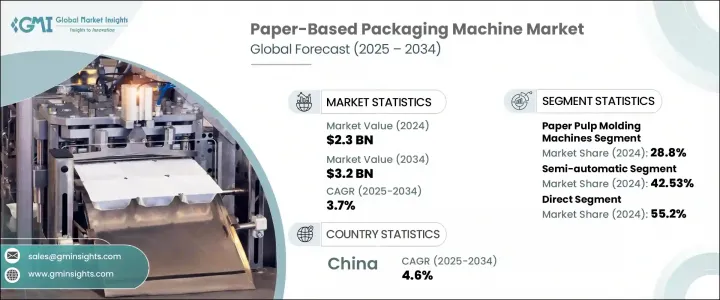
세계의 종이 기반 포장기 시장은 2024년에는 23억 달러로 평가되었고, CAGR 3.7%로 성장할 전망이며, 2034년에는 32억 달러에 이를 것으로 추정되고 있습니다.
이 성장은 환경 의식 증가와 지속 가능한 포장 대체품으로의 세계 변화가 큰 요인이 되고 있습니다. 플라스틱의 사용량을 줄이고 이산화탄소 배출량을 삭감하는 솔루션에 대한 소비자나 기업 수요가 높아지는 가운데, 재활용 가능하고 퇴비화할 수 있는 종이가 선호되는 선택지가 되고 있습니다. 식품에서 퍼스널케어, 온라인 소매에 이르기까지 다양한 분야에서 종이 기반 포장이 채용되고 있습니다. 그 결과, 포장기 제조업체는 지속가능성의 목표에 따라, 내구성이 있고 환경에 배려한 상자나 랩을 효율적으로 생산할 수 있는 보다 선진적인 고속 머신을 개발하게 되고 있습니다.
온라인 쇼핑의 급속한 확대로 신뢰성이 높고 경량인 포장에 대한 수요는 점점 높아지고 있습니다. 기업은 현재 보호성이 있으면서 효율적으로 출하할 수 있는 솔루션을 요구하고 있으며, 종이는 이러한 기준에 적합합니다. 최신 기계는 자동화와 정밀도를 도입하여 인건비를 절감하고 일관성을 높이면서 대량 생산을 실현합니다. 장벽성을 향상시킨 다층 종이 옵션과 같은 혁신은 종이 기반 포맷을 보다 광범위한 용도로 실행 가능하게 하고 있습니다. 이러한 선진 패키징에 의해, 패키징 프로바이더는 소비자의 기대에 부응해, 점점 엄격해지는 환경 규제에 대응해, 업계 전체의 근대화를 추진하고 있습니다.
| 시장 범위 | |
|---|---|
| 시작 연도 | 2024년 |
| 예측 연도 | 2025-2034년 |
| 시작 금액 | 23억 달러 |
| 예측 금액 | 32억 달러 |
| CAGR | 3.7% |
2024년 종이 펄프 성형기 부문의 점유율은 28.8%로 평가되었고, 2034년까지 연평균 복합 성장률(CAGR)은 4.4%로 성장할 전망입니다. 특히 소비재, 일렉트로닉스, 식품 분야에서는, 생분해성으로 지속 가능한 패키징에 대한 요구가 높아지고 있어 성형 펄프 솔루션에 대한 수요를 뒷받침하고 있습니다. 이 기계들은 트레이 및 용기와 같은 3차원 구조를 제조하는 능력에 특징이 있어 높은 보호 효과와 환경 이점을 제공합니다. 종이봉투나 골판지 상자를 제조하는 기계에 비해 펄프 몰드 시스템은 폭넓은 용도에 대응하며, 특히 스티로폼 포장이 전 세계적으로 폐지되는 가운데 보다 우수한 플라스틱 대체품을 제공합니다.
반자동기 부문은 2024년에 42.53%의 점유율을 차지했으며, 2025-2034년 연평균 복합 성장률(CAGR) 4.1%로 성장할 것으로 예측됩니다. 이 우위성은 이러한 기계가 비용 효율, 성능, 적응성 사이에서 최적의 균형을 제공하고 있는 것에 기인하고 있습니다. 반자동 시스템은 중소기업에 있어서 매력적이며, 전자동 시스템과 같은 고액의 투자 및 유지보수의 필요 없이 포장 품질의 향상을 실현합니다. 이러한 기계는 전문적인 훈련의 필요성도 적고 관리도 쉽기 때문에 여전히 수작업을 통한 감시에 의지하고 있는 확장성 높은 운영에 적합한 선택지가 되고 있습니다.
아시아태평양 종이 기반 포장기 시장은 2025-2034년 연평균 복합 성장률(CAGR) 4.6%로 성장할 것으로 예측됩니다. 중국의 리더십 원동력은 대규모 제조 기지, 지속가능성에 대한 정부 지원 정책, 대량 생산을 위한 강력한 인프라입니다. 플라스틱 사용량을 최소화하려는 중국의 노력은 세계의 환경 보호 노력과 일치하며, 선진적인 종이 기반 포장 시스템의 채택을 더욱 가속화하고 있습니다. 풍부한 공급망, 숙련된 노동력, 친환경 대체품에 대한 국내 수요의 증가로 중국은 이 업계의 지역 역학을 계속 형성하고 있습니다.
종이 기반 포장기 시장 경쟁 구도를 형성하는 주요 기업은 FUJI Machinery, Huhtamaki, OPTIMA Packaging Group, Bobst 등입니다. 시장에서의 존재감을 높이기 위해 이 분야의 주요 기업은 기술 혁신, 세계 전개, 비용 효율에 중점을 둔 전략을 실시했습니다. 대기업은 연구개발에 투자하여 보다 고정밀이고 낭비가 적은 차세대 기계를 개발하고 있습니다. 또, 업계를 초월한 다양한 고객 요구에 대응하기 위해, 모듈식으로 에너지 효율이 높은 기기에도 주력하고 있습니다. 파트너십과 인수를 통한 지리적 성장은 특히 아시아태평양 지역의 신시장 개척에 도움이 되고 있습니다. 많은 기업들은 애프터서비스를 강화하고 스마트 오토메이션 기능을 통합함으로써 가동률을 향상시키고 운영 비용을 절감하며 경쟁력을 강화하는 장기적인 고객 관계를 구축하고 있습니다.
목차
제1장 조사 방법 및 범위
제2장 주요 요약
제3장 업계 인사이트
- 생태계 분석
- 공급자의 상황
- 이익률
- 각 단계에서의 부가가치
- 밸류체인에 영향을 주는 요인
- 혁신
- 업계에 미치는 영향요인
- 성장 촉진요인
- 환경 친화적이고 지속 가능한 포장에 대한 수요 증가
- 전자상거래 확대, 포장 요구 증가
- 포장기의 기술 진보
- 업계의 잠재적 위험 및 과제
- 높은 초기 자본 투자 및 운영 비용
- 다양한 패키지 형식에 대한 적응의 복잡성
- 기회
- 성장 촉진요인
- 성장 가능성 분석
- 장래 시장 동향
- 기술 및 혁신의 상황
- 현재의 기술 동향
- 신흥 기술
- 가격 동향
- 지역별
- 기계 유형별
- 규제 프레임워크
- 규격 및 인증
- 환경 규제
- 수출입 규제
- Porter's Five Forces 분석
- PESTEL 분석
제4장 경쟁 구도
- 서문
- 기업의 시장 점유율 분석
- 지역별
- 기업 매트릭스 분석
- 주요 시장 기업의 경쟁 분석
- 경쟁 포지셔닝 매트릭스
- 주요 발전
- 합병 및 인수
- 파트너십 및 협업
- 신제품 발매
- 확장 계획
제5장 시장 추계 및 예측 : 기종별(2021-2034년)
- 주요 동향
- 종이 펄프 성형기
- 종이봉지 제조기
- 골판지 상자 제조기
- 종이관, 캔 및 빨대 제조기
- 판지 조립 및 접는 기계
- 종이컵 및 접시 제조기
- 인쇄기 및 라미네이트기
- 절단기 및 슬리터
제6장 시장 추계 및 예측 : 동작 모드별(2021-2034년)
- 주요 동향
- 수동
- 자동
- 반자동
제7장 시장 추계 및 예측 : 포장별(2021-2034년)
- 주요 동향
- 판지
- 판지
- 종이 가방
- 종이제 수송 봉투
제8장 시장 추계 및 예측 : 용도별(2021-2034년)
- 주요 동향
- 의료용품 및 기기
- 가정용품
- 전자상거래
- 자동차
- 일렉트로닉스
- 출판 및 서점
- 기타
제9장 시장 추계 및 예측 : 유통 채널별(2021-2034년)
- 주요 동향
- 직접
- 간접
제10장 시장 추계 및 예측 : 지역별(2021-2034년)
- 주요 동향
- 북미
- 미국
- 캐나다
- 유럽
- 독일
- 영국
- 프랑스
- 이탈리아
- 스페인
- 아시아태평양
- 중국
- 인도
- 일본
- 한국
- 호주
- 라틴아메리카
- 브라질
- 멕시코
- 중동 및 아프리카
- 남아프리카
- 사우디아라비아
- 아랍에미리트(UAE)
제11장 기업 프로파일
- Bobst
- BVM Brunner
- DS Smith
- Edale
- FUJI MACHINERY CO., LTD
- Heidelberger Druckmaschinen AG
- Huhtamaki
- Manroland Goss
- Mark Andy
- OMET Srl
- OPTIMA Packaging Group
- PAC Machinery
- Pakea
- Parason
- Windmoller &Holscher
The Global Paper-Based Packaging Machine Market was valued at USD 2.3 billion in 2024 and is estimated to grow at a CAGR of 3.7% to reach USD 3.2 billion by 2034. This growth is largely driven by rising environmental awareness and a strong global shift toward sustainable packaging alternatives. With increased consumer and corporate demand for solutions that lower plastic use and reduce carbon emissions, paper has become a preferred choice thanks to its recyclability and compostability. From food to personal care to online retail, multiple sectors are embracing paper-based packaging. As a result, packaging equipment manufacturers are now developing more advanced, high-speed machines that can efficiently produce durable, eco-conscious boxes and wraps in line with sustainability goals.
The rapid expansion of online shopping has only intensified demand for reliable and lightweight packaging. Businesses now require solutions that are protective yet efficient for shipping, and paper fits these criteria. The latest machines provide high-volume output while incorporating automation and precision to reduce labor costs and enhance consistency. Innovations like multi-layer paper options with improved barriers are making paper-based formats viable for broader applications. These advancements allow packaging providers to keep pace with evolving consumer expectations and adapt to increasingly strict environmental regulations, driving industry-wide modernization.
| Market Scope | |
|---|---|
| Start Year | 2024 |
| Forecast Year | 2025-2034 |
| Start Value | $2.3 Billion |
| Forecast Value | $3.2 Billion |
| CAGR | 3.7% |
In 2024, the paper pulp molding machines segment held a 28.8% share and is forecast to grow at a CAGR of 4.4% through 2034. The increasing need for biodegradable and sustainable packaging, especially in consumer goods, electronics, and food sectors, is fueling demand for molded pulp solutions. These machines are unique in their ability to produce three-dimensional structures such as trays and containers, offering high protection and environmental benefits. Compared to machines that manufacture paper bags or corrugated boxes, pulp molding systems support a broader range of applications and provide better plastic alternatives, especially as foam packaging is phased out globally.
The semi-automatic machine segment held a 42.53% share in 2024 and is expected to grow at a CAGR of 4.1% between 2025 and 2034. This dominance is attributed to the optimal balance these machines offer between cost-efficiency, performance, and adaptability. Semi-automatic systems are attractive to small and medium-sized enterprises, providing enhanced packaging quality without the heavy investment and maintenance requirements of fully automatic systems. These machines also demand less specialized training and are easier to manage, making them a preferred choice for scalable operations that still rely on manual oversight.
Asia-Pacific Paper-Based Packaging Machine Market is projected to grow at a CAGR of 4.6% from 2025 to 2034. China's leadership is driven by its large-scale manufacturing base, supportive government policies on sustainability, and strong infrastructure for high-volume production. The country's commitment to minimizing plastic usage aligns with global environmental efforts, further accelerating the adoption of advanced paper-based packaging systems. With an abundant supply chain, skilled labor, and growing domestic demand for eco-friendly alternatives, China continues to shape the regional dynamics of this industry.
Major players shaping the competitive landscape of the Paper-Based Packaging Machine Market include FUJI Machinery, Huhtamaki, OPTIMA Packaging Group, and Bobst. To strengthen their market presence, key companies in this space are implementing targeted strategies that emphasize technological innovation, global expansion, and cost efficiency. Leading firms are investing in R&D to develop next-gen machines capable of higher precision and reduced waste. They're also focusing on modular, energy-efficient equipment to cater to diverse customer needs across industries. Geographic growth through partnerships and acquisitions helps them tap into new markets, especially in Asia-Pacific. Many are enhancing after-sales service and integrating smart automation features to improve uptime, lower operational costs, and build long-term client relationships that solidify their competitive edge.
Table of Contents
Chapter 1 Methodology and Scope
- 1.1 Market scope and definition
- 1.2 Research design
- 1.2.1 Research approach
- 1.2.2 Data collection methods
- 1.3 Data mining sources
- 1.3.1 Global
- 1.3.2 Regional/Country
- 1.4 Base estimates and calculations
- 1.4.1 Base year calculation
- 1.4.2 Key trends for market estimation
- 1.5 Primary research and validation
- 1.5.1 Primary sources
- 1.6 Forecast model
- 1.7 Research assumptions and limitations
Chapter 2 Executive Summary
- 2.1 Industry 3600 synopsis
- 2.2 Key market trends
- 2.2.1 Machine type
- 2.2.2 Mode of operation
- 2.2.3 Packaging
- 2.2.4 Application
- 2.2.5 Distribution Channel
- 2.3 CXO perspectives: Strategic imperatives
- 2.3.1 Key decision points for industry executives
- 2.3.2 Critical success factors for market players
- 2.4 Future outlook and strategic recommendations
Chapter 3 Industry Insights
- 3.1 Industry ecosystem analysis
- 3.1.1 Supplier landscape
- 3.1.2 Profit margin
- 3.1.3 Value addition at each stage
- 3.1.4 Factor affecting the value chain
- 3.1.5 Disruptions
- 3.2 Industry impact forces
- 3.2.1 Growth drivers
- 3.2.1.1 Growing demand for eco-friendly and sustainable packaging
- 3.2.1.2 Expansion of e-commerce, boosting packaging needs
- 3.2.1.3 Technological advancements in packaging machinery
- 3.2.2 Industry pitfalls & challenges
- 3.2.2.1 High initial capital investment and operational costs
- 3.2.2.2 Complexity in adapting to diverse packaging formats
- 3.2.3 Opportunities
- 3.2.1 Growth drivers
- 3.3 Growth potential analysis
- 3.4 Future market trends
- 3.5 Technology and innovation landscape
- 3.5.1 Current technological trends
- 3.5.2 Emerging technologies
- 3.6 Price trends
- 3.6.1 By region
- 3.6.2 By machine type
- 3.7 Regulatory framework
- 3.7.1 Standards and certifications
- 3.7.2 Environmental regulations
- 3.7.3 Import export regulations
- 3.8 Porter's five forces analysis
- 3.9 PESTEL analysis
Chapter 4 Competitive Landscape, 2024
- 4.1 Introduction
- 4.2 Company market share analysis
- 4.2.1 By region
- 4.2.1.1 North America
- 4.2.1.2 Europe
- 4.2.1.3 Asia Pacific
- 4.2.1.4 Latin America
- 4.2.1.5 MEA
- 4.2.1 By region
- 4.3 Company matrix analysis
- 4.4 Competitive analysis of major market players
- 4.5 Competitive positioning matrix
- 4.6 Key developments
- 4.6.1 Mergers & acquisitions
- 4.6.2 Partnerships & collaborations
- 4.6.3 New Product Launches
- 4.6.4 Expansion Plans
Chapter 5 Market Estimates & Forecast, By Machine Type, 2021-2034 (USD Billion) (Units)
- 5.1 Key trends
- 5.2 Paper pulp molding machines
- 5.3 Paper bag making machines
- 5.4 Corrugated box making machines
- 5.5 Paper tube/can/straw making machines
- 5.6 Carton erecting & folding machines
- 5.7 Paper cup/plate making machines
- 5.8 Printing and lamination machines
- 5.9 Cutting & slitting machines
Chapter 6 Market Estimates & Forecast, By Mode of Operation, 2021-2034 (USD Billion) (Units)
- 6.1 Key trends
- 6.2 Manual
- 6.3 Automatic
- 6.4 Semi-automatic
Chapter 7 Market Estimates & Forecast, By Packaging, 2021-2034 (USD Billion) (Units)
- 7.1 Key trends
- 7.2 Cardboard
- 7.3 Paperboard
- 7.4 Paper bags
- 7.5 Paper shipping sacks
Chapter 8 Market Estimates & Forecast, By Application, 2021-2034 (USD Billion) (Units)
- 8.1 Key trends
- 8.2 Medical supplies & equipment
- 8.3 Home goods
- 8.4 E-Commerce
- 8.5 Automotive
- 8.6 Electronics
- 8.7 Publishing/Booksellers
- 8.8 Other
Chapter 9 Market Estimates & Forecast, By Distribution Channel, 2021-2034 (USD Billion) (Units)
- 9.1 Key trends
- 9.2 Direct
- 9.3 Indirect
Chapter 10 Market Estimates & Forecast, By Region, 2021-2034 (USD Billion) (Units)
- 10.1 Key trends
- 10.2 North America
- 10.2.1 U.S.
- 10.2.2 Canada
- 10.3 Europe
- 10.3.1 Germany
- 10.3.2 UK
- 10.3.3 France
- 10.3.4 Italy
- 10.3.5 Spain
- 10.4 Asia Pacific
- 10.4.1 China
- 10.4.2 India
- 10.4.3 Japan
- 10.4.4 South Korea
- 10.4.5 Australia
- 10.5 Latin America
- 10.5.1 Brazil
- 10.5.2 Mexico
- 10.6 MEA
- 10.6.1 South Africa
- 10.6.2 Saudi Arabia
- 10.6.3 UAE
Chapter 11 Company Profiles
- 11.1 Bobst
- 11.2 BVM Brunner
- 11.3 DS Smith
- 11.4 Edale
- 11.5 FUJI MACHINERY CO., LTD
- 11.6 Heidelberger Druckmaschinen AG
- 11.7 Huhtamaki
- 11.8 Manroland Goss
- 11.9 Mark Andy
- 11.10 OMET Srl
- 11.11 OPTIMA Packaging Group
- 11.12 PAC Machinery
- 11.13 Pakea
- 11.14 Parason
- 11.15 Windmoller & Holscher