



|
시장보고서
상품코드
1797747
숙박시설 건설 및 리노베이션 시장 : 기회, 성장 촉진요인, 산업 동향 분석, 예측(2025-2034년)Lodging Construction and Renovation Market Opportunity, Growth Drivers, Industry Trend Analysis, and Forecast 2025 - 2034 |
||||||

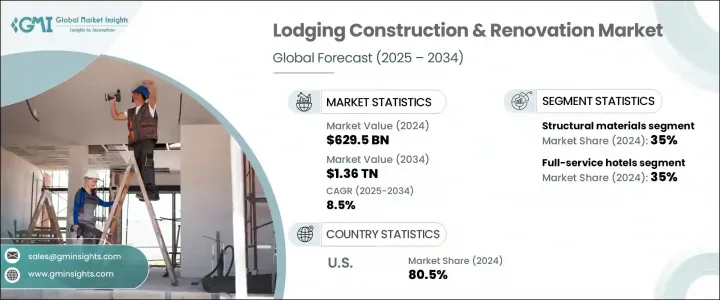
세계의 숙박 시설 건설 및 리노베이션 시장은 2024년 6,295억 달러로 평가되었으며 CAGR 8.5%로 성장하여 2034년까지 1조 3,600억 달러에 이를 것으로 추정됩니다.
이 분야는 지속가능한 건축기술, 모듈 설계, 통합 스마트 인프라의 채택에 부추겨져 현저한 변혁기를 맞이하고 있습니다. 현대적인 숙박시설에서는 에너지 효율적인 시스템, 디지털 설계 기술, 환경에 배려한 소재의 도입이 진행되고 있기 때문에 건설 전문가는 진화하는 규제나 숙박객의 기대에 맞추어, 학제적인 스킬을 익혀 진화해야 합니다. 전통적인 리노베이션에서 디지털 자산 관리, 실시간 운영 및 지속 가능한 재사용을 다루는 라이프사이클 중심의 계획으로의 전환이 가속화되고 있습니다. 브랜드 주도의 건설 기준과 관민의 자금 조달 모델이 대규모 숙박 시설의 업그레이드를 합리화하고 있습니다. 개발자는 예지 보전, IoT 연결, 공기 청정 및 항균 마감 등 건강에 초점을 맞춘 투숙객을 위한 기술을 갖춘 차세대 인프라를 선호합니다.
이러한 혁신은 새로운 도시형 숙박 시설과 고급 숙박 시설의 개념을 빠르게 형성하고 접객 공간을 설계, 건설 및 경험하는 방식을 재정의합니다. 개발자들은 진화하는 숙박객의 기대에 부응하는 고도의 첨단 기술을 갖춘 첨단 환경을 창조하기 위해 스마트 인프라, 모듈식 건설 기술 및 지속 가능한 건축자재를 점점 더 많이 도입하고 있습니다. 에너지 효율적인 시스템과 비접촉형 서비스부터 AI를 활용한 숙박객의 개인화 및 디지털 컨시어지 플랫폼에 이르기까지 최신 숙박 시설 개발은 운영의 민첩성과 쾌적성 향상에 중점을 두고 있습니다. 또한 대도시 지역의 럭셔리 호텔은 디자인의 유연성을 통합하여 레저와 비즈니스 여행객 모두를 위한 다기능 공간을 제공합니다.
| 시장 범위 | |
|---|---|
| 시작 연도 | 2024년 |
| 예측 연도 | 2025-2034년 |
| 시작 금액 | 6,295억 달러 |
| 예측 금액 | 1조 3,600억 달러 |
| CAGR | 8.5% |
구조물 부문은 2024년에 35%의 점유율을 차지했으며, 2034년까지 연평균 복합 성장률(CAGR) 8%를 보일 것으로 예측됩니다. 복합 프레임워크, 구조용 강철, 인공 목재, 철근 콘크리트 등의 재료는 신규 개발과 부동산 재개발 프로젝트 모두의 핵심을 형성합니다. 수직 확장성, 지역별 내진 기준, 구조적 긴 수명을 지원하는 능력은 고급 및 중급 부동산 클래스에서 필수적입니다.
풀서비스 호텔 부문은 2024년 35%의 최대 점유율을 차지했습니다. 이 호텔은 스파 및 컨퍼런스 센터에서 여러 식사 옵션에 이르기까지 다양한 시설을 갖추고 있기 때문에 시장의 중심적인 존재이며, 시장의 매력을 유지하고 진화하는 접객 동향에 맞추기 위해서는 더 빈번한 업데이트가 필요합니다. 풀 서비스형 숙박 시설에 대한 투자는 특히 프리미엄 여행 코리도와 도시 재개발 지역에 집중되어 있습니다.
미국의 숙박시설 건설 및 리노베이션 시장 점유율은 2024년 80.5%, 시장 규모는 1,358억 달러였습니다. 그 리더십은 첨단 관광 인프라, 접객에 대한 부동산 투자 확대, 기술 주도 개발 기법의 적극적인 전개에 기인합니다. 지속 가능한 건설과 프랜차이즈 배포의 광범위한 통합으로 미국은 차세대 접객 프로젝트의 중요한 허브가되고 있습니다. 미국의 주요 호텔 운영 회사는 모듈식 건축, ESG 기준, 적합 설계 전략을 결합한 프로젝트의 선두에 서 있습니다.
시장 포지션을 강화하기 위해 숙박 시설 건설 및 리노베이션의 주요 기업은 모듈 건설 기술에 많은 투자를 실시하여 프로젝트 기간과 환경 영향을 줄입니다. 각 회사는 또한 규제 준수 및 LEED 인증 취득을 위해 개발 전략을 그린 빌딩 기준에 맞추고 있습니다. 기술 공급업체와의 전략적 파트너십은 스마트룸 컨트롤, 에너지 절약 시스템, 디지털 트윈을 신축 및 재건축 건물에 통합하는 데 도움이 됩니다.
목차
제1장 조사 방법
- 시장의 범위와 정의
- 조사 디자인
- 조사 접근
- 데이터 수집 방법
- 데이터 마이닝 소스
- 세계
- 지역/국가
- 기본 추정과 계산
- 기준연도 계산
- 시장 예측의 주요 동향
- 1차 조사와 검증
- 1차 정보
- 예측 모델
- 조사의 전제와 한계
제2장 주요 요약
제3장 업계 인사이트
- 생태계 분석
- 공급자의 상황
- 이익률 분석
- 비용 구조
- 각 단계에서의 부가가치
- 밸류체인에 영향을 주는 요인
- 혁신
- 업계에 미치는 영향요인
- 성장 촉진요인
- 코로나 후의 관광 및 비즈니스 여행 급증
- 지속가능성과 그린빌딩 의무
- 디지털 게스트 경험의 통합
- 프랜차이즈의 확대와 브랜드의 표준화
- 업계의 잠재적 위험 및 과제
- 고비용 도시 프로젝트에 과도하게 의존
- 리노베이션의 복잡성을 과소 평가
- 시장 기회
- 노동력과 숙련노동자 부족
- 불안정한 원재료 가격과 공급망의 혼란
- 성장 촉진요인
- 성장 가능성 분석
- 규제 상황
- 북미
- 유럽
- 아시아태평양
- 라틴아메리카
- 중동 및 아프리카
- Porter's Five Forces 분석
- PESTLE 분석
- 기술과 혁신의 상황
- 현재의 기술 동향
- 신흥기술
- 스킬 갭 분석과 인재 개발
- 현재의 RPA 스킬 부족의 평가
- 미래의 노동력 요건
- 스킬업과 재교육의 대처
- 기업연수와 개인인정
- 학술기관과의 제휴
- 정부 연수 프로그램
- RPA에서의 캐리어 패스 개발
- 가격 분석과 비용 모델
- 연수비용 구조분석
- 벤더의 가격 전략
- 구독 모델과 일괄 지불 모델
- 기업 연수 패키지의 가격
- 인증 비용 분석
- 연수 투자의 ROI 평가
- 플랫폼 간 비용 비교
- 특허 분석
- 지속가능성과 환경 측면
- 지속가능한 관행
- 폐기물 감축 전략
- 생산에서의 에너지 효율
- 환경 친화적인 노력
- 탄소발자국의 고려
- 이용 사례
- 최상의 시나리오
제4장 경쟁 구도
- 소개
- 기업의 시장 점유율 분석
- 북미
- 유럽
- 아시아태평양
- 라틴아메리카
- 중동 및 아프리카
- 주요 시장 기업의 경쟁 분석
- 경쟁 포지셔닝 매트릭스
- 전략적 전망 매트릭스
- 주요 발전
- 합병 및 인수
- 파트너십 및 협업
- 신제품 발매
- 확장계획과 자금조달
제5장 시장 추계 및 예측 : 호텔별, 2021-2034년
- 주요 동향
- 풀 서비스 호텔
- 한정 서비스 호텔
- 전문 호텔
- 대체 숙박 시설
제6장 시장 추계 및 예측 : 프로젝트별, 2021-2034년
- 주요 동향
- 신규 호텔 건설
- 호텔 리노베이션 및 개조
- 호텔 확장 및 증축
- 전환 및 적응형 사용 프로젝트
- 탄소섬유
제7장 시장 추계 및 예측 : 재료 유형별, 2021-2034년
- 주요 동향
- 구조재료
- 건물 외장재
- 내부 마감재
- MEP 재료 및 장비
제8장 시장 추계 및 예측 : 공법별, 2021-2034년
- 주요 동향
- 기존 건설 방법
- 모듈식 및 조립식 건설
- 고급 건설 기술
- 지속 가능한 건설 방법
제9장 시장 추계 및 예측 : 지역별, 2021-2034년
- 주요 동향
- 북미
- 미국
- 캐나다
- 유럽
- 영국
- 독일
- 프랑스
- 이탈리아
- 스페인
- 러시아
- 북유럽 국가
- 아시아태평양
- 중국
- 인도
- 일본
- 호주
- 한국
- 싱가포르
- 베트남
- 태국
- 필리핀
- 라틴아메리카
- 브라질
- 멕시코
- 아르헨티나
- 중동 및 아프리카
- 남아프리카
- 사우디아라비아
- 아랍에미리트(UAE)
제10장 기업 프로파일
- 건설회사
- Clark Construction Group
- Skanska
- Turner Construction
- Whiting-Turner Contracting
- DPR Construction
- 건축 및 설계 리더
- Gensler
- HKS
- Perkins & Will
- WATG
- 접객 전문 기업
- Hensel Phelps Construction
- Mortenson Construction
- Suffolk Construction
- 지속 가능한 건설 회사
- Lendlease
- Webcor Builders
- 모듈러 및 조립식 건설 회사
- AccorHotels
- Hilton Worldwide
- Hilton Worldwide Holdings
- Host Hotels & Resorts
- Hyatt Hotels Corporation
- InterContinental Hotels Group
- Marriott International
The Global Lodging Construction & Renovation Market was valued at USD 629.5 billion in 2024 and is estimated to grow at a CAGR of 8.5% to reach USD 1.36 trillion by 2034. The sector is undergoing a notable transformation fueled by the adoption of sustainable building techniques, modular designs, and integrated smart infrastructure. As modern lodging facilities increasingly embed energy-efficient systems, digital design technologies, and environmentally conscious materials, construction professionals must evolve with multidisciplinary skills to align with evolving regulations and guest expectations. The shift from conventional renovations to lifecycle-focused planning-covering digital asset management, real-time operations, and sustainable reuse-is accelerating. Brand-led construction standards and public-private funding models are streamlining large-scale lodging upgrades. Developers are prioritizing next-gen infrastructure with predictive maintenance, IoT connectivity, and health-focused guest technologies, including air purification and antimicrobial finishes.
These innovations are rapidly shaping new urban and upscale lodging concepts, redefining the way hospitality spaces are designed, built, and experienced. Developers are increasingly incorporating smart infrastructure, modular construction techniques, and sustainable building materials to create adaptive, tech-forward environments that meet evolving guest expectations. From energy-efficient systems and contactless services to AI-enabled guest personalization and digital concierge platforms, modern lodging developments are focusing on operational agility and elevated comfort. Upscale hotels in metropolitan areas also embracing design flexibility, allowing for multifunctional spaces that cater to both leisure and business travelers.
| Market Scope | |
|---|---|
| Start Year | 2024 |
| Forecast Year | 2025-2034 |
| Start Value | $629.5 Billion |
| Forecast Value | $1.36 Trillion |
| CAGR | 8.5% |
The structural materials segment held a 35% share in 2024 and is projected to grow at a CAGR of 8% through 2034. Materials such as composite frameworks, structural steel, engineered wood, and reinforced concrete form the backbone of both new development and property redevelopment projects. Their ability to support vertical scalability, regional seismic codes, and structural longevity makes them essential across upscale and mid-tier property classes.
The Full-service hotels segment held the largest share in 2024, accounting for 35% share. These properties are central to the market due to their extensive facilities-ranging from spas and conference centers to multiple dining options-which require more frequent updates to retain market appeal and align with evolving hospitality trends. Full-service lodging investments are particularly concentrated in premium travel corridors and urban renewal areas.
United States Lodging Construction and Renovation Market held an 80.5% share and generated USD 135.8 billion in 2024. Its leadership stems from an advanced tourism infrastructure, growing real estate investment in hospitality, and the proactive deployment of technology-driven development methods. With widespread integration of sustainable construction and franchise expansion, the U.S. remains a key hub for next-generation hospitality projects. Major U.S. hotel operators continue to spearhead projects that combine modular buildouts, ESG criteria, and adaptive design strategies.
Notable companies active in the Lodging Construction and Renovation Market include InterContinental Hotels (IHG), Barton Malow, AccorHotels, Hilton Worldwide, Gilbane Building, Clark Construction, Balfour Beatty US, Hyatt Hotels, DPR Construction, and Hensel Phelps Construction. To enhance their market position, leading players in lodging construction and renovation are investing heavily in modular construction technologies, reducing project timelines and environmental impact. Companies are also aligning their development strategies with green building standards to meet regulatory compliance and secure LEED certifications. Strategic partnerships with technology vendors help integrate smart room controls, energy-saving systems, and digital twins into new and renovated properties.
Table of Contents
Chapter 1 Methodology
- 1.1 Market scope and definition
- 1.2 Research design
- 1.2.1 Research approach
- 1.2.2 Data collection methods
- 1.3 Data mining sources
- 1.3.1 Global
- 1.3.2 Regional/Country
- 1.4 Base estimates and calculations
- 1.4.1 Base year calculation
- 1.4.2 Key trends for market estimation
- 1.5 Primary research and validation
- 1.5.1 Primary sources
- 1.6 Forecast model
- 1.7 Research assumptions and limitations
Chapter 2 Executive Summary
- 2.1 Industry 360° synopsis, 2021 - 2034
- 2.2 Key market trends
- 2.2.1 Regional
- 2.2.2 Hotel
- 2.2.3 Project
- 2.2.4 Material category
- 2.2.5 Construction method
- 2.3 TAM Analysis, 2025-2034
- 2.4 CXO perspectives: Strategic imperatives
- 2.4.1 Executive decision points
- 2.4.2 Critical success factors
- 2.5 Future outlook and strategic recommendations
Chapter 3 Industry Insights
- 3.1 Industry ecosystem analysis
- 3.1.1 Supplier landscape
- 3.1.2 Profit margin analysis
- 3.1.3 Cost structure
- 3.1.4 Value addition at each stage
- 3.1.5 Factor affecting the value chain
- 3.1.6 Disruptions
- 3.2 Industry impact forces
- 3.2.1 Growth drivers
- 3.2.1.1 Surge in tourism & business travel post-covid
- 3.2.1.2 Sustainability & green building mandates
- 3.2.1.3 Digital guest experience integration
- 3.2.1.4 Franchise expansion and brand standardization
- 3.2.2 Industry pitfalls and challenges
- 3.2.2.1 Over-reliance on high-cost urban projects
- 3.2.2.2 Underestimating renovation complexity
- 3.2.3 Market opportunities
- 3.2.3.1 Labor & skilled workforce shortages
- 3.2.3.2 Volatile material prices & supply chain disruptions
- 3.2.1 Growth drivers
- 3.3 Growth potential analysis
- 3.4 Regulatory landscape
- 3.4.1 North America
- 3.4.2 Europe
- 3.4.3 Asia Pacific
- 3.4.4 Latin America
- 3.4.5 Middle East & Africa
- 3.5 Porter's analysis
- 3.6 PESTEL analysis
- 3.7 Technology and Innovation landscape
- 3.7.1 Current technological trends
- 3.7.2 Emerging technologies
- 3.8 Skills gap analysis and workforce development
- 3.8.1 Current RPA skills shortage assessment
- 3.8.2 Future workforce requirements
- 3.8.3 Reskilling and upskilling initiatives
- 3.8.4 Corporate training vs individual certification
- 3.8.5 Academic institution partnerships
- 3.8.6 Government training programs
- 3.8.7 Career path development in RPA
- 3.9 Pricing analysis and cost models
- 3.9.1 Training cost structure analysis
- 3.9.2 Vendor pricing strategies
- 3.9.3 Subscription vs one-time payment models
- 3.9.4 Corporate training package pricing
- 3.9.5 Certification cost analysis
- 3.9.6 ROI assessment for training investments
- 3.9.7 Cost comparison across platforms
- 3.10 Patent analysis
- 3.11 Sustainability and environmental aspects
- 3.11.1 Sustainable practices
- 3.11.2 Waste reduction strategies
- 3.11.3 Energy efficiency in production
- 3.11.4 Eco-friendly Initiatives
- 3.11.5 Carbon footprint considerations
- 3.12 Use cases
- 3.13 Best-case scenario
Chapter 4 Competitive Landscape, 2024
- 4.1 Introduction
- 4.2 Company market share analysis
- 4.2.1 North America
- 4.2.2 Europe
- 4.2.3 Asia Pacific
- 4.2.4 LATAM
- 4.2.5 MEA
- 4.3 Competitive analysis of major market players
- 4.4 Competitive positioning matrix
- 4.5 Strategic outlook matrix
- 4.6 Key developments
- 4.6.1 Mergers & acquisitions
- 4.6.2 Partnerships & collaborations
- 4.6.3 New Product Launches
- 4.6.4 Expansion Plans and funding
Chapter 5 Market Estimates & Forecast, By Hotel, 2021 - 2034 ($Bn)
- 5.1 Key trends
- 5.2 Full-service hotels
- 5.3 Limited-service hotels
- 5.4 Specialty hotels
- 5.5 Alternative accommodation
Chapter 6 Market Estimates & Forecast, By Project, 2021 - 2034 ($Bn)
- 6.1 Key trends
- 6.2 New hotel construction
- 6.3 Hotel renovation and refurbishment
- 6.4 Hotel expansions and additions
- 6.5 Conversion and adaptive reuse project
- 6.6 Carbon fiber
Chapter 7 Market Estimates & Forecast, By Material Category, 2021 - 2034 ($Bn)
- 7.1 Key trends
- 7.2 Structural materials
- 7.3 Building envelope materials
- 7.4 Interior finish materials
- 7.5 MEP materials and equipment
Chapter 8 Market Estimates & Forecast, By Construction Method, 2021 - 2034 ($Bn)
- 8.1 Key trends
- 8.2 Traditional construction methods
- 8.3 Modular and prefabricated construction
- 8.4 Advanced construction technologies
- 8.5 Sustainable construction methods
Chapter 9 Market Estimates & Forecast, By Region, 2021 - 2034 ($Bn)
- 9.1 Key trends
- 9.2 North America
- 9.2.1 US
- 9.2.2 Canada
- 9.3 Europe
- 9.3.1 UK
- 9.3.2 Germany
- 9.3.3 France
- 9.3.4 Italy
- 9.3.5 Spain
- 9.3.6 Russia
- 9.3.7 Nordics
- 9.4 Asia Pacific
- 9.4.1 China
- 9.4.2 India
- 9.4.3 Japan
- 9.4.4 Australia
- 9.4.5 South Korea
- 9.4.6 Singapore
- 9.4.7 Vietnam
- 9.4.8 Thailand
- 9.4.9 Philippines
- 9.5 Latin America
- 9.5.1 Brazil
- 9.5.2 Mexico
- 9.5.3 Argentina
- 9.6 MEA
- 9.6.1 South Africa
- 9.6.2 Saudi Arabia
- 9.6.3 UAE
Chapter 10 Company Profiles
- 10.1 Construction companies
- 10.1.1 Clark Construction Group
- 10.1.2 Skanska
- 10.1.3 Turner Construction
- 10.1.4 Whiting-Turner Contracting
- 10.1.5 DPR Construction
- 10.2 Architecture and design leaders
- 10.2.1 Gensler
- 10.2.2 HKS
- 10.2.3 Perkins & Will
- 10.2.4 WATG
- 10.3 Hospitality-specialized companies
- 10.3.1 Hensel Phelps Construction
- 10.3.2 Mortenson Construction
- 10.3.3 Suffolk Construction
- 10.4 Sustainable construction companies
- 10.4.1 Lendlease
- 10.4.2 Webcor Builders
- 10.5 Modular and prefabricated construction companies
- 10.5.1 AccorHotels
- 10.5.2 Hilton Worldwide
- 10.5.3 Hilton Worldwide Holdings
- 10.5.4 Host Hotels & Resorts
- 10.5.5 Hyatt Hotels Corporation
- 10.5.6 InterContinental Hotels Group
- 10.5.7 Marriott International

(주말 및 공휴일 제외)
