
|
시장보고서
상품코드
1801829
특수 및 맞춤형 기계 시장 : 기회, 성장 촉진요인, 산업 동향 분석 및 예측(2025-2034년)Special and Custom Machinery Market Opportunity, Growth Drivers, Industry Trend Analysis, and Forecast 2025 - 2034 |
||||||

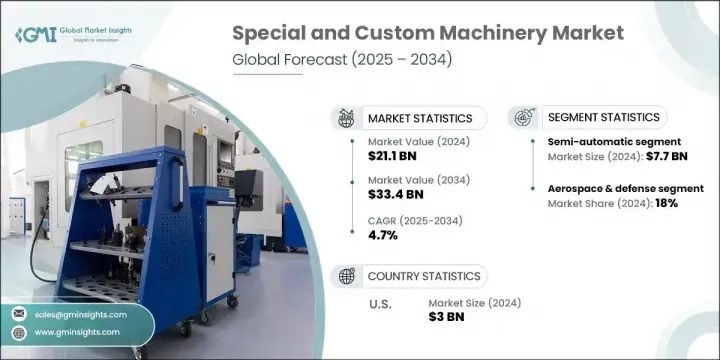
세계의 특수 및 맞춤형 기계 시장은 2024년에 211억 달러로 평가되었으며 CAGR 4.7%로 성장할 전망이며 2034년에는 334억 달러에 이를 것으로 추정됩니다.
이 시장은 산업 4.0 기술의 급속한 통합, 디지털화 확대, 다양한 산업 분야의 자동화 수요 증가에 힘입어 꾸준한 성장을 보이고 있습니다. 특수 및 맞춤형 기계란 표준 기계가 효율적으로 수행할 수 없는 고도로 특화된 작업을 수행하도록 설계된 장비를 의미합니다. 자동차, 항공우주, 제약, 식품 가공, 전자 등 다양한 분야의 제조업체들이 생산성 향상과 오류 마진 감소를 목표로 삼으면서, 고유한 운영 과제에 맞춤화된 시스템으로 점점 더 눈을 돌리고 있습니다.
이러한 맞춤형 기계는 기계 공급업체와 최종 사용자 간의 긴밀한 협력을 통해 개발되며, 종종 단일 용도용 전용 연구 및 엔지니어링을 포함합니다. 더 스마트하고 효율적인 생산 공정으로의 전환은 맞춤형 기계 설정에 IoT, 예측 분석, 로봇공학의 활용을 확대하고 있습니다. 이러한 변화는 생산성과 안전성을 향상시킬 뿐만 아니라 조기 결함 탐지 및 원격 유지보수를 가능하게 합니다. 제조가 더욱 복잡하고 전문화됨에 따라 맞춤형 솔루션은 더 이상 틈새 시장이 아닙니다. 혁신, 품질 관리, 유연성에 중점을 둔 산업 환경에서 운영 성공의 핵심 요소로 자리매김하고 있습니다.
| 시장 범위 | |
|---|---|
| 시작 연도 | 2024년 |
| 예측 연도 | 2025-2034년 |
| 시작 금액 | 211억 달러 |
| 예측 금액 | 334억 달러 |
| CAGR | 4.7% |
반자동 기계 부문은 2024년 77억 달러의 매출을 기록했습니다. 이 기계들은 수동 조작과 자동화 사이의 균형을 이루며 변화하는 생산 요구사항에 매우 유연하게 대응합니다. 다용도성과 낮은 자본 투자 및 유지보수 비용이 결합되어 완전 자동화의 비용 없이 맞춤형 기능을 추구하는 중소규모 기업에 이상적인 선택지로 자리매김하고 있습니다. 특히 사양이 빈번히 변경되는 특수 생산 분야에서 재구성 가능한 특성은 매우 가치 있습니다.
2024년에는 항공우주 및 방위분야가 18%의 점유율을 차지했으며, 그 총액은 39억 달러(18%)를 차지했습니다. 이 산업의 고정밀 및 안전 핵심 요구사항으로 인해 항법 시스템, 엔진 부품, 경량 방위 등급 조립체 등 복잡한 부품 제작에는 맞춤형 기계가 필수적입니다. 이러한 기계는 일반적으로 CNC 시스템, 레이저 절단 공구, 첨단 제조 장치 등 엄격한 기준을 충족하도록 맞춤화된 기술을 활용해 고급 소재와 복잡한 형상을 가공하도록 설계됩니다.
미국의 특수 및 맞춤형 기계 시장은 2024년 30억 달러를 창출하여 세계의 특수 및 맞춤형 기계 분야에서 주도적인 역할을 확고히 했습니다. 미국은 고도로 발달된 산업 인프라, 강력한 연구개발(R&D) 집중도, 확립된 항공우주 및 방위 생태계를 바탕으로 이 분야의 혁신을 지속적으로 주도하고 있습니다. 전자, 자동차, 의료기기 등 산업계의 수요 증가로 틈새 생산 요구에 맞춤화된 고정밀, 유연성, 디지털 기반 기계 솔루션에 대한 투자가 촉진되고 있습니다.
특수 및 맞춤형 기계 분야에서 경쟁 우위를 차지하기 위해 기업은 고도로 전문화된 스마트 장비 개발을 목표로 하는 대규모 R&D 투자를 통해 혁신을 우선시하고 있습니다. 기업들은 고도로 전문화된 스마트 장비 개발을 목표로 막대한 R&D 투자를 통해 혁신을 최우선 과제로 삼고 있습니다. 많은 기업들이 성능, 유연성, 원격 진단에 대한 고객의 변화하는 요구를 충족시키기 위해 디지털 트윈 기술, IoT 통합 및 자동화를 도입하고 있습니다. 최종 사용자와의 전략적 파트너십을 통해 기업들은 고유한 생산 목표에 완벽하게 부합하는 기계를 공동 개발할 수 있습니다. 전 세계 업체들은 신흥 시장으로 확대되며 지역 고객 지원을 강화하기 위해 현지 제조 또는 서비스 허브를 구축하고 있습니다. 맞춤형 설치 후 지원, 예측 유지보수, 모듈식 기계 업그레이드 제공 등 맞춤화와 서비스 차별화는 여전히 핵심 요소로 남아 있습니다.
목차
제1장 조사 방법과 범위
제2장 주요 요약
제3장 업계 인사이트
- 생태계 분석
- 공급자의 상황
- 이익률
- 각 단계에서의 부가가치
- 밸류체인에 영향을 주는 요인
- 업계에 미치는 영향요인
- 성장 촉진요인
- 산업 자동화 확대
- 틈새 용도에 대한 맞춤형 수요 증가
- 기술 발전
- 업계의 잠재적 위험 및 과제
- 높은 제조 비용
- 기술적 복잡성
- 기회
- 첨단 기술 통합
- 신흥 분야에서의 채택
- 성장 촉진요인
- 성장 가능성 분석
- 장래 시장 동향
- 기술과 혁신 미래
- 현재의 기술 동향
- 신흥기술
- 가격 동향
- 지역별
- 기계유형별
- 규제 상황
- 표준 및 규제 준수 요건
- 지역 규제 틀
- 인증기준
- Porter's Five Forces 분석
- PESTEL 분석
제4장 경쟁 구도
- 소개
- 기업의 시장 점유율 분석
- 지역별
- 기업 매트릭스 분석
- 주요 시장 기업의 경쟁 분석
- 경쟁 포지셔닝 매트릭스
- 주요 발전
- 합병과 인수
- 파트너십 및 협업
- 신제품 발매
- 확장 계획
제5장 시장 추계 및 예측 : 기계 유형별(2021-2034년)
- 주요 동향
- 자동
- 반자동
- 수동
제6장 시장 추계 및 예측 : 기술별(2021-2034년)
- 주요 동향
- 공압식
- 유압식
- 전기
- 로봇
제7장 시장 추계 및 예측 : 용도별(2021-2034년)
- 주요 동향
- 자재관리 및 컨베이어 시스템
- 포장 기계
- 제조기계
- 절단 및 굴착 기계
- 용접 및 접합기계
- 검사 및 시험장치
- 마킹 & 라벨링 머신
- 기타
제8장 시장 추계 및 예측 : 최종 이용 산업별(2021-2034년)
- 주요 동향
- 자동차 및 운송
- 항공우주 및 방위
- 전자 및 반도체
- 식품 및 음료
- 건설
- 전력 및 에너지
- 섬유
- 광업
- 기타
제9장 시장 추계 및 예측 : 유통 채널별(2021-2034년)
- 주요 동향
- 직접
- 간접
제10장 시장 추계 및 예측 : 지역별(2021-2034년)
- 주요 동향
- 북미
- 미국
- 캐나다
- 유럽
- 독일
- 영국
- 프랑스
- 스페인
- 이탈리아
- 아시아태평양
- 중국
- 일본
- 인도
- 호주
- 한국
- 라틴아메리카
- 브라질
- 멕시코
- 아르헨티나
- 중동 및 아프리카
- 남아프리카
- 사우디아라비아
- 아랍에미리트(UAE)
제11장 기업 프로파일
- ABB Ltd.
- Bosch Rexroth AG
- Danfoss Group
- Eaton Corporation
- FANUC Corporation
- Harms Equipment
- Hofmann Engineering
- Johnson Electric Holdings Limited
- KUKA AG
- Marel hf.
- Mitsubishi Electric Corporation
- Schneider Electric
- Siemens AG
- SPXFLOW, Inc.
- Yaskawa Electric Corporation
The Global Special and Custom Machinery Market was valued at USD 21.1 billion in 2024 and is estimated to grow at a CAGR of 4.7% to reach USD 33.4 billion by 2034. This market is witnessing steady growth fueled by the rapid integration of Industry 4.0 technologies, increased digitalization, and the rising demand for automation across multiple sectors. Special and custom machinery refers to equipment engineered to perform highly specific tasks that standard machinery cannot execute efficiently. As manufacturers across sectors such as automotive, aerospace, pharmaceuticals, food processing, and electronics aim to boost productivity and reduce error margins, they are increasingly turning to customized systems tailored to unique operational challenges.
These custom machines are developed through close collaboration between machinery providers and end users, often involving dedicated research and engineering for a single application. The shift toward smarter, more efficient production processes is elevating the use of IoT, predictive analytics, and robotics within tailored machinery setups. This transition is not only enhancing output and safety but also enabling early defect detection and remote maintenance. With manufacturing becoming more complex and specialized, custom solutions are no longer niche-they are becoming an integral part of operational success in industrial environments focused on innovation, quality control, and flexibility.
| Market Scope | |
|---|---|
| Start Year | 2024 |
| Forecast Year | 2025-2034 |
| Start Value | $21.1 Billion |
| Forecast Value | $33.4 Billion |
| CAGR | 4.7% |
The semi-automatic machines segment generated USD 7.7 billion in 2024. These machines strike a balance between manual operation and automation, making them highly adaptable for changing production requirements. Their versatility, combined with lower capital investment and maintenance expenses, positions them as an ideal choice for small to mid-sized businesses seeking custom functionality without the cost of full automation. Their reconfigurable nature is especially valuable in specialized production where specifications frequently evolve.
In 2024, the aerospace and defense segment accounted for an 18% share, totaling USD 3.9 billion. High-precision and safety-critical requirements in these industries make custom-built machinery essential for fabricating complex parts such as navigation systems, engine components, and lightweight defense-grade assemblies. These machines are typically designed to work with advanced materials and intricate geometries using technologies like CNC systems, laser cutting tools, and additive manufacturing units customized to meet rigorous standards.
United States Special and Custom Machinery Market generated USD 3 billion in 2024, solidifying its leadership role in the global special and custom machinery sector. With its highly developed industrial infrastructure, strong focus on R&D, and established aerospace and defense ecosystems, the U.S. continues to push innovation in this space. Rising demand from industries such as electronics, automotive, and medical devices is fueling investment in high-precision, flexible, and digitally enabled machinery solutions tailored to niche production needs.
Prominent market players driving growth and innovation include Marel hf., Mitsubishi Electric Corporation, Bosch Rexroth AG, Johnson Electric Holdings Limited, ABB Ltd., KUKA AG, SPXFLOW, Inc., Hofmann Engineering, FANUC Corporation, Schneider Electric, Siemens AG, Danfoss Group, Eaton Corporation, Harms Equipment, and Yaskawa Electric Corporation. To gain a competitive advantage in the special and custom machinery space, companies are prioritizing innovation through heavy R&D investments aimed at developing highly specialized, smart equipment. Many are embracing digital twin technology, IoT integration, and automation to meet evolving customer needs for performance, flexibility, and remote diagnostics. Strategic partnerships with end users enable firms to co-create machinery that aligns perfectly with unique production goals. Global players are expanding into emerging markets, setting up local manufacturing or service hubs to better support regional clients. Customization and service differentiation remain central, with companies offering tailored post-installation support, predictive maintenance, and modular machinery upgrades.
Table of Contents
Chapter 1 Methodology and Scope
- 1.1 Market scope and definition
- 1.2 Research design
- 1.2.1 Research approach
- 1.2.2 Data collection methods
- 1.3 Data mining sources
- 1.3.1 Global
- 1.3.2 Regional/Country
- 1.4 Base estimates and calculations
- 1.4.1 Base year calculation
- 1.4.2 Key trends for market estimation
- 1.5 Primary research and validation
- 1.5.1 Primary sources
- 1.6 Forecast model
- 1.7 Research assumptions and limitations
Chapter 2 Executive Summary
- 2.1 Industry 3600 synopsis
- 2.2 Key market trends
- 2.2.1 Regional
- 2.2.2 Machine type
- 2.2.3 Technology
- 2.2.4 Application
- 2.2.5 End use industry
- 2.2.6 Distribution channel
- 2.3 CXO perspectives: Strategic imperatives
- 2.3.1 Key decision points for industry executives
- 2.3.2 Critical success factors for market players
- 2.4 Future outlook and strategic recommendations
Chapter 3 Industry Insights
- 3.1 Industry ecosystem analysis
- 3.1.1 Supplier landscape
- 3.1.2 Profit margin
- 3.1.3 Value addition at each stage
- 3.1.4 Factor affecting the value chain
- 3.2 Industry impact forces
- 3.2.1 Growth drivers
- 3.2.1.1 Increasing industrial automation
- 3.2.1.2 Growing customization demand for niche applications
- 3.2.1.3 Technological advancements
- 3.2.2 Industry pitfalls & challenges
- 3.2.2.1 High manufacturing costs
- 3.2.2.2 Technical complexity
- 3.2.3 Opportunities
- 3.2.3.1 Integration of advanced technologies
- 3.2.3.2 Adoption in emerging sectors
- 3.2.1 Growth drivers
- 3.3 Growth potential analysis
- 3.4 Future market trends
- 3.5 Technology and innovation landscape
- 3.5.1 Current technological trends
- 3.5.2 Emerging technologies
- 3.6 Price trends
- 3.6.1 By region
- 3.6.2 By machine type
- 3.7 Regulatory landscape
- 3.7.1 Standards and compliance requirements
- 3.7.2 Regional regulatory frameworks
- 3.7.3 Certification standards
- 3.8 Porter’s analysis
- 3.9 PESTEL analysis
Chapter 4 Competitive Landscape, 2024
- 4.1 Introduction
- 4.2 Company market share analysis
- 4.2.1 By region
- 4.2.1.1 North America
- 4.2.1.2 Europe
- 4.2.1.3 Asia Pacific
- 4.2.1.4 Latin America
- 4.2.1.5 Middle East and Africa
- 4.2.1 By region
- 4.3 Company matrix analysis
- 4.4 Competitive analysis of major market players
- 4.5 Competitive positioning matrix
- 4.6 Key developments
- 4.6.1 Mergers & acquisitions
- 4.6.2 Partnerships & collaborations
- 4.6.3 New product launches
- 4.6.4 Expansion plans
Chapter 5 Market Estimates and Forecast, By Machine Type, 2021 - 2034 (USD Billion) (Thousand Units)
- 5.1 Key trends
- 5.2 Automatic
- 5.3 Semi-automatic
- 5.4 Manual
Chapter 6 Market Estimates and Forecast, By Technology, 2021 - 2034 (USD Billion) (Thousand Units)
- 6.1 Key trends
- 6.2 Pneumatic
- 6.3 Hydraulic
- 6.4 Electric
- 6.5 Robotic
Chapter 7 Market Estimates and Forecast, By Application, 2021 - 2034 (USD Billion) (Thousand Units)
- 7.1 Key trends
- 7.2 Material handling & conveying systems
- 7.3 Packaging machinery
- 7.4 Fabrication machinery
- 7.5 Cutting & drilling machinery
- 7.6 Welding & joining machinery
- 7.7 Inspection & testing equipment
- 7.8 Marking & labeling machines
- 7.9 Others
Chapter 8 Market Estimates and Forecast, By End Use Industry, 2021 - 2034 (USD Billion) (Thousand Units)
- 8.1 Key trends
- 8.2 Automotive & transportation
- 8.3 Aerospace & defense
- 8.4 Electronics & semiconductors
- 8.5 Food & beverages
- 8.6 Construction
- 8.7 Power & energy
- 8.8 Textiles
- 8.9 Mining
- 8.10 Others
Chapter 9 Market Estimates and Forecast, By Distribution Channel, 2021 - 2034 (USD Billion) (Thousand Units)
- 9.1 Key trends
- 9.2 Direct
- 9.3 Indirect
Chapter 10 Market Estimates and Forecast, By Region, 2021 - 2034 (USD Billion) (Thousand Units)
- 10.1 Key trends
- 10.2 North America
- 10.2.1 U.S.
- 10.2.2 Canada
- 10.3 Europe
- 10.3.1 Germany
- 10.3.2 UK
- 10.3.3 France
- 10.3.4 Spain
- 10.3.5 Italy
- 10.4 Asia Pacific
- 10.4.1 China
- 10.4.2 Japan
- 10.4.3 India
- 10.4.4 Australia
- 10.4.5 South Korea
- 10.5 Latin America
- 10.5.1 Brazil
- 10.5.2 Mexico
- 10.5.3 Argentina
- 10.6 Middle East and Africa
- 10.6.1 South Africa
- 10.6.2 Saudi Arabia
- 10.6.3 UAE
Chapter 11 Company Profiles
- 11.1 ABB Ltd.
- 11.2 Bosch Rexroth AG
- 11.3 Danfoss Group
- 11.4 Eaton Corporation
- 11.5 FANUC Corporation
- 11.6 Harms Equipment
- 11.7 Hofmann Engineering
- 11.8 Johnson Electric Holdings Limited
- 11.9 KUKA AG
- 11.10 Marel hf.
- 11.11 Mitsubishi Electric Corporation
- 11.12 Schneider Electric
- 11.13 Siemens AG
- 11.14 SPXFLOW, Inc.
- 11.15 Yaskawa Electric Corporation