|
시장보고서
상품코드
1822551
유아용 인큐베이터 시장 : 시장 기회, 성장 촉진요인, 산업 동향 분석, 예측(2025-2034년)Infant Incubator Market Opportunity, Growth Drivers, Industry Trend Analysis, and Forecast 2025 - 2034 |
||||||

세계의 유아용 인큐베이터 시장은 2024년에 7억 5,640만 달러로 평가되었고, CAGR 6.3%로 성장할 전망이며, 2034년까지는 14억 달러에 이를 것으로 예측됩니다.
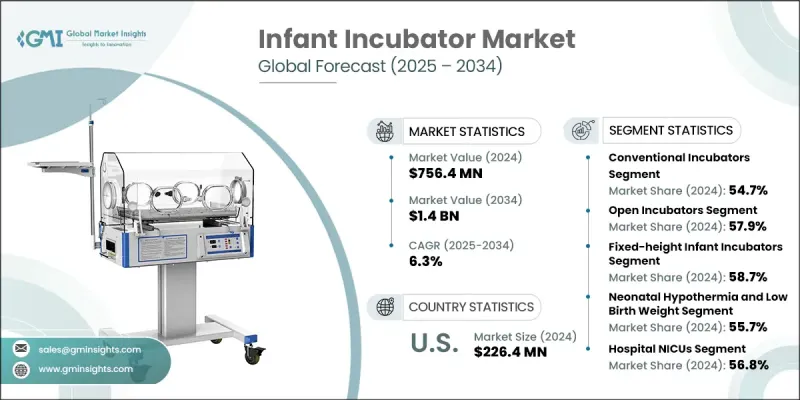
시장의 성장은 조산아 증가, 신생아 사망률 감소에 대한 노력 증가, 신생아 의료 기술의 꾸준한 진보에 의해 추진되고 있습니다. 또한 선진국 및 신흥 국가에서 신생아 집중 치료실의 확대 및 현대화가 고성능 유아용 인큐베이터 수요를 크게 밀어 올리고 있습니다. 이 인큐베이터는 취약한 신생아의 발육과 회복을 지원하기 위해 온도, 습도 및 산소 수준의 최적 제어를 보장하면서 외부 장애로부터 보호하고 신중하게 조정된 환경을 제공합니다. 정부와 의료기관이 신생아 의료 인프라에 대한 투자를 계속하고 있는 가운데, 원격 모니터링이나 IoT 접속 등의 기능을 포함한 선진 모델의 채용이 가속화되고 있습니다. 특히 신흥지역에서의 헬스케어 시스템의 지속적인 업그레이드는 유아의 건강 요구에 대한 의식의 고조 및 보다 고도의 케어 기기엥 대한 이용가능성과 함께 향후 수년간 시장을 밀어올릴 것으로 예측됩니다.
| 시장 범위 | |
|---|---|
| 시작 연도 | 2024년 |
| 예측 연도 | 2025-2034년 |
| 시장 규모 | 7억 5,640만 달러 |
| 예측 금액 | 14억 달러 |
| CAGR | 6.3% |
2024년 기존 인큐베이터의 점유율은 54.7%였습니다. 이러한 시스템은 신뢰성, 효율성, 새로운 기술과 비교할 때 상대적으로 저렴한 비용으로 NIC 전반에 걸쳐 널리 사용되고 있습니다. 고자원 환경에서도 저자원 환경에서도 병원은 미숙아를 위한 안정적인 지원 환경을 확보하기 위해 기존에 크게 의존하고 있습니다. 신생아의 생존에 필수적인 일관된 환경 조건을 유지하는 능력은 전통적으로 산과 병원에서 중요한 치료의 필수적인 부분이 되었습니다. 그 결과, 특히 예산상의 제약으로부터 보다 선진적인 모델의 도입이 제한되고 있는 시설에서는 예측 기간을 통해 시장에서 압도적인 점유율을 차지할 것으로 예측됩니다.
오픈형 인큐베이터의 2024년 점유율은 57.9%였습니다. 접근성, 합리적인 가격, 여러 모니터링 장비와의 호환성으로 알려진 오픈형 인큐베이터는 많은 임상 환경에서 여전히 가장 유력한 후보입니다. 복사식 보온기라고도 불리는 이 기기는 머리 위의 열을 이용하여 유아의 체온을 유지하면서 긴급시 개입이나 일상적인 케어에 이용하기 쉬운 상태를 유지합니다. 폐쇄 시스템과 같은 완벽한 환경 제어는 불가능하지만 개방형 디자인이므로 의료 요구에 신속하게 대응할 수 있습니다. 따라서 액세스가 매우 중요하고 긴급한 경우에 특히 적합합니다. 또한, 유지보수의 필요성이 낮고, 출산 직후의 케어에 있어서 임상 실적이 증명되고 있는 것도, 병원 전체에서의 인기를 지지하고 있습니다.
미국의 유아용 인큐베이터 시장은 2024년에 2억 2,640만 달러에 달했고, 신생아 의료에 대한 투자 증가, 보험에 의한 지원, 조산 사례 증가가 성장을 견인하고 있습니다. 이러한 성장은 첨단 건강 관리 인프라, 연구개발 활동 활성화, 혁신적인 유아 케어 기술을 NICO 환경에 통합하기 위한 광범위한 추진력의 조합에 의해 지원됩니다. 이 지역은 또한 견고한 규제 체제 및 강력한 상환 네트워크로부터 혜택을 누리고 있으며, 공립 및 사립 병원을 불문하고 보다 스마트하고 안전한 보육 시스템의 신속한 도입을 촉진하고 있습니다.
유아용 인큐베이터 시장에서 활약하는 주요 기업으로는 GE HealthCare, Dragerwerk, Koninklijke Philips, Stryker, Natus Medical, Inspiration Healthcare Group 등이 있습니다. 유아용 인큐베이터 시장에 진출한 기업은 혁신, 컴플라이언스, 파트너십에 주력하여 세계 전개를 강화하고 있습니다. 많은 기업들은 스마트 센서, 실시간 모니터링, IoT 기반 연결성을 갖춘 인큐베이터를 설계하기 위한 조사에 투자하고 최신 NICC의 진화하는 요구에 부응하고 있습니다. 병원 및 헬스케어 시스템과의 전략적 제휴는 제조업체가 특정 임상 요구에 맞게 제품을 조정하는 데 도움을 주며, 현지 유통업체와의 제휴는 신흥 지역 진입을 용이하게 합니다. 각 회사는 또한 국제 안전과 성능의 인증을 취득하고 신뢰와 채용을 향상시키기 위해 노력하고 있습니다. 운반용 인큐베이터, 하이브리드 시스템, 완전 디지털화 플랫폼 등 제품 포트폴리오를 확장함으로써 각 회사는 여러 의료 환경에 대응할 수 있습니다. 비용 효율성, 환자의 안전성, 임상 결과는 시장의 리더십을 유지하기 위해 여전히 중요한 중점 분야입니다.
목차
제1장 조사 방법 및 범위
제2장 주요 요약
제3장 업계 인사이트
- 업계 생태계 분석
- 공급자의 상황
- 밸류체인에 영향을 주는 요인
- 업계에 미치는 영향요인
- 성장 촉진요인
- 세계에서 조산 증가
- 신생아 케어에 대한 정부 대처의 고조
- 신생아 케어에 있어서 기술의 진보
- 업계의 잠재적 리스크 및 과제
- 고급 인큐베이터의 높은 비용
- 서비스 및 유지보수의 과제
- 시장 기회
- 하이브리드 인큐베이터 도입 확대
- 신흥경제국에서 신생아의 건강 중시
- 성장 촉진요인
- 성장 가능성 분석
- 규제 상황
- 기술적 진보
- 현재의 기술 동향
- 신흥 기술
- 공급망 분석
- 환급 시나리오
- 가격 분석(2024년)
- 북미
- 유럽
- 아시아태평양
- 장래 시장 동향
- 갭 분석
- Porter's Five Forces 분석
- PESTEL 분석
제4장 경쟁 구도
- 서문
- 기업의 시장 점유율 분석
- 북미
- 유럽
- 아시아태평양
- 기업 매트릭스 분석
- 주요 시장 기업의 경쟁 분석
- 경쟁 포지셔닝 매트릭스
- 주요 발전
- 합병 및 인수
- 파트너십 및 협업
- 신제품 발매
- 확장 계획
제5장 시장 추계 및 예측 : 제품별(2021-2034년)
- 주요 동향
- 기존 인큐베이터
- 하이브리드 인큐베이터
- 수송 인큐베이터
제6장 시장 추계 및 예측 : 유형별(2021-2034년)
- 주요 동향
- 오픈(복사 난방기)
- 폐쇄
제7장 시장 추계 및 예측 : 모달리티별(2021-2034년)
- 주요 동향
- 높이 고정식 인큐베이터
- 높이 조절 가능한 인큐베이터
제8장 시장 추계 및 예측 : 용도별(2021-2034년)
- 주요 동향
- 신생아 저체온증 및 저출생 체중
- 황달
- 기타 용도
제9장 시장 추계 및 예측 : 최종 용도별(2021-2034년)
- 주요 동향
- 병원의 NICU
- 산과 케어 센터
- 응급 의료 서비스
제10장 시장 추계 및 예측 : 지역별(2021-2034년)
- 주요 동향
- 북미
- 미국
- 캐나다
- 유럽
- 독일
- 영국
- 프랑스
- 스페인
- 이탈리아
- 네덜란드
- 아시아태평양
- 중국
- 일본
- 인도
- 호주
- 한국
- 라틴아메리카
- 브라질
- 멕시코
- 아르헨티나
- 중동 및 아프리카
- 남아프리카
- 사우디아라비아
- 아랍에미리트(UAE)
제11장 기업 프로파일
- 세계 기업
- Dragerwerk
- GE HealthCare
- Inspiration Healthcare Group
- Koninklijke Philips
- Natus Medical
- Stryker
- 지역 기업
- Atom Medical
- Avante Health Solutions
- Bistos
- Fanem
- International Biomedical
- MEDICOR Elektronika
- 신흥 기업
- JW Pharmaceutical
- Narang Medical
- NOVOS
The Global Infant Incubator Market was valued at USD 756.4 million in 2024 and is estimated to grow at a CAGR of 6.3% to reach USD 1.4 billion by 2034.
Market growth is being propelled by a rise in premature births, increasing efforts to lower neonatal mortality rates, and steady progress in neonatal care technologies. Additionally, the expansion and modernization of neonatal intensive care units across developed and developing countries is significantly boosting demand for high-performance infant incubators. These incubators provide a carefully regulated environment to support the development and recovery of vulnerable newborns, offering protection from external disturbances while ensuring optimal control of temperature, humidity, and oxygen levels. As governments and health organizations continue to invest in neonatal health infrastructure, the adoption of advanced models that include features like remote monitoring and IoT connectivity is accelerating. Ongoing upgrades to healthcare systems, particularly in emerging regions, combined with rising awareness of infant health needs and the availability of more advanced care devices, are expected to push the market forward over the coming years.
| Market Scope | |
|---|---|
| Start Year | 2024 |
| Forecast Year | 2025-2034 |
| Start Value | $756.4 Million |
| Forecast Value | $1.4 Billion |
| CAGR | 6.3% |
In 2024, the conventional incubators segment accounted for a 54.7% share. These systems remain widely used across NICUs for their reliability, effectiveness, and relatively lower cost when compared with newer technologies. Hospitals in both high- and low-resource settings continue to depend heavily on conventional models to ensure a stable, supportive environment for premature infants. Their ability to maintain consistent environmental conditions essential for neonatal survival has made them an integral part of critical care in maternity hospitals. As a result, they are expected to hold a dominant share of the market throughout the forecast period, particularly in facilities where budget constraints limit the adoption of more advanced models.
The open incubators segment held a 57.9% share in 2024. Known for their ease of access, affordability, and compatibility with multiple monitoring devices, open incubators remain a top choice in many clinical environments. These devices, often referred to as radiant warmers, use overhead heat to maintain infant body temperature while keeping the baby accessible for emergency intervention or routine care. Though they lack the full environmental control of closed systems, their open design allows caregivers to respond quickly to medical needs. This makes them particularly suitable for high-acuity cases where access is critical. Their popularity across hospitals is also supported by their lower maintenance requirements and proven clinical performance in immediate postnatal care.
United States Infant Incubator Market reached USD 226.4 million in 2024, with growth driven by increasing neonatal care investments, insurance support, and rising cases of preterm births. This progress is supported by a combination of advanced healthcare infrastructure, growing R&D activities, and a widespread push toward integrating innovative infant care technologies into NICU environments. The region also benefits from a robust regulatory framework and strong reimbursement networks, which are encouraging the faster adoption of smarter, safer incubator systems across both public and private hospitals.
Key companies active in the Infant Incubator Market include GE HealthCare, Dragerwerk, Koninklijke Philips, Stryker, Natus Medical, and Inspiration Healthcare Group. Companies in the infant incubator market are focusing on innovation, compliance, and partnerships to strengthen their global reach. Many are investing in research to design incubators equipped with smart sensors, real-time monitoring, and IoT-based connectivity to meet the evolving demands of modern NICUs. Strategic collaborations with hospitals and healthcare systems help manufacturers tailor their products for specific clinical needs, while partnerships with local distributors allow easier entry into emerging regions. Firms are also working to meet international safety and performance certifications to improve trust and adoption. Expansion of product portfolios to include transport incubators, hybrid systems, and fully digitized platforms enables players to address multiple care environments. Cost-efficiency, patient safety, and clinical outcomes remain key focus areas to maintain market leadership.
Table of Contents
Chapter 1 Methodology and Scope
- 1.1 Market scope and definition
- 1.2 Research design
- 1.2.1 Research approach
- 1.2.2 Data collection methods
- 1.3 Data mining sources
- 1.3.1 Global
- 1.3.2 Regional/Country
- 1.4 Base estimates and calculations
- 1.4.1 Base year calculation
- 1.4.2 Key trends for market estimation
- 1.5 Primary research and validation
- 1.5.1 Primary sources
- 1.6 Forecast model
- 1.7 Research assumptions and limitations
Chapter 2 Executive Summary
- 2.1 Industry 3600 synopsis
- 2.2 Key market trends
- 2.2.1 Regional trends
- 2.2.2 Product trends
- 2.2.3 Type trends
- 2.2.4 Modality trends
- 2.2.5 Application trends
- 2.2.6 End use trends
- 2.3 CXO perspectives: Strategic imperatives
- 2.3.1 Key decision points for industry executives
- 2.3.2 Critical success factors for market players
- 2.4 Future outlook and strategic recommendations
Chapter 3 Industry Insights
- 3.1 Industry ecosystem analysis
- 3.1.1 Supplier landscape
- 3.1.2 Factor affecting the value chain
- 3.2 Industry impact forces
- 3.2.1 Growth drivers
- 3.2.1.1 Increasing number of preterm births globally
- 3.2.1.2 Rising government initiatives for neonatal care
- 3.2.1.3 Technological advancements in neonatal care
- 3.2.2 Industry pitfalls and challenges
- 3.2.2.1 High cost of advanced incubators
- 3.2.2.2 Service and maintenance challenges
- 3.2.3 Market opportunities
- 3.2.3.1 Growing adoption of hybrid incubators
- 3.2.3.2 Focus on neonatal health in emerging economies
- 3.2.1 Growth drivers
- 3.3 Growth potential analysis
- 3.4 Regulatory landscape
- 3.4.1 North America
- 3.4.2 Europe
- 3.4.3 Asia Pacific
- 3.4.4 Latin America
- 3.4.5 Middle East and Africa
- 3.5 Technological advancements
- 3.5.1 Current technological trends
- 3.5.2 Emerging technologies
- 3.6 Supply chain analysis
- 3.7 Reimbursement scenario
- 3.8 Pricing analysis, 2024
- 3.8.1 North America
- 3.8.2 Europe
- 3.8.3 Asia Pacific
- 3.9 Future market trends
- 3.10 Gap analysis
- 3.11 Porter's analysis
- 3.12 PESTEL analysis
Chapter 4 Competitive Landscape, 2024
- 4.1 Introduction
- 4.2 Company market share analysis
- 4.2.1 North America
- 4.2.2 Europe
- 4.2.3 Asia Pacific
- 4.3 Company matrix analysis
- 4.4 Competitive analysis of major market players
- 4.5 Competitive positioning matrix
- 4.6 Key developments
- 4.6.1 Mergers and acquisitions
- 4.6.2 Partnerships and collaborations
- 4.6.3 New product launches
- 4.6.4 Expansion plans
Chapter 5 Market Estimates and Forecast, By Product, 2021 - 2034 ($ Mn)
- 5.1 Key trends
- 5.2 Conventional incubator
- 5.3 Hybrid incubator
- 5.4 Transport incubator
Chapter 6 Market Estimates and Forecast, By Type, 2021 - 2034 ($ Mn)
- 6.1 Key trends
- 6.2 Open (radiant warmers)
- 6.3 Closed
Chapter 7 Market Estimates and Forecast, By Modality, 2021 - 2034 ($ Mn)
- 7.1 Key trends
- 7.2 Fixed-height infant incubators
- 7.3 Height-adjustable infant incubators
Chapter 8 Market Estimates and Forecast, By Application, 2021 - 2034 ($ Mn)
- 8.1 Key trends
- 8.2 Neonatal hypothermia and low birth weight
- 8.3 Jaundice
- 8.4 Other applications
Chapter 9 Market Estimates and Forecast, By End Use, 2021 - 2034 ($ Mn)
- 9.1 Key trends
- 9.2 Hospital NICU
- 9.3 Maternity care centers
- 9.4 Emergency medical services
Chapter 10 Market Estimates and Forecast, By Region, 2021 - 2034 ($ Mn)
- 10.1 Key trends
- 10.2 North America
- 10.2.1 U.S.
- 10.2.2 Canada
- 10.3 Europe
- 10.3.1 Germany
- 10.3.2 UK
- 10.3.3 France
- 10.3.4 Spain
- 10.3.5 Italy
- 10.3.6 Netherlands
- 10.4 Asia Pacific
- 10.4.1 China
- 10.4.2 Japan
- 10.4.3 India
- 10.4.4 Australia
- 10.4.5 South Korea
- 10.5 Latin America
- 10.5.1 Brazil
- 10.5.2 Mexico
- 10.5.3 Argentina
- 10.6 Middle East and Africa
- 10.6.1 South Africa
- 10.6.2 Saudi Arabia
- 10.6.3 UAE
Chapter 11 Company Profiles
- 11.1 Global players
- 11.1.1 Dragerwerk
- 11.1.2 GE HealthCare
- 11.1.3 Inspiration Healthcare Group
- 11.1.4 Koninklijke Philips
- 11.1.5 Natus Medical
- 11.1.6 Stryker
- 11.2 Regional players
- 11.2.1 Atom Medical
- 11.2.2 Avante Health Solutions
- 11.2.3 Bistos
- 11.2.4 Fanem
- 11.2.5 International Biomedical
- 11.2.6 MEDICOR Elektronika
- 11.3 Emerging players
- 11.3.1 JW Pharmaceutical
- 11.3.2 Narang Medical
- 11.3.3 NOVOS