|
시장보고서
상품코드
1822640
액체 비료 시장 : 기회, 성장 촉진요인, 산업 동향 분석 및 예측(2025-2034년)Liquid Fertilizer Market Opportunity, Growth Drivers, Industry Trend Analysis, and Forecast 2025 - 2034 |
||||||

세계의 액체 비료 시장은 2024년에 176억 달러로 평가되었고 CAGR은 6%를 나타낼 것으로 예측되며 2034년에 314억 달러로 성장할 전망입니다. 이러한 성장은 효율적인 농업 투입재에 대한 수요 증가, 액체 비료의 빠른 흡수 및 우수한 영양분 공급 능력에 의해 주도되며, 이는 작물 수확량과 토양 건강을 향상시킵니다. 기술 발전과 정밀 농업 관행의 도입이 이러한 확장을 더욱 뒷받침하고 있습니다. 또한 증가하는 세계 인구로 인해 식량 생산 증대가 필요해지면서 시장 성장이 촉진되고 있습니다. 농민과 농업 기업들은 생산성과 지속 가능성을 개선하기 위해 액체 비료로 전환하고 있습니다. 지속 가능한 농업을 장려하는 정부 정책과 농업 연구 개발(R&D) 투자가 향후 10년간 시장 성장에 기여할 것으로 예상됩니다. 전체 액체 비료 산업은 제품, 적용 분야, 작물 유형, 최종 용도 및 지역별로 분류됩니다. 2023년 NPK 액체 비료 부문은 70억 달러 규모였으며, 2032년까지 연평균 6.3%의 성장률을 보일 것으로 전망됩니다. 이러한 성장은 다양한 토양 조건에 맞는 균형 잡힌 영양소 솔루션에 대한 수요에 의해 주도됩니다.
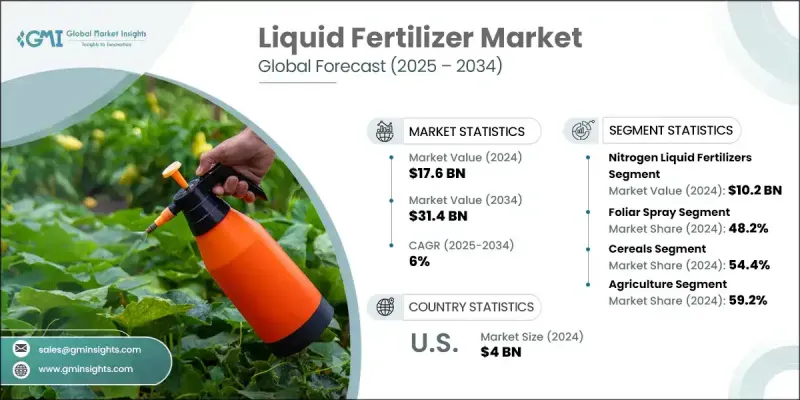
질소(N), 칼륨(K), 인(P)을 함유한 NPK 액체 비료는 포괄적인 영양 공급을 제공하여 토양 비옥도를 개선하고 작물 수확량을 증대시킵니다. 비료 기술과 정밀 농업의 발전은 효과적이고 효율적인 영양 공급을 가능케 하여 해당 부문의 확장에 기여합니다. 농업 생산성과 지속 가능성에 대한 관심은 NPK 액체 비료의 채택을 더욱 촉진합니다. 엽면 살포 적용 부문은 2024년 80억 달러에 도달하고 2024-2032년 연평균 6%의 성장률을 보일 것으로 예상됩니다. 이 성장은 식물에 직접 영양분을 공급하는 효과적인 방법으로 엽면 시비가 인정받음에 따른 것입니다. 엽면 살포는 결핍을 신속히 해결하고 빠른 영양분 흡수를 제공하여 작물의 건강과 생산성을 향상시킵니다.
| 시장 범위 | |
|---|---|
| 시작 연도 | 2024년 |
| 예측 연도 | 2025-2034년 |
| 시장 규모 | 176억 달러 |
| 예측 금액 | 314억 달러 |
| CAGR | 6% |
정밀 농업과 스프레이 기술의 발전은 적용 효율성을 높이고 낭비를 줄입니다. 작물 수확량 최적화와 환경 영향 최소화에 대한 강조가 엽면 시비 수요를 촉진합니다. 아시아태평양 지역의 액체 비료 부문은 2024년부터 2032년까지 연평균 6.1%의 CAGR로 75억 6,000만 달러에 달할 것으로 예상됩니다. 이 성장은 효율적인 영양소 관리와 작물 수확량 증대를 위한 상당한 농업 생산량에 대한 지역의 필요성에 의해 주도됩니다. 비료 제형 개선 및 정밀 농업과 같은 농업 기술 발전은 영양분 공급을 개선하고 환경 영향을 줄입니다. 아시아태평양 지역의 식량 안보에 대한 우려 증가와 인구 확대는 최적화된 농업 투입재에 대한 수요를 촉진합니다.
목차
제1장 조사 방법
- 시장의 범위와 정의
- 조사 디자인
- 조사 접근
- 데이터 수집 방법
- 데이터 마이닝 출처
- 세계
- 지역 및 국가
- 기본 추정과 계산
- 기준연도 계산
- 시장 예측의 주요 동향
- 1차 조사와 검증
- 1차 정보
- 예측 모델
- 조사의 전제와 한계
제2장 주요 요약
제3장 업계 인사이트
- 생태계 분석
- 공급자의 상황
- 이익률 분석
- 비용 구조
- 각 단계에서의 부가가치
- 밸류체인에 영향을 주는 요인
- 혁신
- 업계에 미치는 영향요인
- 성장 촉진요인
- 시비 관개 기술 발전
- 정 밀농업 통합
- 지속 가능한 농업으로의 전환
- 고부가가치 작물 재배 성장
- 업계의 잠재적 위험 및 과제
- 비료의 최적 사용에 대한 인식 부족
- 증가하는 불확실성과 환경에 대한 정책적 관심 증대
- 시장 기회
- 유기농 농업에 대한 수요 증가
- 스마트 농업 기술과의 통합
- 신흥 시장으로 확대
- 성장 촉진요인
- 성장 가능성 분석
- 규제 상황
- 북미
- 유럽
- 아시아태평양
- 라틴아메리카
- 중동 및 아프리카
- Porter's Five Forces 분석
- PESTEL 분석
- 기술과 혁신 상황
- 현재 기술 동향
- 신흥 기술
- 가격 동향
- 지역별
- 제품별
- 코스트 내역 분석
- 특허 분석
- 지속가능성과 환경 측면
- 지속가능한 관행
- 폐기물 감축 전략
- 생산 과정의 에너지 효율성
- 환경 친화적인 노력
- 탄소발자국의 고려
제4장 경쟁 구도
- 소개
- 기업의 시장 점유율 분석
- 북미
- 유럽
- 아시아태평양
- 라틴아메리카
- 중동 및 아프리카
- 주요 시장 기업의 경쟁 분석
- 경쟁 포지셔닝 매트릭스
- 전략적 전망 매트릭스
- 주요 발전
- 합병과 인수
- 파트너십 및 협업
- 신제품 발매
- 확장계획과 자금조달
제5장 시장 추계 및 예측 : 제품별(2021-2034년)
- 주요 동향
- NPK 액체 비료
- NP 10:34 액체 비료
- NP 10:37 액체 비료
- NPK 20:20:20
- NPK 15:15:15
- NPK 12:12:17
- NPK 18:9:18
- NPK 8:16:24
- NPK 14:14:14
- NPK 6:12:18
- NPK 10:10:10
- 기타 NPK 제제
- 질소 액체 비료
- UAN(요소질산암모늄)액체 비료
- 질산암모늄계 액체 비료
- 황산암모늄계 액체 비료
- 질산칼슘계 액체 비료
- 염화암모늄계 액체 비료
- 질산나트륨계 액체 비료
- 요소황산암모늄(UAS) 액체 비료
- 기타 질소 제제
제6장 시장 추계 및 예측 : 용도별(2021-2034년)
- 주요 동향
- 엽면 살포
- 시비 관개
- 토양 관수
- 종자 처리
제7장 시장 추계 및 예측 : 작물별(2021-2034년)
- 주요 동향
- 곡물
- 유지종자
- 과일 및 채소
- 원예 식물(꽃, 관상용 식물 등)
- 기타
제8장 시장 추계 및 예측 : 최종 용도별(2021-2034년)
- 주요 동향
- 농업
- 원예(온실, 묘상)
- 잔디 관리
- 기타
제9장 시장 추계 및 예측 : 지역별(2021-2034년)
- 주요 동향
- 북미
- 미국
- 캐나다
- 유럽
- 독일
- 영국
- 프랑스
- 이탈리아
- 스페인
- 기타 유럽
- 아시아태평양
- 중국
- 인도
- 일본
- 호주
- 한국
- 기타 아시아태평양
- 라틴아메리카
- 브라질
- 멕시코
- 아르헨티나
- 기타 라틴아메리카
- 중동 및 아프리카
- 남아프리카
- 사우디아라비아
- 아랍에미리트(UAE)
- 기타 중동 아시아
제10장 기업 프로파일
- Nutri-Tech Solutions Pty Ltd
- FoxFarm Soil &Fertilizer Co
- CSBP
- ICL
- Compo Expert
- Nutrien Ltd.
- BMS Micro-Nutrients NV
- EuroChem Group
- IFFCO
- KS Aktiengesellschaft
- Yara International ASA
- AgroLiquid
The global liquid fertilizer market was valued at USD 17.6 billion in 2024 and is estimated to grow at a CAGR of 6% to reach USD 31.4 billion by 2034. This growth is driven by increasing demand for efficient agricultural inputs, rapid absorption, and superior nutrient delivery of liquid fertilizers, which enhance crop yields and soil health. Technological advancements and the adoption of precision agriculture practices further support this expansion. The market's growth is also fueled by a rising global population, necessitating increased food production. Farmers and agribusinesses are turning to liquid fertilizers to improve productivity and sustainability. Government initiatives promoting sustainable farming and investments in agricultural R&D are expected to contribute to the market's growth over the next decade. The overall liquid fertilizer industry is classified based on the product, application, crop type, end-use, and region. In 2023, the NPK liquid fertilizers segment accounted for USD 7 billion and is projected to grow at a 6.3% CAGR by 2032. This growth is driven by the demand for balanced nutrient solutions for diverse soil conditions.
NPK liquid fertilizers, containing nitrogen (N), potassium (K), and phosphorus (P), provide comprehensive nutrient support, improving soil fertility and enhancing crop yields. Advancements in fertilizer technology and precision agriculture contribute to the segment's expansion, offering effective and efficient nutrient delivery. The focus on agricultural productivity and sustainability further boosts the adoption of NPK liquid fertilizers. The foliar spray application segment is forecasted to reach USD 8 billion in 2024 and grow at a 6% CAGR from 2024 to 2032. This growth is driven by the recognition of foliar feeding as an effective method for direct nutrient delivery to plants. Foliar sprays can address deficiencies quickly and offer rapid nutrient uptake, enhancing crop health and productivity.
| Market Scope | |
|---|---|
| Start Year | 2024 |
| Forecast Year | 2025-2034 |
| Start Value | $17.6 Billion |
| Forecast Value | $31.4 Billion |
| CAGR | 6% |
Precision agriculture and advancements in spray technology improve application efficiency and reduce waste. The emphasis on optimizing crop yields and minimizing environmental impact drives the demand for foliar applications. The liquid fertilizer sector from Asia Pacific is projected to reach USD 7.56 Billion with a 6.1% CAGR from 2024 to 2032. This growth is driven by the region's need for efficient nutrient management and significant agricultural output to boost crop yields. Advancements in agricultural technology, such as enhanced fertilizer formulations and precision farming, improve nutrient delivery and reduce environmental impact. The growing concerns about food security and the expanding population in the Asia Pacific drive demand for optimized agricultural inputs.
Table of Contents
Chapter 1 Methodology
- 1.1 Market scope and definition
- 1.2 Research design
- 1.2.1 Research approach
- 1.2.2 Data collection methods
- 1.3 Data mining sources
- 1.3.1 Global
- 1.3.2 Regional/Country
- 1.4 Base estimates and calculations
- 1.4.1 Base year calculation
- 1.4.2 Key trends for market estimation
- 1.5 Primary research and validation
- 1.5.1 Primary sources
- 1.6 Forecast model
- 1.7 Research assumptions and limitations
Chapter 2 Executive Summary
- 2.1 Industry 360° synopsis, 2021 - 2034
- 2.2 Key market trends
- 2.2.1 Regional
- 2.2.2 Product
- 2.2.3 Application
- 2.2.4 Crop Type
- 2.2.5 End use
- 2.3 TAM Analysis, 2025-2034
- 2.4 CXO perspectives: Strategic imperatives
- 2.4.1 Executive decision points
- 2.4.2 Critical success factors
- 2.5 Future outlook and strategic recommendations
Chapter 3 Industry Insights
- 3.1 Industry ecosystem analysis
- 3.1.1 Supplier landscape
- 3.1.2 Profit margin analysis
- 3.1.3 Cost structure
- 3.1.4 Value addition at each stage
- 3.1.5 Factor affecting the value chain
- 3.1.6 Disruptions
- 3.2 Industry impact forces
- 3.2.1 Growth drivers
- 3.2.1.1 Advancements in fertigation technology
- 3.2.1.2 Precision agriculture integration
- 3.2.1.3 Shift toward sustainable farming
- 3.2.1.4 Growth in high-value crop cultivation
- 3.2.2 Industry pitfalls and challenges
- 3.2.2.1 Lack of awareness about the optimum usage of fertilizers
- 3.2.2.2 Increasing uncertainties and significant policy focus toward the environment
- 3.2.3 Market opportunities
- 3.2.3.1 Rising demand for organic farming
- 3.2.3.2 Integration with smart farming technologies
- 3.2.3.3 Expansion in emerging markets
- 3.2.1 Growth drivers
- 3.3 Growth potential analysis
- 3.4 Regulatory landscape
- 3.4.1 North America
- 3.4.2 Europe
- 3.4.3 Asia Pacific
- 3.4.4 Latin America
- 3.4.5 Middle East & Africa
- 3.5 Porter's analysis
- 3.6 PESTEL analysis
- 3.7 Technology and innovation landscape
- 3.7.1 Current technological trends
- 3.7.2 Emerging technologies
- 3.8 Price trends
- 3.8.1 By region
- 3.8.2 By product
- 3.9 Cost breakdown analysis
- 3.10 Patent analysis
- 3.11 Sustainability and environmental aspects
- 3.11.1 Sustainable practices
- 3.11.2 Waste reduction strategies
- 3.11.3 Energy efficiency in production
- 3.11.4 Eco-friendly initiatives
- 3.12 Carbon footprint considerations
Chapter 4 Competitive Landscape, 2024
- 4.1 Introduction
- 4.2 Company market share analysis
- 4.2.1 North America
- 4.2.2 Europe
- 4.2.3 Asia Pacific
- 4.2.4 LATAM
- 4.2.5 MEA
- 4.3 Competitive analysis of major market players
- 4.4 Competitive positioning matrix
- 4.5 Strategic outlook matrix
- 4.6 Key developments
- 4.6.1 Mergers & acquisitions
- 4.6.2 Partnerships & collaborations
- 4.6.3 New product launches
- 4.6.4 Expansion plans and funding
Chapter 5 Market Estimates & Forecast, By Product, 2021 - 2034 (USD Billion, Kilo tons)
- 5.1 Key trends
- 5.2 NPK liquid fertilizers
- 5.2.1 NP 10:34 liquid fertilizers
- 5.2.2 NP 10:37 liquid fertilizers
- 5.2.3 NPK 20:20:20
- 5.2.4 NPK 15:15:15
- 5.2.5 NPK 12:12:17
- 5.2.6 NPK 18:9:18
- 5.2.7 NPK 8:16:24
- 5.2.8 NPK 14:14:14
- 5.2.9 NPK 6:12:18
- 5.2.10 NPK 10:10:10
- 5.2.11 Other NPK formulations
- 5.3 Nitrogen liquid fertilizers
- 5.3.1 UAN (urea-ammonium nitrate) liquid fertilizers
- 5.3.2 Ammonium nitrate-based liquid fertilizers
- 5.3.3 Ammonium sulfate-based liquid fertilizers
- 5.3.4 Calcium nitrate-based liquid fertilizers
- 5.3.5 Ammonium chloride-based liquid fertilizers
- 5.3.6 Sodium nitrate-based liquid fertilizers
- 5.3.7 Urea-ammonium sulfate (UAS) liquid fertilizers
- 5.3.8 Other nitrogen formulations
Chapter 6 Market Estimates & Forecast, By Application, 2021 - 2034 (USD Billion, Kilo tons)
- 6.1 Key trends
- 6.2 Foliar spray
- 6.3 Fertigation (irrigation)
- 6.4 Soil drench
- 6.5 Seed treatment
Chapter 7 Market Estimates & Forecast, By Crop Type, 2021 - 2034 (USD Billion, Kilo tons)
- 7.1 Key trends
- 7.2 Cereals
- 7.3 Oilseeds
- 7.4 Fruits and Vegetables
- 7.5 Horticultural plants (flowers, ornamental plants, etc.)
- 7.6 Others
Chapter 8 Market Estimates & Forecast, By End Use, 2021 - 2034 (USD Billion, Kilo tons)
- 8.1 Key trends
- 8.2 Agriculture
- 8.3 Horticulture (greenhouses, nurseries)
- 8.4 Turf and lawn care
- 8.5 Others
Chapter 9 Market Estimates & Forecast, By Region, 2021 - 2034 (USD Billion, Kilo tons)
- 9.1 Key trends
- 9.2 North America
- 9.2.1 U.S.
- 9.2.2 Canada
- 9.3 Europe
- 9.3.1 Germany
- 9.3.2 UK
- 9.3.3 France
- 9.3.4 Italy
- 9.3.5 Spain
- 9.3.6 Rest of Europe
- 9.4 Asia Pacific
- 9.4.1 China
- 9.4.2 India
- 9.4.3 Japan
- 9.4.4 Australia
- 9.4.5 South Korea
- 9.4.6 Rest of Asia Pacific
- 9.5 Latin America
- 9.5.1 Brazil
- 9.5.2 Mexico
- 9.5.3 Argentina
- 9.5.4 Rest of Latin America
- 9.6 MEA
- 9.6.1 South Africa
- 9.6.2 Saudi Arabia
- 9.6.3 UAE
- 9.6.4 Rest of Middle East Asia
Chapter 10 Company Profiles
- 10.1 Nutri-Tech Solutions Pty Ltd
- 10.2 FoxFarm Soil & Fertilizer Co
- 10.3 CSBP
- 10.4 ICL
- 10.5 Compo Expert
- 10.6 Nutrien Ltd.
- 10.7 BMS Micro-Nutrients NV
- 10.8 EuroChem Group
- 10.9 IFFCO
- 10.10 K+S Aktiengesellschaft
- 10.11 Yara International ASA
- 10.12 AgroLiquid