|
시장보고서
상품코드
1833663
식기 세척 장비 시장 기회, 성장 촉진요인, 산업 동향 분석, 예측(2025-2034년)Warewashing Equipment Market Opportunity, Growth Drivers, Industry Trend Analysis, and Forecast 2025 - 2034 |
||||||

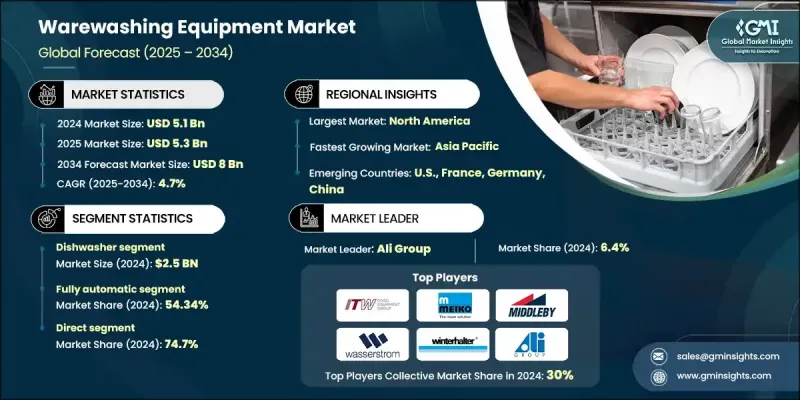
세계의 식기 세척 장비 시장은 2024년에 51억 달러로 평가되었으며, CAGR 4.7%로 성장하여 2034년에는 80억 달러에 달할 것으로 추정됩니다.
시장 확대는 진화하는 외식 산업의 역학과 세척 기술의 일관된 혁신의 조합으로 형성되고 있습니다. 도시와 반도시 지역 모두에서 레스토랑, 호텔, 외식 시설이 증가하고 있으며, 대용량, 에너지 효율적인 식기 세척 솔루션에 대한 수요가 증가하고 있습니다. 이러한 업계에서는 고객 만족도, 위생 기준, 업무 속도에 대한 중요성이 강조되면서 보다 많은 양의 설거지를 정확하고 확실하게 처리할 수 있는 기술적으로 진보된 기계로 전환하고 있습니다. 자동화 시스템, IoT 통합, 센서 기반 유지보수 도구가 표준이 되고 있으며, 식기 세척 시스템을 더욱 지능적이고 빠르게 만들고 있습니다. 상업용 주방과 다점포 레스토랑 체인은 운영 전반에 걸쳐 일관된 청결을 우선시하기 때문에 표준화된 프로그래밍 가능한 설정이 가능한 기계에 대한 수요가 증가하고 있습니다. 이러한 시스템은 위생 상태를 개선할 뿐만 아니라 인건비 상승과 노동력 부족 지역에서 특히 중요한 노동력 의존도를 낮출 수 있습니다. 소비자의 기대치 상승, 규제 강화, 신속한 서비스의 필요성이 결합되어 주방 장비 산업은 지능형 자동화 및 지속가능한 설계의 새로운 단계로 나아가고 있습니다.
| 시장 범위 | |
|---|---|
| 시작 연도 | 2024년 |
| 예측 연도 | 2025-2034 |
| 시장 규모 | 51억 달러 |
| 예측 금액 | 80억 달러 |
| CAGR | 4.7% |
식기세척기 분야는 2024년 25억 달러 규모를 형성하고 2034년까지 CAGR 4.9%로 성장할 것으로 예상됩니다. 모든 식기 세척 시스템 중 식기세척기는 다목적성, 조작의 용이성, 효율성으로 인해 가장 많이 사용되고 있습니다. 조리기구부터 트레이까지 다양한 품목을 세척할 수 있기 때문에 조리센터, 호텔, 시설 주방 등 다양한 상업 환경에서 선호되는 선택이 되고 있습니다. 다른 식기 세척 솔루션과 비교했을 때, 식기세척기는 위생과 효율을 떨어뜨리지 않으면서도 대량의 물량을 처리할 수 있는 다기능의 주력 제품으로서 역할을 하고 있습니다.
2024년 전자동 장비 부문은 54.34%의 점유율을 차지했으며, 2034년까지 4.9%의 연평균 성장률을 보일 것으로 예상됩니다. 전자동 식기세척기는 제한된 수동 입력으로 대량의 주방 용품을 처리할 수 있는 능력으로 인해 대규모 작업에서 점점 더 필수적인 장비가 되고 있습니다. 이러한 시스템은 까다로운 환경에서 속도, 신뢰성, 규제 준수를 실현합니다. 특히 상업용 주방, 병원 및 시설 내 카페테리아에서 이러한 기계를 선호하는데, 이는 인적 오류를 최소화하고, 위생을 개선하며, 현대적 효율성 기준을 충족하면서 운영의 일관성을 지원하기 때문입니다.
미국 식기 세척 장비 시장은 78.7%의 점유율을 차지하며 2024년 14억 달러 규모의 시장을 창출했습니다. 이 지역의 성장은 인건비가 높고 엄격한 위생 규정을 준수해야 하는 성숙된 호스피탈리티 및 식품 서비스 부문에 의해 크게 견인되고 있습니다. 자동 식기 세척 시스템은 운영 비용의 압력과 규제 의무에 대응하여 강력한 견인력을 얻고 있습니다. 또한, 지속가능성으로의 전환이 진행됨에 따라 외식업체들은 비용 절감과 환경적 목표에 따라 에너지 효율과 물 효율이 높은 장비를 도입하고 있습니다. 기업들은 점점 더 많은 기업들이 성능을 향상시키면서 유틸리티 소비를 줄여 워크플로우를 간소화하고 친환경 이니셔티브를 지원하는 장비를 우선시하고 있습니다.
세계 식기 세척 장비 시장을 형성하고 있는 주요 기업으로는 Meiko, Washtech, Hobart, Fagor Industrial, Electrolux Professional, Classeq, Sammic, Ecolab, Winterhalter, Champion Industries, Insinger Machine Company, Smeg Foodservice Equipment, Comenda, Krupps, Jackson Warewashing Systems 등이 있습니다. 장기적인 시장 포지셔닝을 확보하기 위해 식기 세척 장비 업계 기업들은 제품 혁신, 에너지 효율, 기술 통합에 중점을 두고 있습니다. 주요 제조업체들은 예지보전을 지원하고 다운타임을 줄이기 위해 스마트 진단, 터치스크린 제어, 원격 모니터링 기능을 갖춘 기계를 개발하고 있습니다. 특히, 최소한의 노동력 투입으로 운영을 간소화하고자 하는 대량 생산 운영자에게 자동화는 여전히 주요 관심사입니다. 지속가능성은 또 다른 중요한 분야로, 기업들은 물과 에너지 사용을 줄이면서 세척 효율을 극대화하는 시스템을 설계하고 있습니다.
목차
제1장 조사 방법과 범위
제2장 주요 요약
제3장 업계 인사이트
- 생태계 분석
- 공급업체 상황
- 이익률
- 각 단계에서의 부가가치
- 밸류체인에 영향을 미치는 요인
- 업계에 대한 영향요인
- 성장 촉진요인
- 식품 서비스와 호스피탈리티 업계 수요 증가
- 기술적 진보
- 엄격한 위생 규제
- 업계의 잠재적 리스크와 과제
- 높은 초기 투자 비용
- 유지비 및 운영비
- 기회
- 에너지 효율적 솔루션 채용
- 신흥 시장에 대한 확대
- 성장 촉진요인
- 성장 가능성 분석
- 향후 시장 동향
- 테크놀러지와 혁신 상황
- 현재 기술 동향
- 신기술
- 가격 동향
- 지역별
- 제품 유형별
- 규제 상황
- 표준 및 컴플라이언스 요건
- 지역 규제 프레임워크
- 격차 분석
- 리스크 평가와 경감
- 무역 분석(HS 코드 845020)
- 수출국 상위 10개국
- 수입국 상위 10개국
- Porters 분석
- PESTEL 분석
- 소비자 행동 분석
- 구입 패턴
- 기호 분석
- 소비자 행동의 지역적 차이
- E-Commerce가 구매 결정에 미치는 영향
제4장 경쟁 구도
- 소개
- 기업의 시장 점유율 분석
- 지역별
- 기업 매트릭스 분석
- 주요 시장 기업 경쟁 분석
- 경쟁 포지셔닝 매트릭스
- 주요 발전
- 인수합병
- 파트너십과 협업
- 신제품 발매
- 확장 계획
제5장 시장 추정과 예측 : 제품 유형별, 2021-2034
- 주요 동향
- 식기세척기
- 유리세척기
- 랙 컨베이어
- 부스터 히터
- 기타(탈수 등)
제6장 시장 추정과 예측 : 유형별, 2021-2034
- 주요 동향
- 수동
- 반자동
- 전자동
제7장 시장 추정과 예측 : 가격대별, 2021-2034
- 주요 동향
- 저
- 중
- 고
제8장 시장 추정과 예측 : 솔루션별, 2021-2034
- 주요 동향
- 세제
- 린스제
- 살균제
제9장 시장 추정과 예측 : 최종 용도별, 2021-2034
- 주요 동향
- 상업용
- 호텔
- 레스토랑
- 카페
- 케이터링 서비스
- 기타(병원·헬스케어 시설 등)
- 기관
- 산업
제10장 시장 추정과 예측 : 유통 채널별, 2021-2034
- 주요 동향
- 직접
- 간접적
제11장 시장 추정과 예측 : 지역별, 2021-2034
- 주요 동향
- 북미
- 미국
- 캐나다
- 유럽
- 영국
- 독일
- 프랑스
- 이탈리아
- 스페인
- 러시아
- 아시아태평양
- 중국
- 인도
- 일본
- 호주
- 한국
- 라틴아메리카
- 브라질
- 멕시코
- 아르헨티나
- 중동 및 아프리카
- 아랍에미리트
- 남아프리카공화국
- 사우디아라비아
제12장 기업 개요
- Champion Industries
- Classeq
- Comenda
- Electrolux Professional
- Ecolab
- Fagor Industrial
- Hobart
- Insinger Machine Company
- Jackson Warewashing Systems
- Krupps
- Meiko
- Sammic
- Smeg Foodservice Equipment
- Winterhalter
- Washtech
The Global Warewashing Equipment Market was valued at USD 5.1 billion in 2024 and is estimated to grow at a CAGR of 4.7% to reach USD 8 billion by 2034.
Market expansion is being shaped by a mix of evolving food service dynamics and consistent innovation in cleaning technologies. With restaurants, hotels, and food service facilities increasing in both urban and semi-urban areas, demand for high-capacity, energy-efficient warewashing solutions is on the rise. As these industries focus more on customer satisfaction, hygiene standards, and operational speed, there's a greater shift toward technologically advanced machines that can handle larger volumes with precision and reliability. Automated systems, IoT integration, and sensor-driven maintenance tools are becoming standard, making warewashing systems more intelligent and responsive. Commercial kitchens and multi-location restaurant chains are prioritizing consistent cleanliness across operations, creating demand for machines with standardized, programmable settings. These systems not only improve hygiene but also reduce labor dependency, particularly vital in regions with high labor costs or workforce shortages. The combination of rising consumer expectations, stricter regulations, and the need for faster service is driving the warewashing equipment industry into a new phase of intelligent automation and sustainable design.
| Market Scope | |
|---|---|
| Start Year | 2024 |
| Forecast Year | 2025-2034 |
| Start Value | $5.1 Billion |
| Forecast Value | $8 Billion |
| CAGR | 4.7% |
The dishwasher segment generated USD 2.5 billion in 2024 and is forecasted to grow at a CAGR of 4.9% through 2034. Among all warewashing systems, dishwashers continue to be the most used due to their versatility, ease of operation, and efficiency. Their ability to wash a broad range of items, from utensils to trays, makes them a preferred option in various commercial settings, including food prep centers, hospitality, and institutional kitchens. Compared to other warewashing solutions, dishwashers serve as multi-functional workhorses that handle bulk operations without compromising hygiene or efficiency.
In 2024, the fully automatic equipment segment held a 54.34% share and is expected to grow at a CAGR of 4.9% through 2034. Fully automated warewashing machines have become increasingly essential in large-scale operations due to their ability to handle substantial volumes of kitchenware with limited manual input. These systems deliver speed, reliability, and regulatory compliance in demanding environments. Commercial kitchens, hospitals, and institutional cafeterias especially favor these machines because they minimize human error, improve sanitation, and support operational consistency while meeting modern efficiency standards.
United States Warewashing Equipment Market held a 78.7% share and generated USD 1.4 billion in 2024. The growth in this region is largely driven by a mature hospitality and foodservice sector, where labor costs remain high and compliance with stringent hygiene regulations is mandatory. Automated warewashing systems have gained strong traction in response to operational cost pressures and regulatory mandates. Additionally, the ongoing shift toward sustainability has prompted foodservice operators to adopt energy- and water-efficient machines that align with cost-saving and environmental goals. Businesses increasingly prioritize equipment that reduces utility consumption while enhancing performance, helping to streamline workflow and support green initiatives.
Key players shaping the Global Warewashing Equipment Market include Meiko, Washtech, Hobart, Fagor Industrial, Electrolux Professional, Classeq, Sammic, Ecolab, Winterhalter, Champion Industries, Insinger Machine Company, Smeg Foodservice Equipment, Comenda, Krupps, and Jackson Warewashing Systems. To secure long-term market positioning, companies in the warewashing equipment industry are heavily focused on product innovation, energy efficiency, and technological integration. Leading manufacturers are developing machines equipped with smart diagnostics, touch-screen controls, and remote monitoring capabilities to support predictive maintenance and reduce downtime. Automation remains a primary focus, especially for high-volume operators looking to streamline operations with minimal labor input. Sustainability is another critical area, with firms designing systems that reduce water and energy use while maximizing cleaning efficiency.
Table of Contents
Chapter 1 Methodology and Scope
- 1.1 Market scope and definition
- 1.2 Research design
- 1.2.1 Research approach
- 1.3 Data collection methods
- 1.4 Data mining sources
- 1.4.1 Global
- 1.4.2 Regional/Country
- 1.5 Base estimates and calculations
- 1.5.1 Base year calculation
- 1.5.2 Key trends for market estimation
- 1.6 Primary research and validation
- 1.6.1 Primary sources
- 1.7 Forecast model
- 1.8 Research assumptions and limitations
Chapter 2 Executive Summary
- 2.1 Industry 360° synopsis
- 2.2 Key market trends
- 2.2.1 Regional
- 2.2.2 Product type
- 2.2.3 Type
- 2.2.4 Price range
- 2.2.5 Solution
- 2.2.6 End use
- 2.2.7 Distribution channel
- 2.3 CXO perspectives: strategic imperatives
- 2.3.1 Key decision points for industry executives
- 2.3.2 Critical success factors for market players
- 2.4 Future outlook and strategic recommendations
Chapter 3 Industry Insights
- 3.1 Industry ecosystem analysis
- 3.1.1 Supplier landscape
- 3.1.2 Profit margin
- 3.1.3 Value addition at each stage
- 3.1.4 Factors affecting the value chain
- 3.2 Industry impact forces
- 3.2.1 Growth drivers
- 3.2.1.1 Rising demand in food service & hospitality
- 3.2.1.2 Technological advancements
- 3.2.1.3 Stringent hygiene regulations
- 3.2.2 Industry pitfalls & challenges
- 3.2.2.1 High initial investment costs
- 3.2.2.2 Maintenance and operational expenses
- 3.2.3 Opportunities
- 3.2.3.1 Adoption of energy-efficient solutions
- 3.2.3.2 Expansion in emerging markets
- 3.2.1 Growth drivers
- 3.3 Growth potential analysis
- 3.4 Future market trends
- 3.5 Technology and innovation landscape
- 3.5.1 Current technological trends
- 3.5.2 Emerging technologies
- 3.6 Price trends
- 3.6.1 By region
- 3.6.2 By Product type
- 3.7 Regulatory landscape
- 3.7.1 standards and compliance requirements
- 3.7.2 Regional regulatory frameworks
- 3.8 Gap analysis
- 3.9 Risk assessment and mitigation
- 3.10 Trade analysis (HS Code-845020)
- 3.10.1 Top 10 export countries
- 3.10.2 Top 10 import countries
- 3.11 Porter's analysis
- 3.12 PESTEL analysis
- 3.13 Consumer behavior analysis
- 3.13.1 Purchasing patterns
- 3.13.2 Preference analysis
- 3.13.3 Regional variations in consumer behavior
- 3.13.4 Impact of e-commerce on buying decisions
Chapter 4 Competitive Landscape, 2024
- 4.1 Introduction
- 4.2 Company market share analysis
- 4.2.1 By region
- 4.2.1.1 North America
- 4.2.1.2 Europe
- 4.2.1.3 Asia Pacific
- 4.2.1.4 Latin America
- 4.2.1.5 Middle East and Africa
- 4.2.1 By region
- 4.3 Company matrix analysis
- 4.4 Competitive analysis of major market players
- 4.5 Competitive positioning matrix
- 4.6 Key developments
- 4.6.1 Mergers & acquisitions
- 4.6.2 Partnerships & collaborations
- 4.6.3 New Product Launches
- 4.6.4 Expansion Plans
Chapter 5 Market Estimates & Forecast, By Product Type, 2021 - 2034 ($Bn, Thousand Units)
- 5.1 Key trends
- 5.2 Dishwasher
- 5.3 Glasswasher
- 5.4 Rack conveyors
- 5.5 Booster heater
- 5.6 Others (dish drainers, etc.)
Chapter 6 Market Estimates & Forecast, By Type, 2021 - 2034 ($Bn, Thousand Units)
- 6.1 Key trends
- 6.2 Manual
- 6.3 Semi-automatic
- 6.4 Fully automatic
Chapter 7 Market Estimates & Forecast, By Price Range, 2021 - 2034 ($Bn, Thousand Units)
- 7.1 Key trends
- 7.2 Low
- 7.3 Medium
- 7.4 High
Chapter 8 Market Estimates & Forecast, By Solution, 2021 - 2034 ($Bn, Thousand Units)
- 8.1 Key trends
- 8.2 Detergent
- 8.3 Rinse aids
- 8.4 Sanitizer
Chapter 9 Market Estimates & Forecast, By End Use, 2021 - 2034 ($Bn, Thousand Units)
- 9.1 Key trends
- 9.2 Commercial
- 9.2.1 Hotels
- 9.2.2 Restaurants
- 9.2.3 Cafes
- 9.2.4 Catering services
- 9.2.5 Others (hospitals and healthcare facilities, etc.)
- 9.3 Institutional
- 9.4 Industrial
Chapter 10 Market Estimates & Forecast, By Distribution Channel, 2021 - 2034 ($Bn, Thousand Units)
- 10.1 Key trends
- 10.2 Direct
- 10.3 Indirect
Chapter 11 Market Estimates & Forecast, By Region, 2021 - 2034 ($Bn, Thousand Units)
- 11.1 Key trends
- 11.2 North America
- 11.2.1 U.S.
- 11.2.2 Canada
- 11.3 Europe
- 11.3.1 UK
- 11.3.2 Germany
- 11.3.3 France
- 11.3.4 Italy
- 11.3.5 Spain
- 11.3.6 Russia
- 11.4 Asia Pacific
- 11.4.1 China
- 11.4.2 India
- 11.4.3 Japan
- 11.4.4 Australia
- 11.4.5 South Korea
- 11.5 Latin America
- 11.5.1 Brazil
- 11.5.2 Mexico
- 11.5.3 Argentina
- 11.6 MEA
- 11.6.1 UAE
- 11.6.2 South Africa
- 11.6.3 Saudi Arabia
Chapter 12 Company Profiles
- 12.1 Champion Industries
- 12.2 Classeq
- 12.3 Comenda
- 12.4 Electrolux Professional
- 12.5 Ecolab
- 12.6 Fagor Industrial
- 12.7 Hobart
- 12.8 Insinger Machine Company
- 12.9 Jackson Warewashing Systems
- 12.10 Krupps
- 12.11 Meiko
- 12.12 Sammic
- 12.13 Smeg Foodservice Equipment
- 12.14 Winterhalter
- 12.15 Washtech