

|
시장보고서
상품코드
1858851
배터리 용도 이온 액체 시장 : 시장 기회, 성장 촉진요인, 산업 동향 분석, 예측(2025-2034년)Ionic Liquids for Battery Applications Market Opportunity, Growth Drivers, Industry Trend Analysis, and Forecast 2025 - 2034 |
||||||

세계의 배터리 용도 이온 액체 시장은 2024년에는 1억 1,100만 달러로 평가되었고, CAGR 10.2%로 성장할 전망이며, 2034년에는 3억 1,420만 달러에 이를 것으로 예측되고 있습니다.
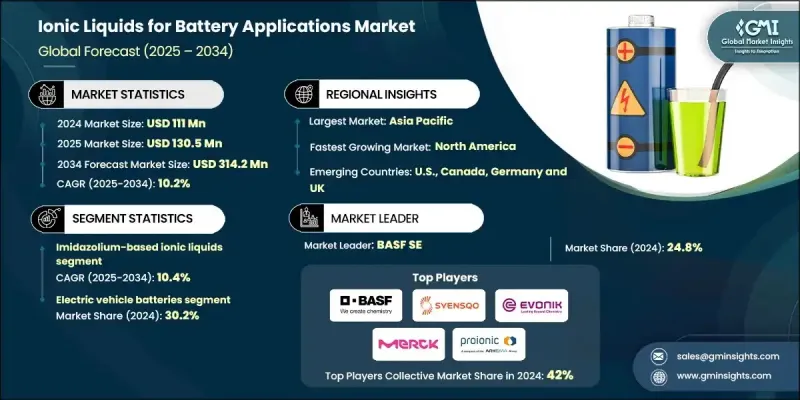
첨단 에너지 저장 시스템에 대한 수요 증가가 시장 확대에 박차를 가하고 있습니다. 이온 액체는 저온에서 액체 형태의 유기염으로 알려져 있으며, 탁월한 이온 전도성, 높은 열 안정성, 낮은 휘발성 및 광범위한 전기 화학적 창을 인정받고 있습니다. 이러한 특성은 리튬 이온 배터리, 나트륨 이온 배터리, 고체 배터리 등 다양한 유형의 배터리 전해질로 매우 적합합니다. 고전압 동작을 가능하게 하고, 넓은 온도 범위에 걸쳐 성능을 유지할 수 있기 때문에 전기자동차, 재생에너지 저장, 휴대 전자 기기에 특히 편리합니다. 전동 모빌리티의 채용이 확대되고 전력망에서 재생에너지의 이용이 증가하고 있기 때문에 보다 안전하고 오래 지속되는 배터리의 필요성이 높아지고 있으며, 이온 액체 전해질의 중요성이 더욱 높아지고 있습니다. 현재 진행 중인 기술 혁신은 전도성 향상 및 제조 비용 절감에 중점을 두고 있으며, 시장 가속화를 계속 지원하고 있습니다. 신뢰성이 높은 고성능 배터리 기술을 요구하는 산업이 늘고 있는 가운데, 이온 액체는 배터리의 수명을 연장하고 다양한 이용 사례에서의 안전성을 높이는 능력으로 큰 지지를 모으고 있습니다.
| 시장 범위 | |
|---|---|
| 시작 연도 | 2024년 |
| 예측 연도 | 2025-2034년 |
| 시장 규모 | 1억 1,100만 달러 |
| 예측 금액 | 3억 1,420만 달러 |
| CAGR | 10.2% |
이미다졸륨계 이온 액체 부문은 2024년에 45.2%의 점유율을 차지했습니다. 이미다졸륨계 이온성 액체는 널리 상업적으로 이용가능하며, 제조의 확장성이 높기 때문에 비용 효율적이고 신뢰성 있는 공급을 유지하는 데 있어서 눈에 띄게 유리합니다. 이러한 요인은 지속적인 연구 투자와 함께 이미다졸륨 화합물이 여러 배터리 화학 분야에서 우위를 유지하는 데 도움이 됩니다. 이 분야는 에너지 저장 시스템의 효율성 및 범용성을 더욱 높이기 위한 일관된 연구개발 지원을 통해 더욱 기세를 늘릴 것으로 예측됩니다.
전기자동차 배터리 부문은 2024년 30.2%의 점유율을 차지했습니다. 이 점유율은 e-모빌리티로의 지속적인 전환과 자동차 부문에서의 안전성에 대한 기대 증가가 원동력이 되고 있습니다. EV 생산 확대, 규제 프레임워크의 엄격화, 보다 우수한 배터리 성능을 요구하는 소비자 기호 등이 이 부문의 성장에 기여하고 있습니다. 차세대 전지 기술의 개발이 진행되고 있는 가운데, 많은 자동차 제조업체는 배터리의 안전성 및 기능성을 향상시키기 위해, 이온 액체 전해질의 채용을 향해 큰 자원을 투입하고 있습니다.
북미의 배터리 용도 이온 액체 2024년 시장 점유율은 28.2%로, 이 지역에서는 배터리 용도 이온 액체 수요가 계속 증가하고 있습니다. 이 성장을 뒷받침하는 것은 전기자동차의 보급, 청정 에너지의 통합, 송전망의 안정성 중시 증가입니다. 첨단 에너지 저장 인프라를 지원하는 정부의 이니셔티브와 함께, 혁신은 이온 액체의 사용 증가에 기여하고 있습니다. 이 지역은 신에너지 기술에 대한 반응이 높고 지속적인 시장 개척에 유리한 조건이 갖추어져 있습니다.
세계의 배터리 용도 이온 액체 시장을 적극적으로 형성하고 있는 주요 기업으로는 Solvionic SA, Merck KGaA, Richman Chemical Inc., Syensqo, NOHMs Technologies, Inc., Evonik Industries AG, BASF SE, Proionic GmbH-Arkema Group, Tokyo Chemical Industry Co., Ltd., and IoLiTec - Ionic Liquids Technologies GmbH 등이 있습니다. 각 회사는 그 지위를 강화하기 위해 다양한 배터리의 화학 반응에 맞춘 맞춤형 이온 액체로 제품 포트폴리오를 확대하는 등 중요한 전략에 주력하고 있습니다. 많은 기업들은 공정 혁신으로 인한 비용 절감을 우선시하고 상업적 실행 가능성을 향상시키기 위해 생산 규모를 확대하고 있습니다. 또한, 이온 액체의 신흥 전지 기술에 대한 통합을 가속하기 위해, 전지 개발 기업이나 OEM과의 공동 연구 개발 구상도 진행되고 있습니다.
자주 묻는 질문
목차
제1장 조사 방법 및 범위
제2장 주요 요약
제3장 업계 인사이트
- 생태계 분석
- 공급자의 상황
- 이익률
- 각 단계에서의 부가가치
- 밸류체인에 영향을 주는 요인
- 혁신
- 업계에 미치는 영향요인
- 성장 촉진요인
- 업계의 잠재적 위험 및 과제
- 시장 기회
- 성장 가능성 분석
- 규제 상황
- 북미
- 유럽
- 아시아태평양
- 라틴아메리카
- 중동 및 아프리카
- Porter's Five Forces 분석
- PESTEL 분석
- 가격 동향
- 지역별
- 용도별
- 향후 시장 동향
- 기술 및 혁신의 전망
- 현재의 기술 동향
- 신흥 기술
- 특허 상황
- 무역 통계(HS 코드 참고 : 무역 통계는 주요 국가에 대해서만 제공됨)
- 주요 수입국
- 주요 수출국
- 지속가능성 및 환경 측면
- 지속가능한 관행
- 폐기물 감축 전략
- 생산에서의 에너지 효율
- 환경 친화적인 노력
- 탄소발자국의 고려
제4장 경쟁 구도
- 서문
- 기업의 시장 점유율 분석
- 지역별
- 북미
- 유럽
- 아시아태평양
- 라틴아메리카
- 중동 및 아프리카
- 지역별
- 기업 매트릭스 분석
- 주요 시장 기업의 경쟁 분석
- 경쟁 포지셔닝 매트릭스
- 주요 발전
- 합병 및 인수
- 파트너십
- 신제품 발표
- 확장 계획
제5장 시장 추계 및 예측 : 이온 액체 유형별(2021-2034년)
- 주요 동향
- 이미다졸륨계 이온 액체
- 피롤리디늄계 이온 액체
- 포스포늄계 이온 액체
- 제4급 암모늄계 이온 액체
제6장 시장 추계 및 예측 : 용도별(2021-2034년)
- 주요 동향
- 전기자동차 배터리
- 자동차용 트랙션 배터리
- 하이브리드 자동차 시스템
- 급속 충전 용도
- 그리드 에너지 저장
- 유틸리티 규모 축전 시스템
- 주파수 조정 용도
- 장기 보존 용액
- 소비자용 전자기기
- 스마트폰 용도
- 노트북 및 휴대용 기기
- 웨어러블 기술
- 항공우주 및 방위
- 위성 배터리 시스템
- 군사 용도
제7장 시장 추계 및 예측 : 지역별(2021-2034년)
- 주요 동향
- 북미
- 미국
- 캐나다
- 유럽
- 독일
- 영국
- 프랑스
- 스페인
- 이탈리아
- 기타 유럽
- 아시아태평양
- 중국
- 인도
- 일본
- 호주
- 한국
- 기타 아시아태평양
- 라틴아메리카
- 브라질
- 멕시코
- 아르헨티나
- 기타 라틴아메리카
- 중동 및 아프리카
- 사우디아라비아
- 남아프리카
- 아랍에미리트(UAE)
- 기타 중동 및 아프리카
제8장 기업 프로파일
- BASF SE
- Syensqo
- Evonik Industries AG
- Merck KGaA
- Proionic GmbH-Arkema Group
- Solvionic SA
- IoLiTec-Ionic Liquids Technologies GmbH
- Tokyo Chemical Industry Co., Ltd.
- NOHMs Technologies, Inc.
- Richman Chemical Inc.
The Global Ionic Liquids for Battery Applications Market was valued at USD 111 million in 2024 and is estimated to grow at a CAGR of 10.2% to reach USD 314.2 million by 2034.
Rising demand for advanced energy storage systems is fueling market expansion. Ionic liquids, known as organic salts in liquid form at low temperatures, are recognized for their outstanding ionic conductivity, high thermal stability, low volatility, and broad electrochemical windows. These properties make them highly suitable as electrolytes in various battery types, including lithium-ion, sodium-ion, and solid-state formats. Their ability to enable high-voltage operation and maintain performance across wide temperature ranges makes them especially valuable in electric vehicles, renewable energy storage, and portable electronics. Growing adoption of electric mobility and the increasing use of renewables in the power grid are driving the need for safer, longer-lasting batteries further elevating the relevance of ionic liquid electrolytes. Ongoing innovations are focusing on improving conductivity and reducing manufacturing costs, which continues to support market acceleration. As more industries seek reliable, high-performance battery technologies, ionic liquids are gaining significant traction for their ability to extend battery lifespan and enhance safety across diverse use cases.
| Market Scope | |
|---|---|
| Start Year | 2024 |
| Forecast Year | 2025-2034 |
| Start Value | $111 Million |
| Forecast Value | $314.2 Million |
| CAGR | 10.2% |
The imidazolium-based ionic liquids segment held a substantial 45.2% share in 2024. Their widespread commercial availability and production scalability give them a distinct edge in maintaining cost efficiency and reliable supply. These factors, along with ongoing research investments, are helping imidazolium compounds maintain their dominance across multiple battery chemistries. The segment is expected to receive further momentum through consistent R&D support aimed at unlocking even greater efficiency and versatility in energy storage systems.
The electric vehicle batteries segment held a 30.2% share in 2024. This share is driven by the continued transition to e-mobility and heightened safety expectations within the automotive sector. The expansion of EV production, stricter regulatory frameworks, and consumer preferences for better battery performance are all contributing to growth in this segment. With next-generation battery technologies under development, many automotive manufacturers are allocating significant resources toward adopting ionic liquid electrolytes to improve battery safety and functionality.
North America Ionic Liquids for Battery Applications Market held a 28.2% share in 2024, as demand for battery-related ionic liquids continues to rise across the region. This growth is being propelled by the widespread adoption of electric vehicles, integration of clean energy sources, and an increasing emphasis on grid stability. Technological innovation, alongside government initiatives to support advanced energy storage infrastructure, is contributing to the rising use of ionic liquids. The region remains highly responsive to new energy technologies, creating favorable conditions for sustained market development.
Key companies actively shaping the Global Ionic Liquids for Battery Applications Market include Solvionic SA, Merck KGaA, Richman Chemical Inc., Syensqo, NOHMs Technologies, Inc., Evonik Industries AG, BASF SE, Proionic GmbH - Arkema Group, Tokyo Chemical Industry Co., Ltd., and IoLiTec - Ionic Liquids Technologies GmbH. To strengthen their position, companies are focusing on key strategies such as expanding their product portfolios with custom-formulated ionic liquids tailored to different battery chemistries. Many are prioritizing cost reduction through process innovation and scaling production to improve commercial viability. Collaborative R&D initiatives with battery developers and OEMs are also being pursued to speed up the integration of ionic liquids into emerging battery technologies.
Table of Contents
Chapter 1 Methodology & Scope
- 1.1 Market scope and definition
- 1.2 Research design
- 1.2.1 Research approach
- 1.2.2 Data collection methods
- 1.3 Data mining sources
- 1.3.1 Global
- 1.3.2 Regional/Country
- 1.4 Base estimates and calculations
- 1.4.1 Base year calculation
- 1.4.2 Key trends for market estimation
- 1.5 Primary research and validation
- 1.5.1 Primary sources
- 1.6 Forecast model
- 1.7 Research assumptions and limitations
Chapter 2 Executive Summary
- 2.1 Industry 360° synopsis
- 2.2 Key market trends
- 2.2.1 Regional
- 2.2.2 Ionic liquids type
- 2.2.3 Application
- 2.3 TAM Analysis, 2025-2034
- 2.4 CXO perspectives: Strategic imperatives
- 2.4.1 Executive decision points
- 2.4.2 Critical success factors
- 2.5 Future Outlook and Strategic Recommendations
Chapter 3 Industry Insights
- 3.1 Industry ecosystem analysis
- 3.1.1 Supplier landscape
- 3.1.2 Profit margin
- 3.1.3 Value addition at each stage
- 3.1.4 Factor affecting the value chain
- 3.1.5 Disruptions
- 3.2 Industry impact forces
- 3.2.1 Growth drivers
- 3.2.2 Industry pitfalls and challenges
- 3.2.3 Market opportunities
- 3.3 Growth potential analysis
- 3.4 Regulatory landscape
- 3.4.1 North America
- 3.4.2 Europe
- 3.4.3 Asia Pacific
- 3.4.4 Latin America
- 3.4.5 Middle East & Africa
- 3.5 Porter's analysis
- 3.6 PESTEL analysis
- 3.7 Price trends
- 3.7.1 By region
- 3.7.2 By application
- 3.8 Future market trends
- 3.9 Technology and Innovation landscape
- 3.9.1 Current technological trends
- 3.9.2 Emerging technologies
- 3.10 Patent Landscape
- 3.11 Trade statistics (HS code Note: the trade statistics will be provided for key countries only)
- 3.11.1 Major importing countries
- 3.11.2 Major exporting countries
- 3.12 Sustainability and environmental aspects
- 3.12.1 Sustainable practices
- 3.12.2 Waste reduction strategies
- 3.12.3 Energy efficiency in production
- 3.12.4 Eco-friendly initiatives
- 3.13 Carbon footprint consideration
Chapter 4 Competitive Landscape, 2024
- 4.1 Introduction
- 4.2 Company market share analysis
- 4.2.1 By region
- 4.2.1.1 North America
- 4.2.1.2 Europe
- 4.2.1.3 Asia Pacific
- 4.2.1.4 LATAM
- 4.2.1.5 MEA
- 4.2.1 By region
- 4.3 Company matrix analysis
- 4.4 Competitive analysis of major market players
- 4.5 Competitive positioning matrix
- 4.6 Key developments
- 4.6.1 Mergers & acquisitions
- 4.6.2 Partnerships & collaborations
- 4.6.3 New Product Launches
- 4.6.4 Expansion Plans
Chapter 5 Market Estimates and Forecast, By Ionic Liquids Type, 2021-2034 (USD Million & Tons)
- 5.1 Key trends
- 5.2 Imidazolium-based ionic liquids
- 5.3 Pyrrolidinium-based ionic liquids
- 5.4 Phosphonium-based ionic liquids
- 5.5 Quaternary ammonium-based ionic liquids
Chapter 6 Market Estimates and Forecast, By Application, 2021-2034 (USD Million & Tons)
- 6.1 Key trends
- 6.2 Electric vehicle batteries
- 6.2.1 Automotive traction batteries
- 6.2.2 Hybrid vehicle systems
- 6.2.3 Fast charging applications
- 6.3 Grid energy storage
- 6.3.1 Utility-scale storage systems
- 6.3.2 Frequency regulation applications
- 6.3.3 Long-duration storage solutions
- 6.4 Consumer electronics
- 6.4.1 Smartphone applications
- 6.4.2 Laptop & portable devices
- 6.4.3 Wearable technology
- 6.5 Aerospace & defense
- 6.5.1 Satellite battery systems
- 6.5.2 Military applications
Chapter 7 Market Estimates and Forecast, By Region, 2021-2034 (USD Million & Tons)
- 7.1 Key trends
- 7.2 North America
- 7.2.1 U.S.
- 7.2.2 Canada
- 7.3 Europe
- 7.3.1 Germany
- 7.3.2 UK
- 7.3.3 France
- 7.3.4 Spain
- 7.3.5 Italy
- 7.3.6 Rest of Europe
- 7.4 Asia Pacific
- 7.4.1 China
- 7.4.2 India
- 7.4.3 Japan
- 7.4.4 Australia
- 7.4.5 South Korea
- 7.4.6 Rest of Asia Pacific
- 7.5 Latin America
- 7.5.1 Brazil
- 7.5.2 Mexico
- 7.5.3 Argentina
- 7.5.4 Rest of Latin America
- 7.6 Middle East and Africa
- 7.6.1 Saudi Arabia
- 7.6.2 South Africa
- 7.6.3 UAE
- 7.6.4 Rest of Middle East and Africa
Chapter 8 Company Profiles
- 8.1 BASF SE
- 8.2 Syensqo
- 8.3 Evonik Industries AG
- 8.4 Merck KGaA
- 8.5 Proionic GmbH - Arkema Group
- 8.6 Solvionic SA
- 8.7 IoLiTec - Ionic Liquids Technologies GmbH
- 8.8 Tokyo Chemical Industry Co., Ltd.
- 8.9 NOHMs Technologies, Inc.
- 8.10 Richman Chemical Inc.


