|
시장보고서
상품코드
1871083
건축용 바이오 시멘트 시장 : 기회, 성장 촉진요인, 산업 동향 분석, 예측(2025-2034년)Biocement for Construction Application Market Opportunity, Growth Drivers, Industry Trend Analysis, and Forecast 2025 - 2034 |
||||||

세계의 건축용 바이오 시멘트 시장은 2024년 3,020만 달러로 평가되었으며, 2034년까지 연평균 복합 성장률(CAGR) 10.9%로 성장하여 8,900만 달러에 이를 것으로 예측됩니다.
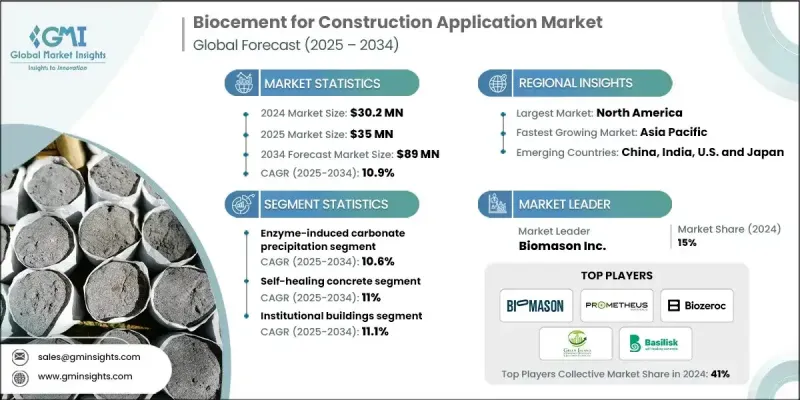
지속가능하고 환경친화적인 건설자재에 대한 세계적 관심의 고조가 본 시장의 급속한 성장을 뒷받침하고 있습니다. 바이오 시멘트는 고탄소 배출로 알려진 전통적인 포틀랜드 시멘트를 대체하는 더 깨끗한 옵션을 제공합니다. 방해석의 침전을 촉진하는 미생물 공정에 의해 제조되는 바이오 시멘트는 현대의 건설 요구에 부응하는 내구성이 우수한 저탄소 결합재입니다. 뛰어난 환경 이점, 저에너지 소비, 강화된 강도 특성으로 인프라, 주택, 상업 프로젝트에서의 채용이 진행되고 있습니다. 바이오 재료와 미생물 기술의 지속적인 발전으로 생산 효율과 비용 효율성이 향상되고 기존 시멘트와의 경쟁이 강화되었습니다. 세계 지속가능성 이니셔티브와 규제 요건은 대규모 프로젝트에 대한 바이오 시멘트 도입을 가속화하고 있습니다. 연구개발에 대한 투자 확대로 토양안정화, 보수공사, 프리캐스트 부재에 대한 응용 가능성이 확대되고 있습니다. 환경 보전 의식 증가와 그린 빌딩 기술에 대한 소비자의 지향은 세계 건축 바이오 시멘트의 전반적인 수요를 계속 견인하고 있습니다.
| 시장 범위 | |
|---|---|
| 시작 연도 | 2024년 |
| 예측 연도 | 2025-2034년 |
| 시작 금액 | 3,020만 달러 |
| 예측 금액 | 8,900만 달러 |
| CAGR | 10.9% |
미생물 유도 탄산염 침전(MICP) 부문은 2024년 60%의 점유율을 차지했습니다. 이 공정은 천연 박테리아를 이용하여 탄산 칼슘을 침전시켜 건설 용도에 이상적인 견고하고 내구성있는 결합 특성을 생성합니다. MICP의 상업적 및 환경적 실현 가능성을 입증하는 광범위한 조사는 업계의 주도적 지위를 더욱 강화했습니다. 지속적인 기술 진보와 콘크리트 보강 및 지반 안정화를 위한 특수 용도의 개발로 향후 수년간 그 우위성이 지속될 것으로 예측됩니다.
산업 및 제조 시설 분야는 2024년 29.8%의 점유율을 차지해, CAGR 10.6%로 성장했습니다. 이러한 분야 수요는 뛰어난 내구성, 내약품성 및 자기 복구 특성을 갖춘 건축자재에 대한 필요성에 의해 견인되고 있습니다. 바이오 시멘트는 서비스 수명을 연장하고 유지 관리 비용을 최소화 할 수 있기 때문에 가혹한 운영 환경에서 산업 시설에서 특히 가치가 있습니다. 화학적 열화에 대한 내성과 까다로운 환경에서도 구조적 무결성을 유지하는 능력으로 산업 건설의 주요 재료로서의 지위를 확립하고 있습니다.
북미의 건축용 바이오 시멘트 시장은 2024년에 43.5%의 점유율을 차지했고, 2034년까지 연평균 복합 성장률(CAGR) 11.1%가 전망되고 있습니다. 이 지역의 성장은 높은 환경 의식, 정부의 지속가능성 이니셔티브 및 전통적인 시멘트 생산에 대한 엄격한 규제에 크게 기여합니다. 미국은 그린빌딩 인프라에 대한 대규모 투자와 환경을 배려한 건설기준으로 최첨단을 유지하고 캐나다는 지속 가능한 도시개발을 촉진하는 정책을 통해 확대를 계속하고 있습니다. 바이오 시멘트 배합의 지속적인 혁신과 제조업체 간의 연구 활동·연계의 강화가 함께, 이 지역 시장 확대는 더욱 가속될 것으로 예측됩니다.
건축용 바이오 시멘트 시장의 주요 기업으로는 Carbicrete Inc., Biozeroc Ltd., Biomason Inc., Prometheus Materials Inc., Green Island International Ltd., and Basilisk B.V 등이 있습니다. 이 시장의 주요 기업은 조사, 전략적 제휴, 생산 규모 확대에 중점을 둔 전략을 전개하여 시장에서의 지위 강화를 도모하고 있습니다. 많은 기업들이 미생물의 효율 향상, 방해석의 석출 최적화, 보다 신속하고 지속 가능한 경화 프로세스의 개발을 위해 연구 개발에 많은 투자를 실시했습니다. 바이오테크놀러지 기업, 건설회사, 학술기관간의 제휴는 제품 개발의 가속과 응용 분야의 확대에 공헌하고 있습니다. 여러 기업은 자동화 및 첨단 바이오엔지니어링 기술을 통해 제조 능력을 확대하고 생산 비용을 줄이기 위해 노력하고 있습니다.
자주 묻는 질문
목차
제1장 조사 방법과 범위
제2장 주요 요약
제3장 업계 인사이트
- 업계 생태계 분석
- 공급자의 상황
- 이익률
- 각 단계에서의 부가가치
- 밸류체인에 영향을 주는 요인
- 혁신
- 업계에 미치는 영향요인
- 성장 촉진요인
- 업계의 잠재적 리스크 및 과제
- 시장 기회
- 성장 가능성 분석
- 규제 상황
- 북미
- 유럽
- 아시아태평양
- 라틴아메리카
- 중동 및 아프리카
- Porter's Five Forces 분석
- PESTEL 분석
- 가격 동향
- 지역별
- 제품 카테고리별
- 미래 시장 동향
- 기술과 혁신의 상황
- 현재의 기술 동향
- 신흥기술
- 특허 상황
- 무역 통계(HS코드)(참고: 무역 통계는 주요 국가에서만 제공됨)
- 주요 수입국
- 주요 수출국
- 지속가능성과 환경면
- 지속가능한 대처
- 폐기물 감축 전략
- 생산에 있어서의 에너지 효율
- 환경에 배려한 대처
- 탄소발자국에 대한 배려
제4장 경쟁 구도
- 소개
- 기업의 시장 점유율 분석
- 지역별
- 북미
- 유럽
- 아시아태평양
- 라틴아메리카
- 중동 및 아프리카
- 지역별
- 기업 매트릭스 분석
- 주요 시장 기업의 경쟁 분석
- 경쟁 포지셔닝 매트릭스
- 주요 발전
- 인수합병
- 제휴 및 공동 사업
- 신제품 발매
- 사업 확대 계획
제5장 시장 추계 및 예측 : 기술 유형별, 2021-2034년
- 주요 동향
- 미생물 유도 탄산염 침전(MICP)
- 우레아 분해 세균 시스템
- 스폴로살시나 파스투리 응용
- 바실러스속균 실용화
- 효소 유도 탄산염 침전(EICP)
- 탄산 탈수 효소 기반 시스템
- 이산화탄소 포획 효소 시스템
- 상온 탄산화
- 강화된 CO2 격리
- 철호흡 세균 시스템
제6장 시장 추계 및 예측 : 용도별, 2021-2034년
- 주요 동향
- 자기 회복 콘크리트
- 자율형 균열 보수 시스템
- 봉입형 박테리아 기술
- 장기 내구성 향상
- 지반 안정화 및 지반 개량
- 기초 보강
- 액상화 방지
- 침식 방지 시스템
- 인프라 수리 및 재생
- 균열 실링 시공
- 지반 체결
- 구조물 복구
- 프리캐스트 건축 부재
- 건축 요소
- 구조 부재
- 장식용
- 도로 및 포장 용도
- 도로 보수 및 유지 관리
- 방진 시스템
- 임시 인프라
제7장 시장 추계 및 예측 : 최종 용도별, 2021-2034년
- 주요 동향
- 주택건설
- 공공시설
- 오피스 빌딩
- 학교
- 병원
- 소매 시설
- 상업시설
- 도로
- 교량
- 공항
- 기타
- 산업 및 제조 시설
- 창고
- 공장
- 물류센터
제8장 시장 추계 및 예측 : 지역별, 2021-2034년
- 주요 동향
- 북미
- 미국
- 캐나다
- 유럽
- 독일
- 영국
- 프랑스
- 스페인
- 이탈리아
- 기타 유럽
- 아시아태평양
- 중국
- 인도
- 일본
- 호주
- 한국
- 기타 아시아태평양
- 라틴아메리카
- 브라질
- 멕시코
- 아르헨티나
- 기타 라틴아메리카
- 중동 및 아프리카
- 사우디아라비아
- 남아프리카
- 아랍에미리트(UAE)
- 기타 중동 및 아프리카
제9장 기업 프로파일
- Biomason Inc.
- Prometheus Materials Inc.
- Biozeroc Ltd.
- Green Island International Ltd.
- Basilisk BV
- Carbicrete Inc.
The Global Biocement for Construction Application Market was valued at USD 30.2 million in 2024 and is estimated to grow at a CAGR of 10.9% to reach USD 89 million by 2034.
The rising global focus on sustainable and eco-friendly construction materials is fueling the rapid growth of this market. Biocement offers a cleaner alternative to traditional Portland cement, which is known for its high carbon emissions. Produced through microbial processes that induce calcite precipitation, biocement provides a durable, low-carbon binding solution for modern construction needs. The material's superior environmental benefits, lower energy consumption, and improved strength characteristics are driving adoption across infrastructure, residential, and commercial projects. Continuous advancements in bio-based materials and microbial technologies are making production more efficient and cost-effective, enhancing competitiveness with conventional cement. Global sustainability initiatives and regulatory mandates are also accelerating biocement's integration into large-scale projects. Growing investment in research and development is expanding its potential for soil stabilization, repair works, and precast components. The increasing awareness of environmental conservation and consumer inclination toward green building practices continue to drive the overall demand for biocement across construction sectors worldwide.
| Market Scope | |
|---|---|
| Start Year | 2024 |
| Forecast Year | 2025-2034 |
| Start Value | $30.2 Million |
| Forecast Value | $89 Million |
| CAGR | 10.9% |
The microbially induced carbonate precipitation (MICP) segment held 60% share in 2024. This process utilizes naturally occurring bacteria to precipitate calcium carbonate, resulting in strong and durable binding properties that are ideal for construction applications. Extensive research validating the commercial and environmental viability of MICP has reinforced its leadership in the industry. Ongoing technological advancements and the development of specialized applications for concrete reinforcement and soil stabilization are expected to sustain its dominance in the coming years.
The industrial and manufacturing facilities segment held 29.8% share, growing at a CAGR of 10.6% in 2024. The demand from these sectors is driven by the need for construction materials with exceptional durability, chemical resistance, and self-healing properties. Biocement's ability to extend service life and minimize maintenance costs makes it particularly valuable in industrial environments that experience extreme operational conditions. Its resistance to chemical degradation and capacity to maintain structural integrity even in demanding settings have positioned it as a key material in industrial construction.
North America Biocement for Construction Application Market held 43.5% share in 2024, with an anticipated CAGR of 11.1% through 2034. The region's growth is largely attributed to strong environmental awareness, government sustainability initiatives, and strict limitations on traditional cement production. The United States remains at the forefront with major investments in green building infrastructure and eco-friendly construction standards, while Canada continues to expand through policies promoting sustainable urban development. Ongoing innovation in biocement formulations, combined with increasing research activity and collaboration among manufacturers, is expected to further accelerate the region's market expansion.
Key companies operating in the Biocement for Construction Application Market include Carbicrete Inc., Biozeroc Ltd., Biomason Inc., Prometheus Materials Inc., Green Island International Ltd., and Basilisk B.V. Leading players in the Biocement for Construction Application Market are employing strategies focused on research innovation, strategic collaborations, and production scalability to enhance their market position. Many companies are investing heavily in R&D to improve microbial efficiency, optimize calcite precipitation, and develop faster, more sustainable curing processes. Partnerships between biotechnology firms, construction companies, and academic institutions are helping accelerate product development and expand application areas. Several firms are working to scale manufacturing capacity and lower production costs through automation and advanced bioengineering techniques.
Table of Contents
Chapter 1 Methodology & Scope
- 1.1 Market scope and definition
- 1.2 Research design
- 1.2.1 Research approach
- 1.2.2 Data collection methods
- 1.3 Data mining sources
- 1.3.1 Global
- 1.3.2 Regional/Country
- 1.4 Base estimates and calculations
- 1.4.1 Base year calculation
- 1.4.2 Key trends for market estimation
- 1.5 Primary research and validation
- 1.5.1 Primary sources
- 1.6 Forecast model
- 1.7 Research assumptions and limitations
Chapter 2 Executive Summary
- 2.1 Industry 3600 synopsis
- 2.2 Key market trends
- 2.2.1 Regional
- 2.2.2 Technology type
- 2.2.3 Application
- 2.2.4 End use
- 2.3 TAM Analysis, 2025-2034
- 2.4 CXO perspectives: Strategic imperatives
- 2.4.1 Executive decision points
- 2.4.2 Critical success factors
- 2.5 Future Outlook and Strategic Recommendations
Chapter 3 Industry Insights
- 3.1 Industry ecosystem analysis
- 3.1.1 Supplier landscape
- 3.1.2 Profit margin
- 3.1.3 Value addition at each stage
- 3.1.4 Factor affecting the value chain
- 3.1.5 Disruptions
- 3.2 Industry impact forces
- 3.2.1 Growth drivers
- 3.2.2 Industry pitfalls and challenges
- 3.2.3 Market opportunities
- 3.3 Growth potential analysis
- 3.4 Regulatory landscape
- 3.4.1 North America
- 3.4.2 Europe
- 3.4.3 Asia Pacific
- 3.4.4 Latin America
- 3.4.5 Middle East & Africa
- 3.5 Porter's analysis
- 3.6 PESTEL analysis
- 3.7 Price trends
- 3.7.1 By region
- 3.7.2 By product category
- 3.8 Future market trends
- 3.9 Technology and Innovation landscape
- 3.9.1 Current technological trends
- 3.9.2 Emerging technologies
- 3.10 Patent Landscape
- 3.11 Trade statistics (HS code) ( Note: the trade statistics will be provided for key countries only)
- 3.11.1 Major importing countries
- 3.11.2 Major exporting countries
- 3.12 Sustainability and environmental aspects
- 3.12.1 Sustainable practices
- 3.12.2 Waste reduction strategies
- 3.12.3 Energy efficiency in production
- 3.12.4 Eco-friendly initiatives
- 3.13 Carbon footprint consideration
Chapter 4 Competitive Landscape, 2024
- 4.1 Introduction
- 4.2 Company market share analysis
- 4.2.1 By region
- 4.2.1.1 North America
- 4.2.1.2 Europe
- 4.2.1.3 Asia Pacific
- 4.2.1.4 LATAM
- 4.2.1.5 MEA
- 4.2.1 By region
- 4.3 Company matrix analysis
- 4.4 Competitive analysis of major market players
- 4.5 Competitive positioning matrix
- 4.6 Key developments
- 4.6.1 Mergers & acquisitions
- 4.6.2 Partnerships & collaborations
- 4.6.3 New Product Launches
- 4.6.4 Expansion Plans
Chapter 5 Market Estimates and Forecast, By Technology Type, 2021-2034 (USD Million & Tons)
- 5.1 Key trends
- 5.2 Microbially induced carbonate precipitation (MICP)
- 5.2.1 Ureolytic bacteria systems
- 5.2.2 Sporosarcina pasteurii applications
- 5.2.3 Bacillus species implementations
- 5.3 Enzyme-induced carbonate precipitation (EICP)
- 5.4 Carbonic anhydrase-based systems
- 5.4.1 Co2-capturing enzyme systems
- 5.4.2 Ambient temperature carbonation
- 5.4.3 Enhanced co2 sequestration
- 5.5 Iron-respiring bacterial systems
Chapter 6 Market Estimates and Forecast, By Application, 2021-2034 (USD Million & Tons)
- 6.1 Key trends
- 6.2 Self-healing concrete
- 6.2.1 Autonomous crack repair systems
- 6.2.2 Encapsulated bacterial technologies
- 6.2.3 Long-term durability enhancement
- 6.3 Soil stabilization & ground improvement
- 6.3.1 Foundation strengthening
- 6.3.2 Liquefaction prevention
- 6.3.3 Erosion control systems
- 6.4 Infrastructure repair & rehabilitation
- 6.4.1 Crack sealing applications
- 6.4.2 Surface consolidation
- 6.4.3 Structural restoration
- 6.5 Precast building components
- 6.5.1 Architectural elements
- 6.5.2 Structural components
- 6.5.3 Decorative applications
- 6.6 Road & pavement applications
- 6.6.1 Road repair & maintenance
- 6.6.2 Dust control systems
- 6.6.3 Temporary infrastructure
Chapter 7 Market Estimates and Forecast, By End Use, 2021-2034 (USD Million & Tons)
- 7.1 Key trends
- 7.2 Residential construction
- 7.3 Institutional buildings
- 7.3.1 Office buildings
- 7.3.2 Schools
- 7.3.3 Hospitals
- 7.3.4 Retail facilities
- 7.4 Commercial structures
- 7.4.1 Roads
- 7.4.2 Bridges
- 7.4.3 Airports
- 7.4.4 Others
- 7.5 Industrial & manufacturing facilities
- 7.5.1 Warehouses
- 7.5.2 Factories
- 7.5.3 Logistic centers
Chapter 8 Market Estimates and Forecast, By Region, 2021-2034 (USD Million & Tons)
- 8.1 Key trends
- 8.2 North America
- 8.2.1 U.S.
- 8.2.2 Canada
- 8.3 Europe
- 8.3.1 Germany
- 8.3.2 UK
- 8.3.3 France
- 8.3.4 Spain
- 8.3.5 Italy
- 8.3.6 Rest of Europe
- 8.4 Asia Pacific
- 8.4.1 China
- 8.4.2 India
- 8.4.3 Japan
- 8.4.4 Australia
- 8.4.5 South Korea
- 8.4.6 Rest of Asia Pacific
- 8.5 Latin America
- 8.5.1 Brazil
- 8.5.2 Mexico
- 8.5.3 Argentina
- 8.5.4 Rest of Latin America
- 8.6 Middle East and Africa
- 8.6.1 Saudi Arabia
- 8.6.2 South Africa
- 8.6.3 UAE
- 8.6.4 Rest of Middle East and Africa
Chapter 9 Company Profiles
- 9.1 Biomason Inc.
- 9.2 Prometheus Materials Inc.
- 9.3 Biozeroc Ltd.
- 9.4 Green Island International Ltd.
- 9.5 Basilisk B.V.
- 9.6 Carbicrete Inc.