

|
시장보고서
상품코드
1871120
자동차 공급망 추적 하드웨어 시장 : 기회, 성장 요인, 업계 동향 분석 및 예측(2025-2034년)Automotive Supply Chain Tracking Hardware Market Opportunity, Growth Drivers, Industry Trend Analysis, and Forecast 2025 - 2034 |
||||||

세계의 자동차 공급망 추적 하드웨어 시장은 2024년 22억 달러로 평가되었고, 2034년까지 연평균 복합 성장률(CAGR)은 11.8%를 나타낼 것으로 예측되며 64억 달러에 달할 전망입니다.
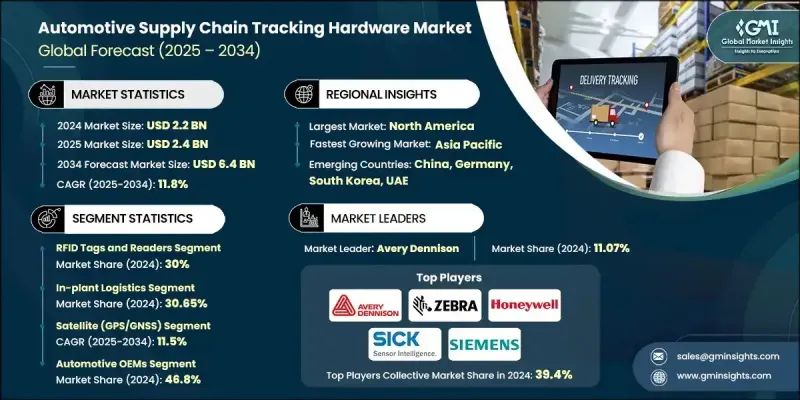
이 시장은 디지털 전환 확대, IoT 발전, 연결성 및 반도체 혁신의 급속한 진전에 힘입어 성장하고 있습니다. 기업들은 물류 및 제조 네트워크 전반에 걸쳐 실시간 추적, 예측 분석, 원활한 통신을 가능하게 하는 에너지 효율적이고 고성능의 하드웨어 개발을 최우선 과제로 삼고 있습니다. 주요 자동차 제조사와 공급업체들이 센서 기반 시스템을 통합함에 따라, 자동차 추적 하드웨어는 글로벌 공급망 전반에 걸쳐 데이터 가시성, 추적성 및 운영 효율성을 보장하는 데 필수적인 요소로 자리 잡고 있습니다. 현대적 추적 모듈은 실시간 인사이트, 자동화, 향상된 에너지 관리를 제공하기 위해 AI 프로세서, IoT 게이트웨이, 에지 컴퓨팅 기술과 공동 설계되고 있습니다. 이러한 진화는 특히 하이브리드 및 전기차에서 반도체, 배터리, 전자 시스템과 같은 핵심 부품의 추적이 품질, 안전성, 지속가능성 규정 준수를 보장하는 데 매우 중요합니다. 차량의 급속한 전기화는 또한 핵심 에너지 및 파워트레인 부품의 이동과 상태를 감독하도록 설계된 친환경적이고 지연 시간이 짧은 모니터링 도구에 대한 수요를 촉진하고 있습니다.
| 시장 범위 | |
|---|---|
| 시작 연도 | 2024년 |
| 예측 연도 | 2025-2034년 |
| 시작 금액 | 22억 달러 |
| 예측 금액 | 64억 달러 |
| CAGR | 11.8% |
RFID 태그 및 리더기 부문은 2024년 30%의 점유율을 기록했으며, 2025-2034년 연평균 12.3%의 성장률을 보일 것으로 예상됩니다. 이 부문의 강력한 입지는 자동차 제조 및 물류 부문에서 RFID 기술의 광범위한 수용과 성숙도를 강조합니다. 이러한 시스템은 생산 주기 전반에 걸쳐 부품, 작업 지시서, 반환 가능한 운송 자산 및 완성차에 대해 정밀한 비접촉식 식별 및 실시간 위치 추적을 제공합니다. 시야가 확보되지 않은 상태에서도 작동하고 대량 데이터 수집을 처리할 수 있는 이 기술의 능력은 효율성과 정확성이 중요한 대규모 자동차 제조 환경에서 특히 가치가 있습니다.
공장 내 물류 부문은 2024년 30.65%의 점유율을 기록했으며, 2025-2034년 연평균 복합 성장률(CAGR) 12.4%로 성장할 것으로 전망됩니다. 이 부문은 생산 시설 내에서 입고되는 자재, 하위 조립품 및 부품의 관리 및 모니터링을 위한 추적 하드웨어 활용에 중점을 둡니다. 이처럼 상당한 점유율은 실시간 자재 가시성이 적시 생산(JIT) 구현과 생산 계획 최적화에 필수적임을 강조합니다. 제조업체들이 디지털화되고 상호 연결된 운영으로 전환함에 따라, 공장 내 물류 추적 시스템은 재고 정확도 향상과 중단 없는 생산 워크플로우 확보에 필수적인 요소로 자리매김하고 있습니다.
북미의 자동차 공급망 추적 하드웨어 시장은 2024년에 6억 8,010만 달러에 이르렀고, 2034년까지 18억 달러에 이를 것으로 예상되며 CAGR은 11.4%를 나타냅니다. 이 지역의 선도적 지위는 선진 물류 시스템, 강력한 규제 체계, 주요 자동차 제조업체들의 디지털 추적 솔루션 조기 도입에 기인합니다. 대규모 차량 생산 능력과 복잡한 공급망 구조를 보유한 미국이 이 성장의 상당 부분을 주도하고 있습니다. 북미는 또한 자동차 시설과 물류 네트워크 전반에 걸쳐 첨단 실시간 데이터 전송 및 IoT 기반 연결성을 지원하는 견고한 통신 인프라와 광범위한 5G 네트워크 커버리지의 혜택을 누리고 있습니다.
세계의 자동차 공급망 추적 하드웨어 시장에서 사업을 전개하는 주요 기업으로는 에이버리 데니슨(Avery Dennison), 허니웰(Honeywell), 제브라(Zebra), 지멘스(Siemens), 엔엑스피 반도체(NXP Semiconductors), 임핀지(Impinj), 식(SICK), 제테스 인더스트리즈(Zetes Industries), RFiD 디스커버리(RFiD Discovery), 타게오스(Tageos) 등이 있습니다. 선도 기업들은 자동차 공급망 추적 하드웨어 시장에서의 입지를 강화하기 위해 혁신, 파트너십, 글로벌 확장을 중심으로 한 전략을 채택하고 있습니다. 기업들은 정확도 향상, 에너지 효율성 증대, 원활한 IoT 통합을 갖춘 차세대 추적 장치 개발을 위해 연구개발(R&D)에 막대한 투자를 하고 있습니다. 많은 기업들이 맞춤형 추적 솔루션을 공동 개발하기 위해 자동차 OEM 및 물류 제공업체와 전략적 제휴를 맺고 있습니다. 또한 생산 능력 확대, 센서 및 RFID 기술 향상, 예측 분석을 위한 인공지능(AI) 활용에도 주력하고 있습니다.
자주 묻는 질문
목차
제1장 조사 방법
- 시장 범위와 정의
- 조사 설계
- 조사 접근
- 데이터 수집 방법
- 데이터 마이닝 소스
- 세계
- 지역별/국가별
- 기본 추정치와 계산
- 기준연도 계산
- 시장 추정에서의 주요 동향
- 1차 조사 및 검증
- 1차 정보
- 예측 모델
- 조사의 전제조건과 제한 사항
제2장 주요 요약
제3장 업계 인사이트
- 생태계 분석
- 공급자의 상황
- 이익률 분석
- 비용 구조
- 각 단계에서의 부가가치
- 밸류체인에 영향을 주는 요인
- 혁신
- 업계에 미치는 영향요인
- 성장 촉진요인
- 규제 준수 요건
- 공급망의 시각화 요구
- 커넥티드카 보급
- 품질 관리 시스템 진화
- 자율주행차 개발
- 업계의 잠재적 억제요인 및 과제
- 도입의 복잡성
- 사이버 보안에 대한 우려
- 표준화 과제
- 높은 초기 투자비용
- 시장 기회
- 전기자동차 공급망 추적
- 블록체인 통합 가능성
- AI를 활용한 예측 분석
- 엣지 컴퓨팅 애플리케이션
- 지속가능성 추적 요건
- 성장 촉진요인
- 성장 가능성 분석
- 규제 상황
- 지역 통합 규제
- 국제 규격의 조화
- Porter's Five Forces 분석
- PESTEL 분석
- 기술과 혁신의 상황
- 현재의 기술 동향
- 신흥기술
- 특허 분석
- 코스트 내역 분석
- 가격 동향
- 지역별
- 하드웨어별
- 생산 통계
- 생산 거점
- 소비 거점
- 수출입
- 지속가능성과 환경면
- 지속가능한 실천
- 폐기물 감축 전략
- 생산에서의 에너지 효율
- 환경에 배려한 대처
- 탄소발자국에 관한 고려 사항
- 요구되는 하드웨어 성능 사양
- 신흥 OEM 디지털화 이니셔티브
- 전망과 기회
- 미래를 바라본 하드웨어 로드맵
- 시장 확대의 기회
- 투자에 관한 권장 사항
- 위험 평가 및 경감책
- 규제의 진화 예측
제4장 경쟁 구도
- 소개
- 기업의 시장 점유율 분석
- 북미
- 유럽
- 아시아태평양
- 라틴아메리카
- 중동 및 아프리카
- 주요 시장 기업의 경쟁 분석
- 경쟁 포지셔닝 매트릭스
- 전략적 전망 매트릭스
- 주요 발전
- 합병 및 인수
- 제휴 및 협력관계
- 신제품 발매
- 확대계획과 자금조달
제5장 시장 추계 및 예측 : 하드웨어별(2021-2034년)
- 주요 동향
- RFID 태그 및 리더기
- GPS 추적 장치
- IoT 센서
- 텔레매틱스 모듈
- BLE 비콘 및 게이트웨이
- 바코드 및 QR 코드 스캐너
제6장 시장 추계 및 예측 : 용도별(2021-2034년)
- 주요 동향
- 인바운드 물류
- 공장 내 물류
- 아웃바운드 물류
- 애프터마켓 및 서비스 사업
- 차량 및 운송 관리
제7장 시장 추계 및 예측 : 기술별(2021-2034년)
- 주요 동향
- 위성(GPS/GNSS)
- 무선 주파수 식별(RFID)
- 블루투스 저에너지(BLE)
- Wi-Fi 및 셀룰러(4G/5G)
- 초광대역(UWB)
- 근거리 무선 통신(NFC)
제8장 시장 추계 및 예측 : 최종 용도별(2021-2034년)
- 주요 동향
- 자동차 제조업체(OEM)
- 제3자물류(3PL) 공급자
- 애프터마켓
- 차량 운영사
제9장 시장 추계 및 예측 : 지역별(2021-2034년)
- 주요 동향
- 북미
- 미국
- 캐나다
- 유럽
- 독일
- 영국
- 프랑스
- 이탈리아
- 스페인
- 러시아
- 북유럽 국가
- 포르투갈
- 크로아티아
- 아시아태평양
- 중국
- 인도
- 일본
- 호주
- 한국
- 싱가포르
- 태국
- 인도네시아
- 라틴아메리카
- 브라질
- 멕시코
- 아르헨티나
- 중동 및 아프리카(MEA)
- 남아프리카
- 사우디아라비아
- 아랍에미리트(UAE)
- 튀르키예
제10장 기업 프로파일
- 세계 기업
- Zebra
- Honeywell
- Avery Dennison
- Impinj
- SICK
- Siemens
- NXP Semiconductors
- Tageos
- RFiD Discovery
- Zetes Industries
- Continental
- Robert Bosch
- Delphi
- Magna
- Denso
- 지역 기업
- Valeo
- ZF Friedrichshafen
- Aptiv
- Infineon
- Qualcomm
- 신흥 기업
- Geotab
- Verizon Connect
- TomTom
- CalAmp
- Trimble
The Global Automotive Supply Chain Tracking Hardware Market was valued at USD 2.2 Billion in 2024 and is estimated to grow at a CAGR of 11.8% to reach USD 6.4 Billion by 2034.
The market is undergoing expansion fueled by increasing digital transformation, advancements in IoT, and rapid progress in connectivity and semiconductor innovations. Companies are prioritizing the development of energy-efficient, high-performance hardware that enables real-time tracking, predictive analysis, and seamless communication across logistics and manufacturing networks. With major automakers and suppliers integrating sensor-enabled systems, automotive tracking hardware is becoming vital for ensuring data visibility, traceability, and operational efficiency throughout global supply chains. Modern tracking modules are being co-engineered with AI processors, IoT gateways, and edge computing technologies to deliver real-time insights, automation, and enhanced energy management. This evolution is especially critical for hybrid and electric vehicles, where tracking of essential components such as semiconductors, batteries, and electronic systems ensures quality, safety, and sustainability compliance. The rapid electrification of vehicles is also spurring demand for eco-friendly, low-latency monitoring tools designed to oversee the movement and condition of vital energy and powertrain components.
| Market Scope | |
|---|---|
| Start Year | 2024 |
| Forecast Year | 2025-2034 |
| Start Value | $2.2 Billion |
| Forecast Value | $6.4 Billion |
| CAGR | 11.8% |
The RFID tags and readers segment held 30% in 2024 and is expected to grow at a CAGR of 12.3% from 2025 to 2034. The strong position of this segment highlights the widespread acceptance and maturity of RFID technology in automotive manufacturing and logistics. These systems provide precise, contactless identification and real-time location tracking for parts, work orders, returnable transport assets, and completed vehicles throughout the production cycle. The technology's ability to operate without line of sight and handle bulk data collection makes it particularly valuable in large-scale automotive manufacturing environments, where efficiency and accuracy are critical.
The in-plant logistics segment held a 30.65% share in 2024 and is projected to grow at a CAGR of 12.4% from 2025 to 2034. This segment focuses on the utilization of tracking hardware for managing and monitoring inbound materials, subassemblies, and components within production facilities. Its substantial share underscores the essential role of real-time material visibility in enabling just-in-time manufacturing and optimizing production planning. As manufacturers move toward digitized and interconnected operations, in-plant logistics tracking systems are becoming indispensable for improving inventory accuracy and ensuring uninterrupted production workflows.
North America Automotive Supply Chain Tracking Hardware Market reached USD 680.1 million in 2024, and is anticipated to reach USD 1.8 Billion by 2034, reflecting a CAGR of 11.4%. The region's leadership is attributed to advanced logistics systems, strong regulatory frameworks, and the early implementation of digital tracking solutions by major automotive manufacturers. The United States drives much of this growth due to its large-scale vehicle production capacity and complex supply chain structures. North America also benefits from a robust telecommunication infrastructure and extensive 5G network coverage, which support advanced real-time data transmission and IoT-enabled connectivity across automotive facilities and logistics networks.
Key companies operating in the Global Automotive Supply Chain Tracking Hardware Market include Avery Dennison, Honeywell, Zebra, Siemens, NXP Semiconductors, Impinj, SICK, Zetes Industries, RFiD Discovery, and Tageos. To strengthen their foothold in the Automotive Supply Chain Tracking Hardware Market, leading companies are adopting strategies centered on innovation, partnerships, and global expansion. Firms are investing heavily in R&D to develop next-generation tracking devices with improved accuracy, energy efficiency, and seamless IoT integration. Many are forming strategic alliances with automotive OEMs and logistics providers to co-create customized tracking solutions. Companies are also focusing on expanding production capacity, enhancing sensor and RFID technologies, and leveraging AI for predictive analytics.
Table of Contents
Chapter 1 Methodology
- 1.1 Market scope and definition
- 1.2 Research design
- 1.2.1 Research approach
- 1.2.2 Data collection methods
- 1.3 Data mining sources
- 1.3.1 Global
- 1.3.2 Regional/Country
- 1.4 Base estimates and calculations
- 1.4.1 Base year calculation
- 1.4.2 Key trends for market estimation
- 1.5 Primary research and validation
- 1.5.1 Primary sources
- 1.6 Forecast model
- 1.7 Research assumptions and limitations
Chapter 2 Executive Summary
- 2.1 Industry 360° synopsis, 2021 - 2034
- 2.2 Key market trends
- 2.2.1 Regional
- 2.2.2 Hardware
- 2.2.3 Application
- 2.2.4 Technology
- 2.2.5 End Use
- 2.3 TAM Analysis, 2025-2034
- 2.4 CXO perspectives: Strategic imperatives
- 2.4.1 Executive decision points
- 2.4.2 Critical success factors
- 2.5 Future outlook and strategic recommendations
Chapter 3 Industry Insights
- 3.1 Industry ecosystem analysis
- 3.1.1 Supplier landscape
- 3.1.2 Profit margin analysis
- 3.1.3 Cost structure
- 3.1.4 Value addition at each stage
- 3.1.5 Factor affecting the value chain
- 3.1.6 Disruptions
- 3.2 Industry impact forces
- 3.2.1 Growth drivers
- 3.2.1.1 Regulatory compliance requirements
- 3.2.1.2 Supply chain visibility demands
- 3.2.1.3 Connected vehicle proliferation
- 3.2.1.4 Quality management system evolution
- 3.2.1.5 Autonomous vehicle development
- 3.2.2 Industry pitfalls and challenges
- 3.2.2.1 Implementation complexity
- 3.2.2.2 Cybersecurity concerns
- 3.2.2.3 Standardization challenges
- 3.2.2.4 High initial investment costs
- 3.2.3 Market opportunities
- 3.2.3.1 Electric vehicle supply chain tracking
- 3.2.3.2 Blockchain integration potential
- 3.2.3.3 AI-powered predictive analytics
- 3.2.3.4 Edge computing applications
- 3.2.3.5 Sustainability tracking requirements
- 3.2.1 Growth drivers
- 3.3 Growth potential analysis
- 3.4 Regulatory landscape
- 3.4.1 Regional integration regulations
- 3.4.2 International standards harmonization
- 3.5 Porter's analysis
- 3.6 PESTEL analysis
- 3.7 Technology and innovation landscape
- 3.7.1 Current technological trends
- 3.7.2 Emerging technologies
- 3.8 Patent analysis
- 3.9 Cost breakdown analysis
- 3.10 Price trends
- 3.10.1 By region
- 3.10.2 By hardware
- 3.11 Production statistics
- 3.11.1 Production hubs
- 3.11.2 Consumption hubs
- 3.11.3 Export and import
- 3.12 Sustainability and environmental aspects
- 3.12.1 Sustainable practices
- 3.12.2 Waste reduction strategies
- 3.12.3 Energy efficiency in production
- 3.12.4 Eco-friendly Initiatives
- 3.13 Carbon footprint considerations
- 3.14 Hardware Performance Specifications Demanded
- 3.15 Emerging OEM Digitalization Initiatives
- 3.16 Future Outlook & Opportunities
- 3.16.1 Future-Ready Hardware Roadmap
- 3.16.2 Market expansion opportunities
- 3.16.3 Investment recommendations
- 3.16.4 Risk assessment & mitigation
- 3.16.5 Regulatory evolution forecast
Chapter 4 Competitive Landscape, 2024
- 4.1 Introduction
- 4.2 Company market share analysis
- 4.2.1 North America
- 4.2.2 Europe
- 4.2.3 Asia Pacific
- 4.2.4 LATAM
- 4.2.5 MEA
- 4.3 Competitive analysis of major market players
- 4.4 Competitive positioning matrix
- 4.5 Strategic outlook matrix
- 4.6 Key developments
- 4.6.1 Mergers & acquisitions
- 4.6.2 Partnerships & collaborations
- 4.6.3 New Product Launches
- 4.6.4 Expansion Plans and funding
Chapter 5 Market Estimates & Forecast, By Hardware, 2021 - 2034 (USD Mn, Units)
- 5.1 Key trends
- 5.2 RFID Tags and readers
- 5.3 GPS Tracking devices
- 5.4 IoT Sensors
- 5.5 Telematics modules
- 5.6 BLE Beacons and gateways
- 5.7 Barcode and QR Scanners
Chapter 6 Market Estimates & Forecast, By Application, 2021 - 2034 (USD Mn, Units)
- 6.1 Key trends
- 6.2 Inbound logistics
- 6.3 In-Plant logistics
- 6.4 Outbound logistics
- 6.5 Aftermarket and service operations
- 6.6 Fleet and transportation management
Chapter 7 Market Estimates & Forecast, By Technology, 2021 - 2034 (USD Mn, Units)
- 7.1 Key trends
- 7.2 Satellite (GPS/GNSS)
- 7.3 Radio Frequency Identification (RFID)
- 7.4 Bluetooth Low Energy (BLE)
- 7.5 Wi-Fi and Cellular (4G/5G)
- 7.6 Ultra-Wideband (UWB)
- 7.7 Near Field Communication (NFC)
Chapter 8 Market Estimates & Forecast, By End use, 2021 - 2034 (USD Mn, Units)
- 8.1 Key trends
- 8.2 Automotive OEMs
- 8.3 Third-Party Logistics (3PL) Providers
- 8.4 Aftermarket
- 8.5 Fleet Operators
Chapter 9 Market Estimates & Forecast, By Region, 2021 - 2034 (USD Mn, Units)
- 9.1 Key trends
- 9.2 North America
- 9.2.1 US
- 9.2.2 Canada
- 9.3 Europe
- 9.3.1 Germany
- 9.3.2 UK
- 9.3.3 France
- 9.3.4 Italy
- 9.3.5 Spain
- 9.3.6 Russia
- 9.3.7 Nordics
- 9.3.8 Portugal
- 9.3.9 Croatia
- 9.4 Asia Pacific
- 9.4.1 China
- 9.4.2 India
- 9.4.3 Japan
- 9.4.4 Australia
- 9.4.5 South Korea
- 9.4.6 Singapore
- 9.4.7 Thailand
- 9.4.8 Indonesia
- 9.5 Latin America
- 9.5.1 Brazil
- 9.5.2 Mexico
- 9.5.3 Argentina
- 9.6 MEA
- 9.6.1 South Africa
- 9.6.2 Saudi Arabia
- 9.6.3 UAE
- 9.6.4 Turkey
Chapter 10 Company Profiles
- 10.1 Global Players
- 10.1.1 Zebra
- 10.1.2 Honeywell
- 10.1.3 Avery Dennison
- 10.1.4 Impinj
- 10.1.5 SICK
- 10.1.6 Siemens
- 10.1.7 NXP Semiconductors
- 10.1.8 Tageos
- 10.1.9 RFiD Discovery
- 10.1.10 Zetes Industries
- 10.1.11 Continental
- 10.1.12 Robert Bosch
- 10.1.13 Delphi
- 10.1.14 Magna
- 10.1.15 Denso
- 10.2 Regional Players
- 10.2.1 Valeo
- 10.2.2 ZF Friedrichshafen
- 10.2.3 Aptiv
- 10.2.4 Infineon
- 10.2.5 Qualcomm
- 10.3 Emerging Players
- 10.3.1 Geotab
- 10.3.2 Verizon Connect
- 10.3.3 TomTom
- 10.3.4 CalAmp
- 10.3.5 Trimble


