|
시장보고서
상품코드
1871128
알루미늄 도어 시장 : 기회, 성장 요인, 업계 동향 분석 및 예측(2025-2034년)Aluminum Doors Market Opportunity, Growth Drivers, Industry Trend Analysis, and Forecast 2025 - 2034 |
||||||

세계의 알루미늄 도어 시장은 2024년에 168억 달러로 평가되었고, 2034년까지 연평균 복합 성장률(CAGR)은 4.9%를 나타낼 것으로 예측되며 268억 달러에 달할 전망입니다.

시장 성장은 글로벌 건설 부문의 급속한 확장과 대규모 인프라 개발에 힘입어 가속화되고 있습니다. 가속화되는 도시화, 인구 증가, 주거 및 상업 프로젝트에 대한 정부 투자 증가는 강도, 내구성, 낮은 유지보수 비용을 결합한 소재에 대한 꾸준한 수요를 창출하고 있습니다. 알루미늄 도어는 내식성, 경량성, 긴 수명으로 이러한 요구 사항을 충족시켜 현대 건축 설계에서 선호되는 선택입니다. 신흥 경제국에서는 스마트 시티의 부상과 광범위한 공공 인프라 프로젝트가 비용 효율성과 장기적 성능으로 인해 알루미늄 기반 솔루션의 채택을 촉진하고 있습니다. 또한 알루미늄 도어는 미적 매력으로 인기를 얻고 있으며, 슬림하고 현대적인 디자인으로 자연 채광과 개방감을 극대화합니다. 다양한 마감 옵션과 디자인 유연성을 통해 현대적 및 전통적 건축 양식을 모두 자연스럽게 조화시켜 주거, 상업, 기관 시장 모두에 어필합니다. 다용도성, 내구성, 세련된 외관은 글로벌 건설 자재 시장에서의 입지를 지속적으로 강화하고 있습니다.
| 시장 범위 | |
|---|---|
| 시작 연도 | 2024년 |
| 예측 기간 | 2025-2034년 |
| 시작 금액 | 168억 달러 |
| 예측 금액 | 268억 달러 |
| CAGR | 4.9% |
주거 부문은 2024년 48.2%의 점유율을 기록했으며, 2025-2034년 연평균 4.6%의 성장률을 보일 것으로 전망됩니다. 이 부문 성장은 도시 및 교외 개발 지역에서 에너지 효율적이고 세련되며 유지보수가 적은 주택 솔루션에 대한 수요 증가에 힘입고 있습니다. 알루미늄 도어는 부식 저항성, 열 효율성 제공, 시간 경과에 따른 미적 매력 유지 능력으로 주거 건축 부문에서 주목받고 있습니다. 이러한 도어는 기능성과 디자인 정교함을 결합하여 주택 가치를 높입니다.
직접 유통 채널은 57.8%의 점유율을 차지했으며, 2034년까지 연평균 복합 성장률(CAGR) 4.7%로 성장할 것으로 예상됩니다. 제조업체와 건설사, 개발사, 기관 구매자 등 주요 고객사는 맞춤형 제품 공급과 효율적인 물류 관리가 가능한 직접 유통 방식을 선호합니다. 이 모델은 대규모 건설 프로젝트에서 운영 성과를 향상시키는 핵심 요소인 신속한 프로젝트 실행, 높은 맞춤화 유연성, 신뢰할 수 있는 사후 서비스를 보장합니다.
미국의 알루미늄 도어 시장은 2024년 35억 달러 규모를 기록했으며, 2025-2034년 연평균 4.4%의 성장률을 보일 것으로 예상됩니다. 미국은 역동적인 건설 부문, 확대되는 인프라 투자, 에너지 효율적인 건축 자재에 대한 관심 증가로 북미 지역 내 주도적 위치를 유지하고 있습니다. 주거용 및 상업용 부동산의 지속적인 발전과 함께, 알루미늄 도어는 현대적인 디자인 능력, 내후성, 대형 유리 패널을 활용한 세련된 외관 구현 능력으로 계속해서 선호도를 높이고 있습니다. 미국의 리모델링 및 친환경 건축 트렌드는 꾸준한 시장 수요에 더욱 기여하고 있습니다.
세계의 알루미늄 도어 시장에서 주요 기업으로는 테크날(Technal, Hydro), ASSA ABLOY, JELD-WEN, YKK AP, 슈코(Schuko), 알레지온(Allegion), 알루프로프 S.A.(Aluprof S.A.), 플리트우드 윈도우 앤 도어스(Fleetwood Windows & Doors), 알루미 S.A.(Alumil S.A.), 카우니어(Kawneer, Arconic), 레이나어스 알루미늄(Reynaers Aluminium), 라칸티나 도어스(LaCantina Doors), 도르마카바(Dormakaba), 그레치-유니타스(Gretsch-Unitas, GU), 앤더슨 코퍼레이션(Andersen Corporation) 등이 있습니다. 알루미늄 도어 시장의 선도 기업들은 혁신, 지역 확장, 지속가능성에 집중함으로써 시장 입지를 강화하고 있습니다. 기업들은 친환경 건축 자재에 대한 수요 증가에 부응하기 위해 우수한 단열성, 에너지 효율성, 맞춤형 미관을 특징으로 하는 첨단 도어 시스템을 개발하고 있습니다. 또한 많은 기업들이 지역 시장에 보다 효과적으로 대응하기 위해 생산 기반과 유통망을 확장하고 있습니다. 개발사, 건축가, 건설사와의 전략적 협력을 통해 제품 접근성과 브랜드 인지도가 향상되고 있습니다.
자주 묻는 질문
목차
제1장 조사 방법과 범위
제2장 주요 요약
제3장 업계 인사이트
- 생태계 분석
- 공급자의 상황
- 이익률
- 각 단계에서의 부가가치
- 밸류체인에 영향을 주는 요인
- 업계에 미치는 영향요인
- 성장 촉진요인
- 건설 및 인프라 프로젝트 급증
- 지속가능성과 에너지 효율에 중점
- 미적 다양성과 현대적 디자인
- 기술 혁신과 스마트 기능
- 업계의 잠재적 억제요인 및 과제
- 변동하는 원재료 가격
- 첨단 기술에 대한 높은 초기 투자 비용
- 성장 촉진요인
- 성장 가능성 분석
- 장래 시장 동향
- 기술과 혁신의 상황
- 현재의 기술 동향
- 신흥기술
- 가격 동향
- 지역별
- 도어 유형별
- 규제 상황
- 규격 및 규정 준수 요건
- 지역별 규제 프레임워크
- 인증기준
- 무역 통계
- 주요 수입국
- 주요 수출국
- Porter's Five Forces 분석
- PESTEL 분석
- 소비자 행동 분석
- 구매 패턴
- 선호 분석
- 지역별 소비자 행동의 차이
- 전자상거래가 구매결정에 미치는 영향
제4장 경쟁 구도
- 소개
- 기업의 시장 점유율 분석
- 지역별
- 북미
- 유럽
- 아시아태평양
- 라틴아메리카
- 중동 및 아프리카
- 지역별
- 기업 매트릭스 분석
- 주요 시장 기업의 경쟁 분석
- 경쟁 포지셔닝 매트릭스
- 주요 발전
- 합병 및 인수
- 제휴 및 협력 관계
- 신제품 발매
- 사업 확대 계획
제5장 시장 추계 및 예측 : 도어 유형별(2021-2034년)
- 주요 동향
- 힌지 도어
- 단일 힌지 도어
- 이중 힌지 도어
- 다중 패널 힌지 시스템
- 슬라이딩 도어 시스템
- 바이패스 슬라이딩 도어
- 포켓 슬라이드 시스템
- 리프트 & 슬라이드 시스템
- 멀티트랙 슬라이딩 도어
- 폴딩 도어 시스템
- 이중 폴딩 도어 시스템
- 다단 폴딩 도어 시스템
- 아코디언식 시스템
- 피벗 도어 시스템
- 센터 피벗 시스템
- 오프셋 피벗 구성
- 헤비 듀티 피벗
- 회전문 시스템
- 수동 회전문
- 자동 회전문 시스템
- 보안 회전문
제6장 시장 추계 및 예측 : 잠금 장치별(2021-2034년)
- 주요 동향
- 수동식 다중 잠금 장치
- 자동/자동 폐쇄 기능
- 전동식 솔루션(출입 통제 통합)
제7장 시장 추계 및 예측 : 가격별(2021-2034년)
- 주요 동향
- 저가
- 중가
- 고가
제8장 시장 추계 및 예측 : 최종 용도별(2021-2034년)
- 주요 동향
- 주거용
- 상업용
- 오피스 빌딩
- 소매점 및 쇼핑몰
- 병원 및 진료소
- 호텔 및 레스토랑
- 교육기관
- 기타(공항 및 교통 거점 등)
- 산업용
제9장 시장 추계 및 예측 : 유통 채널별(2021-2034년)
- 주요 동향
- 직접 판매
- 간접 판매
제10장 시장 추계 및 예측 : 지역별(2021-2034년)
- 주요 동향
- 북미
- 미국
- 캐나다
- 유럽
- 독일
- 영국
- 프랑스
- 이탈리아
- 스페인
- 아시아태평양
- 중국
- 인도
- 일본
- 한국
- 호주
- 인도네시아
- 말레이시아
- 라틴아메리카
- 브라질
- 멕시코
- 아르헨티나
- 중동 및 아프리카
- 사우디아라비아
- 아랍에미리트(UAE)
- 남아프리카
제11장 기업 프로파일
- Allegion
- Alumil SA
- Aluprof SA
- Andersen Corporation
- ASSA ABLOY
- Dormakaba
- Fleetwood Windows &Doors
- Gretsch-Unitas(GU)
- JELD-WEN
- Kawneer(Arconic)
- LaCantina Doors
- Reynaers Aluminium
- Schuco
- Technal(Hydro)
- YKK AP
The Global Aluminum Doors Market was valued at USD 16.8 Billion in 2024 and is estimated to grow at a CAGR of 4.9% to reach USD 26.8 Billion by 2034.
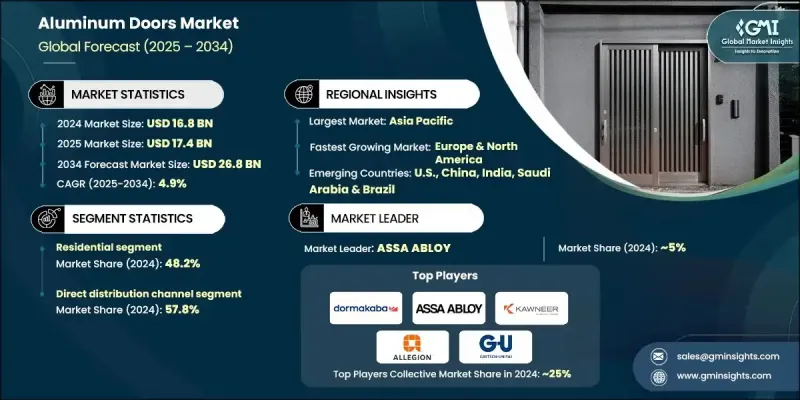
Market growth is being fueled by the rapid expansion of the global construction sector and large-scale infrastructure development. Accelerating urbanization, population growth, and rising government investments in residential and commercial projects are generating consistent demand for materials that combine strength, durability, and low maintenance. Aluminum doors meet these requirements with their corrosion resistance, lightweight nature, and long lifespan, making them a preferred choice in modern building design. In emerging economies, the rise of smart cities and extensive public infrastructure projects is also encouraging the adoption of aluminum-based solutions for their cost-effectiveness and long-term performance. Additionally, aluminum doors have gained popularity for their aesthetic appeal, offering slim, modern designs that allow greater natural light and open spaces. With various finish options and design flexibility, they can seamlessly complement both contemporary and traditional architectural styles, appealing to residential, commercial, and institutional markets alike. Their versatility, durability, and sleek appearance continue to strengthen their position in the global construction materials market.
| Market Scope | |
|---|---|
| Start Year | 2024 |
| Forecast Year | 2025-2034 |
| Start Value | $16.8 billion |
| Forecast Value | $26.8 billion |
| CAGR | 4.9% |
The residential sector held a 48.2% share in 2024 and is projected to grow at a CAGR of 4.6% between 2025 and 2034. Growth in this segment is driven by rising demand for energy-efficient, stylish, and low-maintenance housing solutions across urban and suburban developments. Aluminum doors are gaining traction in residential architecture due to their ability to resist corrosion, provide thermal efficiency, and maintain aesthetic appeal over time. These doors also enhance home value by blending functionality with design sophistication.
The direct distribution channel held a 57.8% share and is anticipated to grow at a CAGR of 4.7% through 2034. Manufacturers and major clients such as construction firms, developers, and institutional buyers prefer direct distribution for its ability to deliver tailored products and efficient logistics. This model ensures quicker project execution, greater customization flexibility, and reliable post-sale service, key factors that enhance operational performance in large-scale construction projects.
U.S Aluminum Doors Market reached USD 3.5 Billion in 2024 and is estimated to grow at a CAGR of 4.4% from 2025 to 2034. The United States maintains its leadership within North America due to its dynamic construction sector, expanding infrastructure investments, and growing emphasis on energy-efficient architectural materials. With sustained development in both residential and commercial properties, aluminum doors continue to gain favor for their modern design capabilities, weather resistance, and ability to support sleek facades with large glass panels. The country's renovation and green building trends are further contributing to steady market demand.
Key companies operating in the Global Aluminum Doors Market include Technal (Hydro), ASSA ABLOY, JELD-WEN, YKK AP, Schuco, Allegion, Aluprof S.A., Fleetwood Windows & Doors, Alumil S.A., Kawneer (Arconic), Reynaers Aluminium, LaCantina Doors, Dormakaba, Gretsch-Unitas (GU), and Andersen Corporation. Leading companies in the aluminum doors market are strengthening their market position by focusing on innovation, regional expansion, and sustainability. Firms are developing advanced door systems that feature superior thermal insulation, energy efficiency, and customizable aesthetics to meet the growing demand for green building materials. Many are also expanding their manufacturing footprints and distribution networks to serve regional markets more effectively. Strategic collaborations with developers, architects, and construction firms are enhancing product reach and brand visibility.
Table of Contents
Chapter 1 Methodology & Scope
- 1.1 Market scope and definition
- 1.2 Research design
- 1.2.1 Research approach
- 1.2.2 Data collection methods
- 1.3 Data mining sources
- 1.3.1 Global
- 1.3.2 Regional/Country
- 1.4 Base estimates and calculations
- 1.4.1 Base year calculation
- 1.4.2 Key trends for market estimation
- 1.5 Primary research and validation
- 1.5.1 Primary sources
- 1.6 Forecast model
- 1.7 Research assumptions and limitations
Chapter 2 Executive Summary
- 2.1 Industry 3600 synopsis
- 2.2 Key market trends
- 2.2.1 Regional
- 2.2.2 Door type
- 2.2.3 Locking mechanism
- 2.2.4 Price
- 2.2.5 End use
- 2.2.6 Distribution channel
- 2.3 CXO perspectives: Strategic imperatives
- 2.3.1 Key decision points for industry executives
- 2.3.2 Critical success factors for market players
- 2.4 Future outlook and strategic recommendations
Chapter 3 Industry Insights
- 3.1 Industry ecosystem analysis
- 3.1.1 Supplier landscape
- 3.1.2 Profit margin
- 3.1.3 Value addition at each stage
- 3.1.4 Factor affecting the value chain
- 3.2 Industry impact forces
- 3.2.1 Growth drivers
- 3.2.1.1 Surge in construction & infrastructure projects
- 3.2.1.2 Emphasis on sustainability & energy efficiency
- 3.2.1.3 Aesthetic versatility & modern designs
- 3.2.1.4 Technological innovation and smart features
- 3.2.2 Industry pitfalls & challenges
- 3.2.2.1 Fluctuating raw material prices
- 3.2.2.2 High initial investment for advanced technologies
- 3.2.1 Growth drivers
- 3.3 Growth potential analysis
- 3.4 Future market trends
- 3.5 Technology and innovation landscape
- 3.5.1 Current technological trends
- 3.5.2 Emerging technologies
- 3.6 Price trends
- 3.6.1 By region
- 3.6.2 By door type
- 3.7 Regulatory landscape
- 3.7.1 Standards and compliance requirements
- 3.7.2 Regional regulatory frameworks
- 3.7.3 Certification standards
- 3.8 Trade statistics
- 3.8.1 Major importing countries
- 3.8.2 Major exporting countries
- 3.9 Porter's analysis
- 3.10 PESTEL analysis
- 3.11 Consumer behavior analysis
- 3.11.1 Purchasing patterns
- 3.11.2 Preference analysis
- 3.11.3 Regional variations in consumer behavior
- 3.11.4 Impact of e-commerce on buying decisions
Chapter 4 Competitive Landscape, 2024
- 4.1 Introduction
- 4.2 Company market share analysis
- 4.2.1 By Region
- 4.2.1.1 North America
- 4.2.1.2 Europe
- 4.2.1.3 Asia Pacific
- 4.2.1.4 Latin America
- 4.2.1.5 Middle East & Africa
- 4.2.1 By Region
- 4.3 Company matrix analysis
- 4.4 Competitive analysis of major market players
- 4.5 Competitive positioning matrix
- 4.6 Key developments
- 4.6.1 Mergers & acquisitions
- 4.6.2 Partnerships & collaborations
- 4.6.3 New product launches
- 4.6.4 Expansion plans
Chapter 5 Market Estimates & Forecast, By Door Type, 2021 - 2034, (USD Billion) (Thousand Units)
- 5.1 Key trends
- 5.2 Hinged doors
- 5.2.1 Single hinged doors
- 5.2.2 Double hinged doors
- 5.2.3 Multi-panel hinged systems
- 5.3 Sliding door systems
- 5.3.1 By-pass sliding doors
- 5.3.2 Pocket sliding systems
- 5.3.3 Lift & slide systems
- 5.3.4 Multi-track sliding doors
- 5.4 Folding door systems
- 5.4.1 Bi-fold door systems
- 5.4.2 Multi-fold configurations
- 5.4.3 Accordion style systems
- 5.5 Pivot door systems
- 5.5.1 Centre pivot systems
- 5.5.2 Offset pivot configurations
- 5.5.3 Heavy-duty pivot applications
- 5.6 Revolving door systems
- 5.6.1 Manual revolving doors
- 5.6.2 Automatic revolving systems
- 5.6.3 Security revolving doors
Chapter 6 Market Estimates & Forecast, By Locking Mechanism, 2021 - 2034, (USD Billion) (Thousand Units)
- 6.1 Key trends
- 6.2 Manual multipoint locks
- 6.3 Automatic/self-closing functions
- 6.4 Motorized solutions (access control integration)
Chapter 7 Market Estimates & Forecast, By Price, 2021 - 2034, (USD Billion) (Thousand Units)
- 7.1 Key trends
- 7.2 Low
- 7.3 Medium
- 7.4 High
Chapter 8 Market Estimates & Forecast, By End Use, 2021 - 2034, (USD Billion) (Thousand Units)
- 8.1 Key trends
- 8.2 Residential
- 8.3 Commercial
- 8.3.1 Office buildings
- 8.3.2 Retail stores & shopping malls
- 8.3.3 Hospitals & clinics
- 8.3.4 Hotels & restaurants
- 8.3.5 Educational institutions
- 8.3.6 Others (airports & transportation hubs, etc.)
- 8.4 Industrial
Chapter 9 Market Estimates & Forecast, By Distribution Channel, 2021 - 2034, (USD Billion) (Thousand Units)
- 9.1 Key trends
- 9.2 Direct
- 9.3 Indirect
Chapter 10 Market Estimates & Forecast, By Region, 2021 - 2034, (USD Billion) (Thousand Units)
- 10.1 Key trends
- 10.2 North America
- 10.2.1 U.S.
- 10.2.2 Canada
- 10.3 Europe
- 10.3.1 Germany
- 10.3.2 UK
- 10.3.3 France
- 10.3.4 Italy
- 10.3.5 Spain
- 10.4 Asia Pacific
- 10.4.1 China
- 10.4.2 India
- 10.4.3 Japan
- 10.4.4 South Korea
- 10.4.5 Australia
- 10.4.6 Indonesia
- 10.4.7 Malaysia
- 10.5 Latin America
- 10.5.1 Brazil
- 10.5.2 Mexico
- 10.5.3 Argentina
- 10.6 MEA
- 10.6.1 Saudi Arabia
- 10.6.2 UAE
- 10.6.3 South Africa
Chapter 11 Company Profiles
- 11.1 Allegion
- 11.2 Alumil S.A.
- 11.3 Aluprof S.A.
- 11.4 Andersen Corporation
- 11.5 ASSA ABLOY
- 11.6 Dormakaba
- 11.7 Fleetwood Windows & Doors
- 11.8 Gretsch-Unitas (GU)
- 11.9 JELD-WEN
- 11.10 Kawneer (Arconic)
- 11.11 LaCantina Doors
- 11.12 Reynaers Aluminium
- 11.13 Schuco
- 11.14 Technal (Hydro)
- 11.15 YKK AP