|
시장보고서
상품코드
1871151
해충 방제 제품 시장 : 기회, 성장 요인, 업계 동향 분석 및 예측(2025-2034년)Pest Control Products Market Opportunity, Growth Drivers, Industry Trend Analysis, and Forecast 2025 - 2034 |
||||||

세계의 해충 방제 제품 시장은 2024년에 840억 달러로 평가되었고, 2034년까지 연평균 복합 성장률(CAGR)은 4.1%를 나타낼 것으로 예측되며 1,255억 달러에 달할 전망입니다.
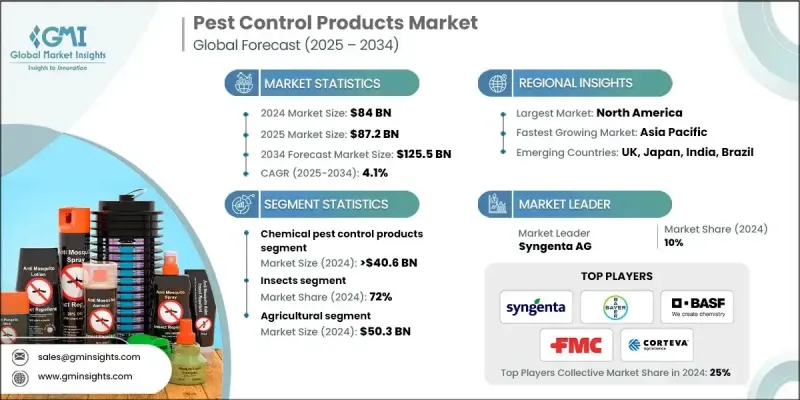
전 세계적으로 가속화되는 도시화는 해충 방제 솔루션에 대한 수요를 재편하고 있습니다. 도시 확장은 인구 밀집, 폐기물 증가, 지속적인 건설을 초래하며, 이 모든 요소가 해충이 번식하기에 이상적인 조건을 제공합니다. 하수도 시스템, 다층 건물, 공공 시설과 같은 도시 기반 시설은 종종 설치류, 흰개미, 바퀴벌레를 위한 독특한 서식지를 형성하여 특수 해충 방제 제품에 대한 필요성을 촉진합니다. 도심 지역의 주거 단지, 상업용 부동산, 공공 건물의 증가는 이러한 수요를 더욱 확대합니다. 주택, 위생, 교통 인프라에 대규모 투자를 진행 중인 신흥 경제국들은 해충 방제 기업들에게 추가적인 기회를 창출하고 있습니다. 토양을 교란하고 잔해를 발생시키는 건설 프로젝트는 해충 침입 가능성을 높여, 건설 전후 해충 관리가 매우 중요해졌습니다. 제조사들은 이러한 도시 및 인프라 관련 문제를 해결하기 위해 설계된 제품을 점점 더 많이 개발하고 있으며, 위생, 안전, 규제 기준을 충족시키면서 다양한 고객 요구 사항을 충족시키고 있습니다.
| 시장 범위 | |
|---|---|
| 시작 연도 | 2024년 |
| 예측 기간 | 2025-2034년 |
| 시작 금액 | 840억 달러 |
| 예측 금액 | 1,255억 달러 |
| CAGR | 4.1% |
2024년, 곤충 부문은 바퀴벌레, 개미, 모기, 파리 등 주거 및 도시 환경을 지배하는 해충들로 인해 72%의 점유율을 차지했습니다. 도시 주거지와 상업 시설은 특히 고온 다습한 지역에서 스프레이, 젤, 에어로졸 제품, 전자식 방충제 등 곤충 전용 해충 방제 제품의 주요 사용자입니다.
농업 부문은 2024년 503억 달러의 매출을 기록했습니다. 농민들은 수확량과 품질에 영향을 미치는 곤충, 설치류, 곰팡이 및 기타 위협으로부터 작물을 보호하기 위해 농약에 의존합니다. 작물 손실을 최소화하면서 식량 안보를 보장하기 위해 화학 농약, 생물학적 해결책 및 통합 해충 관리 접근법이 널리 사용됩니다. 증가하는 인구를 먹여 살려야 하는 압박이 커짐에 따라, 농업 관계자들은 특히 고부가가치 작물을 위해 다른 농약과 함께 작용하는 광범위하고 잔류 효과가 있는 제품을 요구하고 있습니다.
미국의 해충 방제 제품 시장은 72.6%의 점유율을 차지했으며 2024년에는 207억 달러를 창출했습니다. 미국의 기술 발전, 규제 체계, 제형, 생물학적 살충제, 스마트 해충 방제 솔루션 부문의 적극적인 혁신은 이 나라를 글로벌 리더로 자리매김하게 합니다. 미국 환경보호청(EPA) 기준 준수는 제조업체들이 제품에서 안전성, 효과성, 지속 가능성을 최우선으로 고려하도록 보장합니다.
세계의 해충 방제 제품 시장의 주요 기업은 BASF SE, American Vanguard, Bayer CropScience, Corteva Agriscience, Syngenta AG, FMC, Nufarm, ADAMA Agricultural Solutions, B&G Equipment Company, Valent BioSciences, Control Solutions, Sumitomo Chemical, Birchmeier, UPL 등이 있습니다. 해충 방제 제품 시장 기업들은 시장 지위 강화를 위해 혁신, 지속 가능성, 지역적 확장에 주력하고 있습니다. 이들은 향상된 효능과 감소된 환경 영향을 지닌 차세대 화학적·생물학적 제형을 개발 중입니다. 연구개발 투자를 통해 기업들은 도시, 농업, 산업용으로 맞춤화된 제품을 창출할 수 있습니다. 유통업체, 소매업체, 농업협동조합과의 전략적 협력은 시장 접근성 확대와 제품 공급 안정성을 보장합니다. 기업들은 또한 신뢰 구축과 경쟁 우위 확보를 위해 규제 준수 및 인증 획득을 최우선 과제로 삼고 있습니다. 안전성, 성능, 친환경성을 강조하는 마케팅 캠페인은 브랜드 인지도를 높입니다.
자주 묻는 질문
목차
제1장 조사 방법과 범위
제2장 주요 요약
제3장 업계 인사이트
- 생태계 분석
- 공급자의 상황
- 이익률
- 각 단계에서의 부가가치
- 밸류체인에 영향을 주는 요인
- 업계에 미치는 영향요인
- 성장 촉진요인
- 도시화와 인프라 성장
- 공중 보건 인식
- 규제 및 위생 기준
- 업계의 잠재적 억제요인 및 과제
- 규제상의 제약
- 공급망의 혼란
- 기회
- 스마트 해충 방제 기술
- 친환경 및 생물학적 살충제 솔루션
- 성장 촉진요인
- 성장 가능성 분석
- 장래 시장 동향
- 기술과 혁신의 상황
- 현재의 기술 동향
- 신흥기술
- 가격 동향
- 지역별
- 제품별
- 규제 상황
- 규격 및 규정 준수 요건
- 지역별 규제 프레임워크
- 인증기준
- Porter's Five Forces 분석
- PESTEL 분석
제4장 경쟁 구도
- 소개
- 기업의 시장 점유율 분석
- 지역별
- 기업 매트릭스 분석
- 주요 시장 기업의 경쟁 분석
- 경쟁 포지셔닝 매트릭스
- 주요 발전
- 합병 및 인수
- 제휴 및 협업
- 신제품 발매
- 확대 계획
제5장 시장 추계 및 예측 : 제품별(2021-2034년)
- 주요 동향
- 화학적 해충 방제 제품
- 즉시 사용 가능한 스프레이 및 에어로졸
- 농축액
- 과립제 및 분말제
- 미끼 및 젤 제형
- 훈증제 및 공간 처리제
- 생물학적 및 천연 해충 방제 제품
- 미생물 농약
- 식물성 및 오일 기반
- 페로몬 트랩 및 유인제
- 기계적 및 물리적 방제 제품
- 트랩 및 모니터링 장치
- 전자 기기 및 IoT 지원 장치
- 초음파 장치
제6장 시장 추계 및 예측 : 해충 유형별(2021-2034년)
- 주요 동향
- 곤충
- 설치류
- 기타
제7장 시장 추계 및 예측 : 최종 용도별(2021-2034년)
- 주요 동향
- 주택 소비자
- 상업 및 산업 사용자
- 식품가공 및 음식점
- 의료시설 및 제약
- 호텔 및 오피스 빌딩
- 창고 및 물류
- 기타
- 농업 사용자
제8장 시장 추계 및 예측 : 유통 채널별(2021-2034년)
- 주요 동향
- 직접 판매
- 유통 네트워크
- 전문 소매점
- 온라인 및 디지털 채널
제9장 시장 추계 및 예측 : 지역별(2021-2034년)
- 주요 동향
- 북미
- 미국
- 캐나다
- 유럽
- 독일
- 영국
- 프랑스
- 이탈리아
- 스페인
- 아시아태평양
- 중국
- 일본
- 인도
- 호주
- 한국
- 라틴아메리카
- 브라질
- 멕시코
- 아르헨티나
- 중동 및 아프리카
- 남아프리카
- 사우디아라비아
- 아랍에미리트(UAE)
제10장 기업 프로파일
- ADAMA Agricultural Solutions
- American Vanguard
- B&G Equipment Company
- BASF SE
- Bayer CropScience
- Birchmeier
- Control Solutions
- Corteva Agriscience
- FMC
- Koppert Biological Systems
- Nufarm
- Sumitomo Chemical
- Syngenta AG
- UPL
- Valent BioSciences
The Global Pest Control Products Market was valued at USD 84 Billion in 2024 and is estimated to grow at a CAGR of 4.1% to reach USD 125.5 Billion by 2034.

The rapid pace of urbanization worldwide is reshaping demand for pest control solutions. Expanding cities create dense populations, increased waste, and continuous construction, all of which provide ideal conditions for pests to thrive. Urban infrastructure, such as sewer systems, multi-story buildings, and public facilities, often develops unique habitats for rodents, termites, and cockroaches, driving the need for specialized pest control products. Growth in residential complexes, commercial properties, and public buildings in urban centers further amplifies this demand. Emerging economies, investing heavily in housing, sanitation, and transportation infrastructure, are creating additional opportunities for pest control companies. Construction projects, which disturb soil and generate debris, increase the likelihood of infestations, making pre- and post-construction pest management crucial. Manufacturers are increasingly developing products designed to address these urban and infrastructure-related challenges, meeting hygiene, safety, and regulatory standards while catering to diverse customer requirements.
| Market Scope | |
|---|---|
| Start Year | 2024 |
| Forecast Year | 2025-2034 |
| Start Value | $84 Billion |
| Forecast Value | $125.5 Billion |
| CAGR | 4.1% |
The insects segment accounted for a 72% share in 2024, as pests such as cockroaches, ants, mosquitoes, and flies dominate residential and urban environments. Urban residences and commercial establishments are primary users of insect-specific pest control products, including sprays, gels, aerosol products, and electronic deterrents, particularly in areas with high temperatures and humidity.
The agricultural segment generated USD 50.3 Billion in 2024. Farmers rely on pesticides to protect crops from insects, rodents, fungi, and other threats that affect yield and quality. Chemical pesticides, biological solutions, and integrated pest management approaches are widely used to minimize crop loss while ensuring food security. With rising pressure to feed growing populations, agricultural stakeholders are demanding broad-spectrum, residual-effect products that work alongside other agrochemicals, particularly for high-value crops.
U.S. Pest Control Products Market held a 72.6% share, generating USD 20.7 Billion in 2024. The country's technological advancements, regulatory frameworks, and active innovation in formulations, biopesticides, and smart pest control solutions position it as a global leader. Compliance with U.S. Environmental Protection Agency (EPA) standards ensures that manufacturers prioritize safety, effectiveness, and sustainability in their offerings.
Key players in the Global Pest Control Products Market include BASF SE, American Vanguard, Bayer CropScience, Corteva Agriscience, Syngenta AG, FMC, Nufarm, ADAMA Agricultural Solutions, B&G Equipment Company, Valent BioSciences, Control Solutions, Sumitomo Chemical, Birchmeier, and UPL. Companies in the pest control products market are focusing on innovation, sustainability, and geographic expansion to strengthen their market positions. They are developing next-generation chemical and biological formulations with improved efficacy and reduced environmental impact. Investment in research and development allows firms to create products tailored for urban, agricultural, and industrial applications. Strategic collaborations with distributors, retailers, and agricultural cooperatives help expand reach and ensure product availability. Companies also prioritize regulatory compliance and certifications to build trust and gain a competitive edge. Marketing campaigns emphasizing safety, performance, and eco-friendliness enhance brand visibility.
Table of Contents
Chapter 1 Methodology and Scope
- 1.1 Market scope and definition
- 1.2 Research design
- 1.2.1 Research approach
- 1.2.2 Data collection methods
- 1.3 Data mining sources
- 1.3.1 Global
- 1.3.2 Regional/Country
- 1.4 Base estimates and calculations
- 1.4.1 Base year calculation
- 1.4.2 Key trends for market estimation
- 1.5 Primary research and validation
- 1.5.1 Primary sources
- 1.6 Forecast model
- 1.7 Research assumptions and limitations
Chapter 2 Executive Summary
- 2.1 Industry 360° synopsis
- 2.2 Key market trends
- 2.2.1 Regional
- 2.2.2 Product
- 2.2.3 Pest type
- 2.2.4 End Use
- 2.2.5 Distribution channel
- 2.3 CXO perspectives: Strategic imperatives
- 2.3.1 Key decision points for industry executives
- 2.3.2 Critical success factors for market players
- 2.4 Future outlook and strategic recommendations
Chapter 3 Industry Insights
- 3.1 Industry ecosystem analysis
- 3.1.1 Supplier landscape
- 3.1.2 Profit margin
- 3.1.3 Value addition at each stage
- 3.1.4 Factor affecting the value chain
- 3.2 Industry impact forces
- 3.2.1 Growth drivers
- 3.2.1.1 Urbanization and infrastructure growth
- 3.2.1.2 Public health awareness
- 3.2.1.3 Regulatory and hygiene standards
- 3.2.2 Industry pitfalls & challenges
- 3.2.2.1 Regulatory constraints
- 3.2.2.2 Supply chain disruptions
- 3.2.3 Opportunities
- 3.2.3.1 Smart pest control technologies
- 3.2.3.2 Eco-friendly and biopesticide solutions
- 3.2.1 Growth drivers
- 3.3 Growth potential analysis
- 3.4 Future market trends
- 3.5 Technology and innovation landscape
- 3.5.1 Current technological trends
- 3.5.2 Emerging technologies
- 3.6 Price trends
- 3.6.1 By region
- 3.6.2 By product
- 3.7 Regulatory landscape
- 3.7.1 Standards and compliance requirements
- 3.7.2 Regional regulatory frameworks
- 3.7.3 Certification standards
- 3.8 Porter's analysis
- 3.9 PESTEL analysis
Chapter 4 Competitive Landscape, 2024
- 4.1 Introduction
- 4.2 Company market share analysis
- 4.2.1 By region
- 4.2.1.1 North America
- 4.2.1.2 Europe
- 4.2.1.3 Asia Pacific
- 4.2.1.4 Latin America
- 4.2.1.5 Middle East and Africa
- 4.2.1 By region
- 4.3 Company matrix analysis
- 4.4 Competitive analysis of major market players
- 4.5 Competitive positioning matrix
- 4.6 Key developments
- 4.6.1 Mergers & acquisitions
- 4.6.2 Partnerships & collaborations
- 4.6.3 New product launches
- 4.6.4 Expansion plans
Chapter 5 Market Estimates and Forecast, By Product, 2021 - 2034 (USD Billion) (Million units)
- 5.1 Key trends
- 5.2 Chemical pest control products
- 5.2.1 Ready-to-use sprays & aerosols
- 5.2.2 Concentrated liquid
- 5.2.3 Granular & powder
- 5.2.4 Baits & gel formulations
- 5.2.5 Fumigants & space treatment
- 5.3 Biological & natural pest control products
- 5.3.1 Microbial pesticides
- 5.3.2 Botanical & essential oil-based
- 5.3.3 Pheromone traps & attractants
- 5.4 Mechanical & physical control products
- 5.4.1 Traps & monitoring devices
- 5.4.2 Electronic & IoT-enabled devices
- 5.4.3 Ultrasonic device
Chapter 6 Market Estimates and Forecast, By Pest Type, 2021 - 2034 (USD Billion) (Million units)
- 6.1 Key trends
- 6.2 Insects
- 6.3 Rodents
- 6.4 Others
Chapter 7 Market Estimates and Forecast, By End Use, 2021 - 2034 (USD Billion) (Million units)
- 7.1 Key trends
- 7.2 Residential consumers
- 7.3 Commercial & industrial users
- 7.3.1 Food processing and restaurants
- 7.3.2 Healthcare facilities and pharmaceuticals
- 7.3.3 Hospitality and office buildings
- 7.3.4 Warehousing and logistics
- 7.3.5 Others
- 7.4 Agricultural users
Chapter 8 Market Estimates and Forecast, By Distribution Channel, 2021 - 2034 (USD Billion) (Million units)
- 8.1 Key trends
- 8.2 Direct sales
- 8.3 Distributor networks
- 8.4 Specialty retailers
- 8.5 Online and digital channels
Chapter 9 Market Estimates and Forecast, By Region, 2021 - 2034 (USD Billion) (Million units)
- 9.1 Key trends
- 9.2 North America
- 9.2.1 U.S.
- 9.2.2 Canada
- 9.3 Europe
- 9.3.1 Germany
- 9.3.2 UK
- 9.3.3 France
- 9.3.4 Italy
- 9.3.5 Spain
- 9.4 Asia Pacific
- 9.4.1 China
- 9.4.2 Japan
- 9.4.3 India
- 9.4.4 Australia
- 9.4.5 South Korea
- 9.5 Latin America
- 9.5.1 Brazil
- 9.5.2 Mexico
- 9.5.3 Argentina
- 9.6 Middle East and Africa
- 9.6.1 South Africa
- 9.6.2 Saudi Arabia
- 9.6.3 UAE
Chapter 10 Company Profiles
- 10.1 ADAMA Agricultural Solutions
- 10.2 American Vanguard
- 10.3 B&G Equipment Company
- 10.4 BASF SE
- 10.5 Bayer CropScience
- 10.6 Birchmeier
- 10.7 Control Solutions
- 10.8 Corteva Agriscience
- 10.9 FMC
- 10.10 Koppert Biological Systems
- 10.11 Nufarm
- 10.12 Sumitomo Chemical
- 10.13 Syngenta AG
- 10.14 UPL
- 10.15 Valent BioSciences