|
시장보고서
상품코드
1871163
항공우주용 극저온 밸브 시장 : 기회, 성장 요인, 업계 동향 분석 및 예측(2025-2034년)Cryogenic Valve for Aerospace Market Opportunity, Growth Drivers, Industry Trend Analysis, and Forecast 2025 - 2034 |
||||||

세계의 항공우주용 극저온 밸브 시장은 2024년에 2억 1,060만 달러로 평가되었고, 2034년까지 연평균 복합 성장률(CAGR)은 6.1%를 나타낼 것으로 예측되며 3억 7,910만 달러에 달할 전망입니다.
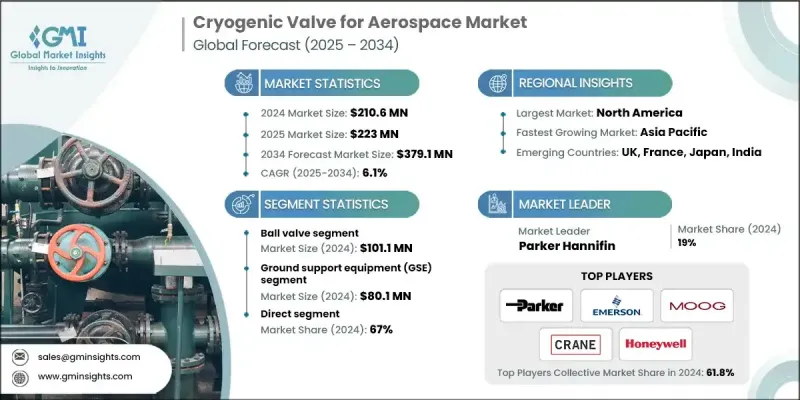
우주 탐사 임무의 지속적인 증가와 액체 산소 및 수소와 같은 극저온 연료의 사용 확대는 특수 극저온 밸브 수요를 촉진하는 주요 촉진요인입니다. 이러한 밸브는 극저온 유체를 안전하고 효율적으로 처리하는 데 핵심적인 역할을 수행하며, 우주 발사 및 추진 과정에서 정밀성과 신뢰성을 보장합니다. 항공우주 기술이 발전함에 따라 극저온 밸브 시스템은 고강도 조건 하에서 향상된 제어력, 운영 안전성 및 내구성을 제공하도록 정교화되고 있습니다. 재료, 설계 및 자동화 부문의 발전으로 성능이 향상되어 궤도 및 지상 항공우주 응용 부문 전반에 걸쳐 정밀한 유량 제어와 누출 없는 작동을 가능하게 합니다. 상업용 우주 프로그램, 위성 배치 및 심우주 탐사 프로젝트의 수요 증가는 제품 개발을 지속적으로 촉진하고 있습니다. 또한 극저온 밸브에 스마트 센서 및 모니터링 시스템을 통합함으로써 실시간 추적 및 예측 유지보수를 가능하게 하여 전 세계적으로 임무에 중요한 항공우주 운영에 필수적인 운영 효율성을 변화시키고 있습니다.
| 시장 범위 | |
|---|---|
| 시작 연도 | 2024년 |
| 예측 연도 | 2025-2034년 |
| 시작 금액 | 2억 1,060만 달러 |
| 예측 금액 | 3억 7,910만 달러 |
| CAGR | 6.1% |
볼 밸브 부문은 2024년 1억 110만 달러의 매출을 기록했습니다. 이 부문의 선도적 지위는 강력한 밀봉 능력과 항공우주 환경의 까다로운 조건에 대한 적응성 덕분입니다. 볼 밸브는 극한의 온도 변화, 진동, 압력 변동 속에서도 안정적인 성능을 유지하는 능력으로 특히 높이 평가됩니다. 일관된 유량 조절이 중요한 추진 시스템, 연료 라인, 극저온 저장 탱크에서 그 신뢰성은 필수 불가결합니다. 또한 극저온 환경에서 동결이나 균열을 방지하는 특수 합금 및 소재 개발을 위한 업계의 지속적인 노력은 항공우주 시스템 내 볼 밸브 채택을 더욱 촉진하고 있습니다.
지상 지원 장비(GSE) 부문은 2024년 8010만 달러의 매출을 기록했습니다. 이 부문은 연료 보급, 배기, 냉각 절차를 통해 발사 및 유지보수 작업을 지원하는 핵심 역할을 합니다. GSE 시스템의 효율성은 우주 임무의 발사 빈도와 회전 시간에 직접적인 영향을 미칩니다. 지상지원장비의 설계 및 성능에 대한 지속적인 업그레이드는 우주 프로그램의 운영 준비성과 안전성을 크게 향상시켰습니다. 발사 전 주기 단축에 기여함으로써 현대 항공우주 인프라의 핵심 구성 요소로서의 역할을 강화하여 신뢰성과 임무 일관성을 높였습니다.
미국은 2024년 기준에서 항공우주용 극저온 밸브 시장에서 87.5%의 점유율을 차지했습니다. 이러한 선도적 지위는 미국의 첨단 항공우주 역량, 극저온 시스템에 대한 지속적인 투자, 주요 제조업체의 존재에 기인합니다. 미국은 연구, 기술 혁신, 상업 및 정부 우주 프로그램의 지속적인 확장에 집중함으로써 경쟁 우위를 유지하고 있습니다. 견고한 국내 공급망과 확립된 규제 체계, 극저온 연료 취급 인프라가 결합되어 지역 및 글로벌 시장 성장에서 미국의 선도적 역할을 강화하고 있습니다.
항공우주용 극저온 밸브 시장에서 활동하는 주요 기업으로는 우드워드(Woodward), 플로우서브(Flowserve), 무그(Moog), 파커 해니핀(Parker Hannifin), 베이커 휴즈(Baker Hughes), 프리시전 플루이드 컨트롤스(Precision Fluid Controls), 헤로즈(Herose), 삼손(SAMSON), 크라이오팹(Cryofab, Inc.), 브레이 인터내셔널(Bray International), 키츠(Kitz), 크레인 컴퍼니(Crane Company), BAC 밸브스(BAC Valves), 허니웰(Honeywell), 에머슨(Emerson) 등이 있습니다. 항공우주용 극저온 밸브 시장의 주요 기업들이 채택한 핵심 전략은 혁신, 전략적 파트너십, 기술 발전에 중점을 두고 있습니다. 업계 선도 기업들은 극한 환경에서의 신뢰성 향상과 실시간 성능 모니터링을 위해 첨단 소재 및 스마트 밸브 기술에 투자하고 있습니다. 항공우주 기관 및 민간 우주 기업과의 협력을 통해 추진 및 연료 관리와 같은 고정밀 응용 부문에 맞춤형 솔루션을 개발하고 있습니다. 또한 극저온 시스템에 대한 수요 증가에 대응하기 위해 글로벌 생산 역량을 확대하고 있습니다.
자주 묻는 질문
목차
제1장 조사 방법과 범위
제2장 주요 요약
제3장 업계 인사이트
- 생태계 분석
- 공급자의 상황
- 이익률
- 각 단계에서의 부가가치
- 밸류체인에 영향을 주는 요인
- 업계에 미치는 영향요인
- 성장 촉진요인
- 우주 탐사 및 발사 프로그램의 성장
- 상업용 항공우주 및 위성 배치의 부상
- 극저온 기술의 진전
- 업계의 잠재적 억제요인 및 과제
- 극한의 운영 조건
- 높은 비용 및 긴 개발 주기
- 기회
- 수소 동력 항공기 개발
- 높은 비용 및 긴 개발 주기
- 성장 촉진요인
- 성장 가능성 분석
- 장래 시장 동향
- 기술과 혁신의 상황
- 현재의 기술 동향
- 신흥기술
- 가격 동향
- 지역별
- 밸브 유형별
- 규제 상황
- 규격 및 규정 준수 요건
- 지역별 규제 프레임워크
- 인증기준
- 무역 통계
- 주요 수입국
- 주요 수출국
- 갭 분석
- 리스크 평가 및 경감책
- Porter's Five Forces 분석
- PESTEL 분석
제4장 경쟁 구도
- 소개
- 기업의 시장 점유율 분석
- 지역별
- 기업 매트릭스 분석
- 주요 시장 기업의 경쟁 분석
- 경쟁 포지셔닝 매트릭스
- 주요 발전
- 합병 및 인수
- 제휴 및 협업
- 신제품 발매
- 확대 계획
제5장 시장 추계 및 예측 : 밸브 유형별(2021-2034년)
- 주요 동향
- 볼 밸브
- 글로브 밸브
- 게이트 밸브
- 체크 밸브
- 버터플라이 밸브
- 기타
제6장 시장 추계 및 예측 : 밸브 사이즈별(2021-2034년)
- 주요 동향
- 소형 밸브(2인치 미만)
- 중형 밸브(2-6인치)
- 대형 밸브(6-12인치)
- 초대형 밸브(12인치 초과)
제7장 시장 추계 및 예측 : 용도별(2021-2034년)
- 주요 동향
- 항공기 시스템
- 지상 지원 장비(GSE)
- 항공우주 제조 및 시험
- 방어 및 군사 용도
제8장 시장 추계 및 예측 : 유통 채널별(2021-2034년)
- 주요 동향
- 직접 판매
- 간접 판매
제9장 시장 추계 및 예측 : 지역별(2021-2034년)
- 주요 동향
- 북미
- 미국
- 캐나다
- 유럽
- 독일
- 영국
- 프랑스
- 스페인
- 이탈리아
- 아시아태평양
- 중국
- 일본
- 인도
- 호주
- 한국
- 라틴아메리카
- 브라질
- 멕시코
- 아르헨티나
- 중동 및 아프리카(MEA)
- 남아프리카
- 사우디아라비아
- 아랍에미리트(UAE)
제10장 기업 프로파일
- Baker Hughes
- Bray International
- BAC Valves
- Crane Company
- Cryofab, Inc.
- Emerson
- Flowserve
- Honeywell
- Herose
- Kitz
- SAMSON
- Moog
- Parker Hannifin
- Precision Fluid Controls
- Woodward
The Global Cryogenic Valve for Aerospace Market was valued at USD 210.6 million in 2024 and is estimated to grow at a CAGR of 6.1% to reach USD 379.1 million by 2034.
The continuous rise in space exploration missions and the increasing use of cryogenic fuels such as liquid oxygen and hydrogen are key drivers boosting the need for specialized cryogenic valves. These valves play a vital role in handling extremely low-temperature fluids safely and efficiently, ensuring precision and reliability during space launches and propulsion processes. As aerospace technology evolves, cryogenic valve systems are being refined to deliver enhanced control, operational safety, and durability under high-stress conditions. Advancements in materials, design, and automation have improved their performance, enabling precise flow control and leak-free operation across both orbital and terrestrial aerospace applications. Growing demand from commercial space programs, satellite deployments, and deep-space exploration projects continues to fuel product development. Furthermore, the integration of smart sensors and monitoring systems into cryogenic valves is transforming operational efficiency by enabling real-time tracking and predictive maintenance, which are essential for mission-critical aerospace operations worldwide.
| Market Scope | |
|---|---|
| Start Year | 2024 |
| Forecast Year | 2025-2034 |
| Start Value | $210.6 Million |
| Forecast Value | $379.1 Million |
| CAGR | 6.1% |
The ball valve segment generated USD 101.1 million in 2024. The segment's leadership can be attributed to its robust sealing capabilities and adaptability to the demanding conditions of aerospace environments. Ball valves are particularly valued for their ability to maintain stable performance under extreme temperature shifts, vibration, and pressure variations. Their reliability makes them indispensable in propulsion systems, fuel lines, and cryogenic storage tanks where consistent flow regulation is crucial. Additionally, the industry's ongoing efforts to develop specialized alloys and materials that prevent freezing or cracking under cryogenic temperatures further enhance the adoption of ball valves in aerospace systems.
The ground support equipment (GSE) segment generated USD 80.1 million in 2024. This segment is integral to supporting launch and maintenance operations through refueling, venting, and cooling procedures. The efficiency of GSE systems directly impacts launch frequency and turnaround times for aerospace missions. Continuous upgrades in GSE design and performance have significantly improved operational readiness and safety in space programs. Their contribution to reducing pre-launch cycles has strengthened their role as an essential component of modern aerospace infrastructure, enhancing reliability and mission consistency.
United States Cryogenic Valve for Aerospace Market held an 87.5% share in 2024. This leadership is driven by the country's advanced aerospace capabilities, ongoing investment in cryogenic systems, and the presence of major manufacturing players. The U.S. maintains a competitive advantage due to its strong focus on research, technological innovation, and the continuous expansion of both commercial and government space programs. The robust domestic supply chain, combined with an established regulatory framework and infrastructure for cryogenic fuel handling, reinforces the country's leading role in regional and global market growth.
Prominent companies operating in the Cryogenic Valve for Aerospace Market include Woodward, Flowserve, Moog, Parker Hannifin, Baker Hughes, Precision Fluid Controls, Herose, SAMSON, Cryofab, Inc., Bray International, Kitz, Crane Company, BAC Valves, Honeywell, and Emerson. Key strategies adopted by major companies in the Cryogenic Valve for Aerospace Market focus on innovation, strategic partnerships, and technological advancement. Industry leaders are investing in advanced materials and smart valve technologies to enhance reliability and real-time performance monitoring under extreme conditions. Collaborations with aerospace agencies and private space enterprises are helping tailor solutions for high-precision applications like propulsion and fuel management. Companies are also expanding global manufacturing capabilities to meet the increasing demand for cryogenic systems.
Table of Contents
Chapter 1 Methodology & Scope
- 1.1 Market scope and definition
- 1.2 Research design
- 1.2.1 Research approach
- 1.2.2 Data collection methods
- 1.3 Data mining sources
- 1.3.1 Global
- 1.3.2 Regional
- 1.4 Base estimates and calculations
- 1.4.1 Base year calculation
- 1.4.2 Key trends for market estimation
- 1.5 Primary research and validation
- 1.5.1 Primary sources
- 1.6 Forecast model
- 1.7 Research assumptions and limitations
Chapter 2 Executive Summary
- 2.1 Industry 360° synopsis
- 2.2 Key market trends
- 2.2.1 Regional
- 2.2.2 Valve type
- 2.2.3 Valve size
- 2.2.4 Application
- 2.2.5 Distribution channel
- 2.3 CXO perspectives: Strategic imperatives
- 2.3.1 Key decision points for industry executives
- 2.3.2 Critical success factors for market players
- 2.4 Future outlook and strategic recommendations
Chapter 3 Industry Insights
- 3.1 Industry ecosystem analysis
- 3.1.1 Supplier landscape
- 3.1.2 Profit margin
- 3.1.3 Value addition at each stage
- 3.1.4 Factor affecting the value chain
- 3.2 Industry impact forces
- 3.2.1 Growth drivers
- 3.2.1.1 Growth in space exploration & launch programs
- 3.2.1.2 Rise of commercial aerospace & satellite deployment
- 3.2.1.3 Advancements in cryogenic technologies
- 3.2.2 Industry pitfalls & challenges
- 3.2.2.1 Extreme operating conditions
- 3.2.2.2 High cost & long development cycles
- 3.2.3 Opportunities
- 3.2.3.1 Hydrogen-powered aircraft development
- 3.2.3.2 High cost & long development cycles
- 3.2.1 Growth drivers
- 3.3 Growth potential analysis
- 3.4 Future market trends
- 3.5 Technology and innovation landscape
- 3.5.1 Current technological trends
- 3.5.2 Emerging technologies
- 3.6 Price trends
- 3.6.1 By region
- 3.6.2 By Valve type
- 3.7 Regulatory landscape
- 3.7.1 Standards and compliance requirements
- 3.7.2 Regional regulatory frameworks
- 3.7.3 Certification standards
- 3.8 Trade statistics
- 3.8.1 Major importing countries
- 3.8.2 Major exporting countries
- 3.9 Gap analysis
- 3.10 Risk assessment and mitigation
- 3.11 Porter's analysis
- 3.12 PESTEL analysis
Chapter 4 Competitive Landscape, 2024
- 4.1 Introduction
- 4.2 Company market share analysis
- 4.2.1 By region
- 4.2.1.1 North America
- 4.2.1.2 Europe
- 4.2.1.3 Asia Pacific
- 4.2.1.4 Latin America
- 4.2.1.5 Middle East and Africa
- 4.2.1 By region
- 4.3 Company matrix analysis
- 4.4 Competitive analysis of major market players
- 4.5 Competitive positioning matrix
- 4.6 Key developments
- 4.6.1 Mergers & acquisitions
- 4.6.2 Partnerships & collaborations
- 4.6.3 New product launches
- 4.6.4 Expansion plans
Chapter 5 Market Estimates & Forecast, By Valve type, 2021-2034 (USD Million) (Thousand Units)
- 5.1 Key trends
- 5.2 Ball valves
- 5.3 Globe valves
- 5.4 Gate valves
- 5.5 Check valves
- 5.6 Butterfly valves
- 5.7 Others
Chapter 6 Market Estimates & Forecast, By Valve size, 2021-2034 (USD Million) (Thousand Units)
- 6.1 Key trends
- 6.2 Small Valves (≤2 inches)
- 6.3 Medium Valves (2-6 inches)
- 6.4 Large Valves (6-12 inches)
- 6.5 Extra-Large Valves (>12 inches)
Chapter 7 Market Estimates & Forecast, By Application, 2021-2034 (USD Million) (Thousand Units)
- 7.1 Key trends
- 7.2 Aircraft systems
- 7.3 Ground support equipment (GSE)
- 7.4 Aerospace manufacturing and testing
- 7.5 Defense and military applications
Chapter 8 Market Estimates & Forecast, By Distribution Channel, 2021-2034 (USD Million) (Thousand Units)
- 8.1 Key trends
- 8.2 Direct
- 8.3 Indirect
Chapter 9 Market Estimates & Forecast, By Region, 2021-2034 (USD Million) (Thousand Units)
- 9.1 Key trends
- 9.2 North America
- 9.2.1 U.S.
- 9.2.2 Canada
- 9.3 Europe
- 9.3.1 Germany
- 9.3.2 UK
- 9.3.3 France
- 9.3.4 Spain
- 9.3.5 Italy
- 9.4 Asia Pacific
- 9.4.1 China
- 9.4.2 Japan
- 9.4.3 India
- 9.4.4 Australia
- 9.4.5 South Korea
- 9.5 Latin America
- 9.5.1 Brazil
- 9.5.2 Mexico
- 9.5.3 Argentina
- 9.6 MEA
- 9.6.1 South Africa
- 9.6.2 Saudi Arabia
- 9.6.3 UAE
Chapter 10 Company Profiles
- 10.1 Baker Hughes
- 10.2 Bray International
- 10.3 BAC Valves
- 10.4 Crane Company
- 10.5 Cryofab, Inc.
- 10.6 Emerson
- 10.7 Flowserve
- 10.8 Honeywell
- 10.9 Herose
- 10.10 Kitz
- 10.11 SAMSON
- 10.12 Moog
- 10.13 Parker Hannifin
- 10.14 Precision Fluid Controls
- 10.15 Woodward