|
시장보고서
상품코드
1871178
웨어러블 혈압 모니터 시장 : 기회, 성장 요인, 업계 동향 분석 및 예측(2025-2034년)Wearable Blood Pressure Monitor Market Opportunity, Growth Drivers, Industry Trend Analysis, and Forecast 2025 - 2034 |
||||||

세계의 웨어러블 혈압 모니터 시장은 2024년 21억 달러로 평가되었으며, 2034년까지 연평균 복합 성장률(CAGR) 15.4%로 성장하여 87억 달러에 이를 것으로 예측됩니다.

시장 성장은 고혈압 환자 증가와 지속적이고 비침습적인 건강 모니터링 솔루션에 대한 수요 증가로 인한 것입니다. 웨어러블 혈압 측정 장치는 실시간 통찰력을 제공하고, 예방 의료를 지원하고, 임상 판단을 보조함으로써 소비자, 의료 제공업체, 보험자에 의한 심혈관 건강 관리 방법을 변화시키고 있습니다. 이 장치에는 AI 구동 분석 기능과 무선 연결 기능을 갖춘 손목 장착형, 커프리스형, 스마트 워치 통합 모니터가 포함되어 사용자가 편리하고 정확하게 혈압을 추적할 수 있습니다. 스마트폰과의 연계, AI 기반의 데이터 분석, 블루투스 접속 등의 기술 혁신으로 사용의 용이성, 정밀도, 환자의 관여가 향상되고 있습니다. 컴팩트하고 사용하기 쉬운 이 모니터는 지속적인 심혈관 모니터링, 이상 조기 발견, 편리한 혈압 관리를 제공하며 개인이 자신의 건강에 적극적으로 참여할 수 있도록 합니다.
| 시장 범위 | |
|---|---|
| 시작 연도 | 2024년 |
| 예측 연도 | 2025-2034년 |
| 시작 금액 | 21억 달러 |
| 예측 금액 | 87억 달러 |
| CAGR | 15.4% |
2024년에 손목식 혈압계 부문은 58.1%의 점유율을 차지했습니다. 인기의 배경은 휴대성, 사용자 친화적인 디자인, 실시간 추적 기능이 있으며, 기술에 익숙한 소비자층과 노인 사용자층 모두에게 지지되고 있습니다. 이러한 장치는 지속적인 가정 및 포인트 오브 케어 모니터링에 이상적이며 전문가 감독이 필요하지 않습니다. 소형화된 센서, 모바일 앱과의 연계, 블루투스 연결 등 최근 기술 진보로 실시간 데이터 추적, 개별화된 분석 결과, 장기적인 경향 분석이 가능해져 더욱 보급을 촉진하고 있습니다.
블루투스 기반 부문은 2024년에 79.2%의 점유율을 차지했으며, 2034년까지 72억 달러에 이를 것으로 예측됩니다. Bluetooth 기술의 보급으로 스마트폰, 태블릿 및 기타 연결 장치와의 원활한 통신이 가능해져 혈압 측정치를 모바일 앱 및 의료 제공업체에게 즉시 전송할 수 있습니다. 이 편의성과 건강 및 피트니스 용도의 이용 확대가 함께, 정기적인 모니터링, 적극적인 질환 관리, 예방 의료 루틴에 환자 참가가 촉진되고 있습니다.
북미의 웨어러블 혈압계 시장은 2024년 35.5%의 점유율을 차지했습니다. 이 지역의 주도적 지위는 첨단 의료 인프라, 디지털 건강 솔루션의 높은 보급률, 심혈관 질환 증가 경향에 기인하고 있습니다. 예방 의료에 대한 광범위한 인지, 지원 상환 정책, 원격 환자 모니터링에 대한 규제 뒷받침이 더욱 성장을 가속하고 있습니다. 웨어러블 디바이스와 스마트폰의 높은 보급률은 원활한 건강 데이터 추적을 가능하게 하고, 지속적인 혈압 모니터링을 소비자에게 친숙하고 매력적인 것으로 하고 있습니다.
웨어러블 혈압 모니터 시장의 주요 기업은 Samsung, Fitbit (Google), HUAWEI, iHealth Labs, CardiacSense, Caretaker Medical, Biobeat Medical, OMRON Healthcare, Tenovi, Withings, SunTech Medical, Corsano Health, CardieX, Aktiia, Apple 등입니다. 웨어러블 혈압 모니터 시장의 기업은 혁신, 전략적 제휴 및 시장 확대 노력을 통해 기반을 강화하고 있습니다. 디바이스의 정밀도 향상, 설계 개량, 모바일 헬스 플랫폼과의 통합 촉진을 위해 연구 개발에 많은 투자를 실시했습니다. 의료 제공업체 및 기술 기업과의 협력을 통해 AI를 활용한 모니터링 솔루션의 개발과 건강 앱과의 상호 운용성 향상을 실현하고 있습니다. 기업은 신규 지역 진출, 유통 채널 확립, 원격 의료와의 통합 활용을 통해 세계 사업 전개를 확대하고 있습니다.
자주 묻는 질문
목차
제1장 조사 방법과 범위
제2장 주요 요약
제3장 업계 인사이트
- 생태계 분석
- 업계에 미치는 영향요인
- 성장 촉진요인
- 고혈압 및 심혈관질환(CVD) 유병률 상승
- 재택 케어 및 원격 환자 모니터링(RPM)으로 이행
- 의료용 웨어러블 기기 보급 확대
- 커프리스 센서 기술(PPG/PTT/AI 알고리즘)의 진보
- 업계의 잠재적 위험 및 과제
- 임상적 정밀도와 검증에 대한 우려
- 규제상의 장벽과 승인 프로세스의 다양성
- 시장 기회
- 센서 기술의 혁신
- 신흥 시장에서의 확대
- 성장 촉진요인
- 성장 가능성 분석
- 규제 상황
- 북미
- 유럽
- 아시아태평양
- LAMEA
- 가격 분석 2024
- 기술 상황
- 현재의 기술 동향
- 휴대형 및 재택형 웨어러블 혈압계의 성장
- 원격 모니터링을 가능하게 하는 디지털 헬스 플랫폼
- 환자에게 사용하기 쉬운 비침습적인 모니터링 시스템
- 신흥기술
- AI를 활용한 예측 분석
- 웨어러블 접속 디바이스
- 적응형 모니터링 기능을 갖춘 스마트 디바이스
- 현재의 기술 동향
- 갭 분석
- Porter's Five Forces 분석
- PESTEL 분석
- 장래 시장 동향
- AI, 디지털 헬스 및 커넥티드 디바이스의 융합
- 재택 및 원격 모니터링 솔루션 확대
- 커프리스 및 비침습적 기술의 채용
- 웰니스 및 예방 의료 프로그램과의 제휴
제4장 경쟁 구도
- 소개
- 기업 매트릭스 분석
- 기업의 시장 점유율 분석
- 세계
- 북미
- 유럽
- 아시아태평양
- LAMEA
- 경쟁 포지셔닝 매트릭스
- 주요 시장 기업의 경쟁 분석
- 주요 발전
- 인수합병
- 제휴 및 협업
- 신서비스 유형의 제공 개시
- 확대 계획
제5장 시장 추계 및 예측 : 제품 유형별, 2021-2034년
- 주요 동향
- 손목식 혈압계
- 손가락 혈압계
- 상완식 혈압계
제6장 시장 추계 및 예측 : 접속 기술별, 2021-2034년
- 주요 동향
- 블루투스 기반
- WiFi 기반
제7장 시장 추계 및 예측 : 적응증별, 2021-2034년
- 주요 동향
- 고혈압
- 부정맥
- 저혈압
제8장 시장 추계 및 예측 : 측정 방식별, 2021-2034년
- 주요 동향
- 오실로메트릭법
- 동맥식 안압계
- 맥파 전달 시간(PPT)
- 광전식 맥파 측정법(PPG)
제9장 시장 추계 및 예측 : 최종 용도별, 2021-2034년
- 주요 동향
- 재택치료 환경
- 병원 및 진료소
- 외래수술센터(ASC)
- 기타 용도
제10장 시장 추계 및 예측 : 지역별, 2021-2034년
- 주요 동향
- 북미
- 미국
- 캐나다
- 유럽
- 독일
- 영국
- 프랑스
- 스페인
- 이탈리아
- 네덜란드
- 아시아태평양
- 중국
- 일본
- 인도
- 호주
- 한국
- 라틴아메리카
- 브라질
- 멕시코
- 아르헨티나
- 중동 및 아프리카
- 남아프리카
- 사우디아라비아
- 아랍에미리트(UAE)
제11장 기업 프로파일
- Aktiia
- Apple
- Biobeat Medical
- CardiacSense
- CardieX
- Caretaker Medical
- Corsano Health
- Fitbit(Google)
- HUAWEI
- iHealth Labs
- Microlife
- OMRON Healthcare
- Samsung
- Sotera Wireless
- SunTech Medical
- Tenovi
- Withings
The Global Wearable Blood Pressure Monitor Market was valued at USD 2.1 Billion in 2024 and is estimated to grow at a CAGR of 15.4% to reach USD 8.7 Billion by 2034.
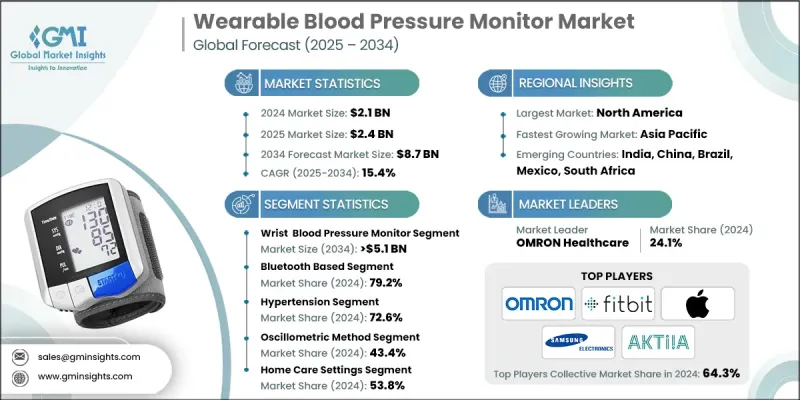
Market growth is fueled by the increasing prevalence of hypertension and the rising demand for continuous, non-invasive health monitoring solutions. Wearable blood pressure devices are transforming the way consumers, healthcare providers, and payers manage cardiovascular health by offering real-time insights, supporting preventive care, and aiding clinical decision-making. These devices include wrist-worn, cuffless, and smartwatch-integrated monitors equipped with AI-driven analytics and wireless connectivity, allowing users to track blood pressure conveniently and accurately. Technological innovations such as smartphone integration, AI-based data analysis, and Bluetooth-enabled connectivity enhance usability, accuracy, and patient engagement. Compact and user-friendly, these monitors provide continuous cardiovascular monitoring, early detection of anomalies, and convenient management of blood pressure, empowering individuals to take a proactive role in their health.
| Market Scope | |
|---|---|
| Start Year | 2024 |
| Forecast Year | 2025-2034 |
| Start Value | $2.1 Billion |
| Forecast Value | $8.7 Billion |
| CAGR | 15.4% |
The wrist blood pressure monitors segment held a 58.1% share in 2024. Their popularity stems from portability, user-friendly design, and real-time tracking capabilities, which appeal to both tech-savvy consumers and elderly users. These devices are ideal for ongoing home and point-of-care monitoring, eliminating the need for professional supervision. Recent technological advances, including miniaturized sensors, mobile app integration, and Bluetooth connectivity, allow for real-time data tracking, personalized insights, and long-term trend analysis, further driving adoption.
The Bluetooth-based segment held 79.2% share in 2024 and is estimated to reach USD 7.2 Billion through 2034. The widespread use of Bluetooth technology enables seamless communication with smartphones, tablets, and other connected devices, allowing instant transmission of blood pressure readings to mobile apps or healthcare providers. This convenience, combined with the growing use of health and fitness applications, encourages regular monitoring, active disease management, and patient engagement in preventive care routines.
North America Wearable Blood Pressure Monitor Market held a 35.5% share in 2024. The region's leadership is attributed to advanced healthcare infrastructure, high adoption of digital health solutions, and a rising incidence of cardiovascular disorders. Widespread awareness of preventive healthcare, supportive reimbursement policies, and regulatory encouragement for remote patient monitoring further drive growth. High penetration of wearable devices and smartphones facilitates seamless health data tracking, making continuous blood pressure monitoring accessible and appealing to consumers.
Key players operating in the Wearable Blood Pressure Monitor Market include Samsung, Fitbit (Google), HUAWEI, iHealth Labs, CardiacSense, Caretaker Medical, Biobeat Medical, OMRON Healthcare, Tenovi, Withings, SunTech Medical, Corsano Health, CardieX, Aktiia, and Apple. Companies in the wearable blood pressure monitor market are strengthening their foothold through innovation, strategic partnerships, and market expansion initiatives. They are investing heavily in research and development to enhance device accuracy, design, and integration with mobile health platforms. Collaborations with healthcare providers and technology firms enable the creation of AI-driven monitoring solutions and improve interoperability with health apps. Firms are expanding their global presence by entering new regions, establishing distribution channels, and leveraging telehealth integration.
Table of Contents
Chapter 1 Methodology and Scope
- 1.1 Market scope and definitions
- 1.2 Research design
- 1.2.1 Research approach
- 1.2.2 Data collection methods
- 1.3 Data mining sources
- 1.3.1 Global
- 1.3.2 Regional/country
- 1.4 Base estimates and calculations
- 1.4.1 Base year calculation
- 1.4.2 Key trends for market estimation
- 1.5 Primary research and validation
- 1.5.1 Primary sources
- 1.6 Forecast model
- 1.7 Research assumptions and limitations
Chapter 2 Executive Summary
- 2.1 Industry 3600 synopsis
- 2.2 Key market trends
- 2.2.1 Regional trends
- 2.2.2 Product type trends
- 2.2.3 Connecting technology trends
- 2.2.4 Indication trends
- 2.2.5 Measurement type trends
- 2.2.6 End use trends
- 2.3 CXO perspectives: Strategic imperatives
- 2.3.1 Key decision points for industry executives
- 2.3.2 Critical success factors for market players
- 2.4 Future outlook and strategic recommendations
Chapter 3 Industry Insights
- 3.1 Industry ecosystem analysis
- 3.2 Industry impact forces
- 3.2.1 Growth drivers
- 3.2.1.1 Rising prevalence of hypertension & CVD
- 3.2.1.2 Shift to home care & remote patient monitoring (RPM)
- 3.2.1.3 Growing adoption of medical wearables
- 3.2.1.4 Advances in cuffless sensor tech (PPG/PTT/AI algorithms)
- 3.2.2 Industry pitfalls and challenges
- 3.2.2.1 Clinical accuracy & validation concerns
- 3.2.2.2 Regulatory hurdles & variable approval pathways
- 3.2.3 Market opportunities
- 3.2.3.1 Innovation in sensor technology
- 3.2.3.2 Expansion in emerging markets
- 3.2.1 Growth drivers
- 3.3 Growth potential analysis
- 3.4 Regulatory landscape
- 3.4.1 North America
- 3.4.2 Europe
- 3.4.3 Asia Pacific
- 3.4.4 LAMEA
- 3.5 Pricing analysis, 2024
- 3.6 Technology landscape
- 3.6.1 Current technological trends
- 3.6.1.1 Growth of portable and home-based wearable blood pressure monitors
- 3.6.1.2 Digital health platforms enabling remote monitoring
- 3.6.1.3 Patient-friendly, non-invasive monitoring systems
- 3.6.2 Emerging technologies
- 3.6.2.1 AI-Powered predictive analytics
- 3.6.2.2 Wearable connected devices
- 3.6.2.3 Smart devices with adaptive monitoring modes
- 3.6.1 Current technological trends
- 3.7 Gap analysis
- 3.8 Porter's analysis
- 3.9 PESTEL analysis
- 3.10 Future market trends
- 3.10.1 Convergence of AI, digital health, and connected devices
- 3.10.2 Expansion of home-based and remote monitoring solutions
- 3.10.3 Adoption of cuffless and non-invasive technologies
- 3.10.4 Integration with wellness and preventive health programs
Chapter 4 Competitive Landscape, 2024
- 4.1 Introduction
- 4.2 Company matrix analysis
- 4.3 Company market share analysis
- 4.3.1 Global
- 4.3.2 North America
- 4.3.3 Europe
- 4.3.4 Asia Pacific
- 4.3.5 LAMEA
- 4.4 Competitive positioning matrix
- 4.5 Competitive analysis of major market players
- 4.6 Key developments
- 4.6.1 Mergers & acquisitions
- 4.6.2 Partnerships & collaborations
- 4.6.3 New service type launches
- 4.6.4 Expansion plans
Chapter 5 Market Estimates and Forecast, By Product Type, 2021 - 2034 ($ Mn)
- 5.1 Key trends
- 5.2 Wrist blood pressure monitor
- 5.3 Finger blood pressure monitor
- 5.4 Upper arm blood pressure monitor
Chapter 6 Market Estimates and Forecast, By Connecting Technology, 2021 - 2034 ($ Mn)
- 6.1 Key trends
- 6.2 Bluetooth based
- 6.3 WiFi based
Chapter 7 Market Estimates and Forecast, By Indication, 2021 - 2034 ($ Mn)
- 7.1 Key trends
- 7.2 Hypertension
- 7.3 Irregular heartbeat
- 7.4 Hypotension
Chapter 8 Market Estimates and Forecast, By Measurement Type, 2021 - 2034 ($ Mn)
- 8.1 Key trends
- 8.2 Oscillometric method
- 8.3 Arterial tonometry
- 8.4 Pulse transit time (PPT)
- 8.5 Photoplethysmography (PPG)
Chapter 9 Market Estimates and Forecast, By End Use, 2021 - 2034 ($ Mn)
- 9.1 Key trends
- 9.2 Home care settings
- 9.3 Hospital & clinics
- 9.4 Ambulatory surgical centers
- 9.5 Other end use
Chapter 10 Market Estimates and Forecast, By Region, 2021 - 2034 ($ Mn)
- 10.1 Key trends
- 10.2 North America
- 10.2.1 U.S.
- 10.2.2 Canada
- 10.3 Europe
- 10.3.1 Germany
- 10.3.2 UK
- 10.3.3 France
- 10.3.4 Spain
- 10.3.5 Italy
- 10.3.6 Netherlands
- 10.4 Asia Pacific
- 10.4.1 China
- 10.4.2 Japan
- 10.4.3 India
- 10.4.4 Australia
- 10.4.5 South Korea
- 10.5 Latin America
- 10.5.1 Brazil
- 10.5.2 Mexico
- 10.5.3 Argentina
- 10.6 Middle East and Africa
- 10.6.1 South Africa
- 10.6.2 Saudi Arabia
- 10.6.3 UAE
Chapter 11 Company Profiles
- 11.1 Aktiia
- 11.2 Apple
- 11.3 Biobeat Medical
- 11.4 CardiacSense
- 11.5 CardieX
- 11.6 Caretaker Medical
- 11.7 Corsano Health
- 11.8 Fitbit (Google)
- 11.9 HUAWEI
- 11.10 iHealth Labs
- 11.11 Microlife
- 11.12 OMRON Healthcare
- 11.13 Samsung
- 11.14 Sotera Wireless
- 11.15 SunTech Medical
- 11.16 Tenovi
- 11.17 Withings