|
시장보고서
상품코드
1871179
E-메탄올 시장 : 기회, 성장 요인, 업계 동향 분석 및 예측(2025-2034년)E-Methanol Market Opportunity, Growth Drivers, Industry Trend Analysis, and Forecast 2025 - 2034 |
||||||

세계의 E-메탄올 시장은 2024년 10억 달러로 평가되었으며, 2034년까지 연평균 복합 성장률(CAGR) 32.2%로 성장하여 161억 달러에 이를 것으로 예측됩니다.
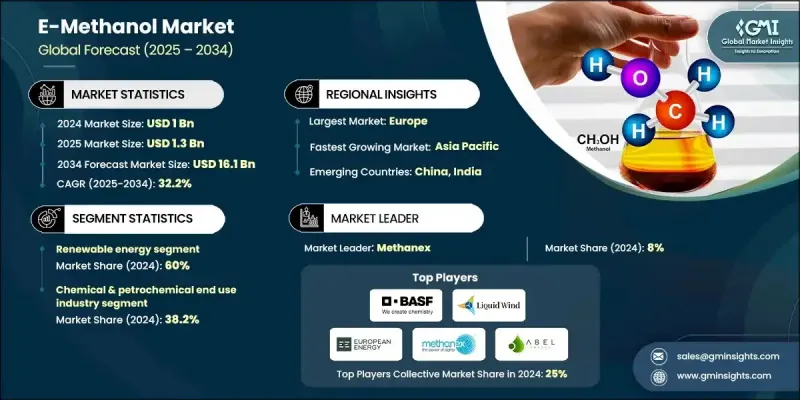
세계 E-메탄올 시장은 2024년 10억 달러로 평가되었으며, 2034년까지 연평균 복합 성장률(CAGR) 32.2%로 성장하여 161억 달러에 이를 것으로 예측됩니다.
| 시장 범위 | |
|---|---|
| 시작 연도 | 2024년 |
| 예측 기간 | 2025-2034년 |
| 시작 금액 | 10억 달러 |
| 예측 금액 | 161억 달러 |
| CAGR | 32.2% |
특히 산업부문 및 운수부문에서 세계적인 탄소 배출량 감축의 대처 확대가 시장의 주요 촉진요인이 되고 있습니다. E-메탄올은 전통적인 화석 유래 메탄올의 중요한 대안으로 부상하고 있으며 국제적인 기후 목표에 따라 보다 깨끗한 솔루션을 제공합니다. 이러한 전환은 재생가능한 연료 생산에 대한 정책 틀, 정부 인센티브, 보조금에 의해 강력하게 지원되고 있으며, 이들 모두는 운영 비용 절감과 대규모 투자 유치에 기여하고 있습니다. 그린 수소 생산과의 통합과 전해조 기술의 진보가 시장의 기세를 더욱 뒷받침하고 있습니다. 또한, 순환 경제 모델, 특히 폐기물에서 연료를 생산하는 노력에 대한 관심 증가는 지속 가능한 개발에서 E-메탄올의 선택으로서의 매력을 향상시키고 있습니다. 도시 쓰레기와 산업 폐기물을 메탄올로 전환하면 배출 감소에 기여할 뿐만 아니라 원료 비용도 절감됩니다. 지속가능한 항공연료의 생산에 있어서 본 제품의 역할과 화학제조 분야에서의 응용 확대가 수요를 더욱 강화할 것으로 예측됩니다. 세계의 항공수송과 산업생산이 계속 확대되고 있는 가운데 E-메탄올과 같은 청정에너지 대체원의 필요성도 마찬가지로 높아질 것으로 전망됩니다.
2024년 기준에서 재생가능에너지 부문은 60%의 점유율을 차지했고 2034년까지 연평균 복합 성장률(CAGR) 33%로 확대될 것으로 예측되고 있습니다. 녹색수소와 재생가능에너지 인프라의 연계 강화가 수요를 견인하고 있습니다. 재생 가능 전력 용량의 확대와 전해 장치의 성능 향상에 따라, E-메탄올의 생산 경제성은 보다 유리하게 되고 있습니다. 이를 통해 세계적인 청정 에너지 정책과 탈탄소화 목표에 부합하는 확장 가능한 솔루션을 만들 수 있습니다. 재생가능 발전과 그린메탄올 생산의 시너지 효과는 앞으로도 이 부문의 성장을 결정하는 요인이 될 것입니다.
선박연료 부문은 배출규제 강화와 세계적인 항만 인프라 확충을 배경으로 2034년까지 연평균 복합 성장률(CAGR) 33.7%로 추이할 것으로 예측되고 있습니다. 새로운 배출규제가 시행되고 있는 가운데 E-메탄올은 기존의 추진기술이나 연료공급 시스템과의 호환성을 통해 선박연료로 주목을 받고 있습니다. 해운 사업자는 저탄소 연료로의 전환을 가속화하고 있으며, E-메탄올은 운영면과 환경면의 요구 사항을 충족하는 도입 준비가 된 옵션을 제공합니다.
2024년 기준에서 미국 E-메탄올 시장은 84%의 점유율을 차지했으며 1억 2,000만 달러의 규모에 도달했습니다. 지역 성장은 산업의 탈탄소화 노력, 대체 선박 연료 수요 증가, 정책 지원을 받은 메탄올 생산에 의해 추진되고 있습니다. 주요 항만에서의 인프라 정비의 진전에 의해 깨끗한 선박 연료의 연료 보급과 유통이 가능해지고 있습니다. 동시에 제조업체는 지속 가능한 제품 포트폴리오에 E-메탄올을 도입하여 국가의 청정 에너지 전환 목표를 지원합니다.
세계 E-메탄올 산업의 주요 기업으로는 Enerkem, BASF, Pacifico Mexinol, Andes Mining & Energy, ReIntegrate, MAN Energy Solutions, Liquid Wind, Shanghai Electric, Methanex, Carbon Recycling International, Thyssenkrupp Uhde GmbH, Mitsubishi Gas Chemical, Khimod, Hyosung, Europe Energy, Renewable Hydrogen Canada, Johnson Matthey, Maersk, Celanese, ABEL Energy, Dalian Institute of Chemical Physics 등을 들 수 있습니다. 주요 E-메탄올 기업은 그린 수소와 CO2 포집 기술을 결합한 통합 생산 시설에 투자하여 시장에서의 존재감을 확대하기 위한 적극적인 전략을 추진하고 있습니다. 전력회사나 수소 공급업체와의 제휴에 의해 엔드 투 엔드 저탄소 연료 밸류 체인의 구축이 가능해지고 있습니다. 또한 많은 기업들이 산업 부문과 해운 사업자와의 장기적인 오프 테이크 계약을 체결하여 안정적인 수요와 투자 이익률(ROI)을 확보하고 있습니다. 정부와의 연계는 특히 신흥 시장에서 보조금 획득 및 규제 당국의 승인 취득에 유효합니다. 또한 전해 장치의 성능 최적화와 모듈식 생산 유닛의 도입으로 분산형 제조의 실현을 도모하고 있습니다.
자주 묻는 질문
목차
제1장 조사 방법과 범위
제2장 주요 요약
제3장 업계 인사이트
- 생태계 분석
- 규제 상황
- 업계에 미치는 영향요인
- 성장 촉진요인
- 업계의 잠재적 위험 및 과제
- 성장 가능성 분석
- Porter's Five Forces 분석
- PESTEL 분석
- 새로운 기회와 동향
- 디지털화와 IoT 통합
- 신흥 시장 진출
제4장 경쟁 구도
- 소개
- 기업의 시장 점유율 분석
- 전략적 노력
- 경쟁 벤치마킹
- 전략적 대시보드
- 혁신과 기술의 정세
제5장 시장 규모와 예측 : 원료별, 2021-2034년
- 주요 동향
- 물 원료
- 수소 베이스
제6장 시장 규모와 예측 : 소스별, 2021-2034년
- 주요 동향
- 신재생에너지
- 화석연료
제7장 시장 규모와 예측 : 최종 용도별, 2021-2034년
- 주요 동향
- 화학제품 및 석유화학제품
- 선박용 연료
- 발전
- 산업용
- 기타
제8장 시장 규모와 예측 : 지역별, 2021-2034년
- 주요 동향
- 북미
- 미국
- 캐나다
- 유럽
- 독일
- 영국
- 프랑스
- 네덜란드
- 스페인
- 아시아태평양
- 중국
- 호주
- 인도
- 일본
- 한국
- 세계 기타 지역
제9장 기업 프로파일
- ABEL Energy
- Andes Mining &Energy
- BASF
- Carbon Recycling International
- Celanese
- Dalian Institute of Chemical Physics
- Enerkem
- European Energy
- Hyosung
- Johnson Matthey
- Khimod
- Liquid Wind
- Maersk
- MAN Energy Solutions
- Mitsubishi Gas Chemical
- Methanex
- Pacifico Mexinol
- ReIntegrate
- Renewable Hydrogen Canada
- Shanghai Electric
- Thyssenkrupp Uhde GmbH
The Global E-Methanol Market was valued at USD 1 Billion in 2024 and is estimated to grow at a CAGR of 32.2% to reach USD 16.1 Billion by 2034.
The Global E-Methanol Market was valued at USD 1 Billion in 2024 and is estimated to grow at a CAGR of 32.2% to reach USD 16.1 Billion by 2034.
| Market Scope | |
|---|---|
| Start Year | 2024 |
| Forecast Year | 2025-2034 |
| Start Value | $1 Billion |
| Forecast Value | $16.1 Billion |
| CAGR | 32.2% |
Growing global efforts to reduce carbon emissions, particularly across the industrial and transportation sectors, are a key driver for the market. E-methanol is emerging as a vital alternative to conventional fossil-based methanol, offering a cleaner solution that aligns with international climate targets. This transition is strongly supported by policy frameworks, government incentives, and subsidies for renewable fuel production, all of which are helping to lower operational costs and attract large-scale investment. Integration with green hydrogen production, along with advancements in electrolyzer technology, is further reinforcing market momentum. Additionally, increasing interest in circular economy models especially waste-to-fuel initiatives is making e-methanol an appealing option for sustainable development. Transforming municipal and industrial waste into methanol not only contributes to emission reductions but also brings down feedstock costs. The product's role in producing sustainable aviation fuel and its growing application across chemical manufacturing are expected to strengthen demand. As global air travel and industrial output continue to rise, so will the need for clean energy alternatives like e-methanol.
In 2024, the renewable energy segment held a 60% share and is forecasted to grow at a CAGR of 33% through 2034. The increasing connection between green hydrogen and renewable energy infrastructure is driving demand. As renewable electricity capacity grows and electrolyzer performance improves, the economics of producing e-methanol become more favorable. This creates a scalable solution aligned with clean energy policies and decarbonization objectives worldwide. The synergy between renewable power generation and green methanol production will continue to be a defining growth factor for this segment.
The marine fuel sector is anticipated to register a CAGR of 33.7% through 2034, supported by tightening emission regulations and the expansion of global port infrastructure. As new emission rules are enforced, e-methanol is gaining traction as a marine fuel due to its compatibility with existing propulsion technologies and fueling systems. Maritime operators are increasingly shifting toward low-carbon fuels, and e-methanol provides a ready-to-deploy option that meets operational and environmental requirements.
U.S. E-Methanol Market held 84% share and generated USD 120 million in 2024. Regional growth is being driven by industrial decarbonization efforts, rising demand for alternative marine fuels, and policy-backed methanol production. Infrastructure upgrades at major port locations are enabling bunkering and distribution for clean marine fuels. At the same time, manufacturers are adopting e-methanol into their sustainable product portfolios, supporting the country's clean energy transition goals.
Prominent companies in the Global E-Methanol Industry include Enerkem, BASF, Pacifico Mexinol, Andes Mining & Energy, ReIntegrate, MAN Energy Solutions, Liquid Wind, Shanghai Electric, Methanex, Carbon Recycling International, Thyssenkrupp Uhde GmbH, Mitsubishi Gas Chemical, Khimod, Hyosung, Europe Energy, Renewable Hydrogen Canada, Johnson Matthey, Maersk, Celanese, ABEL Energy, and Dalian Institute of Chemical Physics. Leading e-methanol companies are pursuing aggressive strategies to scale their market presence by investing in integrated production facilities that combine green hydrogen and CO2 capture technologies. Partnerships with utility firms and hydrogen suppliers are enabling them to build end-to-end, low-carbon fuel value chains. Many players are also entering long-term offtake agreements with industries and maritime operators to ensure stable demand and ROI. Collaborations with governments help secure grants and regulatory approvals, especially in emerging markets. Additionally, firms are optimizing electrolyzer performance and adopting modular production units to enable decentralized manufacturing.
Table of Contents
Chapter 1 Methodology & Scope
- 1.1 Research design
- 1.2 Base estimates & calculations
- 1.3 Forecast calculation
- 1.4 Data sources
- 1.4.1 Primary
- 1.4.2 Secondary
- 1.4.2.1 Paid
- 1.4.2.2 Public
- 1.5 Market definitions
Chapter 2 Executive Summary
- 2.1 Industry synopsis, 2021 - 2034
Chapter 3 Industry Insights
- 3.1 Industry ecosystem analysis
- 3.2 Regulatory landscape
- 3.3 Industry impact forces
- 3.3.1 Growth drivers
- 3.3.2 Industry pitfalls & challenges
- 3.4 Growth potential analysis
- 3.5 Porter's analysis
- 3.5.1 Bargaining power of suppliers
- 3.5.2 Bargaining power of buyers
- 3.5.3 Threat of new entrants
- 3.5.4 Threat of substitutes
- 3.6 PESTEL analysis
- 3.6.1 Political factors
- 3.6.2 Economic factors
- 3.6.3 Social factors
- 3.6.4 Technology factors
- 3.6.5 environmental factors
- 3.6.6 Legal factors
- 3.7 Emerging opportunities & trends
- 3.7.1 Digitalization and IoT integration
- 3.7.2 Emerging market penetration
Chapter 4 Competitive landscape, 2025
- 4.1 Introduction
- 4.2 Company market share analysis, 2024
- 4.3 Strategic initiatives
- 4.4 Competitive benchmarking
- 4.5 Strategic dashboard
- 4.6 Innovation & technology landscape
Chapter 5 Market Size and Forecast, By Feedstock, 2021 - 2034 (USD Million)
- 5.1 Key trends
- 5.2 Water sourced
- 5.3 Hydrogen based
Chapter 6 Market Size and Forecast, By Source, 2021 - 2034 (USD Million)
- 6.1 Key trends
- 6.2 Renewable energy
- 6.3 Fossil fuel
Chapter 7 Market Size and Forecast, By End Use, 2021 - 2034 (USD Million)
- 7.1 Key trends
- 7.2 Chemical & petrochemical
- 7.3 Marine fuel
- 7.4 Power generation
- 7.5 Industrial
- 7.6 Others
Chapter 8 Market Size and Forecast, By Region, 2021 - 2034 (USD Million)
- 8.1 Key trends
- 8.2 North America
- 8.2.1 U.S.
- 8.2.2 Canada
- 8.3 Europe
- 8.3.1 Germany
- 8.3.2 UK
- 8.3.3 France
- 8.3.4 Netherlands
- 8.3.5 Spain
- 8.4 Asia Pacific
- 8.4.1 China
- 8.4.2 Australia
- 8.4.3 India
- 8.4.4 Japan
- 8.4.5 South Korea
- 8.5 Rest of the world
Chapter 9 Company Profiles
- 9.1 ABEL Energy
- 9.2 Andes Mining & Energy
- 9.3 BASF
- 9.4 Carbon Recycling International
- 9.5 Celanese
- 9.6 Dalian Institute of Chemical Physics
- 9.7 Enerkem
- 9.8 European Energy
- 9.9 Hyosung
- 9.10 Johnson Matthey
- 9.11 Khimod
- 9.12 Liquid Wind
- 9.13 Maersk
- 9.14 MAN Energy Solutions
- 9.15 Mitsubishi Gas Chemical
- 9.16 Methanex
- 9.17 Pacifico Mexinol
- 9.18 ReIntegrate
- 9.19 Renewable Hydrogen Canada
- 9.20 Shanghai Electric
- 9.21 Thyssenkrupp Uhde GmbH