

|
시장보고서
상품코드
1871198
정밀 영양 웨어러블 센서 시장 : 기회, 성장 요인, 업계 동향 분석 및 예측(2025-2034년)Precision Nutrition Wearable Sensors Market Opportunity, Growth Drivers, Industry Trend Analysis, and Forecast 2025 - 2034 |
||||||

세계의 정밀 영양 웨어러블 센서 시장은 2024년 28억 달러로 평가되었으며, 2034년까지 연평균 복합 성장률(CAGR) 12.5%로 성장하여 94억 달러에 이를 것으로 예측됩니다.
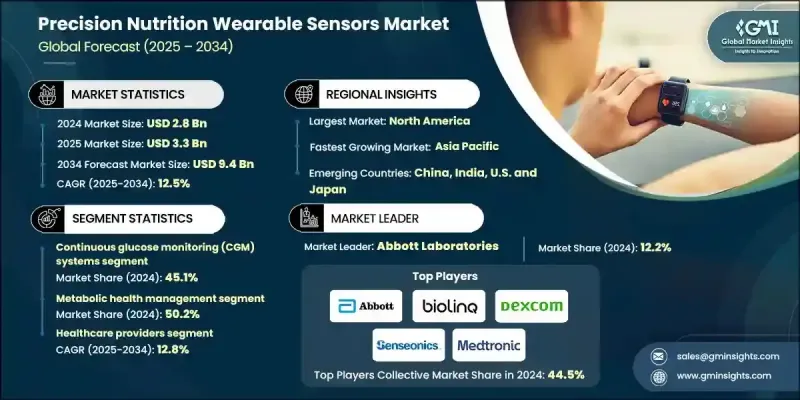
건강 모니터링 기술의 발전과 맞춤형 영양에 대한 관심 증가로 시장이 확대되고 있습니다. 이 센서는 수분 공급, 영양 섭취량, 대사율, 신체 활동과 같은 주요 생리적 지표를 실시간으로 추적합니다. 정확한 모니터링을 제공함으로써 소비자와 의료 전문가 모두 영양 계획을 사용자 정의하고, 건강 상태를 개선하고, 식사와 관련된 질병을 예방할 수 있습니다. 건강 의식 증가, 스마트 장치의 보급, 생활 습관병 증가가 강한 수요를 창출하고 있습니다. 신흥 시장에서는 가처분소득 증가와 개별화된 건강 솔루션에 대한 인식이 높아짐에 따라 큰 성장 기회가 탄생하고 있습니다. 다항목 센서, AI를 활용한 분석기술, 기타 건강기기와의 연계 등의 혁신이 시장 성장을 가속시킬 것으로 예측됩니다.
| 시장 범위 | |
|---|---|
| 시작 연도 | 2024년 |
| 예측 기간 | 2025-2034년 |
| 시작 금액 | 28억 달러 |
| 예측 금액 | 94억 달러 |
| CAGR | 12.5% |
연속 혈당 모니터링(CGM) 시스템 부문은 2024년 45.1%의 점유율을 차지했습니다. 이것은 당뇨병 관리 및 영양 추적에서 수십 년에 걸쳐 임상 효능의 검증을 반영합니다. 제조 기술의 성숙도, 센서의 정확성 및 확립된 규제 프레임워크가 이 부문의 이점에 기여합니다.
대사 건강 관리 부문은 2024년 50.2%의 점유율을 차지했습니다. 여기에는 당뇨병, 비만, 대사 증후군 등의 상태 모니터링 및 최적화가 포함됩니다. 높은 수요는 실시간 대사 데이터에 대한 임상적 요구에 기인하며, 개별화된 개입 지원, 정밀 치료 처방 보조, 약물 복용량 조정, 대사 합병증 진행 예방에 기여하고 있습니다.
북미의 정밀 영양 웨어러블 센서 시장은 42.2%의 점유율을 획득했으며 CAGR은 12.6%였습니다. 2024년 미국 시장의 가치는 9억 2,160만 달러로 평가되었습니다. 이 지역의 리더십은 고급 의료 인프라, 편리한 규제 환경 및 건강 기술의 보급률이 높아짐에 따라 지원됩니다. FDA의 웨어러블 바이오센서에 대한 명확한 규제 경로는 안전과 효율성을 보장하면서 혁신을 강화하고 있습니다.
세계 정밀 영양 웨어러블 센서 시장의 주요 기업으로는 Biolinq Inc., Dexcom Inc., Abbott Laboratories, Epicore Biosystems, Medtronic plc, DayTwo Inc., Nutrisense Inc., Senseonics Holdings Inc., Genesis Healthcare Co., Prenetics Global Limited 등이 있습니다. 정밀 영양 웨어러블 센서 시장의 기업은 제품 혁신, AI를 활용한 분석 통합, 정확성과 사용 편의성을 높이기 위한 다중 파라미터 센서 개발에 주력하고 있습니다. 의료 제공업체 및 연구 기관과의 전략적 파트너십을 통해 임상 검증 및 신뢰성을 보장합니다. 유통채널 확대와 신흥 시장 진출로 세계 전개를 추진하고 있습니다. 기업은 승인과 시장 도입을 가속화하기 위해 규제 준수를 중시합니다. 맞춤형 솔루션, 구독 기반 모니터링 서비스, 모바일 앱과의 완벽한 기기 통합을 통해 고객 참여도를 높이고 있습니다.
자주 묻는 질문
목차
제1장 조사 방법과 범위
제2장 주요 요약
제3장 업계 인사이트
- 생태계 분석
- 공급자의 상황
- 이익률
- 각 단계에서의 부가가치
- 밸류체인에 영향을 주는 요인
- 혁신
- 업계에 미치는 영향요인
- 성장 촉진요인
- 업계의 잠재적 위험 및 과제
- 시장 기회
- 성장 가능성 분석
- 규제 상황
- 북미
- 유럽
- 아시아태평양
- 라틴아메리카
- 중동 및 아프리카
- Porter's Five Forces 분석
- PESTEL 분석
- 가격 동향
- 지역별
- 제품 카테고리별
- 장래 시장 동향
- 기술과 혁신의 상황
- 현재의 기술 동향
- 신흥기술
- 특허 상황
- 무역 통계(HS코드 참고: 무역 통계는 주요 국가에서만 제공됨)
- 주요 수입국
- 주요 수출국
- 지속가능성과 환경적 측면
- 지속가능한 대처
- 폐기물 감축 전략
- 생산에 있어서의 에너지 효율
- 환경에 배려한 대처
- 탄소발자국에 대한 배려
제4장 경쟁 구도
- 소개
- 기업의 시장 점유율 분석
- 지역별
- 북미
- 유럽
- 아시아태평양
- 라틴아메리카
- 중동 및 아프리카
- 지역별
- 기업 매트릭스 분석
- 주요 시장 기업의 경쟁 분석
- 경쟁 포지셔닝 매트릭스
- 주요 발전
- 인수합병
- 제휴 및 공동 사업
- 신제품 발매
- 사업 확대 계획
제5장 시장 추계 및 예측 : 기술 유형별, 2021-2034년
- 주요 동향
- 연속 혈당 모니터(CGM)
- 땀 기반 바이오센서
- 생체 전기저항 센서
- 광학식 센서
제6장 시장 추계 및 예측 : 용도별, 2021-2034년
- 주요 동향
- 대사 건강 관리
- 혈당 모니터링 및 당뇨병 관리
- 케토시스 추적용
- 대사 유연성 평가
- 스포츠 영양학 및 퍼포먼스
- 수분 보급 모니터링 시스템
- 전해질 밸런스 추적
- 젖산 측정
- 임상영양요법
- 질병 관리 응용
- 치료 모니터링 시스템
- 복약 준수 상황 추적
- 종합적인 건강 증진과 예방
- 라이프스타일 최적화 플랫폼
- 식사 준수 상황 모니터링
- 예방 의료 응용
제7장 시장 추계 및 예측 : 최종 용도별, 2021-2034년
- 주요 동향
- 의료 제공업체
- 병원 통합 시스템
- 클리닉 기반 모니터링 프로그램
- 원격 의료 플랫폼 통합
- 소비자용 직접 판매
- 개인 소비자에 의한 채용
- 피트니스 애호가 부문
- 건강 의식이 높은 사용자층
- 기업용 건강 증진 프로그램
- 고용주 주도의 건강 증진 시책
- 보험사와의 제휴
- 산업 보건 용도
- 연구기관
- 임상시험 응용
- 학술연구 프로그램
- 의약품 개발 지원
제8장 시장 추계 및 예측 : 지역별, 2021-2034년
- 주요 동향
- 북미
- 미국
- 캐나다
- 유럽
- 독일
- 영국
- 프랑스
- 스페인
- 이탈리아
- 기타 유럽
- 아시아태평양
- 중국
- 인도
- 일본
- 호주
- 한국
- 기타 아시아태평양
- 라틴아메리카
- 브라질
- 멕시코
- 아르헨티나
- 기타 라틴아메리카
- 중동 및 아프리카
- 사우디아라비아
- 남아프리카
- 아랍에미리트(UAE)
- 기타 중동 및 아프리카
제9장 기업 프로파일
- Abbott Laboratories
- Biolinq Inc
- DayTwo Inc
- Dexcom Inc
- Epicore Biosystems
- Genesis Healthcare Co.
- Medtronic plc
- Nutrisense Inc
- Prenetics Global Limited
- Senseonics Holdings Inc
The Global Precision Nutrition Wearable Sensors Market was valued at USD 2.8 Billion in 2024 and is estimated to grow at a CAGR of 12.5% to reach USD 9.4 Billion by 2034.
The market is expanding due to advancements in health-monitoring technologies and growing interest in personalized nutrition. These sensors provide real-time tracking of key physiological metrics such as hydration, nutrient intake, metabolic rate, and physical activity. By offering accurate monitoring, they enable both consumers and healthcare professionals to tailor nutrition plans, enhance health outcomes, and prevent diet-related conditions. The rising health awareness, proliferation of smart devices, and increasing prevalence of lifestyle-related diseases are creating strong demand. Emerging markets are presenting significant growth opportunities, driven by higher disposable incomes and growing awareness of personalized health solutions. Innovations in multi-parameter sensors, AI-driven analytics, and integration with other health devices are expected to accelerate market growth.
| Market Scope | |
|---|---|
| Start Year | 2024 |
| Forecast Year | 2025-2034 |
| Start Value | $2.8 Billion |
| Forecast Value | $9.4 Billion |
| CAGR | 12.5% |
The continuous glucose monitoring (CGM) systems segment held a 45.1% share in 2024, reflecting decades of clinical validation in managing diabetes and nutritional tracking. The maturity of manufacturing, sensor accuracy, and established regulatory frameworks contribute to the segment's dominance.
The metabolic health management segment held a 50.2% share in 2024. This includes monitoring and optimizing conditions such as diabetes, obesity, and metabolic syndrome. The high demand stems from the clinical need for real-time metabolic data, which supports personalized interventions, helps in precise therapy prescriptions, adjusts medication dosages, and prevents the progression of metabolic complications.
North America Precision Nutrition Wearable Sensors Market captured 42.2% share, with a CAGR of 12.6%, and the U.S. market was valued at USD 921.6 million in 2024. The region's leadership is supported by advanced healthcare infrastructure, a favorable regulatory environment, and high adoption of health technologies. The FDA's clear regulatory pathways for wearable biosensors reinforce innovation while ensuring safety and efficacy.
Leading companies in the Global Precision Nutrition Wearable Sensors Market include Biolinq Inc., Dexcom Inc., Abbott Laboratories, Epicore Biosystems, Medtronic plc, DayTwo Inc., Nutrisense Inc., Senseonics Holdings Inc., Genesis Healthcare Co., and Prenetics Global Limited. Companies in the Precision Nutrition Wearable Sensors Market focus on product innovation, integrating AI-powered analytics, and developing multi-parameter sensors to improve accuracy and usability. Strategic partnerships with healthcare providers and research institutions enable clinical validation and credibility. Expanding distribution channels and targeting emerging markets help increase global reach. Companies emphasize regulatory compliance to speed up approvals and market adoption. Personalized solutions, subscription-based monitoring services, and seamless device integration with mobile apps strengthen customer engagement.
Table of Contents
Chapter 1 Methodology & Scope
- 1.1 Market scope and definition
- 1.2 Research design
- 1.2.1 Research approach
- 1.2.2 Data collection methods
- 1.3 Data mining sources
- 1.3.1 Global
- 1.3.2 Regional/Country
- 1.4 Base estimates and calculations
- 1.4.1 Base year calculation
- 1.4.2 Key trends for market estimation
- 1.5 Primary research and validation
- 1.5.1 Primary sources
- 1.6 Forecast model
- 1.7 Research assumptions and limitations
Chapter 2 Executive Summary
- 2.1 Industry 360° synopsis
- 2.2 Key market trends
- 2.2.1 Regional
- 2.2.2 Technology type
- 2.2.3 Application
- 2.2.4 End Use
- 2.3 TAM Analysis, 2025-2034
- 2.4 CXO perspectives: Strategic imperatives
- 2.4.1 Executive decision points
- 2.4.2 Critical success factors
- 2.5 Future Outlook and Strategic Recommendations
Chapter 3 Industry Insights
- 3.1 Industry ecosystem analysis
- 3.1.1 Supplier landscape
- 3.1.2 Profit margin
- 3.1.3 Value addition at each stage
- 3.1.4 Factor affecting the value chain
- 3.1.5 Disruptions
- 3.2 Industry impact forces
- 3.2.1 Growth drivers
- 3.2.2 Industry pitfalls and challenges
- 3.2.3 Market opportunities
- 3.3 Growth potential analysis
- 3.4 Regulatory landscape
- 3.4.1 North America
- 3.4.2 Europe
- 3.4.3 Asia Pacific
- 3.4.4 Latin America
- 3.4.5 Middle East & Africa
- 3.5 Porter's analysis
- 3.6 PESTEL analysis
- 3.7 Price trends
- 3.7.1 By region
- 3.7.2 By product category
- 3.8 Future market trends
- 3.9 Technology and Innovation landscape
- 3.9.1 Current technological trends
- 3.9.2 Emerging technologies
- 3.10 Patent Landscape
- 3.11 Trade statistics (HS code Note: the trade statistics will be provided for key countries only)
- 3.11.1 Major importing countries
- 3.11.2 Major exporting countries
- 3.12 Sustainability and environmental aspects
- 3.12.1 Sustainable practices
- 3.12.2 Waste reduction strategies
- 3.12.3 Energy efficiency in production
- 3.12.4 Eco-friendly initiatives
- 3.13 Carbon footprint consideration
Chapter 4 Competitive Landscape, 2024
- 4.1 Introduction
- 4.2 Company market share analysis
- 4.2.1 By region
- 4.2.1.1 North America
- 4.2.1.2 Europe
- 4.2.1.3 Asia Pacific
- 4.2.1.4 LATAM
- 4.2.1.5 MEA
- 4.2.1 By region
- 4.3 Company matrix analysis
- 4.4 Competitive analysis of major market players
- 4.5 Competitive positioning matrix
- 4.6 Key developments
- 4.6.1 Mergers & acquisitions
- 4.6.2 Partnerships & collaborations
- 4.6.3 New Product Launches
- 4.6.4 Expansion Plans
Chapter 5 Market Estimates and Forecast, By Technology Type, 2021-2034 (USD Million & Units)
- 5.1 Key trends
- 5.2 Continuous glucose monitors (CGMs)
- 5.3 Sweat-based biosensors
- 5.4 Bioimpedance sensors
- 5.5 Optical sensors
Chapter 6 Market Estimates and Forecast, By Application, 2021-2034 (USD Million & Units)
- 6.1 Key trends
- 6.2 Metabolic health management
- 6.2.1 Glucose monitoring & diabetes management
- 6.2.2 Ketosis tracking applications
- 6.2.3 Metabolic flexibility assessment
- 6.3 Sports nutrition & performance
- 6.3.1 Hydration monitoring systems
- 6.3.2 Electrolyte balance tracking
- 6.3.3 Lactate measurement
- 6.4 Clinical nutrition therapy
- 6.4.1 Disease management applications
- 6.4.2 Therapeutic monitoring systems
- 6.4.3 Medication adherence tracking
- 6.5 General wellness & prevention
- 6.5.1 Lifestyle optimization platforms
- 6.5.2 Dietary compliance monitoring
- 6.5.3 Preventive health applications
Chapter 7 Market Estimates and Forecast, By End Use, 2021-2034 (USD Million & Units)
- 7.1 Key trends
- 7.2 Healthcare providers
- 7.2.1 Hospital integration systems
- 7.2.2 Clinic-based monitoring programs
- 7.2.3 Telehealth platform integration
- 7.3 Direct-to-consumer
- 7.3.1 Individual consumer adoption
- 7.3.2 Fitness enthusiast segment
- 7.3.3 Health-conscious user demographics
- 7.4 Corporate wellness programs
- 7.4.1 Employer-sponsored health initiatives
- 7.4.2 Insurance company partnerships
- 7.4.3 Occupational health applications
- 7.5 Research institutions
- 7.5.1 Clinical trial applications
- 7.5.2 Academic research programs
- 7.5.3 Pharmaceutical development support
Chapter 8 Market Estimates and Forecast, By Region, 2021-2034 (USD Million & Units)
- 8.1 Key trends
- 8.2 North America
- 8.2.1 U.S.
- 8.2.2 Canada
- 8.3 Europe
- 8.3.1 Germany
- 8.3.2 UK
- 8.3.3 France
- 8.3.4 Spain
- 8.3.5 Italy
- 8.3.6 Rest of Europe
- 8.4 Asia Pacific
- 8.4.1 China
- 8.4.2 India
- 8.4.3 Japan
- 8.4.4 Australia
- 8.4.5 South Korea
- 8.4.6 Rest of Asia Pacific
- 8.5 Latin America
- 8.5.1 Brazil
- 8.5.2 Mexico
- 8.5.3 Argentina
- 8.5.4 Rest of Latin America
- 8.6 Middle East and Africa
- 8.6.1 Saudi Arabia
- 8.6.2 South Africa
- 8.6.3 UAE
- 8.6.4 Rest of Middle East and Africa
Chapter 9 Company Profiles
- 9.1 Abbott Laboratories
- 9.2 Biolinq Inc
- 9.3 DayTwo Inc
- 9.4 Dexcom Inc
- 9.5 Epicore Biosystems
- 9.6 Genesis Healthcare Co.
- 9.7 Medtronic plc
- 9.8 Nutrisense Inc
- 9.9 Prenetics Global Limited
- 9.10 Senseonics Holdings Inc


