|
시장보고서
상품코드
1871202
팔레트 트럭 시장 : 기회, 성장 요인, 업계 동향 분석 및 예측(2025-2034년)Pallet Truck Market Opportunity, Growth Drivers, Industry Trend Analysis, and Forecast 2025 - 2034 |
||||||

세계의 팔레트 트럭 시장은 2024년 338억 달러로 평가되었으며, 2034년까지 연평균 복합 성장률(CAGR) 5.8%로 성장했으며 591억 달러에 이를 것으로 예측됩니다.
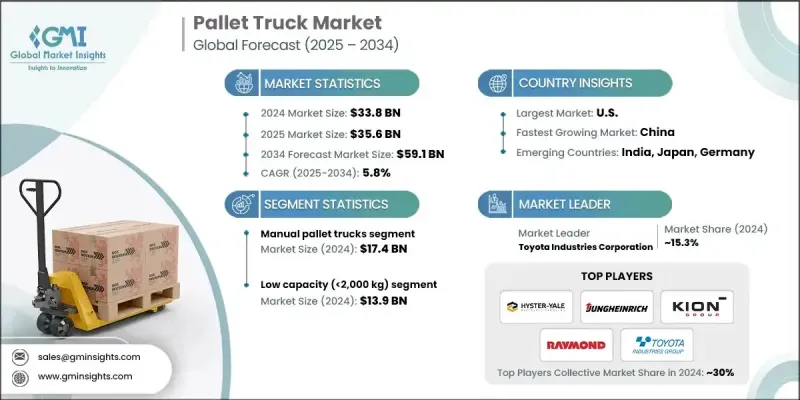
창고의 자동화 진전, 노동력 부족의 심각화, 자재관리 기술의 지속적인 진화를 배경으로 시장은 큰 변혁기를 맞이하고 있습니다. 수동식, 전동식, 무인운반차(AGV)를 포함한 팔레트 트럭은 세계 물류업무에 필수적인 존재가 되고 있습니다. 공급망 기업의 76%가 노동력 부족을 보고하는 동안 자동화는 전략적 필요가 되고 있습니다. 첨단 리튬 이온 배터리로의 전환은 이러한 변화를 가속화하고 있습니다. 기존의 에너지 시스템과 비교하여 높은 효율성, 긴 가동 수명, 보다 빠른 충전을 실현하고 있습니다. 제조업체 각사는 공급망의 탄력 강화를 위해 지역을 넘은 생산의 다양화를 추진하고 있습니다. 한편, 자동화 기술, 전지 시스템, 창고 관리 기술과의 통합에 있어서의 혁신을 통하여, 경쟁은 격화의 일도를 따라가고 있습니다. 유럽 기업은 에너지 효율과 환경 규제 준수를 주요 차별화 요인으로 중시하는 한편, 세계의 로봇 공학 및 자동화 분야의 리더 기업이 팔레트 트럭의 성능 기준에 점점 영향을 미치고 있습니다. 이러한 복합 요인은 고도로 역동적이고 기술 중심의 세계 자재관리 생태계를 형성합니다.
| 시장 범위 | |
|---|---|
| 시작 연도 | 2024년 |
| 예측 연도 | 2025-2034년 |
| 시작 금액 | 338억 달러 |
| 예측 금액 | 591억 달러 |
| CAGR | 5.8% |
수동 팔레트 트럭 부문은 2024년 174억 달러 시장 규모를 기록했으며 2025년부터 2034년까지 연평균 복합 성장률(CAGR) 5.1%를 보일 것으로 예측됩니다. 수동 모델은 합리적인 가격, 조작의 간편성 및 낮은 유지 보수 비용을 기반으로 시장을 계속 독점하고 있습니다. 특히 중소기업(SME)이나 예산이 한정된 사업자에게 선호되고 있습니다. 단순한 설계와 사용 편의성으로 운영자의 고급 교육이 필요 없으며 전반적인 운영 비용을 절감할 수 있습니다. 인건비가 낮은 지역에서 수동 팔레트 트럭은 자재 운반을 위한 효율적이고 경제적인 솔루션을 제공하며, 이는 업계와 상관없이 세계 수요 지속에 기여하고 있습니다.
2024년에는 최대 적재량 2,000kg 이하의 저용량 팔레트 트럭 부문이 139억 달러로 시장을 선도해 41.1%의 점유율을 획득했습니다. 이 부문의 이점은 소매점, 소규모 창고 및 경공업 시설에서 높은 보급률로 인한 것입니다. 이 트럭은 비용 효율적이고 컴팩트한 디자인으로 경량 수하물의 단거리 운송에 이상적입니다. 특히 공간이 한정된 중소기업이나 하역 요건이 낮은 기업에 있어서 실용적인 선택이 됩니다. 합리적인 가격과 조작의 간편함으로 유연성과 비용 효과를 중시하는 물류 및 제조 환경에서 범용성이 높은 선택지가 되고 있습니다.
미국 팔레트 트럭 시장은 2024년 79억 달러에 이르렀으며, 2025년부터 2034년까지 연평균 복합 성장률(CAGR) 5.9%로 확대될 전망입니다. 창고, 물류, EC 유통 네트워크의 급속한 확대에 따라 국내 수요가 가속화되고 있습니다. 완성 센터 및 보관 기지에서 효율적인 자재 이동 솔루션에 대한 필요성이 증가함에 따라 도입이 촉진됩니다. 팔레트 트럭은 대량 처리 업무에서 워크플로우 최적화, 작업자 안전성 향상, 생산성 향상에 필수적인 도구가 되고 있으며, 미국은 첨단 팔레트 핸들링 솔루션의 주요 시장 중 하나로 자리매김하고 있습니다.
세계 팔레트 트럭 시장의 주요 기업으로는 HU-LIFT, Toyota Industries Corporation, Jungheinrich AG, The Raymond Corporation, Hangcha, CUBLIFT, KION Group, Noblelift, Crown Equipment Corporation, Vestil Manufacturing Corp., Howard Handling, CLARK, Nantong Allman Industry, Anhui Heli, Hyster-Yale 등을 들 수 있습니다. 팔레트 트럭 시장의 주요 제조업체는 세계 경쟁력을 강화하기 위해 다양한 전략을 채택하고 있습니다. 많은 기업들이 자동화, 배터리 효율, 제품 내구성 향상을 위해 연구 개발에 많은 투자를 하고 있습니다. 지속가능하고 저배출 기기에 대한 수요 증가에 대응하기 위해 전기식 및 반전기식 팔레트 트럭의 제품 라인 확충에 주력하고 있습니다. 물류사업자나 전자상거래기업과의 전략적 제휴는 시장 확대에 기여하고 있습니다. 또한 공급망 위험을 최소화하고 납기 최적화를 위해 지역 생산 거점을 설립하고 있습니다.
자주 묻는 질문
목차
제1장 조사 방법과 범위
제2장 주요 요약
제3장 업계 인사이트
- 생태계 분석
- 공급자의 상황
- 이익률
- 각 단계에서의 부가가치
- 밸류체인에 영향을 주는 요인
- 혁신
- 업계에 미치는 영향요인
- 성장 촉진요인
- 업계의 잠재적 위험 및 과제
- 기회
- 성장 가능성 분석
- 가격 분석, 2024년년
- 지역별 및 제품 유형별
- 원재료 비용
- 장래 시장 동향
- 리스크 평가 및 경감책
- 규제 준수 위험
- 생산 능력 제약의 영향 분석
- 기술 전환 위험
- 가격 변동 위험과 비용 상승 위험
- Porter's Five Forces 분석
- PESTEL 분석
제4장 경쟁 구도
- 소개
- 기업의 시장 점유율 분석
- 지역별
- 기업 매트릭스 분석
- 주요 시장 기업의 경쟁 분석
- 경쟁 포지셔닝 매트릭스
- 주요 발전
- 인수합병
- 제휴 및 협업
- 신제품 발매
- 확대 계획
제5장 시장 추계 및 예측 : 제품 유형별, 2021-2034년
- 주요 동향
- 핸드 팔레트 트랙
- 보행식 팔레트 트럭
- 라이더식 팔레트 트럭
- 하이 리프트 팔레트 트랙
- 시저 리프트 팔레트 트랙
- 기타(스트래들 팔레트 트럭 등)
제6장 시장 추계 및 예측 : 운용 형태별, 2021-2034년
- 주요 동향
- 수동 팔레트 트럭
- 반전동 팔레트 트랙
- 전동 팔레트 트럭
제7장 시장 추계 및 예측 : 용량별, 2021-2034년
- 주요 동향
- 저용량(2,000 kg 미만)
- 중용량(2,000-4,000 kg)
- 고용량(4,000-6,000 kg)
- 초중량용량(6,000 kg 초과)
제8장 시장 추계 및 예측 : 용도별, 2021-2034년
- 주요 동향
- 창고 및 유통 센터
- 제조 시설
- 소매업 및 전자상거래 업무
- 운송 및 물류
- 기타(건설, 농업 등)
제9장 시장 추계 및 예측 : 유통 채널별, 2021-2034년
- 주요 동향
- 직접 판매
- 간접 판매
제10장 시장 추계 및 예측 : 지역별, 2021-2034년
- 주요 동향
- 북미
- 미국
- 캐나다
- 유럽
- 독일
- 영국
- 프랑스
- 이탈리아
- 스페인
- 네덜란드
- 아시아태평양
- 중국
- 인도
- 일본
- 한국
- 호주
- 라틴아메리카
- 브라질
- 멕시코
- 아르헨티나
- 중동 및 아프리카
- 아랍에미리트(UAE)
- 사우디아라비아
- 남아프리카
제11장 기업 프로파일
- Anhui Heli
- CLARK
- Crown Equipment Corporation
- CUBLIFT
- Hangcha
- Howard Handling
- HU-LIFT
- Hyster-Yale
- Jungheinrich AG
- KION Group
- Nantong Allman Industry
- Noblelift
- The Raymond Corporation
- Toyota Industries Corporation
- Vestil Manufacturing Corp.
The Global Pallet Truck Market was valued at USD 33.8 Billion in 2024 and is estimated to grow at a CAGR of 5.8% to reach USD 59.1 Billion by 2034.
The market is undergoing a major evolution fueled by the rise of warehouse automation, growing labor shortages, and continuous advancements in material handling technologies. Pallet trucks, including manual, electric, and automated guided vehicles (AGVs), are becoming indispensable in logistics operations worldwide. With 76% of supply chain organizations reporting workforce shortages, automation has become a strategic necessity. The shift toward advanced lithium-ion batteries has accelerated this transformation, offering higher efficiency, longer operational life, and faster charging compared to traditional energy systems. Manufacturers are diversifying production across regions to strengthen supply chain resilience, while competition continues to intensify through innovations in automation, battery systems, and integration with warehouse management technologies. European companies are emphasizing energy efficiency and environmental compliance as key differentiators, while global robotics and automation leaders are increasingly influencing pallet truck performance standards. These combined factors are shaping a highly dynamic and technology-driven global material handling ecosystem.
| Market Scope | |
|---|---|
| Start Year | 2024 |
| Forecast Year | 2025-2034 |
| Start Value | $33.8 Billion |
| Forecast Value | $59.1 Billion |
| CAGR | 5.8% |
The manual pallet truck segment generated USD 17.4 Billion in 2024 and is projected to grow at a CAGR of 5.1% between 2025 and 2034. Manual models continue to dominate the market based on their affordability, operational simplicity, and low maintenance costs. They are especially preferred by small and medium-sized enterprises (SMEs) and businesses operating with constrained budgets. Their uncomplicated design and ease of use eliminate the need for extensive operator training, reducing overall operational expenses. In regions with lower labor costs, manual pallet trucks provide an efficient and economical solution for material handling, which contributes to their sustained global demand across industries.
The low-capacity pallet truck segment, handling up to 2,000 kg, led the market in 2024 with USD 13.9 Billion and captured a 41.1% share. This segment's prominence is attributed to its strong adoption across retail spaces, small warehouses, and light industrial facilities. These trucks are cost-efficient, compact, and ideal for short-distance transport of lighter loads, making them especially practical for SMEs and enterprises with limited space or lower handling requirements. Their affordability and ease of operation make them a versatile choice in logistics and manufacturing environments that prioritize flexibility and cost-effectiveness.
U.S. Pallet Truck Market reached USD 7.9 Billion in 2024 and is projected to grow at a CAGR of 5.9% from 2025 to 2034. Demand in the country is accelerating due to the rapid expansion of warehousing, logistics, and e-commerce distribution networks. The increased need for efficient material movement solutions in fulfillment centers and storage hubs is driving adoption. Pallet trucks are becoming essential tools in optimizing workflows, enhancing worker safety, and improving productivity in high-volume operations, positioning the U.S. as one of the leading markets for advanced pallet handling solutions.
Key companies operating in the Global Pallet Truck Market include HU-LIFT, Toyota Industries Corporation, Jungheinrich AG, The Raymond Corporation, Hangcha, CUBLIFT, KION Group, Noblelift, Crown Equipment Corporation, Vestil Manufacturing Corp., Howard Handling, CLARK, Nantong Allman Industry, Anhui Heli, and Hyster-Yale. Leading manufacturers in the Pallet Truck Market are adopting diverse strategies to strengthen their competitive position globally. Many are investing heavily in research and development to enhance automation, battery efficiency, and product durability. Companies are focusing on expanding their electric and semi-electric pallet truck portfolios to meet growing demand for sustainable and low-emission equipment. Strategic alliances with logistics providers and e-commerce companies are helping to expand market reach. Firms are also establishing regional production hubs to minimize supply chain risks and optimize delivery timelines.
Table of Contents
Chapter 1 Methodology & Scope
- 1.1 Market scope and definition
- 1.2 Research design
- 1.2.1 Research approach
- 1.2.2 Data collection methods
- 1.3 Data mining sources
- 1.3.1 Global
- 1.3.2 Regional/Country
- 1.4 Base estimates and calculations
- 1.4.1 Base year calculation
- 1.4.2 Key trends for market estimation
- 1.5 Primary research and validation
- 1.5.1 Primary sources
- 1.6 Forecast model
- 1.7 Research assumptions and limitations
Chapter 2 Executive Summary
- 2.1 Industry 3600 synopsis
- 2.2 Key market trends
- 2.2.1 Product type trends
- 2.2.2 Mode of Operation trends
- 2.2.3 Capacity trends
- 2.2.4 Application trends
- 2.2.5 Distribution channel trends
- 2.2.6 Regional trends
- 2.3 CXO perspective: Strategic imperatives
- 2.3.1 Key decision points for industry executives
- 2.3.2 Critical success factors for market players
- 2.4 Future outlook and strategic recommendations
- 2.5 Strategic recommendations
- 2.5.1 Supply chain diversification strategy
- 2.5.2 Product portfolio enhancement
- 2.5.3 Partnership and alliance opportunities
- 2.5.4 Cost management and pricing strategy
- 2.6 Decision framework
- 2.6.1 Investment priority matrix
- 2.6.2 Risk-adjusted ROI analysis
Chapter 3 Industry Insights
- 3.1 Industry ecosystem analysis
- 3.1.1 Supplier Landscape
- 3.1.2 Profit Margin
- 3.1.3 Value addition at each stage
- 3.1.4 Factor affecting the value chain
- 3.1.5 Disruptions
- 3.2 Industry Impact forces
- 3.2.1 Growth drivers
- 3.2.2 Industry pitfalls & challenges
- 3.2.3 Opportunities
- 3.3 Growth potential analysis
- 3.4 Pricing analysis, 2024
- 3.4.1 By region and product type
- 3.4.2 Raw material cost
- 3.5 Future market trends
- 3.6 Risk assessment and mitigation
- 3.6.1 Regulatory compliance risks
- 3.6.2 Capacity constraint impact analysis
- 3.6.3 Technology transition risks
- 3.6.4 Pricing volatility and cost escalation risks
- 3.7 Porter's analysis
- 3.8 PESTEL analysis
Chapter 4 Competitive Landscape, 2024
- 4.1 Introduction
- 4.2 Company market share analysis
- 4.2.1 By Region
- 4.2.1.1 North America
- 4.2.1.2 Europe
- 4.2.1.3 Asia Pacific
- 4.2.1.4 Latin America
- 4.2.1.5 Middle East and Africa
- 4.2.1 By Region
- 4.3 Company matrix analysis
- 4.4 Competitive analysis of major market players
- 4.5 Competitive positioning matrix
- 4.6 Key developments
- 4.6.1 Mergers & acquisitions
- 4.6.2 Partnerships & collaborations
- 4.6.3 New Product Launches
- 4.6.4 Expansion Plans
Chapter 5 Market Estimates & Forecast, By Product Type, 2021 - 2034 (USD Billion) (Thousand Units)
- 5.1 Key trends
- 5.2 Hand Pallet Trucks
- 5.3 Walkie Pallet Trucks
- 5.4 Rider Pallet Trucks
- 5.5 High-Lift Pallet Trucks
- 5.6 Scissor Lift Pallet Trucks
- 5.7 Others (Straddle Pallet Trucks, etc.)
Chapter 6 Market Estimates & Forecast, By Mode of Operation, 2021 - 2034 (USD Billion) (Thousand Units)
- 6.1 Key trends
- 6.2 Manual Pallet Trucks
- 6.3 Semi-Electric Pallet Trucks
- 6.4 Electric Pallet Trucks
Chapter 7 Market Estimates & Forecast, By Capacity, 2021 - 2034 (USD Billion) (Thousand Units)
- 7.1 Key trends
- 7.2 Low Capacity (<2,000 kg)
- 7.3 Medium Capacity (2,000-4,000 kg)
- 7.4 High Capacity (4,000-6,000 kg)
- 7.5 Extra Heavy Capacity (>6,000 kg)
Chapter 8 Market Estimates & Forecast, By Application, 2021 - 2034 (USD Billion) (Thousand Units)
- 8.1 Key trends
- 8.2 Warehousing and Distribution Centers
- 8.3 Manufacturing Facilities
- 8.4 Retail and E-commerce Operations
- 8.5 Transportation and Logistics
- 8.6 Others (Construction, Agriculture, etc.)
Chapter 9 Market Estimates & Forecast, By Distribution Channel, 2021 - 2034, (USD Billion) (Thousand Units)
- 9.1 Key trends
- 9.2 Direct sales
- 9.3 Indirect sales
Chapter 10 Market Estimates & Forecast, By Region, 2021 - 2034, (USD Billion) (Thousand Units)
- 10.1 Key trends
- 10.2 North America
- 10.2.1 U.S.
- 10.2.2 Canada
- 10.3 Europe
- 10.3.1 Germany
- 10.3.2 U.K.
- 10.3.3 France
- 10.3.4 Italy
- 10.3.5 Spain
- 10.3.6 Netherlands
- 10.4 Asia Pacific
- 10.4.1 China
- 10.4.2 India
- 10.4.3 Japan
- 10.4.4 South Korea
- 10.4.5 Australia
- 10.5 Latin America
- 10.5.1 Brazil
- 10.5.2 Mexico
- 10.5.3 Argentina
- 10.6 MEA
- 10.6.1 UAE
- 10.6.2 Saudi Arabia
- 10.6.3 South Africa
Chapter 11 Company Profiles (Business Overview, Financial Data, Product Landscape, Strategic Outlook, SWOT Analysis)
- 11.1 Anhui Heli
- 11.2 CLARK
- 11.3 Crown Equipment Corporation
- 11.4 CUBLIFT
- 11.5 Hangcha
- 11.6 Howard Handling
- 11.7 HU-LIFT
- 11.8 Hyster-Yale
- 11.9 Jungheinrich AG
- 11.10 KION Group
- 11.11 Nantong Allman Industry
- 11.12 Noblelift
- 11.13 The Raymond Corporation
- 11.14 Toyota Industries Corporation
- 11.15 Vestil Manufacturing Corp.