

|
시장보고서
상품코드
1871203
순환형 양식 시스템 시장 : 기회, 성장 요인, 업계 동향 분석 및 예측(2025-2034년)Recirculating Aquaculture System Market Opportunity, Growth Drivers, Industry Trend Analysis, and Forecast 2025 - 2034 |
||||||

세계의 순환형 양식 시스템 시장은 2024년 34억 달러로 평가되었으며, 2034년까지 연평균 복합 성장률(CAGR) 9.4%로 성장하여 82억 달러에 이를 것으로 예측됩니다.
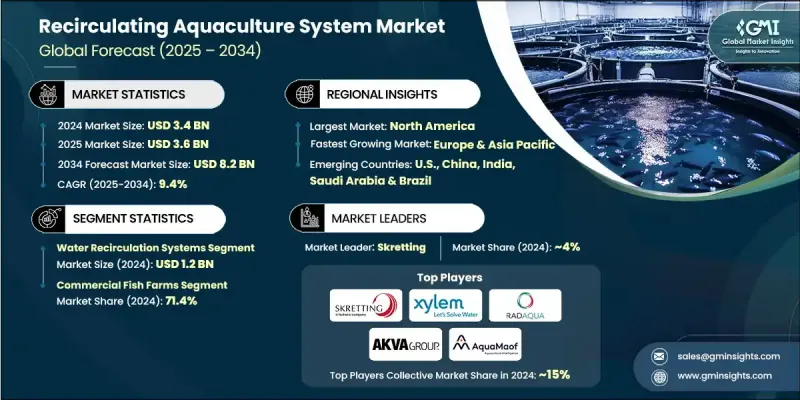
이러한 견조한 시장 성장은 지속가능하고 친환경적인 양식 기법에 대한 세계적 관심 증가로 이어지고 있습니다. 기존의 양식 사업은 수질 오염, 생태계의 열화, 질병 발생 등의 과제의 심각화에 직면하고 있으며, 보다 청결하고 관리된 수법으로의 이행이 촉진되고 있습니다. RAS 기술은 물 소비량 감소, 자원 재활용 및 폐기물 배출 최소화를 실현하면서 수산 생물의 최적 성장 환경을 유지함으로써 이러한 우려에 대응합니다. 세계 각국의 정부 및 환경 당국은 지속 가능한 양식 시스템의 도입을 촉진하기 위해 엄격한 규제의 도입과 우대 조치의 제공을 진행하고 있습니다. 인구 증가, 도시화, 오메가 3 지방산을 풍부하게 포함한 고단백 식품에 대한 수요 증가에 추진된 수산물 소비량 증가는 효율적인 생산 시스템의 필요성을 더욱 강화하고 있습니다. 환경 의식이 증가하고 혁신이 진행됨에 따라 RAS는 양식업의 장기적인 지속가능성과 식량 안보를 보장하기위한 유력한 해결책 중 하나가되었습니다.
| 시장 범위 | |
|---|---|
| 시작 연도 | 2024년 |
| 예측 연도 | 2025-2034년 |
| 시작 금액 | 34억 달러 |
| 예측 금액 | 82억 달러 |
| CAGR | 9.4% |
물 순환 시스템 부문은 2024년 12억 달러 규모였고, 2025년부터 2034년까지 CAGR 9.1%를 보일 것으로 예측됩니다. 이러한 시스템은 지속적인 물의 재사용을 가능하게 함으로써 순환형 양식 시스템에 있어서 중요한 역할을 하고, 담수 자원에 대한 의존도를 대폭 저감함과 동시에 생태계에의 부하를 억제합니다. 산소농도, 수온, pH값을 조정하여 폐기물이나 오염물질을 효과적으로 제거함으로써 안정된 수질 파라미터의 유지에 기여합니다. 이러한 환경 조건의 지속적인 관리는 물고기 성장 촉진, 생존율 향상, 질병 발생 위험의 감소를 지원하고, 물 순환 시스템을 현대적인 양식 인프라의 기반으로 하고 있습니다.
상업 양식 부문은 71.4%의 점유율을 차지해 2025년부터 2034년까지 CAGR 9.2%를 보일 것으로 예측됩니다. 천연 생선 자원의 감소와 세계적인 환경 기준의 강화에 따라 생산 효율성과 지속가능성의 향상이 이 분야에 강력하게 요구되고 있습니다. RAS 기술을 통해 대규모 사업자는 폐쇄된 고도로 관리되는 환경에서 어류를 사육할 수 있어 송어, 연어, 새우 등의 고부가가치 종을 연간 생산할 수 있습니다. 이 방법은 안정적인 수율, 바이오 보안 향상, 개방 수역 자원에 대한 의존도 감소를 실현하여 상업 양식장이 생태계에 대한 적합성을 유지하면서 수익성을 높일 수 있습니다.
미국의 순환형 양식 시스템 시장은 2024년 9억 7,000만 달러 규모에 이르렀습니다. 이 나라는 첨단 모니터링 기술, IoT 대응 제어 시스템, 고효율 수처리 기술의 급속한 도입에 힘입어 육상 양식에서 혁신의 주요 거점으로 계속되고 있습니다. 고급 어종용 RAS 시설에 대한 적극적인 투자가 국내 생산을 촉진하여 수입 수산물에 대한 의존도를 저하시키고 있습니다. 엄격한 환경 정책과 지속가능성 기준의 도입은 생산자에게 순환 시스템의 채용을 더욱 촉진하고 생태계 관리와 사업 수익성을 양립시키고 있습니다.
세계의 순환형 양식 시스템 시장에서 주요 기업로서 PR Aqua, Billund Aquaculture, Clewer Aquaculture, Xylem, FRD Japan, Blue Planet Ecosystems, AquaMaof, AKVA Group, Nofitech, Eyvi, RADAQUA, Hesy Aquaculture, Aquacare Environment, Qingdao Haixing, Skretting 등을 들 수 있습니다. 순환형 양식시스템 시장에서 사업을 전개하는 기업은 기술 혁신, 전략적 제휴, 생산능력 확대에 주력하여 세계 시장에서의 지위 강화를 도모하고 있습니다. 주요 기업은 운영 관리 및 수질 관리를 향상시키기 위해 자동화, 스마트 센서, AI 구동 모니터링 시스템에 많은 투자를 하고 있습니다. 양식생산자나 연구기관과의 제휴에 의해 RAS 설계의 에너지 효율과 지속가능성의 향상을 도모하고 있습니다. 또한 상업용 및 조사용 용도를 횡단하는 확장 가능한 설치를 지원하는 모듈식 시스템을 통합함으로써 제품 포트폴리오의 다양화도 진행하고 있습니다.
자주 묻는 질문
목차
제1장 조사 방법과 범위
제2장 주요 요약
제3장 업계 인사이트
- 생태계 분석
- 공급자의 상황
- 이익률
- 각 단계에서의 부가가치
- 밸류체인에 영향을 주는 요인
- 업계에 미치는 영향요인
- 성장 촉진요인
- 지속 가능한 양식업에 대한 수요 증가
- 세계 수산물 소비량 증가
- 수처리에 있어서의 기술적 진보
- 업계의 잠재적 위험 및 과제
- 높은 초기 자본 투자액
- 복잡한 시스템 설계 및 운영
- 성장 촉진요인
- 성장 가능성 분석
- 장래 시장 동향
- 기술과 혁신의 상황
- 현재의 기술 동향
- 신흥기술
- 가격 동향
- 지역별
- 컴포넌트별
- 규제 상황
- 규격 및 컴플라이언스 요건
- 지역별 규제 프레임워크
- 인증기준
- 무역 통계
- 주요 수입국
- 주요 수출국
- Porter's Five Forces 분석
- PESTEL 분석
제4장 경쟁 구도
- 소개
- 기업의 시장 점유율 분석
- 지역별
- 북미
- 유럽
- 아시아태평양
- 라틴아메리카
- 중동 및 아프리카
- 지역별
- 기업 매트릭스 분석
- 주요 시장 기업의 경쟁 분석
- 경쟁 포지셔닝 매트릭스
- 주요 발전
- 인수합병
- 제휴 및 협업
- 신제품 발매
- 사업 확대 계획
제5장 시장 추계 및 예측 : 컴포넌트별, 2021-2034년
- 주요 동향
- 물 순환 시스템
- 바이오 여과 장치
- 산소 공급 시스템
- 냉난방 시스템
- 감시 및 제어 시스템
- 설비(탱크, 펌프, 에어레이터 등)
- 소프트웨어(실시간 감시, 분석)
- 서비스(컨설팅, 유지보수, 트레이닝)
제6장 시장 추계 및 예측 : 시스템 유형별, 2021-2034년
- 주요 동향
- 실내식 RAS
- 옥외형 RAS
- 모듈식 RAS
- 컨테이너형 RAS
- 담수 순환형 양식 시스템(RAS)
- 해수 순환형 양식 시스템(RAS)
- 하이브리드 RAS
- 통합 시스템
- 전용 시스템
제7장 시장 추계 및 예측 : 사업 규모별, 2021-2034년
- 주요 동향
- 소규모 시스템
- 중규모 시스템
- 대규모 시스템
제8장 시장 추계 및 예측 : 종별, 2021-2034년
- 주요 동향
- 어류(연어, 송어, 틸라피아, 메기, 농어)
- 갑각류(새우, 랍스터)
- 기타
제9장 시장 추계 및 예측 : 용도별, 2021-2034년
- 주요 동향
- 상업 양식
- 양식업
- 조개 양식
- 연체동물 양식
- 수생식물 재배
- 연구개발
- 실험적 양식
- 도시형 양식
- 종의 보전
제10장 시장 추계 및 예측 : 최종 용도별, 2021-2034년
- 주요 동향
- 상업 양식장
- 연구기관
- 교육기관
- 수족관 시설
- 학술기관
제11장 시장 추계 및 예측 : 유통 채널별, 2021-2034년
- 주요 동향
- 직접 판매
- 간접 판매
제12장 시장 추계 및 예측 : 지역별, 2021-2034년
- 주요 동향
- 북미
- 미국
- 캐나다
- 유럽
- 독일
- 영국
- 프랑스
- 이탈리아
- 스페인
- 아시아태평양
- 중국
- 인도
- 일본
- 한국
- 호주
- 인도네시아
- 말레이시아
- 라틴아메리카
- 브라질
- 멕시코
- 아르헨티나
- 중동 및 아프리카
- 사우디아라비아
- 아랍에미리트(UAE)
- 남아프리카
제13장 기업 프로파일
- AKVA Group
- Aquacare Environment
- AquaMaof
- Billund Aquaculture
- Blue Planet Ecosystems
- Clewer Aquaculture
- Eyvi
- FRD Japan
- Hesy Aquaculture
- Nofitech
- PR Aqua
- Qingdao Haixing
- RADAQUA
- Skretting
- Xylem
The Global Recirculating Aquaculture System Market was valued at USD 3.4 Billion in 2024 and is estimated to grow at a CAGR of 9.4% to reach USD 8.2 Billion by 2034.
The strong market growth is driven by the increasing global emphasis on sustainable and environmentally responsible aquaculture practices. Conventional aquaculture operations are facing escalating challenges such as water pollution, ecosystem degradation, and disease outbreaks, prompting a transition toward cleaner and more controlled methods. RAS technology addresses these concerns by reducing water consumption, recycling resources, and minimizing waste discharge while maintaining optimal growth conditions for aquatic species. Governments and environmental authorities across the globe are introducing strict regulations and offering incentives to encourage the adoption of sustainable aquaculture systems. Rising seafood consumption, fueled by population growth, urbanization, and the demand for high-protein diets rich in omega-3 fatty acids, continues to reinforce the need for efficient production systems. As environmental awareness strengthens and technological innovation advances, RAS has become one of the preferred solutions for ensuring long-term aquaculture sustainability and food security.
| Market Scope | |
|---|---|
| Start Year | 2024 |
| Forecast Year | 2025-2034 |
| Start Value | $3.4 billion |
| Forecast Value | $8.2 billion |
| CAGR | 9.4% |
The water recirculation systems segment is USD 1.2 Billion in 2024 and is forecasted to register a CAGR of 9.1% between 2025 and 2034. These systems play a crucial role within RAS by facilitating continuous water reuse, which significantly reduces the dependency on freshwater resources and limits the ecological footprint. They help maintain stable water parameters by regulating oxygen concentration, temperature, and pH levels while effectively removing waste and contaminants. This consistent control of environmental conditions supports faster fish growth, enhances survival rates, and reduces the risk of disease outbreaks, making water recirculation systems a cornerstone of modern aquaculture infrastructure.
The commercial fish farms segment held a 71.4% share and is projected to grow at a CAGR of 9.2% from 2025 to 2034. The sector is under mounting pressure to improve production efficiency and sustainability as natural fish stocks decline, and environmental standards tighten worldwide. RAS technology enables large-scale operators to rear fish in closed, highly controlled environments, offering year-round production of high-value species such as trout, salmon, and shrimp. The method ensures consistent yield, improved biosecurity, and reduced reliance on open water resources, allowing commercial farms to enhance profitability while maintaining ecological compliance.
U.S. Recirculating Aquaculture System Market generated USD 970 million in 2024. The country remains a key hub for innovation in land-based aquaculture, supported by rapid integration of advanced monitoring, IoT-enabled control systems, and high-efficiency water treatment technologies. Strong investments in RAS facilities for premium fish species are driving domestic production and reducing dependence on imported seafood. The implementation of strict environmental policies and sustainability standards has further encouraged producers to adopt recirculating systems, aligning ecological stewardship with operational profitability.
Key players operating in the Global Recirculating Aquaculture System Market include PR Aqua, Billund Aquaculture, Clewer Aquaculture, Xylem, FRD Japan, Blue Planet Ecosystems, AquaMaof, AKVA Group, Nofitech, Eyvi, RADAQUA, Hesy Aquaculture, Aquacare Environment, Qingdao Haixing, and Skretting. Companies operating in the Recirculating Aquaculture System Market are focusing on technological advancement, strategic collaboration, and capacity expansion to strengthen their global market position. Leading firms are investing heavily in automation, smart sensors, and AI-driven monitoring systems to enhance operational control and water quality management. Partnerships with aquaculture producers and research institutions are being formed to improve energy efficiency and sustainability in RAS designs. Companies are also diversifying their product portfolios by integrating modular systems that support scalable installations across commercial and research applications.
Table of Contents
Chapter 1 Methodology & Scope
- 1.1 Market scope and definition
- 1.2 Research design
- 1.2.1 Research approach
- 1.2.2 Data collection methods
- 1.3 Data mining sources
- 1.3.1 Global
- 1.3.2 Regional/Country
- 1.4 Base estimates and calculations
- 1.4.1 Base year calculation
- 1.4.2 Key trends for market estimation
- 1.5 Primary research and validation
- 1.5.1 Primary sources
- 1.6 Forecast model
- 1.7 Research assumptions and limitations
Chapter 2 Executive Summary
- 2.1 Industry 360° synopsis
- 2.2 Key market trends
- 2.2.1 Regional
- 2.2.2 Component
- 2.2.3 System type
- 2.2.4 Scale of operation
- 2.2.5 Application
- 2.2.6 Species
- 2.2.7 End use
- 2.2.8 Distribution channel
- 2.3 CXO perspectives: Strategic imperatives
- 2.3.1 Key decision points for industry executives
- 2.3.2 Critical success factors for market players
- 2.4 Future outlook and strategic recommendations
Chapter 3 Industry Insights
- 3.1 Industry ecosystem analysis
- 3.1.1 Supplier landscape
- 3.1.2 Profit margin
- 3.1.3 Value addition at each stage
- 3.1.4 Factor affecting the value chain
- 3.2 Industry impact forces
- 3.2.1 Growth drivers
- 3.2.1.1 Rising demand for sustainable aquaculture
- 3.2.1.2 Increasing global seafood consumption
- 3.2.1.3 Technological advancements in water treatment
- 3.2.2 Industry pitfalls & challenges
- 3.2.2.1 High initial capital investment
- 3.2.2.2 Complex system design and operation
- 3.2.1 Growth drivers
- 3.3 Growth potential analysis
- 3.4 Future market trends
- 3.5 Technology and innovation landscape
- 3.5.1 Current technological trends
- 3.5.2 Emerging technologies
- 3.6 Price trends
- 3.6.1 By region
- 3.6.2 By Component
- 3.7 Regulatory landscape
- 3.7.1 Standards and compliance requirements
- 3.7.2 Regional regulatory frameworks
- 3.7.3 Certification standards
- 3.8 Trade statistics
- 3.8.1 Major importing countries
- 3.8.2 Major exporting countries
- 3.9 Porter's analysis
- 3.10 PESTEL analysis
Chapter 4 Competitive Landscape, 2024
- 4.1 Introduction
- 4.2 Company market share analysis
- 4.2.1 By Region
- 4.2.1.1 North America
- 4.2.1.2 Europe
- 4.2.1.3 Asia Pacific
- 4.2.1.4 Latin America
- 4.2.1.5 Middle East & Africa
- 4.2.1 By Region
- 4.3 Company matrix analysis
- 4.4 Competitive analysis of major market players
- 4.5 Competitive positioning matrix
- 4.6 Key developments
- 4.6.1 Mergers & acquisitions
- 4.6.2 Partnerships & collaborations
- 4.6.3 New product launches
- 4.6.4 Expansion plans
Chapter 5 Market Estimates & Forecast, By Component, 2021 - 2034, (USD Billion) (Thousand Units)
- 5.1 Key trends
- 5.2 Water recirculation systems
- 5.3 Biofiltration units
- 5.4 Oxygenation systems
- 5.5 Heating and cooling systems
- 5.6 Monitoring and control systems
- 5.7 Equipment (tanks, pumps, aerators, etc.)
- 5.8 Software (real-time monitoring, analytics)
- 5.9 Services (consulting, maintenance, training)
Chapter 6 Market Estimates & Forecast, By System Type, 2021 - 2034, (USD Billion) (Thousand Units)
- 6.1 Key trends
- 6.2 Indoor RAS
- 6.3 Outdoor RAS
- 6.4 Modular RAS
- 6.5 Containerized RAS
- 6.6 Freshwater RAS
- 6.7 Saltwater RAS
- 6.8 Hybrid RAS
- 6.9 Integrated systems
- 6.10 Specialized systems
Chapter 7 Market Estimates & Forecast, By Scale of Operation, 2021 - 2034, (USD Billion) (Thousand Units)
- 7.1 Key trends
- 7.2 Small scale systems
- 7.3 Medium scale systems
- 7.4 Large scale systems
Chapter 8 Market Estimates & Forecast, By Species, 2021 - 2034, (USD Billion) (Thousand Units)
- 8.1 Key trends
- 8.2 Finfish (salmon, trout, tilapia, catfish, sea bass)
- 8.3 Shellfish (shrimp, lobster)
- 8.4 Others
Chapter 9 Market Estimates & Forecast, By Application, 2021 - 2034, (USD Billion) (Thousand Units)
- 9.1 Key trends
- 9.2 Commercial aquaculture
- 9.3 Fish farming
- 9.4 Shellfish farming
- 9.5 Mollusk farming
- 9.6 Aquatic plant farming
- 9.7 Research & development
- 9.8 Experimental aquaculture
- 9.9 Urban aquaculture
- 9.10 Species conservation
Chapter 10 Market Estimates & Forecast, By End use, 2021 - 2034, (USD Billion) (Thousand Units)
- 10.1 Key trends
- 10.2 Commercial fish farms
- 10.3 Research institutes
- 10.4 Educational institutes
- 10.5 Aquarium facilities
- 10.6 Academic institutions
Chapter 11 Market Estimates & Forecast, By Distribution Channel, 2021 - 2034,(USD Billion) (Thousand Units)
- 11.1 Key trends
- 11.2 Direct sales
- 11.3 Indirect sales
Chapter 12 Market Estimates & Forecast, By Region, 2021 - 2034, (USD Billion) (Thousand Units)
- 12.1 Key trends
- 12.2 North America
- 12.2.1 U.S.
- 12.2.2 Canada
- 12.3 Europe
- 12.3.1 Germany
- 12.3.2 UK
- 12.3.3 France
- 12.3.4 Italy
- 12.3.5 Spain
- 12.4 Asia Pacific
- 12.4.1 China
- 12.4.2 India
- 12.4.3 Japan
- 12.4.4 South Korea
- 12.4.5 Australia
- 12.4.6 Indonesia
- 12.4.7 Malaysia
- 12.5 Latin America
- 12.5.1 Brazil
- 12.5.2 Mexico
- 12.5.3 Argentina
- 12.6 MEA
- 12.6.1 Saudi Arabia
- 12.6.2 UAE
- 12.6.3 South Africa
Chapter 13 Company Profiles
- 13.1 AKVA Group
- 13.2 Aquacare Environment
- 13.3 AquaMaof
- 13.4 Billund Aquaculture
- 13.5 Blue Planet Ecosystems
- 13.6 Clewer Aquaculture
- 13.7 Eyvi
- 13.8 FRD Japan
- 13.9 Hesy Aquaculture
- 13.10 Nofitech
- 13.11 PR Aqua
- 13.12 Qingdao Haixing
- 13.13 RADAQUA
- 13.14 Skretting
- 13.15 Xylem


