|
시장보고서
상품코드
1871215
종양학 바이오의약품 시장 : 기회, 성장 요인, 업계 동향 분석 및 예측(2025-2034년)Oncology Biopharmaceuticals Market Opportunity, Growth Drivers, Industry Trend Analysis, and Forecast 2025 - 2034 |
||||||

세계의 종양학 바이오의약품 시장은 2024년 1,306억 달러로 평가되었고, 2034년까지 연평균 복합 성장률(CAGR) 7.5%로 성장해 2,683억 달러에 이를 것으로 예측되고 있습니다.

세계적인 암 발생률 증가와 개별화 및 표적 치료 솔루션에 대한 수요 증가를 배경으로 시장은 변혁기를 맞이하고 있습니다. 차세대 시퀀싱 기술, 면역요법, AI를 활용한 신약개발에서의 지속적인 기술 혁신이, 암의 치료법과 검출 방법을 변혁하고 있습니다. 지난 1년간, 새로운 치료법의 혁신과 고급 바이오의약품에 대한 접근성 개선으로 혈액 및 고형 종양 모두에서 치료 기준이 재정의되었습니다. 정밀 종양학 기술은 조기 진단을 향상시키고 치료의 개별화를 통해 환자의 생존율 향상에 공헌하고 있습니다. 시장 확대는 유리한 정부 프로그램, 건강 관리 투자 증가, 진화하는 규제 경로에 의해 지원됩니다. 종양학 바이오의약품 분야는 각 환자의 분자 프로파일에 따른 치료의 맞춤화를 통해 정밀의료로의 전환을 주도하고 있습니다. 바이오의약품이나 면역요법의 진보, 그리고 세계적으로 보다 효과적인 암 관리가 긴급하게 필요한 가운데, 정밀의료에 근거한 진료 실천의 보급 확대가, 이 업계의 성장을 한층 더 추진하고 있습니다.
| 시장 범위 | |
|---|---|
| 시작 연도 | 2024년 |
| 예측 기간 | 2025-2034년 |
| 시작 금액 | 1,306억 달러 |
| 예측 금액 | 2,683억 달러 |
| CAGR | 7.5% |
단클론항체 부문은 2024년 37.6%의 점유율을 차지했으며, 2034년까지 960억 달러에 이르고, CAGR 7%를 보일 것으로 예측됩니다. 단클론항체는 암세포에 발현하는 특유의 항원에 결합하는 고특이성의 생물학적 제제이며, 현대 종양학의 기반을 이어가고 있습니다. 이러한 표적 요법은 종양 세포를 직접 공격하고, 종양 증식 신호를 차단하고, 면역 활성을 자극하여 암 조직을 제거함으로써 작용합니다. 기존의 화학요법에 비해, 단일클론항체는 보다 양호한 안전성 프로파일을 제공하고, 표적외 효과를 최소화하고, 치료의 정확성을 향상시킵니다.
폐암 치료 분야는 2024년 375억 달러 시장 규모를 기록했습니다. 폐암은 여전히 세계에서 가장 치사율이 높은 암이며, 비소세포 폐암(NSCLC)이 전 증례의 약 85%를 차지하고 있습니다. 정밀의료 및 면역 종양학을 기반으로 한 치료법의 보급으로 시장은 큰 변화를 경험하고 있습니다. 특정 유전자 및 분자 표적에 초점을 맞춘 현대 치료 기술의 발전은 환자의 예후와 치료 성공률을 현저하게 향상시키고 있습니다.
미국의 종양학 바이오의약품 시장은 2024년 519억 달러에 달했습니다. 인공지능(AI)의 기술 진보는 암 진단에 혁명을 가져다 차세대 항암제의 개발을 가속시키고 있습니다. 그러나 이러한 첨단 치료에 대한 접근 격차는 특히 사회적 약자층에서 여전히 해결해야 할 과제로 남아 있습니다. 미국에서는 바이오시밀러와 맞춤형 치료의 추진에 계속 꾸준한 진전이 보이고 있으며, 세포요법과 면역요법의 비용효과 향상과 환자 접근 확대를 목적으로 한 강력한 투자가 이루어지고 있습니다.
종양학 바이오의약품 시장의 주요 기업으로는 AbbVie, Amgen, AstraZeneca, Bayer, Biogen, Bristol-Myers Squibb, Eli Lilly, F. Hoffmann-La Roche, GlaxoSmithKline, Johnson & Johnson, Merck, Novartis, Pfizer, Sanofi, Takeda Pharmaceutical, Sandoz, Biocon, Celltrion, Adaptimmune, Legend Biotech, Arcellx 등이 포함됩니다. 세계 종양헉 바이오의약품 시장에서의 지위를 강화하기 위해 주요 기업은 전략적 제휴, 합병, 인수에 주력하여 종양 파이프라인의 확충과 의약품 개발의 가속을 도모하고 있습니다. 기업은 바이오테크놀러지의 혁신기업과의 연구 제휴를 확대하여 표적형 생물제제 및 면역요법의 공동개발을 추진하고 있습니다. 정밀의료의 능력 강화를 위해 AI, 유전체학, 분자 프로파일링 등의 첨단 기술에 대한 투자가 우선되고 있습니다. 또한 제품 승인을 가속화하고 지리적 범위를 확대하기 위해 규제 정합을 위해 노력하고 있습니다.
자주 묻는 질문
목차
제1장 조사 방법과 범위
제2장 주요 요약
제3장 업계 인사이트
- 생태계 분석
- 공급자의 상황
- 각 단계에서의 부가가치
- 밸류체인에 영향을 주는 요인
- 업계에 미치는 영향요인
- 성장 촉진요인
- 세계의 암 발생률의 상승과 고령화
- 면역요법 및 표적 생물학적 제형의 진보
- 바이오마커 구동형 및 정밀 종양학의 확대
- 신속 승인에 대한 규제 지원 강화
- 업계의 잠재적 위험 및 과제
- 생물학적 제제의 고비용과 저소득 지역에서의 한정된 가격 합리성
- 복잡한 제조 및 공급망 물류
- 시장 기회
- 종양 비의존형 및 범암 치료법의 확대
- 디지털 헬스 및 원격 모니터링 툴의 도입 확대
- 성장 촉진요인
- 성장 가능성 분석
- 규제 상황
- 북미
- 미국
- 캐나다
- 유럽
- 아시아태평양
- 라틴아메리카
- 중동 및 아프리카
- 북미
- 기술 상황
- 현재의 기술 동향
- 신흥기술
- 장래 시장 동향
- 파이프라인 분석
- Porter's Five Forces 분석
- PESTEL 분석
제4장 경쟁 구도
- 소개
- 기업의 시장 점유율 분석
- 세계
- 북미
- 유럽
- 기업 매트릭스 분석
- 주요 시장 기업의 경쟁 분석
- 경쟁 포지셔닝 매트릭스
- 주요 발전
- 인수합병
- 제휴 및 협력 관계
- 신제품 발매
- 확대 계획
제5장 시장 추계 및 예측 : 제품 유형별, 2021-2034년
- 주요 동향
- 단클론항체
- 면역관문억제제
- 세포 및 유전자 치료
- 항체 약물 복합체(ADC)
- 암 백신
- 기타 제품 유형
제6장 시장 추계 및 예측 : 암종별, 2021-2034년
- 주요 동향
- 폐암
- 유방암
- 대장암
- 전립선암
- 백혈병 및 림프종
- 악성 흑색종
- 난소암 및 자궁경부암
- 기타 암종
제7장 시장 추계 및 예측 : 투여 경로별, 2021-2034년
- 주요 동향
- 경구 투여
- 비경구 투여
- 기타 투여 경로
제8장 시장 추계 및 예측 : 약제 유형별, 2021-2034년
- 주요 동향
- 독자 개발품(브랜드품)
- 바이오시밀러
제9장 시장 추계 및 예측 : 유통 채널별, 2021-2034년
- 주요 동향
- 병원 약국
- 약국 및 소매 약국
- 온라인 약국
제10장 시장 추계 및 예측 : 지역별, 2021-2034년
- 주요 동향
- 북미
- 미국
- 캐나다
- 유럽
- 독일
- 영국
- 프랑스
- 스페인
- 이탈리아
- 네덜란드
- 아시아태평양
- 중국
- 인도
- 일본
- 호주
- 한국
- 라틴아메리카
- 브라질
- 멕시코
- 아르헨티나
- 중동 및 아프리카
- 남아프리카
- 사우디아라비아
- 아랍에미리트(UAE)
제11장 기업 프로파일
- AbbVie
- Amgen
- AstraZeneca
- Bayer
- Biogen
- Bristol-Myers Squibb
- Eli Lilly
- F. Hoffmann-La Roche
- GlaxoSmithKline
- Johnson & Johnson
- Merck
- Novartis
- Pfizer
- Sanofi
- Takeda Pharmaceutical
- Sandoz
- Biocon
- Celltrion
- Adaptimmune
- Legend Biotech
- Arcellx
The Global Oncology Biopharmaceuticals Market was valued at USD 130.6 Billion in 2024 and is estimated to grow at a CAGR of 7.5% to reach USD 268.3 Billion by 2034.
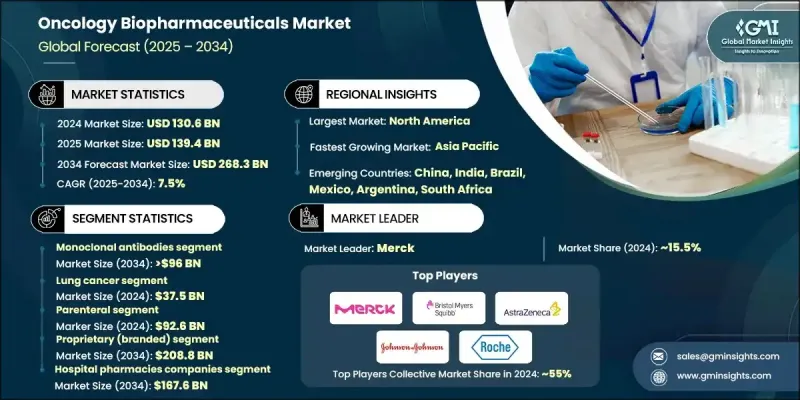
The market is witnessing a transformative phase driven by the growing worldwide incidence of cancer and the rising need for personalized and targeted treatment solutions. Continuous breakthroughs in next-generation sequencing, immunotherapy, and AI-powered drug development are reshaping how cancer is treated and detected. Over the past year, new treatment innovations and improved access to advanced biologics have redefined therapeutic standards for both hematologic and solid tumors. Precision oncology technologies are enhancing early diagnosis and individualizing treatments to improve patient survival. Market expansion is supported by favorable government programs, higher healthcare investments, and evolving regulatory pathways. The oncology biopharmaceuticals sector continues to lead the shift toward precision medicine by customizing therapies according to each patient's molecular profile. The industry's growth is further supported by advancements in biologics, immunotherapies, and the increasing adoption of precision-based medical practices to address the urgent need for more effective cancer management worldwide.
| Market Scope | |
|---|---|
| Start Year | 2024 |
| Forecast Year | 2025-2034 |
| Start Value | $130.6 Billion |
| Forecast Value | $268.3 Billion |
| CAGR | 7.5% |
The monoclonal antibodies segment held a 37.6% share in 2024 and is anticipated to reach USD 96 Billion by 2034, growing at a CAGR of 7%. Monoclonal antibodies remain a cornerstone of contemporary oncology, as they are highly specific biologic agents that bind to unique antigens expressed on cancer cells. These targeted therapies work by directly attacking tumor cells, interrupting tumor growth signaling, and stimulating immune activity to eliminate cancerous tissues. Compared to conventional chemotherapy, monoclonal antibodies offer a more favorable safety profile, minimizing off-target effects and enhancing treatment precision.
The lung cancer application segment generated USD 37.5 Billion in 2024. Lung cancer remains the most fatal cancer type globally, with non-small cell lung cancer (NSCLC) accounting for nearly 85% of all cases. The market has experienced a major transformation due to the growing availability of precision-based and immuno-oncology treatments. Modern therapeutic advancements focused on specific genetic and molecular targets have significantly improved patient outcomes and treatment success rates.
U.S. Oncology Biopharmaceuticals Market reached USD 51.9 Billion in 2024. Technological progress in artificial intelligence is revolutionizing cancer diagnostics and accelerating the development of next-generation oncology drugs. However, unequal access to these advanced treatments remains a persistent challenge, particularly among underrepresented groups. The U.S. continues to make strides in advancing biosimilars and personalized therapies, with strong investments aimed at improving affordability and enhancing patient access to cell-based and immune therapies.
Key participants in the Oncology Biopharmaceuticals Market include AbbVie, Amgen, AstraZeneca, Bayer, Biogen, Bristol-Myers Squibb, Eli Lilly, F. Hoffmann-La Roche, GlaxoSmithKline, Johnson & Johnson, Merck, Novartis, Pfizer, Sanofi, Takeda Pharmaceutical, Sandoz, Biocon, Celltrion, Adaptimmune, Legend Biotech, and Arcellx. To reinforce their position in the Global Oncology Biopharmaceuticals Market, major companies are focusing on strategic collaborations, mergers, and acquisitions to broaden their oncology pipelines and accelerate drug development. Firms are expanding their research partnerships with biotech innovators to co-develop targeted biologics and immunotherapies. Investment in advanced technologies such as AI, genomics, and molecular profiling is being prioritized to strengthen precision medicine capabilities. Companies are also working toward regulatory alignment to speed up product approvals and expand geographic reach.
Table of Contents
Chapter 1 Methodology and Scope
- 1.1 Market scope and definition
- 1.2 Research design
- 1.2.1 Research approach
- 1.2.2 Data collection methods
- 1.3 Data mining sources
- 1.3.1 Global
- 1.3.2 Regional/Country
- 1.4 Base estimates and calculations
- 1.4.1 Base year calculation
- 1.4.2 Key trends for market estimation
- 1.5 Primary research and validation
- 1.5.1 Primary sources
- 1.6 Forecast model
- 1.7 Research assumptions and limitations
Chapter 2 Executive Summary
- 2.1 Industry 360° synopsis
- 2.2 Key market trends
- 2.2.1 Regional trends
- 2.2.2 Product type trends
- 2.2.3 Cancer type trends
- 2.2.4 Route of administration trends
- 2.2.5 Drug type trends
- 2.2.6 Distribution channel
- 2.3 CXO perspectives: Strategic imperatives
- 2.3.1 Key decision points for industry executives
- 2.3.2 Critical success factors for market players
- 2.4 Future outlook and strategic recommendations
Chapter 3 Industry Insights
- 3.1 Industry ecosystem analysis
- 3.1.1 Supplier landscape
- 3.1.2 Value addition at each stage
- 3.1.3 Factors affecting the value chain
- 3.2 Industry impact forces
- 3.2.1 Growth drivers
- 3.2.1.1 Rising global cancer incidence and aging population
- 3.2.1.2 Advancements in immunotherapy and targeted biologics
- 3.2.1.3 Expansion of biomarker-driven and precision oncology
- 3.2.1.4 Increasing regulatory support for accelerated approvals
- 3.2.2 Industry pitfalls and challenges
- 3.2.2.1 High cost of biologics and limited affordability in low-income regions
- 3.2.2.2 Complex manufacturing and supply chain logistics
- 3.2.3 Market opportunities
- 3.2.3.1 Expansion of tumor-agnostic and pan-cancer therapies
- 3.2.3.2 Increased adoption of digital health and remote monitoring tools
- 3.2.1 Growth drivers
- 3.3 Growth potential analysis
- 3.4 Regulatory landscape
- 3.4.1 North America
- 3.4.1.1 U.S.
- 3.4.1.2 Canada
- 3.4.2 Europe
- 3.4.3 Asia Pacific
- 3.4.4 Latin America
- 3.4.5 Middle East and Africa
- 3.4.1 North America
- 3.5 Technology landscape
- 3.5.1 Current technological trends
- 3.5.2 Emerging technologies
- 3.6 Future market trends
- 3.7 Pipeline analysis
- 3.8 Porter's analysis
- 3.9 PESTEL analysis
Chapter 4 Competitive Landscape, 2024
- 4.1 Introduction
- 4.2 Company market share analysis
- 4.2.1 Global
- 4.2.2 North America
- 4.2.3 Europe
- 4.3 Company matrix analysis
- 4.4 Competitive analysis of major market players
- 4.5 Competitive positioning matrix
- 4.6 Key developments
- 4.6.1 Merger and acquisition
- 4.6.2 Partnership and collaboration
- 4.6.3 New product launches
- 4.6.4 Expansion plans
Chapter 5 Market Estimates and Forecast, By Product Type, 2021 - 2034 ($ Bn)
- 5.1 Key trends
- 5.2 Monoclonal antibodies
- 5.3 Immune checkpoint inhibitors
- 5.4 Cell and gene therapies
- 5.5 Antibody-drug conjugates (ADCs)
- 5.6 Cancer vaccines
- 5.7 Other product types
Chapter 6 Market Estimates and Forecast, By Cancer Type, 2021 - 2034 ($ Bn)
- 6.1 Key trends
- 6.2 Lung cancer
- 6.3 Breast cancer
- 6.4 Colorectal cancer
- 6.5 Prostate cancer
- 6.6 Leukemia and lymphoma
- 6.7 Melanoma
- 6.8 Ovarian and cervical cancer
- 6.9 Other cancer types
Chapter 7 Market Estimates and Forecast, By Route of Administration, 2021 - 2034 ($ Bn)
- 7.1 Key trends
- 7.2 Oral
- 7.3 Parenteral
- 7.4 Other route of administration
Chapter 8 Market Estimates and Forecast, By Drug Type, 2021 - 2034 ($ Bn)
- 8.1 Key trends
- 8.2 Proprietary (Branded)
- 8.3 Biosimilars
Chapter 9 Market Estimates and Forecast, By Distribution Channel, 2021 - 2034 ($ Bn)
- 9.1 Key trends
- 9.2 Hospital pharmacies
- 9.3 Drug stores and retail pharmacies
- 9.4 Online pharmacies
Chapter 10 Market Estimates and Forecast, By Region, 2021 - 2034 ($ Bn)
- 10.1 Key trends
- 10.2 North America
- 10.2.1 U.S.
- 10.2.2 Canada
- 10.3 Europe
- 10.3.1 Germany
- 10.3.2 UK
- 10.3.3 France
- 10.3.4 Spain
- 10.3.5 Italy
- 10.3.6 Netherlands
- 10.4 Asia Pacific
- 10.4.1 China
- 10.4.2 India
- 10.4.3 Japan
- 10.4.4 Australia
- 10.4.5 South Korea
- 10.5 Latin America
- 10.5.1 Brazil
- 10.5.2 Mexico
- 10.5.3 Argentina
- 10.6 Middle East and Africa
- 10.6.1 South Africa
- 10.6.2 Saudi Arabia
- 10.6.3 UAE
Chapter 11 Company Profiles
- 11.1 AbbVie
- 11.2 Amgen
- 11.3 AstraZeneca
- 11.4 Bayer
- 11.5 Biogen
- 11.6 Bristol-Myers Squibb
- 11.7 Eli Lilly
- 11.8 F. Hoffmann-La Roche
- 11.9 GlaxoSmithKline
- 11.10 Johnson & Johnson
- 11.11 Merck
- 11.12 Novartis
- 11.13 Pfizer
- 11.14 Sanofi
- 11.15 Takeda Pharmaceutical
- 11.16 Sandoz
- 11.17 Biocon
- 11.18 Celltrion
- 11.19 Adaptimmune
- 11.20 Legend Biotech
- 11.21 Arcellx