


|
시장보고서
상품코드
1871222
조립질 바이오연료 시장 : 기회, 성장 요인, 업계 동향 분석 및 예측(2025-2034년)Coarse Grain Biofuel Market Opportunity, Growth Drivers, Industry Trend Analysis, and Forecast 2025 - 2034 |
||||||

세계의 조립질 바이오연료 시장은 2024년 507억 달러로 평가되었으며, 2034년까지 연평균 복합 성장률(CAGR) 10.9%로 성장하여 1,424억 달러에 이를 것으로 예측됩니다.

이 분야의 견조한 성장은 연료 혼합에 관한 정부의 의무화 확대와 지속 가능한 항공 연료(SAF)의 원료 수요 증가에 의해 지원되고 있습니다. 각국이 화석연료에 대한 의존도 저감을 위한 노력을 강화하는 가운데, 바이오연료 목표는 배출량 저감 전략에 중요한 역할을 하고 있습니다. 옥수수와 수수 같은 조립질에서 생산되는 에탄올은 특히 항공 분야가 탈탄소화 경로를 모색하는 가운데 운송 연료 정책에 필수적입니다. 에탄올 기반 SAF를 촉진하는 규제 프레임 워크는 조립질 바이오연료의 역할을 도로 운송 이외의 새로운 용도로 확대하는 데 도움이 되었습니다. 지속가능성에 대한 관심이 높아지고, 국가 에너지 안보, 지역 자원 활용으로의 전환 등의 요소가 결합되어 양호한 비즈니스 환경이 형성되고 있습니다. 넷 제로 목표를 향한 국제적인 노력이 가속화되고 있는 가운데, 산업계에서는 저탄소 연료의 도입이 급격히 진행되고 있습니다. 수명 주기 배출량이 상당히 낮은 조립질 유래 에탄올은 운송 부문과 산업 생태계 모두에서 장기적인 탈탄소화 계획의 중요한 구성요소로 부상하고 있습니다.
| 시장 범위 | |
|---|---|
| 시작 연도 | 2024년 |
| 예측 연도 | 2025-2034년 |
| 시작 금액 | 507억 달러 |
| 예측 금액 | 1,424억 달러 |
| CAGR | 10.9% |
에탄올계 연료 부문은 2024년 78.6%의 점유율을 차지했으며, 2034년까지 연평균 복합 성장률(CAGR) 11%를 보일 것으로 예측됩니다. 이 우위는 정책 주도 수요와 드라이밀식 에탄올 생산 기술의 응용 확대에 의해 추진되고 있습니다. 미국에서는 에탄올 생산의 대부분이 드라이 밀 플랜트에 의해 이루어지고 있습니다. 이러한 플랜트에서는 원료의 변환 효율 향상, 에너지 사용량의 삭감, 제품 가치의 최적화를 도모하기 위해 최신 기술이 도입되고 있습니다. 이 시설은 옥수수와 설탕을 에탄올, 옥수수 기름, 증류 껍질로 변환하여 생산 체인에 경제적 및 환경적 가치를 제공합니다.
바이오디젤 시장은 2034년까지 250억 달러 규모에 이를 전망입니다. 기존의 식물성 기름이 주요 원료인 반면, 에탄올 정제 제품별인 옥수수 기름의 바이오디젤 혼합 용도가 확대되고 있습니다. 이 통합은 원료 이용 효율을 높일 뿐만 아니라, 폐기물 감축과 용도 다양화에 의해 순환형 바이오 이코노미의 이념에 따른 대처가 됩니다.
2024년 현재 미국 조립질 바이오연료 시장은 93%의 점유율을 차지하고 187억 달러를 창출했습니다. 이 주도적 지위는 농업정책과 기후목표의 강력한 연계에 힘입어 곡물생산이 전략적 우위로 작용하고 있습니다. 미국과 캐나다의 바이오연료 노력은 운송, 농업, 산업 부문을 포함한 보다 광범위한 탈탄소화 계획과 밀접한 관련이 있으며, 이 지역의 에너지 자립 및 배출 관리에 대한 노력을 강화하고 있습니다.
조립질 바이오연료 시장의 주요 기업으로는 Verbio, Chevron, Praj Industries, Clariant, POET, TotalEnergies, FutureFuel, Wilmar International, The Andersons, ADM, Neste, My Eco Energy, Borregaard, Zilor, BTG Bioliquids, Munzer Bioindustrie, UPM, CropEnergies, COFCO, Cargill 등이 있습니다. 세계의 조립질 바이오연료 시장에서의 지위를 굳히기 위해, 주요 기업은 몇 가지 중점 전략을 전개하고 있습니다. 각 회사는 공정 효율성과 제품 수율을 개선하기 위해 특히 건식 분쇄 및 발효 시스템에서 기술 업그레이드에 많은 투자를 하고 있습니다. 원료 기반의 확대와 옥수수유 등의 제품별을 바이오디젤 체인에 통합함으로써 사업가치 향상에 공헌하고 있습니다. 또한 많은 기업들이 정부 기관과 협력하여 특히 SAF 부문에서 제품 개발을 규제 목표에 맞추고 있습니다.
자주 묻는 질문
목차
제1장 조사 방법과 범위
제2장 주요 요약
제3장 업계 인사이트
- 생태계 분석
- 규제 상황
- 업계에 미치는 영향요인
- 성장 촉진요인
- 업계의 잠재적 위험 및 과제
- 성장 가능성 분석
- Porter's Five Forces 분석
- PESTEL 분석
- 새로운 기회와 동향
- 디지털화와 IoT 통합
- 신흥 시장 진출
제4장 경쟁 구도
- 소개
- 기업의 시장 점유율 분석
- 북미
- 유럽
- 아시아태평양
- 중동 및 아프리카
- 라틴아메리카
- 전략적 이니셔티브
- 경쟁 벤치마킹
- 전략적 대시보드
- 혁신과 기술의 정세
제5장 시장 규모와 예측 : 연료별, 2021-2034년
- 주요 동향
- 에탄올
- 바이오디젤
- 기타
제6장 시장 규모와 예측 : 용도별, 2021-2034년
- 주요 동향
- 교통기관
- 항공분야
- 기타
제7장 시장 규모와 예측 : 지역별, 2021-2034년
- 주요 동향
- 북미
- 미국
- 캐나다
- 멕시코
- 유럽
- 독일
- 영국
- 이탈리아
- 프랑스
- 스페인
- 아시아태평양
- 중국
- 호주
- 인도
- 인도네시아
- 한국
- 중동 및 아프리카
- 사우디아라비아
- 남아프리카
- 라틴아메리카
- 브라질
- 아르헨티나
제8장 기업 프로파일
- ADM
- Borregaard
- BTG Bioliquids
- Cargill
- Chevron
- Clariant
- COFCO
- CropEnergies
- FutureFuel
- Munzer Bioindustrie
- My Eco Energy
- Neste
- POET
- Praj Industries
- The Andersons
- TotalEnergies
- UPM
- Verbio
- Wilmar International
- Zilor
The Global Coarse Grain Biofuel Market was valued at USD 50.7 Billion in 2024 and is estimated to grow at a CAGR of 10.9% to reach USD 142.4 Billion by 2034.
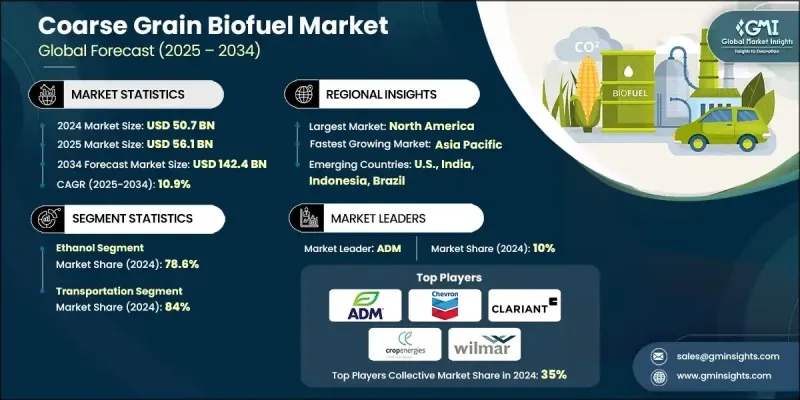
Strong growth in the sector is supported by expanding government mandates on fuel blending and increasing feedstock demand for sustainable aviation fuel. As countries ramp up efforts to reduce dependence on fossil fuels, biofuel targets are playing a key role in emissions reduction strategies. Ethanol produced from coarse grains such as corn and sorghum is becoming integral to transport fuel policies, particularly as the aviation sector looks for decarbonization pathways. Regulatory frameworks that promote ethanol-based SAF are helping to expand the role of coarse grain biofuels into new applications beyond road transportation. Growing emphasis on sustainability, national energy security, and the shift toward localized resource utilization are all contributing to a favorable business environment. With international commitments to net-zero targets gaining momentum, industries are accelerating the adoption of low-carbon fuels. Coarse grain-based ethanol, with its significantly lower lifecycle emissions, is emerging as a key component in long-term decarbonization plans across both transportation and industrial ecosystems.
| Market Scope | |
|---|---|
| Start Year | 2024 |
| Forecast Year | 2025-2034 |
| Start Value | $50.7 Billion |
| Forecast Value | $142.4 Billion |
| CAGR | 10.9% |
The ethanol-based fuels segment accounted for a 78.6% share in 2024 and is forecast to grow at a CAGR of 11% through 2034. This dominant position is being driven by policy-driven demand and the increasing application of dry mill ethanol production technologies. In the U.S., most ethanol output comes from dry mill plants, which have adopted modern technologies to enhance feedstock conversion efficiency, reduce energy use, and optimize product value. These facilities convert corn and sorghum into ethanol, corn oil, and distillers' grains, delivering both economic and environmental value to the production chain.
The biodiesel segment will reach USD 25 Billion by 2034. While traditional vegetable oils remain a primary input, corn oil, a byproduct of ethanol refining, is seeing expanded use in biodiesel blending. This integration not only boosts the efficiency of feedstock utilization but also aligns with the principles of a circular bioeconomy by minimizing waste and diversifying end uses.
U.S. Coarse Grain Biofuel Market held 93% share in 2024, generating USD 18.7 Billion. This leadership is underpinned by a strong alignment of agricultural policy and climate goals, with grain production serving as a strategic advantage. Biofuel initiatives across the U.S. and Canada are closely tied to broader decarbonization plans involving transport, agriculture, and industrial sectors, reinforcing the region's commitment to energy independence and emissions control.
Key companies in the Coarse Grain Biofuel Market include Verbio, Chevron, Praj Industries, Clariant, POET, TotalEnergies, FutureFuel, Wilmar International, The Andersons, ADM, Neste, My Eco Energy, Borregaard, Zilor, BTG Bioliquids, Munzer Bioindustrie, UPM, CropEnergies, COFCO, and Cargill. To solidify their position in the Global Coarse Grain Biofuel Market, major players are deploying several focused strategies. Companies are heavily investing in technology upgrades, particularly in dry mill and fermentation systems, to improve process efficiencies and product yields. Expanding their feedstock base and incorporating co-products like corn oil into biodiesel chains is helping increase operational value. Many firms are also collaborating with government bodies to align product development with regulatory goals, especially in the SAF segment.
Table of Contents
Chapter 1 Methodology & Scope
- 1.1 Research design
- 1.2 Base estimates & calculations
- 1.3 Forecast calculation
- 1.4 Data sources
- 1.4.1 Primary
- 1.4.2 Secondary
- 1.4.2.1 Paid
- 1.4.2.2 Public
- 1.5 Market definitions
Chapter 2 Executive Summary
- 2.1 Industry synopsis, 2021 - 2034
Chapter 3 Industry Insights
- 3.1 Industry ecosystem analysis
- 3.2 Regulatory landscape
- 3.3 Industry impact forces
- 3.3.1 Growth drivers
- 3.3.2 Industry pitfalls & challenges
- 3.4 Growth potential analysis
- 3.5 Porter's analysis
- 3.5.1 Bargaining power of suppliers
- 3.5.2 Bargaining power of buyers
- 3.5.3 Threat of new entrants
- 3.5.4 Threat of substitutes
- 3.6 PESTEL analysis
- 3.6.1 Political factors
- 3.6.2 Economic factors
- 3.6.3 Social factors
- 3.6.4 Technology factors
- 3.6.5 environmental factors
- 3.6.6 Legal factors
- 3.7 Emerging opportunities & trends
- 3.7.1 Digitalization and IoT integration
- 3.7.2 Emerging market penetration
Chapter 4 Competitive landscape, 2025
- 4.1 Introduction
- 4.2 Company market share analysis, 2024
- 4.2.1 North America
- 4.2.2 Europe
- 4.2.3 Asia Pacific
- 4.2.4 Middle East & Africa
- 4.2.5 Latin America
- 4.3 Strategic initiatives
- 4.4 Competitive benchmarking
- 4.5 Strategic dashboard
- 4.6 Innovation & technology landscape
Chapter 5 Market Size and Forecast, By Fuel, 2021 - 2034 (USD Million, Mtoe)
- 5.1 Key trends
- 5.2 Ethanol
- 5.3 Biodiesel
- 5.4 Others
Chapter 6 Market Size and Forecast, By Application, 2021 - 2034 (USD Million, Mtoe)
- 6.1 Key trends
- 6.2 Transportation
- 6.3 Aviation
- 6.4 Others
Chapter 7 Market Size and Forecast, By Region, 2021 - 2034 (USD Million, Mtoe)
- 7.1 Key trends
- 7.2 North America
- 7.2.1 U.S.
- 7.2.2 Canada
- 7.2.3 Mexico
- 7.3 Europe
- 7.3.1 Germany
- 7.3.2 UK
- 7.3.3 Italy
- 7.3.4 France
- 7.3.5 Spain
- 7.4 Asia Pacific
- 7.4.1 China
- 7.4.2 Australia
- 7.4.3 India
- 7.4.4 Indonesia
- 7.4.5 South Korea
- 7.5 Middle East & Africa
- 7.5.1 Saudi Arabia
- 7.5.2 South Africa
- 7.6 Latin America
- 7.6.1 Brazil
- 7.6.2 Argentina
Chapter 8 Company Profiles
- 8.1 ADM
- 8.2 Borregaard
- 8.3 BTG Bioliquids
- 8.4 Cargill
- 8.5 Chevron
- 8.6 Clariant
- 8.7 COFCO
- 8.8 CropEnergies
- 8.9 FutureFuel
- 8.10 Munzer Bioindustrie
- 8.11 My Eco Energy
- 8.12 Neste
- 8.13 POET
- 8.14 Praj Industries
- 8.15 The Andersons
- 8.16 TotalEnergies
- 8.17 UPM
- 8.18 Verbio
- 8.19 Wilmar International
- 8.20 Zilor

(주말 및 공휴일 제외)


