|
시장보고서
상품코드
1871223
에너지 수집용 압전 폴리머 시장 : 기회, 성장 요인, 업계 동향 분석, 예측(2025-2034년)Piezoelectric Polymers for Energy Harvesting Market Opportunity, Growth Drivers, Industry Trend Analysis, and Forecast 2025 - 2034 |
||||||

세계 에너지 수집용 압전 폴리머 시장은 2024년 4,410만 달러로 평가되었으며, 2034년까지 연평균 복합 성장률(CAGR) 14.3%로 성장하여 1억 6,350만 달러에 이를 것으로 예측됩니다.
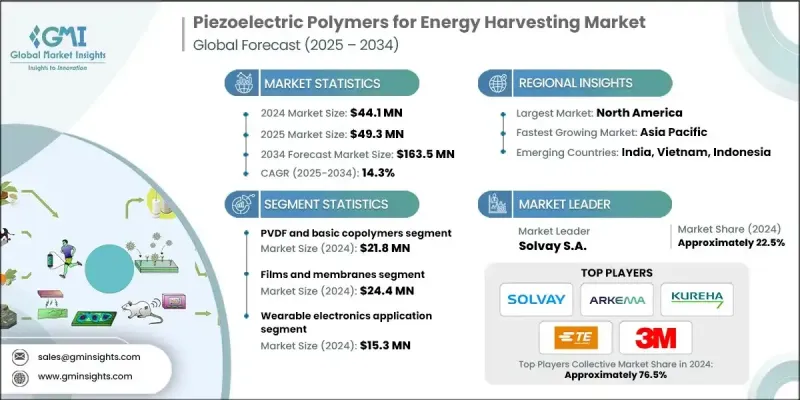
시장의 성장은 컴팩트하고 가볍고 유연한 전원을 필요로 하는 웨어러블 기기 및 IoT 기기의 보급 확대에 의해 견인되고 있습니다. 압전 폴리머는 지속적인 에너지 생성을 실현하는 지속 가능한 솔루션을 제공하여 센서, 건강 모니터 및 연결 장치가 빈번한 배터리 교체 없이 작동할 수 있습니다. 특히, 소비자용 전자기기, 의료 모니터링, 피트니스 트래킹 용도에 있어서 수요 증가가 현저합니다. PVDF 및 PVDF-TrFE 폴리머의 성능 향상은 기계적 유연성, 내구성 및 에너지 변환 효율을 향상시켰으며, 이러한 재료는 차세대 에너지 수확 시스템의 동력원으로 활용되고 있습니다. 지속적인 조사와 재료혁신에 의해 상업적 채택이 확대되어 산업용 및 소비자용 전자기기 분야에서의 응용이 가능해지고 있습니다. 이 폴리머는 가볍고 다재다능하며 자체 발전 솔루션을 제공하므로 유연한 전자 및 마이크로 에너지 수확 장치에서 점점 더 선호되고 있습니다.
| 시장 범위 | |
|---|---|
| 시작 연도 | 2024년 |
| 예측 연도 | 2025-2034년 |
| 시작 금액 | 4,410만 달러 |
| 예측 금액 | 1억 6,350만 달러 |
| CAGR | 14.3% |
PVDF 및 기본 공중합체 부문은 2024년에 2,180만 달러로 평가되었으며, 2025년부터 2034년까지 13.9%의 연평균 복합 성장률(CAGR)로 성장할 것으로 예측됩니다. 이 폴리머는 신뢰할 수 있는 압전 성능, 적응성 및 가공의 용이함에서 선호됩니다. 웨어러블 기기, 소형 센서, 소비자용 전자 기기에 널리 응용되어 효율적이고 자립형 에너지 솔루션을 제공합니다. 그 비용 효과와 범용성으로 산업용 및 소비자용 용도에서 일관된 채택이 진행되고 있습니다.
필름 및 멤브레인 부문은 2024년 2,440만 달러에 이르고, 2025년부터 2034년까지 연평균 복합 성장률(CAGR) 14.4%로 성장할 것으로 예측됩니다. 필름 및 멤브레인은 유연성, 제조 용이성, 웨어러블 장비 및 전자 시스템과의 호환성으로 가장 널리 사용됩니다. 컴팩트한 기기 설계, 용이한 적층, 패터닝을 가능하게 해 에너지 변환 효율의 향상에 기여합니다. 스마트 텍스타일이나 플렉서블 일렉트로닉스 분야에서의 이용이 증가하고 있어, 사용자의 동작으로부터 기기 내에서의 에너지 생성을 실현하고 있습니다.
북미의 에너지 수집용 압전 폴리머 시장은 2024년 33.5%의 점유율을 차지했습니다. 의료, 산업 자동화 및 인프라 용도에서 산업 분야가 자기 발전형 감지 솔루션을 채택함에 따라 이 지역 수요가 확대되고 있습니다. 미국에서는 에너지 효율에 대한 강력한 연구개발과 규제의 초점에 힘입어 스마트 인프라, 군용도, 웨어러블 기기가 채택을 추진하고 있습니다. 스마트 시티와 국가 인프라 프로젝트에 대한 투자는 도로, 교량 및 도시 환경에서 센서에 폴리머 기반 에너지 수확기의 통합을 촉진합니다. 제조업체 각 사는 가혹한 환경하에서도 장수명과 신뢰성 있는 성능을 확보하기 위해 폴리머의 내구성과 효율성을 향상시키고 있어 상업 규모로의 전개를 가능하게 하고 있습니다.
에너지 수집용 압전 폴리머 시장의 주요 기업으로는 3M사, 아르케마 그룹, TE커넥티비티, 크레하 주식회사, 솔베이 SA 등을 들 수 있습니다. 이 시장의 기업은 시장 지위 강화를 위해 여러 전략을 추진 중입니다. 차세대 에너지 수확기를 위해 에너지 변환 효율, 기계적 내구성 및 재료 유연성을 향상시키기 위해 연구 개발에 많은 투자를 실시했습니다. 전자기기 제조업체나 웨어러블 기기 제조업체와의 제휴에 의해 산업용 및 소비자용 용도으로의 채택 확대를 도모하고 있습니다. 각 회사는 소형화 센서, 스마트 텍스타일, 플렉서블 일렉트로닉스에 대응하기 위해 제품 라인의 다양화를 추진하고 있습니다. 생산 능력 확대, 공급망 최적화, 비용 효율성 향상으로 세계 시장 침투가 더욱 촉진되고 있습니다.
자주 묻는 질문
목차
제1장 조사 방법
- 시장 범위와 정의
- 조사 설계
- 조사 접근
- 데이터 수집 방법
- 데이터 마이닝 소스
- 세계
- 지역별/국가별
- 기본 추정치와 계산
- 기준연도 계산
- 시장 추정에서의 주요 동향
- 1차 조사 및 검증
- 1차 정보
- 예측 모델
- 조사의 전제조건과 제한 사항
제2장 주요 요약
제3장 업계 인사이트
- 생태계 분석
- 공급자의 상황
- 이익률
- 각 단계에서의 부가가치
- 밸류체인에 영향을 주는 요인
- 혁신
- 업계에 미치는 영향요인
- 성장 촉진요인
- 업계의 잠재적 위험 및 과제
- 공급망의 복잡성
- 시장 기회
- 성장 가능성 분석
- 규제 상황
- 북미
- 유럽
- 아시아태평양
- 라틴아메리카
- 중동 및 아프리카
- Porter's Five Forces 분석
- PESTEL 분석
- 가격 동향
- 지역별
- 제품별
- 장래 시장 동향
- 특허 상황
- 무역 통계(주 : 무역 통계는 주요 국가에 대해서만 제공됨)
- 주요 수입국
- 주요 수출국
- 지속가능성과 환경적 측면
- 지속가능한 실천
- 폐기물 감축 전략
- 생산에 있어서의 에너지 효율
- 친환경 이니셔티브
- 탄소발자국에 관한 고려 사항
제4장 경쟁 구도
- 소개
- 기업의 시장 점유율 분석
- 지역별
- 북미
- 유럽
- 아시아태평양
- 라틴아메리카
- 중동 및 아프리카
- 지역별
- 기업 매트릭스 분석
- 주요 시장 기업의 경쟁 분석
- 경쟁 포지셔닝 매트릭스
- 주요 발전
- 합병 및 인수
- 제휴 및 협력관계
- 신제품 발매
- 사업 확대 계획
제5장 시장 추정 및 예측 : 폴리머 유형별, 2021년-2034년
- 주요 동향
- PVDF 및 기본 공중합체
- 순수한 PVDF 필름
- PVDF-HFP 공중합체
- 기본 PVDF 복합재료
- P(VDF-TrFE) 고급 공중합체
- P(VDF-TrFE) 박막
- P(VDF-TrFE) 나노섬유
- MEMS 대응 P(VDF-TrFE)
- 폴리머 세라믹 복합재료
- PVDF-BaTiO3 복합재료
- PVDF-ZnO 나노복합재
- 다상 세라믹-폴리머계
- 특수 및 신흥 폴리머
- 바이오 베이스 압전 폴리머
- 전도성 폴리머 블렌드
- 연구단계의 신규 폴리머
제6장 시장 추정 및 예측 : 형태별, 2021년-2034년
- 주요 동향
- 필름 및 막
- 박막(10μm 미만)
- 표준 필름(10-100 μm)
- 후막(100μm 초과)
- 섬유와 섬유
- 일렉트로스판 나노섬유
- Core-spun yarns
- 직조형 압전 섬유
- 벌크 및 복합 구조체
- 3D 프린팅 구조체
- 성형 부품
- 적층 복합 시스템
제7장 시장 추정 및 예측 : 용도별, 2021년-2034년
- 주요 동향
- 웨어러블 전자 기기
- 스마트 섬유 및 전자 섬유
- 피트니스 트래커 및 건강 모니터
- 스마트 워치 및 액세서리
- 전자 피부(e-skin)의 응용
- IoT 센서 및 무선 네트워크
- 환경 모니터링 센서
- 산업용 IoT 센서
- 스마트 시티 인프라 센서
- 농업 및 원격 감시
- 의료기기 및 임플란트
- 이식형 페이스메이커 시스템
- 바이오센서 및 모니터링 장치
- 보철물 및 보조 장치
- 약물 전달 시스템
- 구조 건전성 감시
- 교량·인프라 감시
- 건축 구조물의 감시
- 파이프라인 및 유틸리티 모니터링
- 자동차 용도
- 타이어 공압 감시 시스템
- 차량 구조 모니터링
- 차내 센서 네트워크
- 항공우주 및 방위
- 항공기 구조 모니터링
- 군용 센서 네트워크
- 우주 응용
제8장 시장 추정 및 예측 : 지역별, 2021년-2034년
- 주요 동향
- 북미
- 미국
- 캐나다
- 유럽
- 독일
- 영국
- 프랑스
- 이탈리아
- 스페인
- 기타 유럽
- 아시아태평양
- 중국
- 인도
- 일본
- 호주
- 한국
- 기타 아시아태평양
- 라틴아메리카
- 브라질
- 멕시코
- 아르헨티나
- 기타 라틴아메리카
- 중동 및 아프리카
- 사우디아라비아
- 남아프리카
- 아랍에미리트(UAE)
- 기타 중동 및 아프리카
제9장 기업 프로파일
- Solvay SA
- Arkema Group
- 3M Company
- Kureha Corporation
- Daikin Industries
- Smart Material Corp
- Measurement Specialties/TE Connectivity
- PI Ceramic
- Noliac A/S
- CeramTec
- Piezotech SA
- USound GmbH
- EnOcean GmbH
- Energiot Ltd
- Ionix Advanced Technologies
- Johnson Matthey
- Murata Manufacturing
- Morgan Advanced Materials
- Honeywell International
- Others(Harri, etc.)
- Matregenix
- APC International
- Physik Instrumente
- Cedrat Technologies
- Perpetuum
The Global Piezoelectric Polymers for Energy Harvesting Market was valued at USD 44.1 million in 2024 and is estimated to grow at a CAGR of 14.3% to reach USD 163.5 million by 2034.
The market's growth is driven by the expanding adoption of wearables and IoT devices, which require compact, lightweight, and flexible power sources. Piezoelectric polymers offer a sustainable solution for continuous energy generation, enabling sensors, health monitors, and connected devices to operate without frequent battery replacement. Rising demand is particularly evident in consumer electronics, healthcare monitoring, and fitness tracking applications. Enhanced performance of PVDF and PVDF-TrFE polymers has improved mechanical flexibility, durability, and energy conversion efficiency, allowing these materials to power next-generation energy-harvesting systems. Continuous research and material innovations are helping expand commercial adoption, enabling applications in both industrial and consumer electronics sectors. These polymers provide lightweight, versatile, and self-powered solutions that are increasingly preferred for flexible electronics and micro-energy harvesting devices.
| Market Scope | |
|---|---|
| Start Year | 2024 |
| Forecast Year | 2025-2034 |
| Start Value | $44.1 million |
| Forecast Value | $163.5 million |
| CAGR | 14.3% |
The PVDF and basic copolymers segment was valued at USD 21.8 million in 2024 and is expected to grow at a CAGR of 13.9% from 2025 to 2034. These polymers are favored for their reliable piezoelectric performance, adaptability, and ease of processing. They are widely applied in wearables, miniaturized sensors, and consumer electronics, providing efficient, self-sustaining energy solutions. Their cost-effectiveness and versatility support consistent adoption across industrial and consumer applications.
The films and membranes segment reached USD 24.4 million in 2024 and is projected to grow at a CAGR of 14.4% during 2025-2034. Films and membranes are the most used forms because of their flexibility, ease of manufacturing, and compatibility with wearable and electronic systems. They allow compact device designs, easy layering, and patterning to improve energy conversion efficiency. Their use is increasing in smart textiles and flexible electronics, enabling in-device energy generation from user movements.
North America Piezoelectric Polymers for Energy Harvesting Market held a 33.5% share in 2024. Demand in the region is growing as industries adopt self-powered sensing solutions across healthcare, industrial automation, and infrastructure applications. Smart infrastructure, military applications, and wearables are driving adoption in the U.S., supported by strong R&D and regulatory focus on energy efficiency. Investments in smart cities and national infrastructure projects are promoting the integration of polymer-based energy harvesters in sensors across roads, bridges, and urban environments. Manufacturers are enhancing polymer durability and efficiency to ensure long lifespans and reliable performance in harsh conditions, facilitating commercial-scale deployment.
Key players in the Piezoelectric Polymers for Energy Harvesting Market include 3M Company, Arkema Group, TE Connectivity, Kureha Corporation, Solvay S.A., and others. Companies in the Piezoelectric Polymers for Energy Harvesting Market are pursuing several strategies to strengthen their market position. They are investing heavily in R&D to improve energy conversion efficiency, mechanical durability, and material flexibility for next-generation energy harvesters. Partnerships with electronics and wearable device manufacturers help secure adoption in industrial and consumer applications. Firms are diversifying product lines to cater to miniaturized sensors, smart textiles, and flexible electronics. Scaling production capacity, optimizing supply chains, and enhancing cost-effectiveness are further enabling global market penetration.
Table of Contents
Chapter 1 Methodology
- 1.1 Market scope and definition
- 1.2 Research design
- 1.2.1 Research approach
- 1.2.2 Data collection methods
- 1.3 Data mining sources
- 1.3.1 Global
- 1.3.2 Regional/Country
- 1.4 Base estimates and calculations
- 1.4.1 Base year calculation
- 1.4.2 Key trends for market estimation
- 1.5 Primary research and validation
- 1.5.1 Primary sources
- 1.6 Forecast model
- 1.7 Research assumptions and limitations
Chapter 2 Executive Summary
- 2.1 Industry 3600 synopsis
- 2.2 Key market trends
- 2.2.1 Regional
- 2.2.2 Polymer Type
- 2.2.3 Form
- 2.2.4 Application
- 2.3 TAM Analysis, 2025-2034
- 2.4 CXO perspectives: Strategic imperatives
- 2.4.1 Executive decision points
- 2.4.2 Critical success factors
- 2.5 Future Outlook and Strategic Recommendations
Chapter 3 Industry Insights
- 3.1 Industry ecosystem analysis
- 3.1.1 Supplier Landscape
- 3.1.2 Profit Margin
- 3.1.3 Value addition at each stage
- 3.1.4 Factor affecting the value chain
- 3.1.5 Disruptions
- 3.2 Industry impact forces
- 3.2.1 Growth drivers
- 3.2.2 Industry pitfalls and challenges
- 3.2.2.1 Supply chain complexity
- 3.2.3 Market opportunities
- 3.3 Growth potential analysis
- 3.4 Regulatory landscape
- 3.4.1 North America
- 3.4.2 Europe
- 3.4.3 Asia Pacific
- 3.4.4 Latin America
- 3.4.5 Middle East & Africa
- 3.5 Porter's analysis
- 3.6 PESTEL analysis
- 3.6.1 Technology and Innovation landscape
- 3.6.2 Current technological trends
- 3.6.3 Emerging technologies
- 3.7 Price trends
- 3.7.1 By region
- 3.7.2 By product
- 3.8 Future market trends
- 3.9 Patent Landscape
- 3.10 Trade statistics (Note: the trade statistics will be provided for key countries only)
- 3.10.1 Major importing countries
- 3.10.2 Major exporting countries
- 3.11 Sustainability and Environmental Aspects
- 3.11.1 Sustainable Practices
- 3.11.2 Waste Reduction Strategies
- 3.11.3 Energy Efficiency in Production
- 3.11.4 Eco-friendly Initiatives
- 3.12 Carbon Footprint Considerations
Chapter 4 Competitive Landscape, 2024
- 4.1 Introduction
- 4.2 Company market share analysis
- 4.2.1 By region
- 4.2.1.1 North America
- 4.2.1.2 Europe
- 4.2.1.3 Asia Pacific
- 4.2.1.4 LATAM
- 4.2.1.5 MEA
- 4.2.1 By region
- 4.3 Company matrix analysis
- 4.4 Competitive analysis of major market players
- 4.5 Competitive positioning matrix
- 4.6 Key developments
- 4.6.1 Mergers & acquisitions
- 4.6.2 Partnerships & collaborations
- 4.6.3 New Product Launches
- 4.6.4 Expansion Plans
Chapter 5 Market Estimates and Forecast, By Polymer Type, 2021 - 2034 (USD Million, Kilo Tons)
- 5.1 Key trends
- 5.2 PVDF and Basic Copolymers
- 5.2.1 Pure PVDF Films
- 5.2.2 PVDF-HFP Copolymers
- 5.2.3 Basic PVDF Composites
- 5.3 P(VDF-TrFE) Advanced Copolymers
- 5.3.1 P(VDF-TrFE) Thin Films
- 5.3.2 P(VDF-TrFE) Nanofibers
- 5.3.3 MEMS-Compatible P(VDF-TrFE)
- 5.4 Polymer-Ceramic Composites
- 5.4.1 PVDF-BaTiO3 Composites
- 5.4.2 PVDF-ZnO Nanocomposites
- 5.4.3 Multi-phase Ceramic-Polymer Systems
- 5.5 Specialty and Emerging Polymers
- 5.5.1 Bio-based Piezoelectric Polymers
- 5.5.2 Conductive Polymer Blends
- 5.5.3 Research-stage Novel Polymers
Chapter 6 Market Estimates and Forecast, By Form, 2021 - 2034 (USD Million, Kilo Tons)
- 6.1 Key trends
- 6.2 Films and membranes
- 6.2.1 Thin films (<10 μm)
- 6.2.2 Standard films (10-100 μm)
- 6.2.3 Thick films (>100 μm)
- 6.3 Fibers and textiles
- 6.3.1 Electrospun nanofibers
- 6.3.2 Core-spun yarns
- 6.3.3 Woven piezoelectric fabrics
- 6.4 Bulk and composite structures
- 6.4.1 3D-printed structures
- 6.4.2 Molded components
- 6.4.3 Layered composite systems
Chapter 7 Market Estimates and Forecast, By Application, 2021 - 2034 (USD Million, , Kilo Tons)
- 7.1 Key trends
- 7.2 Wearable electronics
- 7.2.1 Smart textiles and e-fabrics
- 7.2.2 Fitness trackers and health monitors
- 7.2.3 Smart watches and accessories
- 7.2.4 Electronic skin (e-skin) applications
- 7.3 IoT sensors and wireless networks
- 7.3.1 Environmental monitoring sensors
- 7.3.2 Industrial IoT sensors
- 7.3.3 Smart city infrastructure sensors
- 7.3.4 Agricultural and remote monitoring
- 7.4 Medical devices and implants
- 7.4.1 Implantable pacemaker systems
- 7.4.2 Biosensors and monitoring devices
- 7.4.3 Prosthetics and assistive devices
- 7.4.4 Drug delivery systems
- 7.5 Structural health monitoring
- 7.5.1 Bridge and infrastructure monitoring
- 7.5.2 Building structural monitoring
- 7.5.3 Pipeline and utility monitoring
- 7.6 Automotive applications
- 7.6.1 Tire pressure monitoring systems
- 7.6.2 Vehicle structural monitoring
- 7.6.3 In-cabin sensor networks
- 7.7 Aerospace and defense
- 7.7.1 Aircraft structural monitoring
- 7.7.2 Military sensor networks
- 7.7.3 Space applications
Chapter 8 Market Estimates and Forecast, By Region, 2021 - 2034 (USD Million, Kilo Tons)
- 8.1 Key trends
- 8.2 North America
- 8.2.1 U.S.
- 8.2.2 Canada
- 8.3 Europe
- 8.3.1 Germany
- 8.3.2 UK
- 8.3.3 France
- 8.3.4 Italy
- 8.3.5 Spain
- 8.3.6 Rest of Europe
- 8.4 Asia Pacific
- 8.4.1 China
- 8.4.2 India
- 8.4.3 Japan
- 8.4.4 Australia
- 8.4.5 South Korea
- 8.4.6 Rest of Asia Pacific
- 8.5 Latin America
- 8.5.1 Brazil
- 8.5.2 Mexico
- 8.5.3 Argentina
- 8.5.4 Rest of Latin America
- 8.6 Middle East & Africa
- 8.6.1 Saudi Arabia
- 8.6.2 South Africa
- 8.6.3 UAE
- 8.6.4 Rest of Middle East & Africa
Chapter 9 Company Profiles
- 9.1 Solvay S.A.
- 9.2 Arkema Group
- 9.3 3M Company
- 9.4 Kureha Corporation
- 9.5 Daikin Industries
- 9.6 Smart Material Corp
- 9.7 Measurement Specialties / TE Connectivity
- 9.8 PI Ceramic
- 9.9 Noliac A/S
- 9.10 CeramTec
- 9.11 Piezotech S.A.
- 9.12 USound GmbH
- 9.13 EnOcean GmbH
- 9.14 Energiot Ltd
- 9.15 Ionix Advanced Technologies
- 9.16 Johnson Matthey
- 9.17 Murata Manufacturing
- 9.18 Morgan Advanced Materials
- 9.19 Honeywell International
- 9.20 Others (Harri, etc.)
- 9.21 Matregenix
- 9.22 APC International
- 9.23 Physik Instrumente
- 9.24 Cedrat Technologies
- 9.25 Perpetuum