|
시장보고서
상품코드
1871231
객실 승무원 훈련 시장 : 기회, 성장 요인, 업계 동향 분석 및 예측(2025-2034년)Cabin Crew Training Market Opportunity, Growth Drivers, Industry Trend Analysis, and Forecast 2025 - 2034 |
||||||

세계의 객실 승무원 훈련 시장은 2024년 173억 달러로 평가되었으며, 2034년까지 연평균 복합 성장률(CAGR) 7.4%로 성장해 352억 달러에 이를 것으로 예측됩니다.
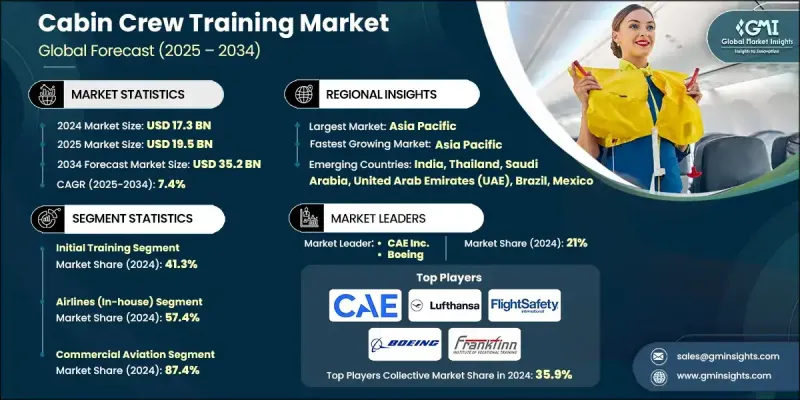
시장 성장의 배경은 국제항공 여행의 꾸준한 증가, 항공사의 장비 확충 및 각 지역의 신규 항공사의 진입을 포함합니다. 규제 당국의 감시 강화와 여객 안전에 대한 강한 주력으로 기존 항공사와 저비용 항공사 모두에서 전문적인 승무원 훈련이 필수적입니다. 세계 각국의 항공 당국은 보다 엄격한 안전 및 컴플라이언스 틀의 도입을 계속하고 있으며, 항공사는 운항 준비 태세의 확보와 국제 안전 기준에의 준수를 보장하는 종합적인 훈련 프로그램에 많은 투자를 촉구하고 있습니다. 증강현실(AR)과 가상현실(VR), AI 기반의 분석기술, 고화질 시뮬레이터 등의 기술 활용이 확대되고, 상황 대응 능력의 향상과 훈련 시간의 단축에 의해 객실 승무원의 준비 태세를 변화시키고 있습니다. 주요 OEM 제조업체와 훈련 기관은 응급 대응 및 안전 훈련을 강화하기 위해 실제 환경을 재현하는 몰입형 솔루션을 통합합니다. 이 훈련 과정에서의 디지털 변혁은 2020년 이후 기세를 늘리고 있으며, 세계 항공사가 운항의 우수성과 승무원의 신속한 능력 습득에 주력하는 가운데 향후 10년 동안 결정적인 트렌드로 지속될 것으로 예측됩니다.
| 시장 범위 | |
|---|---|
| 시작 연도 | 2024년 |
| 예측 연도 | 2025-2034년 |
| 시작 금액 | 173억 달러 |
| 예측 금액 | 352억 달러 |
| CAGR | 7.4% |
초기 훈련 부문은 2024년에 41.3%의 점유율을 차지했습니다. 이 부문은 풀서비스 항공사와 저가 항공사 모두 안전 및 서비스 프로토콜 준수를 보장하는 필수 온보딩 프로그램을 통해 계속 주도적인 지위를 유지하고 있습니다. 신규 항공기 및 항공사 직원의 수가 증가함에 따라 체계화된 초기 훈련 프로그램의 필요성이 급속히 증가하고 있습니다. 교육 기관은 교육 품질을 유지하면서 국제 규제 기준을 충족하기 위해 수용 능력을 확대하고, 가상 세션과 교실 세션을 결합한 혼합 학습 모델을 채택하고, 신흥 항공사와 전략적 제휴를 구축하는 데 주력하고 있습니다.
항공사(사내) 연수 부문은 2024년 57.4%의 점유율을 차지했습니다. 이 부문이 주도적 위치에 있는 주된 이유는 항공사가 교육 과정을 직접 관리하는 것을 우선시하고 내부 안전 절차 및 운영 기준을 준수할 수 있다는 점입니다. 사내 프로그램은 비용 효율성, 표준화 향상, 확대하는 객실 승무원 팀을 위한 신속한 도입 교육 및 정기 교육주기를 제공합니다. 그러나 독립 훈련 기관은 전문적인 훈련 솔루션, 시뮬레이터에 대한 액세스 및 고급 디지털 학습 시스템을 제공하기 위해 항공사와의 협력을 강화하고 있습니다. 이들은 내부 프로그램을 보완하고 확장하는 아웃소싱 수요에 대응합니다.
미국의 객실 승무원 훈련 시장은 광범위한 민간 항공 네트워크와 엄격한 안전 및 운영 기준으로 지원되었으며 2024년에는 39억 달러로 평가되었습니다. 연방항공국(FAA)이 주도하는 이 나라의 규제 프레임워크는 고급 시뮬레이션 툴, 긴급 대응 훈련, 정기적인 인증 프로그램에 대한 지속적인 수요를 추진하고 있습니다. 미국에서 사업을 전개하는 기업은 연방규제에 준거하면서 비용효율이 뛰어나고 확장성이 뛰어나 기술 주도형 훈련 프로그램을 제공하기 위해 AI를 활용한 훈련, 디지털 시뮬레이션 플랫폼, 모듈식 학습 시스템에 대한 투자를 추진하고 있습니다.
세계의 객실 승무원 훈련 업계에서 활동하는 주요 기업으로는 Air France, Lufthansa, FlightSafety International, Emirates, Etihad Aviation, Skytech Aviation, Boeing, Embraer, CAE Inc., Singapore Airlines, Airbus, Frankfinn Institute 등이 있습니다. 객실 승무원 훈련 시장의 주요 기업은 시장의 존재감을 높이기 위해 기술 혁신, 전략적 제휴, 세계 전개에 주력하고 있습니다. 많은 기업들이 몰입형 AR/VR 시뮬레이션 시스템과 AI를 활용한 분석 기술에 투자해 안전성 향상과 학습 효율을 높이는 현실적인 데이터 구동형 훈련 환경을 구축하고 있습니다. 항공사와 교육기관의 협력을 통해 규제 기준을 충족하면서 비용과 훈련 시간을 줄이는 유연한 혼합 학습 프로그램의 개발이 진행되고 있습니다. 또한 성장 현저한 항공지역에서 신훈련센터 개설과 합작사업을 통해 지리적 전개를 확대하는 움직임도 볼 수 있습니다.
자주 묻는 질문
목차
제1장 조사 방법
- 시장 범위와 정의
- 조사 설계
- 조사 접근
- 데이터 수집 방법
- 데이터 마이닝 소스
- 세계
- 지역별/국가별
- 기본 추정치와 계산
- 기준연도 계산
- 시장 추정에서의 주요 동향
- 1차 조사 및 검증
- 1차 정보
- 예측 모델
- 조사의 전제조건과 제한 사항
제2장 주요 요약
제3장 업계 인사이트
- 생태계 분석
- 공급자의 상황
- 이익률 분석
- 비용 구조
- 각 단계에서의 부가가치
- 밸류체인에 영향을 주는 요인
- 혁신
- 업계에 미치는 영향요인
- 성장 촉진요인
- 국제항공여행 확대
- 기재 확충과 신규 항공사의 설립
- 여객의 안전과 규제 준수에 대한 주력 강화
- 디지털 및 시뮬레이터 기반 훈련 도입
- 저비용 항공사(LCC) 사업 확대
- 업계의 잠재적 위험 및 과제
- 시뮬레이터 및 훈련 시설에 대한 고액의 자본 투자
- 유자격의 훈련 교관 및 지도원의 부족
- 시장 기회
- e러닝, VR, AR 기술의 채용
- 전문 훈련 프로그램의 확충
- 신흥 항공 시장의 성장
- 성장 촉진요인
- 성장 가능성 분석
- 규제 상황
- 북미
- 유럽
- 아시아태평양
- 라틴아메리카
- 중동 및 아프리카
- Porter's Five Forces 분석
- PESTEL 분석
- 기술 및 혁신 정세
- 현재의 기술 동향
- 신흥기술
- 가격 동향
- 지역별
- 가격 전략
- 신흥 비즈니스 모델
- 컴플라이언스 요건
- 방위 예산 분석
- 세계의 방위 지출 동향
- 지역별 방위 예산 배분
- 북미
- 유럽
- 아시아태평양
- 중동 및 아프리카
- 라틴아메리카
- 주요 방위 근대화 프로그램
- 예산 예측(2025-2034년)
- 산업 성장에 미치는 영향
- 국가별 방위 예산
- 방위 예산의 부문별 배분
- 인원
- 운용 및 보수
- 조달
- 연구개발 및 시험평가
- 인프라 및 건설
- 기술과 혁신
- 공급 체인의 탄력
- 지정학적 분석
- 노동력 분석
- 디지털 전환
- 합병, 인수 및 전략적 제휴 상황
- 위험 평가 및 관리
- 주요 계약 수여(2021-2024년)
제4장 경쟁 구도
- 소개
- 기업의 시장 점유율 분석
- 지역별
- 북미
- 유럽
- 아시아태평양
- 라틴아메리카
- 중동 및 아프리카
- 지역별
- 주요 기업의 경쟁 벤치마킹
- 재무실적 비교
- 수익
- 이익률
- 연구개발
- 제품 포트폴리오 비교
- 제품 라인의 폭
- 기술
- 혁신
- 지리적 존재 비교
- 세계 사업 전개 분석
- 서비스 네트워크 커버리지
- 지역별 시장 침투율
- 경쟁 포지셔닝 매트릭스
- 리더기업
- 과제자
- 팔로워
- 틈새 기업
- 전략적 전망 매트릭스
- 재무실적 비교
- 주요 발전, 2021-2024년
- 인수합병
- 제휴 및 협력 관계
- 기술적 진보
- 확대 및 투자 전략
- 디지털 전환의 대처
- 신흥/스타트업 경쟁의 정세
제5장 시장 추계 및 예측 : 연수유형별, 2021-2034년
- 주요 동향
- 초기 훈련
- 재훈련
- 전환 미 차이 훈련
- 업그레이드 연수
- 기타
제6장 시장 추계 및 예측 : 제공 형태별, 2021-2034년
- 주요 동향
- 대면식 트레이닝
- 시뮬레이터 활용 연수
- e러닝
- 하이브리드
제7장 시장 추계 및 예측 : 연수 제공업체별, 2021-2034년
- 주요 동향
- 항공사(사내)
- 독립계 훈련 기관
- 항공 당국
제8장 시장 추계 및 예측 : 최종 용도별, 2021-2034년
- 주요 동향
- 상용항공
- 풀서비스 항공사
- 저가 항공사
- 지역 항공사
- 일반항공
- 비즈니스 제트 및 법인 항공
- 전세 서비스
- 프라이빗 항공사
제9장 시장 추계 및 예측 : 지역별, 2021-2034년
- 주요 동향
- 북미
- 미국
- 캐나다
- 유럽
- 독일
- 영국
- 프랑스
- 이탈리아
- 스페인
- 네덜란드
- 아시아태평양
- 중국
- 인도
- 일본
- 호주
- 한국
- 라틴아메리카
- 브라질
- 멕시코
- 아르헨티나
- 중동 및 아프리카
- 남아프리카
- 사우디아라비아
- 아랍에미리트(UAE)
제10장 기업 프로파일
- 세계 주요 기업
- Airbus
- Boeing
- Embraer
- CAE Inc.
- 지역별 주요 기업
- 북미
- American Airlines
- FlightSafety International
- 유럽
- Air France
- ATR
- BAA Training
- Lufthansa
- TAG Aviation
- Skytech Aviation
- 아시아태평양
- Singapore Airlines
- Frankfinn Institute
- 중동 및 아프리카
- Emirates
- Etihad Aviation
- Immaculate Training Services
- Junosis
- 북미
- 틈새 기업/디스 랩터
- Immaculate Training Services
- Junosis
- Baines Simmons
The Global Cabin Crew Training Market was valued at USD 17.3 Billion in 2024 and is estimated to grow at a CAGR of 7.4% to reach USD 35.2 Billion by 2034.
The market growth is fueled by the steady increase in international air travel, the expansion of airline fleets, and the launch of new carriers across various regions. Rising regulatory scrutiny and a strong focus on passenger safety have made professional crew training indispensable for both established and low-cost airlines. Aviation authorities worldwide continue to implement stricter safety and compliance frameworks, compelling airlines to invest heavily in comprehensive training programs that ensure operational readiness and adherence to international safety standards. The growing use of technologies such as augmented and virtual reality (AR/VR), AI-based analytics, and high-fidelity simulators is transforming cabin crew preparation by improving situational response and reducing training time. Major OEMs and training institutions are integrating immersive solutions that replicate real-world conditions to enhance emergency and safety training. This digital transformation in training processes has been gaining traction since 2020 and is expected to remain a defining trend throughout the next decade as global airlines focus on operational excellence and faster crew competency.
| Market Scope | |
|---|---|
| Start Year | 2024 |
| Forecast Year | 2025-2034 |
| Start Value | $17.3 billion |
| Forecast Value | $35.2 billion |
| CAGR | 7.4% |
The initial training segment captured a 41.3% share in 2024. This segment continues to dominate due to the mandatory onboarding programs that ensure compliance with safety and service protocols across full-service and budget airlines. As the number of new aircraft and airline employees rises, the need for structured initial training programs has grown rapidly. Training institutions are focusing on expanding capacity, adopting blended learning models combining virtual and classroom sessions, and forming strategic partnerships with emerging airlines to maintain training quality while meeting global regulatory standards.
The airlines' (in-house) training segment accounted for a 57.4% share in 2024. This segment's leadership is primarily attributed to airlines' preference for maintaining direct control over their training processes, allowing them to ensure adherence to internal safety procedures and operational benchmarks. In-house programs provide cost efficiency, better standardization, and quicker onboarding and recurrent training cycles for expanding cabin crew teams. However, independent training providers are increasingly collaborating with airlines to deliver specialized training solutions, simulator access, and advanced digital learning systems that complement internal programs and cater to growing outsourcing needs.
U.S. Cabin Crew Training Market was valued at USD 3.9 Billion in 2024, supported by a vast commercial aviation network and stringent safety and operational standards. The country's regulatory framework, led by the FAA, drives continuous demand for advanced simulation tools, emergency response training, and recurrent certification programs. Companies operating in the U.S. are investing in AI-enabled training, digital simulation platforms, and modular learning systems to align with federal regulations while offering cost-efficient, scalable, and technology-driven training programs.
Major companies active in the Global Cabin Crew Training Industry include Air France, Lufthansa, FlightSafety International, Emirates, Etihad Aviation, Skytech Aviation, Boeing, Embraer, CAE Inc., Singapore Airlines, Airbus, and Frankfinn Institute. Leading players in the Cabin Crew Training Market are focusing on technological innovation, strategic partnerships, and global expansion to enhance their market footprint. Many are investing in immersive AR/VR simulation systems and AI-powered analytics to create realistic, data-driven training experiences that improve safety outcomes and learning efficiency. Collaborations between airlines and training providers are helping to develop flexible, blended learning programs that address regulatory standards while reducing costs and training time. Companies are also expanding their geographic reach through new training centers and joint ventures in high-growth aviation regions.
Table of Contents
Chapter 1 Methodology
- 1.1 Market scope and definition
- 1.2 Research design
- 1.2.1 Research approach
- 1.2.2 Data collection methods
- 1.3 Data mining sources
- 1.3.1 Global
- 1.3.2 Regional/Country
- 1.4 Base estimates and calculations
- 1.4.1 Base year calculation
- 1.4.2 Key trends for market estimation
- 1.5 Primary research and validation
- 1.5.1 Primary sources
- 1.6 Forecast model
- 1.7 Research assumptions and limitations
Chapter 2 Executive Summary
- 2.1 Industry 360° synopsis, 2021 - 2034
- 2.2 Key market trends
- 2.2.1 Type of training trends
- 2.2.2 Delivery mode trends
- 2.2.3 Training provider trends
- 2.2.4 End use trends
- 2.2.5 Regional trends
- 2.3 TAM Analysis, 2025-2034
- 2.4 CXO perspectives: Strategic imperatives
- 2.4.1 Executive decision points
- 2.4.2 Critical success factors
- 2.5 Future outlook and strategic recommendations
Chapter 3 Industry Insights
- 3.1 Industry ecosystem analysis
- 3.1.1 Supplier landscape
- 3.1.2 Profit margin analysis
- 3.1.3 Cost structure
- 3.1.4 Value addition at each stage
- 3.1.5 Factor affecting the value chain
- 3.1.6 Disruptions
- 3.2 Industry impact forces
- 3.2.1 Growth drivers
- 3.2.1.1 Expansion of international air travel
- 3.2.1.2 Fleet expansion and new airline launches
- 3.2.1.3 Increasing focus on passenger safety and regulatory compliance
- 3.2.1.4 Adoption of digital and simulator-based training
- 3.2.1.5 Growing low-cost carrier (LCC) operations
- 3.2.2 Industry pitfalls and challenges
- 3.2.2.1 High capital investment in simulators and training facilities
- 3.2.2.2 Shortage of qualified trainers and instructors
- 3.2.3 Market opportunities
- 3.2.3.1 Adoption of e-learning, VR, and AR technologies
- 3.2.3.2 Expansion of specialized training programs
- 3.2.3.3 Growth of emerging aviation markets
- 3.2.1 Growth drivers
- 3.3 Growth potential analysis
- 3.4 Regulatory landscape
- 3.4.1 North America
- 3.4.2 Europe
- 3.4.3 Asia Pacific
- 3.4.4 Latin America
- 3.4.5 Middle East & Africa
- 3.5 Porter's analysis
- 3.6 PESTEL analysis
- 3.7 Technology and Innovation landscape
- 3.7.1 Current technological trends
- 3.7.2 Emerging technologies
- 3.8 Price trends
- 3.8.1 By region
- 3.9 Pricing Strategies
- 3.10 Emerging Business Models
- 3.11 Compliance Requirements
- 3.12 Defense Budget Analysis
- 3.13 Global Defense Spending Trends
- 3.14 Regional Defense Budget Allocation
- 3.14.1 North America
- 3.14.2 Europe
- 3.14.3 Asia Pacific
- 3.14.4 Middle East and Africa
- 3.14.5 Latin America
- 3.15 Key Defense Modernization Programs
- 3.16 Budget Forecast (2025-2034)
- 3.16.1 Impact on Industry Growth
- 3.16.2 Defense Budgets by Country
- 3.16.3 Defense Budget Allocation by Segment
- 3.16.3.1 Personnel
- 3.16.3.2 Operations and Maintenance
- 3.16.3.3 Procurement
- 3.16.3.4 Research, Development, Test and Evaluation
- 3.16.3.5 Infrastructure and Construction
- 3.16.3.6 Technology and Innovation
- 3.17 Supply Chain Resilience
- 3.18 Geopolitical Analysis
- 3.19 Workforce Analysis
- 3.20 Digital Transformation
- 3.21 Mergers, Acquisitions, and Strategic Partnerships Landscape
- 3.22 Risk Assessment and Management
- 3.23 Major Contract Awards (2021-2024)
Chapter 4 Competitive Landscape, 2024
- 4.1 Introduction
- 4.2 Company market share analysis
- 4.2.1 By region
- 4.2.1.1 North America
- 4.2.1.2 Europe
- 4.2.1.3 Asia Pacific
- 4.2.1.4 Latin America
- 4.2.1.5 Middle East & Africa
- 4.2.1 By region
- 4.3 Competitive benchmarking of key players
- 4.3.1 Financial performance comparison
- 4.3.1.1 Revenue
- 4.3.1.2 Profit margin
- 4.3.1.3 R&D
- 4.3.2 Product portfolio comparison
- 4.3.2.1 Product range breadth
- 4.3.2.2 Technology
- 4.3.2.3 Innovation
- 4.3.3 Geographic presence comparison
- 4.3.3.1 Global footprint analysis
- 4.3.3.2 Service network coverage
- 4.3.3.3 Market penetration by region
- 4.3.4 Competitive positioning matrix
- 4.3.4.1 Leaders
- 4.3.4.2 Challengers
- 4.3.4.3 Followers
- 4.3.4.4 Niche players
- 4.3.5 Strategic outlook matrix
- 4.3.1 Financial performance comparison
- 4.4 Key developments, 2021-2024
- 4.4.1 Mergers and acquisitions
- 4.4.2 Partnerships and collaborations
- 4.4.3 Technological advancements
- 4.4.4 Expansion and investment strategies
- 4.4.5 Digital transformation initiatives
- 4.5 Emerging/ startup competitors landscape
Chapter 5 Market Estimates and Forecast, By Type of Training, 2021 - 2034 (USD Million)
- 5.1 Key trends
- 5.2 Initial training
- 5.3 Recurrent training
- 5.4 Conversion/differences training
- 5.5 Upgrade training
- 5.6 Others
Chapter 6 Market Estimates and Forecast, By Delivery Mode, 2021 - 2034 (USD Million)
- 6.1 Key trends
- 6.2 Classroom-based training
- 6.3 Simulator-based training
- 6.4 E-learning
- 6.5 Hybrid
Chapter 7 Market Estimates and Forecast, By Training Provider, 2021 - 2034 (USD Million)
- 7.1 Key trends
- 7.2 Airlines (in-house)
- 7.3 Independent training providers
- 7.4 Aviation authorities
Chapter 8 Market Estimates and Forecast, By End Use, 2021 - 2034 (USD Million)
- 8.1 Key trends
- 8.2 Commercial aviation
- 8.2.1 Full-service airlines
- 8.2.2 Low-cost carriers
- 8.2.3 Regional airlines
- 8.3 General aviation
- 8.3.1 Business jets & corporate aviation
- 8.3.2 Charter services
- 8.3.3 Private aviation operators
Chapter 9 Market Estimates & Forecast, By Region, 2021 - 2034 (USD Million)
- 9.1 Key trends
- 9.2 North America
- 9.2.1 U.S.
- 9.2.2 Canada
- 9.3 Europe
- 9.3.1 Germany
- 9.3.2 UK
- 9.3.3 France
- 9.3.4 Italy
- 9.3.5 Spain
- 9.3.6 Netherlands
- 9.4 Asia Pacific
- 9.4.1 China
- 9.4.2 India
- 9.4.3 Japan
- 9.4.4 Australia
- 9.4.5 South Korea
- 9.5 Latin America
- 9.5.1 Brazil
- 9.5.2 Mexico
- 9.5.3 Argentina
- 9.6 MEA
- 9.6.1 South Africa
- 9.6.2 Saudi Arabia
- 9.6.3 UAE
Chapter 10 Company Profiles
- 10.1 Global Key Players
- 10.1.1 Airbus
- 10.1.2 Boeing
- 10.1.3 Embraer
- 10.1.4 CAE Inc.
- 10.2 Regional Key Players
- 10.2.1 North America
- 10.2.1.1 American Airlines
- 10.2.1.2 FlightSafety International
- 10.2.2 Europe
- 10.2.2.1 Air France
- 10.2.2.2 ATR
- 10.2.2.3 BAA Training
- 10.2.2.4 Lufthansa
- 10.2.2.5 TAG Aviation
- 10.2.2.6 Skytech Aviation
- 10.2.3 Asia Pacific
- 10.2.3.1 Singapore Airlines
- 10.2.3.2 Frankfinn Institute
- 10.2.4 MEA
- 10.2.4.1 Emirates
- 10.2.4.2 Etihad Aviation
- 10.2.4.3 Immaculate Training Services
- 10.2.4.4 Junosis
- 10.2.1 North America
- 10.3 Niche Players / Disruptors
- 10.3.1 Immaculate Training Services
- 10.3.2 Junosis
- 10.3.3 Baines Simmons