|
시장보고서
상품코드
1871237
수공구 시장 : 기회, 성장 요인, 업계 동향 분석 및 예측(2025-2034년)Hand Tool Market Opportunity, Growth Drivers, Industry Trend Analysis, and Forecast 2025 - 2034 |
||||||

세계의 수공구 시장은 2024년 370억 달러로 평가되었으며, 2034년까지 연평균 복합 성장률(CAGR) 4.5%로 성장하여 572억 달러에 이를 것으로 예측됩니다.
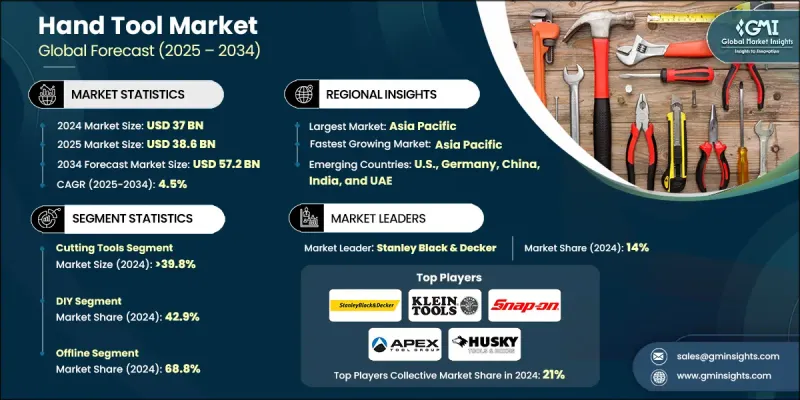
건설, 자동차, 주택 개수 분야 수요 증가에 따라, 소비자나 전문가가 보다 내구성이 높고, 인체공학에 근거한 설계로, 정밀한 공구를 요구하게 되고 있기 때문에 시장은 변혁기를 맞이하고 있습니다. 최신 세대 수공구는 이러한 기대에 부응하기 위해 선진 소재, 다기능 설계, 사용 용이성 향상을 도입하고 있습니다. 소셜미디어의 영향과 인기 있는 주택 리노베이션 컨텐츠에 힘입어 'DIY' 문화의 확대는 특히 젊은 애호가들 사이에서 인지도와 보급률을 더욱 높여줍니다. 전자상거래의 성장은 개인화된 공구 키트와 소비자를 위한 직접 판매를 가능하게 하여 입수 편의성을 향상시킵니다. 산업 사용자는 안전 기준과 생산성 기준을 충족하는 고성능 공구를 계속 요구하고 있으며, 한편으로는 지속가능성과 내구성이 우선사항이 되고 있습니다. 이는 브랜드가 친환경 소재와 재활용 가능한 포장에 주력하는 경향이 강해지기 때문입니다. 이러한 요인의 융합은 혁신과 성장을 가속하고 소비자 중심 시장으로의 전환을 뒷받침하고 있습니다.
| 시장 범위 | |
|---|---|
| 시작 연도 | 2024년 |
| 예측 연도 | 2025-2034년 |
| 시작 금액 | 370억 달러 |
| 예측 금액 | 572억 달러 |
| CAGR | 4.5% |
절삭 공구 부문은 2024년에 39.8%의 점유율을 차지했고 2034년까지 연평균 복합 성장률(CAGR) 4.8%를 보일 것으로 예측됩니다. 절삭 공구는 건설, 자동차, 금속 가공, 목공 등의 산업에서 필수적인 존재로 계속되고 있습니다. 톱, 칼, 니퍼 등의 제품은 전문 및 DIY 환경에서 널리 사용되며, 절삭 공구가 다양한 직종에서 필수적인 역할을 하고 있음을 보여줍니다.
DIY 부문은 2024년 42.9%를 차지하고 2025년부터 2034년까지 CAGR 4.7%를 보일 것으로 예측됩니다. 주택 개수 프로젝트 증가, 자기 수리에 대한 소비자의 신뢰감 증가, 사용하기 쉬운 공구의 보급이 이러한 성장을 뒷받침하고 있습니다. 온라인 튜토리얼과 합리적인 가격의 공구에 쉽게 액세스하면 개인이 전문가의 도움없이 광범위한 프로젝트를 완료 할 수 있습니다.
아시아태평양의 수공구 시장은 급속한 도시화, 확대되는 인프라 프로젝트, 성장하는 DIY 문화에 견인되어 2024년에 35.6%의 점유율을 차지했습니다. 이 지역 시장은 강력한 제조 능력과 국제 수출 성장에 힘입어 개인 애호가부터 산업 규모의 사용자까지 다양한 소비자 부문으로 확산되고 있습니다. 이 다양한 수요는 지역의 꾸준한 성장과 수공구의 지속적인 혁신을 보장합니다.
세계 수공구 시장의 주요 기업으로는 Apex Tool, Milwaukee Tool, Atlas Copco, Husqvarna, Stanley Black & Decker, ChannelLock, Ronix, Husky Tools, Makita, Klein Tools, Snap-on, Ryobi, Robert Bosch, Ingersoll-Rand, Irwin Tools 등이 있습니다. 세계 수공구 시장의 기업은 제품 혁신에 주력하고 진화하는 고객의 요구에 부응하기 위해 인간 공학에 근거한 설계와 다기능성을 갖춘 공구를 도입함으로써 자사의 지위를 강화하고 있습니다. 내구성과 성능을 향상시키는 선진재료에 대한 투자를 실시하는 한편, 액세스성을 높이기 위해 전자상거래 채널과 소비자용 직접 판매의 확충에도 임하고 있습니다. 소매업체, 온라인 플랫폼, 산업 고객과의 전략적 제휴를 통해 유통 네트워크를 강화하고, 소셜 미디어, 튜토리얼, 인플루언서와의 제휴를 통한 마케팅 시책에 따라 성장을 계속하는 DIY층을 타겟으로 하고 있습니다.
자주 묻는 질문
목차
제1장 조사 방법과 범위
제2장 주요 요약
제3장 업계 인사이트
- 생태계 분석
- 공급자의 상황
- 이익률
- 각 단계에서의 부가가치
- 밸류체인에 영향을 주는 요인
- 업계에 미치는 영향요인
- 성장 촉진요인
- 건설 및 제조업 수요 증가
- DIY 문화의 고조와 주택 개수 동향
- 공구재료와 인체공학의 진보
- 업계의 잠재적 위험 및 과제
- 신흥 시장에서의 가격감응도
- 전동 공구 및 자동화 기술과의 경쟁
- 기회
- 인프라 프로젝트가 증가함에 따라 신흥 경제국의 확대
- IoT 통합형 스마트 수공구 개발
- 건설회사 및 소매업체와의 전략적 제휴
- 성장 촉진요인
- 성장 가능성 분석
- 장래 시장 동향
- 기술과 혁신 동향
- 현재의 기술 동향
- 신흥기술
- 가격 동향
- 지역별
- 제품 유형별
- 규제 프레임워크
- 규격 및 컴플라이언스 요건
- 지역별 규제 프레임워크
- 인증기준
- 무역 통계
- 주요 수입국
- 주요 수출국
- Porter's Five Forces 분석
- PESTEL 분석
- 소비자 행동 분석
- 구매 패턴
- 선호 분석
- 지역별 소비자 행동의 차이
- 전자상거래가 구매결정에 미치는 영향
제4장 경쟁 구도
- 소개
- 기업의 시장 점유율 분석
- 지역별
- 기업 매트릭스 분석
- 주요 시장 기업의 경쟁 분석
- 경쟁 포지셔닝 매트릭스
- 주요 발전
- 인수합병
- 제휴 및 협업
- 신제품 발매
- 확대 계획
제5장 시장 추계 및 예측 : 제품 유형별, 2021-2034년
- 주요 동향
- 절삭 공구
- 손 톱
- 톱날
- 칼
- 블레이드
- 전단기
- 가위
- 기타(벼룩 등)
- 타격 공구
- 망치
- 말렛
- 축
- 펀치
- 기타(도끼 등)
- 유지 및 파지 공구
- 펜치
- 바이스
- 클램프
- 인발기 및 추출기
- 기타(통이나 족집게 등)
- 구동 공구
- 성장 촉진요인
- 렌치
- 기타(키류, 헥스 툴 등)
- 측정 및 마킹 툴
- 눈금자
- 캘리퍼
- 마이크로미터
- 게이지 블록
- 레벨기
- 기타(조각도 및 원뿔 등)
- 기타(충격 공구 및 해체 공구 등)
제6장 시장 추계 및 예측 : 기술 유형별, 2021-2034년
- 주요 동향
- 비동력식 수공구
- 동력식 수공구
제7장 시장 추계 및 예측 : 가격별, 2021-2034년
- 주요 동향
- 저가격대(20달러 미만)
- 중가격대(20-100달러)
- 고가격대(100달러 이상)
제8장 시장 추계 및 예측 : 최종 용도별, 2021-2034년
- 주요 동향
- DIY
- 상업용
- 산업용
- 건설
- 전자기기
- 자동차
- 목공
- 항공우주 및 방위산업
- 기타(선박 및 조선 등)
제9장 시장 추계 및 예측 : 유통 채널별, 2021-2034년
- 주요 동향
- 온라인
- 전자상거래
- 회사 웹사이트
- 오프라인
- 슈퍼마켓 및 하이퍼마켓
- 소매 하드웨어 스토어
- 기타
제10장 시장 추계 및 예측 : 지역별, 2021-2034년
- 주요 동향
- 북미
- 미국
- 캐나다
- 유럽
- 독일
- 영국
- 프랑스
- 이탈리아
- 스페인
- 아시아태평양
- 중국
- 인도
- 일본
- 한국
- 호주
- 라틴아메리카
- 브라질
- 멕시코
- 아르헨티나
- 중동 및 아프리카
- 남아프리카
- 사우디아라비아
- 아랍에미리트(UAE)
제11장 기업 프로파일
- Apex Tool
- Atlas Copco
- ChannelLock
- Husky Tools
- Husqvarna
- Ingersoll-Rand
- Irwin Tools
- Klein Tools
- Makita
- Milwaukee Tool
- Robert Bosch
- Ronix
- Ryobi
- Snap-on
- Stanley Black &Decker
The Global Hand Tool Market was valued at USD 37 Billion in 2024 and is estimated to grow at a CAGR of 4.5% to reach USD 57.2 Billion by 2034.
The market is experiencing a transformation as rising demand from construction, automotive, and home improvement sectors pushes consumers and professionals to seek tools that are more durable, ergonomically designed, and precise. The latest generation of hand tools incorporates advanced materials, multifunctional designs, and improved usability to meet these expectations. The expanding "DIY" culture, fueled by social media influence and popular home improvement content, has further increased visibility and adoption, especially among younger hobbyists. Growth in e-commerce has enabled personalized tool kits and direct-to-consumer offerings, improving accessibility. Industrial users continue to demand high-performance tools that comply with safety and productivity standards, while sustainability and durability are becoming priorities as brands increasingly focus on eco-friendly materials and recyclable packaging. This convergence of factors is driving innovation, growth, and a shift toward a consumer-centric market.
| Market Scope | |
|---|---|
| Start Year | 2024 |
| Forecast Year | 2025-2034 |
| Start Value | $37 Billion |
| Forecast Value | $57.2 Billion |
| CAGR | 4.5% |
The cutting tools segment held 39.8% share in 2024 and is expected to grow at a CAGR of 4.8% through 2034. Cutting tools remain essential across industries such as construction, automotive, metalworking, and woodworking. Items like saws, knives, and snips are widely used in both professional and DIY settings, highlighting the indispensable role of cutting tools in multiple trades.
The DIY segment is 42.9% in 2024 and is forecasted to grow at a CAGR of 4.7% from 2025 to 2034. The rise of home improvement projects, increased consumer confidence in self-repair, and the availability of user-friendly tools have fueled this growth. Online tutorials and easy access to affordable tools enable individuals to complete a wide range of projects without professional assistance.
Asia Pacific Hand Tool Market held 35.6% share in 2024, driven by rapid urbanization, expanding infrastructure projects, and a growing DIY culture. The region's market spans diverse consumer segments, from individual hobbyists to industrial-scale users, supported by strong manufacturing capabilities and international export growth. This diverse demand ensures steady regional growth and continuous innovation in hand tools.
Prominent companies in the Global Hand Tool Market include Apex Tool, Milwaukee Tool, Atlas Copco, Husqvarna, Stanley Black & Decker, ChannelLock, Ronix, Husky Tools, Makita, Klein Tools, Snap-on, Ryobi, Robert Bosch, Ingersoll-Rand, and Irwin Tools. Companies in the Global Hand Tool Market are strengthening their position by focusing on product innovation, introducing ergonomically designed and multifunctional tools to meet evolving customer needs. They are investing in advanced materials to improve durability and performance, while also expanding e-commerce channels and direct-to-consumer offerings to increase accessibility. Strategic partnerships with retailers, online platforms, and industrial clients enhance distribution networks, and marketing initiatives target the growing DIY demographic through social media, tutorials, and influencer engagement.
Table of Contents
Chapter 1 Methodology and Scope
- 1.1 Market scope and definition
- 1.2 Research design
- 1.2.1 Research approach
- 1.2.2 Data collection methods
- 1.3 Data mining sources
- 1.3.1 Global
- 1.3.2 Regional/country
- 1.4 Base estimates and calculations
- 1.4.1 Base year calculation
- 1.4.2 Key trends for market estimation
- 1.5 Primary research and validation
- 1.5.1 Primary sources
- 1.6 Forecast model
- 1.7 Research assumptions and limitations
Chapter 2 Executive Summary
- 2.1 Industry 3600 synopsis
- 2.2 Key market trends
- 2.2.1 Regional
- 2.2.2 Product type
- 2.2.3 Technology type
- 2.2.4 Price
- 2.2.5 End use
- 2.2.6 Distribution channel
- 2.3 CXO perspectives: strategic imperatives
- 2.3.1 Key decision points for industry executives
- 2.3.2 Critical success factors for market players
- 2.4 Future outlook and strategic recommendations
Chapter 3 Industry Insights
- 3.1 Industry ecosystem analysis
- 3.1.1 Supplier landscape
- 3.1.2 Profit margin
- 3.1.3 Value addition at each stage
- 3.1.4 Factor affecting the value chain
- 3.2 Industry impact forces
- 3.2.1 Growth drivers
- 3.2.1.1 Growing demand in construction and manufacturing sectors
- 3.2.1.2 Rising DIY culture and home improvement trends
- 3.2.1.3 Advancements in tool materials and ergonomics
- 3.2.2 Industry pitfalls & challenges
- 3.2.2.1 Price sensitivity in emerging markets
- 3.2.2.2 Competition from power tools and automation
- 3.2.3 Opportunities
- 3.2.3.1 Expansion in emerging economies with growing infrastructure projects
- 3.2.3.2 Development of smart hand tools with IoT integration
- 3.2.3.3 Strategic partnerships with construction firms and retailers
- 3.2.1 Growth drivers
- 3.3 Growth potential analysis
- 3.4 Future market trends
- 3.5 Technology and Innovation landscape
- 3.5.1 Current technological trends
- 3.5.2 Emerging technologies
- 3.6 Price trends
- 3.6.1 By region
- 3.6.2 By product type
- 3.7 Regulatory framework
- 3.7.1 standards and compliance requirements
- 3.7.2 Regional regulatory frameworks
- 3.7.3 Certification standards
- 3.8 Trade statistics
- 3.8.1 Major importing countries
- 3.8.2 Major exporting countries
- 3.9 Porter's five forces analysis
- 3.10 PESTEL analysis
- 3.11 Consumer behaviour analysis
- 3.11.1 Purchasing patterns
- 3.11.2 Preference analysis
- 3.11.3 Regional variations in consumer behaviour
- 3.11.4 Impact of e-commerce on buying decisions
Chapter 4 Competitive Landscape, 2024
- 4.1 Introduction
- 4.2 Company market share analysis
- 4.2.1 By region
- 4.2.1.1 North America
- 4.2.1.2 Europe
- 4.2.1.3 Asia Pacific
- 4.2.1.4 Latin America
- 4.2.1.5 MEA
- 4.2.1 By region
- 4.3 Company matrix analysis
- 4.4 Competitive analysis of major market players
- 4.5 Competitive positioning matrix
- 4.6 Key developments
- 4.6.1 Mergers & acquisitions
- 4.6.2 Partnerships & collaborations
- 4.6.3 New product launches
- 4.6.4 Expansion plans
Chapter 5 Market Estimates & Forecast, By Product Type, 2021-2034 (USD Billion) (Million Units)
- 5.1 Key trends
- 5.2 Cutting tools
- 5.2.1 Hand saws
- 5.2.2 Saw blades
- 5.2.3 Knives
- 5.2.4 Blades
- 5.2.5 Shears
- 5.2.6 Scissors
- 5.2.7 Others (chisels, etc.)
- 5.3 Striking tools
- 5.3.1 Hammers
- 5.3.2 Mallets
- 5.3.3 Axes
- 5.3.4 Punches
- 5.3.5 Others (hatchets etc.)
- 5.4 Holding and gripping tools
- 5.4.1 Pliers
- 5.4.2 Vises
- 5.4.3 Clamps
- 5.4.4 Pullers and extractors
- 5.4.5 Others (tongs and tweezers, etc.)
- 5.5 Driving tools
- 5.5.1 Screwdrivers
- 5.5.2 Wrenches
- 5.5.3 Others (keys and hex tools, etc.)
- 5.6 Measuring and marking tools
- 5.6.1 Rulers
- 5.6.2 Calipers
- 5.6.3 Micrometers
- 5.6.4 Gauge blocks
- 5.6.5 Spirit levels
- 5.6.6 Others (scribes and awls, etc.)
- 5.7 Others (impact and demolition tools, etc.)
Chapter 6 Market Estimates & Forecast, By Technology Type, 2021-2034 (USD Billion) (Million Units)
- 6.1 Key trends
- 6.2 Non-powered hand tools
- 6.3 Power-driven hand tools
Chapter 7 Market Estimates & Forecast, By Price, 2021-2034 (USD Billion) (Million Units)
- 7.1 Key trends
- 7.2 Low (below $20)
- 7.3 Medium ($20-$100)
- 7.4 High (above $100)
Chapter 8 Market Estimates & Forecast, By End Use, 2021-2034 (USD Billion) (Million Units)
- 8.1 Key trends
- 8.2 DIY
- 8.3 Commercial
- 8.4 Industrial
- 8.4.1 Construction
- 8.4.2 Electronics
- 8.4.3 Automotive
- 8.4.4 Woodworking
- 8.4.5 Aerospace and defense
- 8.4.6 Others (marine and shipbuilding, etc.)
Chapter 9 Market Estimates & Forecast, By Distribution Channel, 2021-2034 (USD Billion) (Million Units)
- 9.1 Key trends
- 9.2 Online
- 9.2.1 E-commerce
- 9.2.2 Company website
- 9.3 Offline
- 9.3.1 Supermarkets and hypermarkets
- 9.3.2 Retail hardware stores
- 9.3.3 Other
Chapter 10 Market Estimates & Forecast, By Region, 2021-2034 (USD Billion) (Million Units)
- 10.1 Key trends
- 10.2 North America
- 10.2.1 U.S.
- 10.2.2 Canada
- 10.3 Europe
- 10.3.1 Germany
- 10.3.2 UK
- 10.3.3 France
- 10.3.4 Italy
- 10.3.5 Spain
- 10.4 Asia Pacific
- 10.4.1 China
- 10.4.2 India
- 10.4.3 Japan
- 10.4.4 South Korea
- 10.4.5 Australia
- 10.5 Latin America
- 10.5.1 Brazil
- 10.5.2 Mexico
- 10.5.3 Argentina
- 10.6 MEA
- 10.6.1 South Africa
- 10.6.2 Saudi Arabia
- 10.6.3 UAE
Chapter 11 Company Profiles
- 11.1 Apex Tool
- 11.2 Atlas Copco
- 11.3 ChannelLock
- 11.4 Husky Tools
- 11.5 Husqvarna
- 11.6 Ingersoll-Rand
- 11.7 Irwin Tools
- 11.8 Klein Tools
- 11.9 Makita
- 11.10 Milwaukee Tool
- 11.11 Robert Bosch
- 11.12 Ronix
- 11.13 Ryobi
- 11.14 Snap-on
- 11.15 Stanley Black & Decker