|
시장보고서
상품코드
1871277
탄소섬유 복합재료 시장 : 기회, 성장 요인, 업계 동향 분석 및 예측(2025-2034년)Carbon Fiber Composites Market Opportunity, Growth Drivers, Industry Trend Analysis, and Forecast 2025 - 2034 |
||||||

세계의 탄소섬유 복합재료 시장은 2024년 205억 달러로 평가되었고, 2034년까지 연평균 복합 성장률(CAGR) 10%로 성장해 536억 달러에 이를 것으로 예측되고 있습니다.
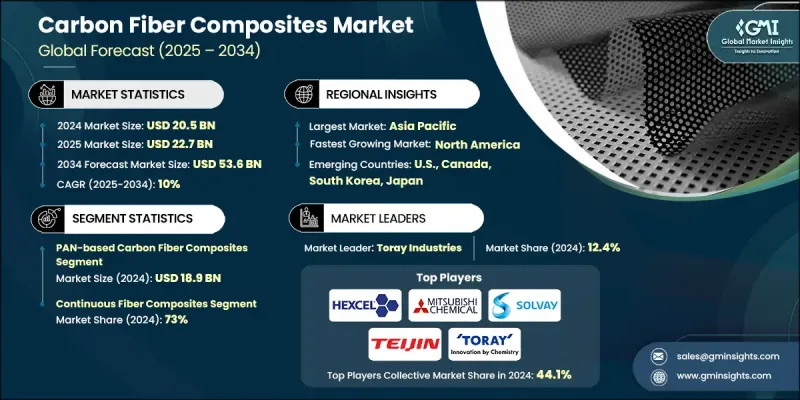
탄소섬유 복합재료는 폴리머 매트릭스에 탄소섬유를 내장한 고급 재료입니다. 이러한 복합재료는 탁월한 강도 중량비, 우수한 내구성, 내식성으로 알려져 있으며, 고성능 산업 분야에서 필수적인 존재가 되고 있습니다. 시장 확대는 주로 자동차산업과 항공우주산업을 중심으로 경량 재료에 대한 수요가 높아지고 있는 것에 기인하고 있습니다. 자동화 및 첨단 수지 시스템과 같은 제조 기술 혁신으로 생산 비용이 크게 줄어들어 대규모 생산이 가능해졌습니다. 또한 지속가능성의 동향으로부터 재생 탄소섬유가 도입되어 환경부하와 비용 절감을 도모하고 있습니다. 덧붙여, 적층 조형이나 3D 프린팅 기술에 의해 탄소섬유 복합재료의 설계 자유도가 확대되는 것과 동시에, 재료 폐기물의 삭감이 진행되고 있습니다. 자동 섬유 배치, 수지 트랜스퍼 성형, 로봇 시스템을 포함한 현대적인 생산 공정의 발전으로 제조 정밀도와 비용 효율성이 향상되었으며, 제조업체는 성능 향상과 재료 최적화로 급증하는 세계 수요에 대응할 수 있게 되었습니다.
| 시장 범위 | |
|---|---|
| 시작 연도 | 2024년 |
| 예측 연도 | 2025-2034년 |
| 시작 금액 | 205억 달러 |
| 예측 금액 | 536억 달러 |
| CAGR | 10% |
PAN계 탄소섬유 복합재료 부문은 2024년 189억 달러 시장 규모를 창출했습니다. 이 부문은 폴리 아크릴로 니트릴(PAN) 전구체 시스템의 신뢰성과 기술 성숙도를 배경으로 업계를 선도하고 있습니다. 일관된 품질은 큰 강점이며 제조업체가 경쟁 우위를 유지하는 데 도움이 됩니다. 엄격한 품질보증 절차와 엄격한 시험기준으로 다양한 산업용도에서 PAN계 복합재의 신뢰성이 더욱 높아지고 있습니다.
연속 섬유 복합재료 부문은 2024년 73%의 점유율을 차지했습니다. 이러한 재료는 특히 자동차, 신재생에너지, 항공우주 등의 분야에서 높은 강성과 강도가 요구되는 응용 분야에서 선호됩니다. 이러한 복합재의 제조 공정은 정확한 섬유 배향과 일관된 배치를 보장하는 정밀 기술로 전환하고 있습니다. 이러한 진화는 성능을 향상시킬 뿐만 아니라 폐기물 및 전반적인 재료 사용량을 줄이고 생산주기 전반에 걸쳐 비용 효율성과 지속가능성을 높입니다.
북미의 탄소섬유 복합재료 시장은 2025년부터 2034년까지 CAGR 10%로 성장할 전망입니다. 인프라, 항공우주, 자동차 산업에 있어서의 고강도 및 경량 재료의 채용 증가가 지역적인 확대를 견인하고 있습니다. 전기자동차의 생산 증가와 항공우주 산업의 기술 진보가 수요를 더욱 밀어 올리고 있습니다. 게다가 자동 섬유 배치나 수지 트랜스퍼 성형 등 생산 기술의 지속적인 진보가 제조 효율과 제품 전체의 성능 향상에 계속 기여하고 있습니다. 고성능 복합재료에 대한 수요 증가가 북미 전역에서 업계 성장을 가속시키는 주요 요인으로 계속되고 있습니다.
세계의 탄소섬유 복합재료 시장에서 주요 기업으로는 Toray Industries, SGL Carbon, Mitsubishi Chemical Corporation, Solvay S.A., Formosa Plastics Corporation, Zoltek Companies, Inc., Teijin Limited, Nippon Graphite Fiber, Hexcel Corporation, Hengshen 등이 참가하고 있습니다. 탄소섬유 복합재료 시장의 주요 기업은 시장에서의 지위를 강화하기 위해 다양한 전략을 실시했습니다. Toray Industries, Solvay S.A., Teijin Limited 등의 기업은 생산 효율 향상과 비용 절감을 목적으로 첨단 제조 기술에 대규모 투자를 실시했습니다. 전략적 제휴 및 합병은 각 회사가 제품 포트폴리오를 확대하고 새로운 지역 시장에 액세스하는 데 도움이 됩니다. 지속적인 R&D 투자는 재활용성을 향상시킨 고성능, 지속가능한 복합재료 개발을 향하고 있습니다. 제조업체는 또한 정밀도와 확장성을 높이기 위해 자동화, 로봇, AI 구동 시스템의 통합을 추진하고 있습니다.
자주 묻는 질문
목차
제1장 조사 방법과 범위
제2장 주요 요약
제3장 업계 인사이트
- 생태계 분석
- 공급자의 상황
- 이익률
- 각 단계에서의 부가가치
- 밸류체인에 영향을 주는 요인
- 혁신
- 업계에 미치는 영향요인
- 성장 촉진요인
- 항공우주 및 자동차 산업에서의 경량화 수요
- 재생에너지 인프라 확충
- 첨단 제조 공정 도입
- 업계의 잠재적 위험 및 과제
- 원재료비 및 제조비용 상승
- 대형 토우 용도에서의 기술적 장벽
- 시장 기회
- 재생 탄소섬유 시장 시장 개척
- 3D 프린팅 및 적층 조형 기술의 응용 분야
- 성장 촉진요인
- 성장 가능성 분석
- 규제 상황
- 북미
- 유럽
- 아시아태평양
- 라틴아메리카
- 중동 및 아프리카
- Porter's Five Forces 분석
- PESTEL 분석
- 기술과 혁신의 상황
- 현재의 기술 동향
- 신흥기술
- 가격 동향
- 지역별
- 전구체 유형별
- 장래 시장 동향
- 특허 상황
- 무역 통계(HS코드)(참고: 무역 통계는 주요 국가에서만 제공됨)
- 주요 수입국
- 주요 수출국
- 지속가능성과 환경적 측면
- 지속가능한 대처
- 폐기물 감축 전략
- 생산에 있어서의 에너지 효율
- 환경에 배려한 대처
- 탄소발자국에 대한 배려
제4장 경쟁 구도
- 소개
- 기업의 시장 점유율 분석
- 지역별
- 북미
- 유럽
- 아시아태평양
- 라틴아메리카
- 중동 및 아프리카
- 지역별
- 기업 매트릭스 분석
- 주요 시장 기업의 경쟁 분석
- 경쟁 포지셔닝 매트릭스
- 주요 발전
- 인수합병
- 제휴 및 협업
- 신제품 발매
- 확대 계획
제5장 시장 추계 및 예측 : 전구체 유형별, 2021-2034년
- 주요 동향
- PAN계 탄소섬유 복합재료
- 피치계 탄소섬유 복합재료
제6장 시장 추계 및 예측 : 섬유 형태별, 2021-2034년
- 주요 동향
- 연속 섬유 복합재료
- 불연속 섬유 복합재료
제7장 시장 추계 및 예측 : 섬유 유형별, 2021-2034년
- 주요 동향
- 표준 탄성률(SM)
- 중간 탄성률(IM)
- 고탄성률(HM)
- 초고탄성률(UHM)
제8장 시장 추계 및 예측 : 최종 이용 산업별, 2021-2034년
- 주요 동향
- 항공우주 및 방위
- 상용항공
- 군 및 방위
- 우주 및 위성
- 무인 항공기
- 자동차
- 전기자동차
- 고급 및 고성능 차량
- 모터스포츠
- 상용차
- 신재생에너지
- 풍력에너지
- 태양광 에너지
- 수력 발전
- 해양
- 레크리에이션용 선박
- 상업선박
- 해군 및 방위 해양
- 건설 및 인프라
- 건축 및 건설
- 교량 및 인프라
- 내진 보강
- 스포츠 및 레크리에이션
- 의료 및 헬스케어
- 장비
- 의료기기
- 재활 장비
- 기타
- 전자기기 및 기술
- 제조 및 산업기기
- 에너지 저장 및 발전
제9장 시장 추계 및 예측 : 지역별, 2021-2034년
- 주요 동향
- 북미
- 미국
- 캐나다
- 유럽
- 독일
- 영국
- 프랑스
- 스페인
- 이탈리아
- 기타 유럽
- 아시아태평양
- 중국
- 인도
- 일본
- 호주
- 한국
- 기타 아시아태평양
- 라틴아메리카
- 브라질
- 멕시코
- 아르헨티나
- 기타 라틴아메리카
- 중동 및 아프리카
- 사우디아라비아
- 남아프리카
- 아랍에미리트(UAE)
- 기타 중동 및 아프리카
제10장 기업 프로파일
- Formosa Plastics Corporation
- Hengshen
- Hexcel Corporation
- Mitsubishi Chemical Corporation
- Nippon Graphite Fiber
- SGL Carbon
- Solvay SA
- Teijin Limited
- Toray Industries
- Zoltek Companies, Inc.
The Global Carbon Fiber Composites Market was valued at USD 20.5 billion in 2024 and is estimated to grow at a CAGR of 10% to reach USD 53.6 billion by 2034.
Carbon fiber composites are advanced materials composed of carbon fibers embedded in a polymer matrix. These composites are recognized for their exceptional strength-to-weight ratio, superior durability, and corrosion-resistant nature, making them essential across high-performance industries. The market's expansion is primarily fueled by the increasing need for lightweight materials, particularly within the automotive and aerospace industries. Technological innovations in manufacturing, such as automation and advanced resin systems, have notably reduced production costs, enabling mass-scale manufacturing. Sustainability trends have also introduced recycled carbon fiber, minimizing environmental impact and cost. In addition, additive manufacturing and 3D printing technologies are broadening the design flexibility of carbon fiber composites while cutting material waste. The advancement of modern production processes, including automated fiber placement, resin transfer molding, and robotic systems, has improved manufacturing precision and cost efficiency, allowing manufacturers to meet surging global demand with enhanced performance and material optimization.
| Market Scope | |
|---|---|
| Start Year | 2024 |
| Forecast Year | 2025-2034 |
| Start Value | $20.5 Billion |
| Forecast Value | $53.6 Billion |
| CAGR | 10% |
The PAN-based carbon fiber composites segment generated USD 18.9 billion in 2024. This segment dominates the industry, driven by the reliability and technological maturity of polyacrylonitrile (PAN) precursor systems. Consistent quality has been a major advantage, helping manufacturers maintain a competitive edge. Strict quality assurance procedures and rigorous testing standards continue to strengthen the credibility of PAN-based composites in various industrial applications.
The continuous fiber composites segment held a 73% share in 2024. These materials are preferred for applications demanding high stiffness and strength, particularly in sectors such as automotive, renewable energy, and aerospace. Manufacturing processes for these composites are shifting toward precision-driven technologies that ensure accurate fiber orientation and consistent placement. This evolution not only improves performance but also reduces waste and overall material use, leading to higher cost-effectiveness and sustainability across production cycles.
North American Carbon Fiber Composites Market will grow at a CAGR of 10% between 2025 and 2034. Rising adoption of high-strength, lightweight materials in the infrastructure, aerospace, and automotive industries is driving regional expansion. Increasing electric vehicle production and technological advancements in the aerospace industry are further propelling demand. Additionally, ongoing progress in production technologies such as automated fiber placement and resin transfer molding continues to enhance manufacturing efficiency and overall product performance. The growing preference for high-performance composite materials remains the key factor accelerating industry growth across North America.
Major companies active in the Global Carbon Fiber Composites Market include Toray Industries, SGL Carbon, Mitsubishi Chemical Corporation, Solvay S.A., Formosa Plastics Corporation, Zoltek Companies, Inc., Teijin Limited, Nippon Graphite Fiber, Hexcel Corporation, and Hengshen. Leading players in the Carbon Fiber Composites Market are implementing diverse strategies to strengthen their market foothold. Companies such as Toray Industries, Solvay S.A., and Teijin Limited are investing heavily in advanced manufacturing technologies to boost production efficiency and reduce costs. Strategic collaborations and mergers are helping firms expand their product portfolios and access new regional markets. Continuous R&D investments are directed toward developing high-performance, sustainable composite materials with improved recyclability. Manufacturers are also integrating automation, robotics, and AI-driven systems to enhance precision and scalability.
Table of Contents
Chapter 1 Methodology & Scope
- 1.1 Market scope and definition
- 1.2 Research design
- 1.2.1 Research approach
- 1.2.2 Data collection methods
- 1.3 Data mining sources
- 1.3.1 Global
- 1.3.2 Regional/Country
- 1.4 Base estimates and calculations
- 1.4.1 Base year calculation
- 1.4.2 Key trends for market estimation
- 1.5 Primary research and validation
- 1.5.1 Primary sources
- 1.6 Forecast model
- 1.7 Research assumptions and limitations
Chapter 2 Executive Summary
- 2.1 Industry 3600 synopsis
- 2.2 Key market trends
- 2.2.1 Precursor type trends
- 2.2.2 Fiber form trends
- 2.2.3 Fiber type trends
- 2.2.4 End use industry trends
- 2.2.5 Regional trends
- 2.3 TAM Analysis, 2025-2034
- 2.4 CXO perspectives: strategic imperatives
- 2.4.1 Executive decision points
- 2.4.2 Critical success factors
- 2.5 Future outlook and strategic recommendations
Chapter 3 Industry Insights
- 3.1 Industry ecosystem analysis
- 3.1.1 Supplier landscape
- 3.1.2 Profit margin
- 3.1.3 Value addition at each stage
- 3.1.4 Factor affecting the value chain
- 3.1.5 Disruptions
- 3.2 Industry impact forces
- 3.2.1 Growth drivers
- 3.2.1.1 Lightweighting demand in aerospace & automotive
- 3.2.1.2 Renewable energy infrastructure expansion
- 3.2.1.3 Advanced manufacturing process adoption
- 3.2.2 Industry pitfalls and challenges
- 3.2.2.1 High raw material & manufacturing costs
- 3.2.2.2 Technical barriers in large tow applications
- 3.2.3 Market opportunities
- 3.2.3.1 Recycled carbon fiber market development
- 3.2.3.2 3D printing & additive manufacturing applications
- 3.2.1 Growth drivers
- 3.3 Growth potential analysis
- 3.4 Regulatory landscape
- 3.4.1 North America
- 3.4.2 Europe
- 3.4.3 Asia Pacific
- 3.4.4 Latin America
- 3.4.5 Middle East & Africa
- 3.5 Porter's analysis
- 3.6 PESTEL analysis
- 3.7 Technology and Innovation landscape
- 3.7.1 Current technological trends
- 3.7.2 Emerging technologies
- 3.8 Price trends
- 3.8.1 By region
- 3.8.2 By precursor type
- 3.9 Future market trends
- 3.10 Patent landscape
- 3.11 Trade statistics (HS code) (Note: the trade statistics will be provided for key countries only)
- 3.11.1 Major importing countries
- 3.11.2 Major exporting countries
- 3.12 Sustainability and environmental aspects
- 3.12.1 Sustainable practices
- 3.12.2 Waste reduction strategies
- 3.12.3 Energy efficiency in production
- 3.12.4 Eco-friendly initiatives
- 3.13 Carbon footprint consideration
Chapter 4 Competitive Landscape, 2024
- 4.1 Introduction
- 4.2 Company market share analysis
- 4.2.1 By region
- 4.2.1.1 North America
- 4.2.1.2 Europe
- 4.2.1.3 Asia Pacific
- 4.2.1.4 LATAM
- 4.2.1.5 MEA
- 4.2.1 By region
- 4.3 Company matrix analysis
- 4.4 Competitive analysis of major market players
- 4.5 Competitive positioning matrix
- 4.6 Key developments
- 4.6.1 Mergers & acquisitions
- 4.6.2 Partnerships & collaborations
- 4.6.3 New product launches
- 4.6.4 Expansion plans
Chapter 5 Market Estimates and Forecast, By Precursor Type, 2021-2034 (USD Billion) (Kilo Tons)
- 5.1 Key trends
- 5.2 PAN-based carbon fiber composites
- 5.3 Pitch-based carbon fiber composites
Chapter 6 Market Estimates and Forecast, By Fiber Form, 2021-2034 (USD Billion) (Kilo Tons)
- 6.1 Key trends
- 6.2 Continuous fiber composites
- 6.3 Discontinuous fiber composites
Chapter 7 Market Estimates and Forecast, By Fiber Type, 2021-2034 (USD Billion) (Kilo Tons)
- 7.1 Key trends
- 7.2 Standard modulus (SM)
- 7.3 Intermediate modulus (IM)
- 7.4 High modulus (HM)
- 7.5 Ultra-high modulus (UHM)
Chapter 8 Market Estimates and Forecast, By End Use Industry, 2021-2034 (USD Billion) (Kilo Tons)
- 8.1 Key trends
- 8.2 Aerospace & defense
- 8.2.1 Commercial aviation
- 8.2.2 Military & defense
- 8.2.3 Space & satellite
- 8.2.4 Unmanned aerial vehicles
- 8.3 Automotive
- 8.3.1 Electric vehicle
- 8.3.2 Luxury & performance vehicle
- 8.3.3 Motorsports
- 8.3.4 Commercial vehicle
- 8.4 Renewable energy
- 8.4.1 Wind energy
- 8.4.2 Solar energy
- 8.4.3 Hydroelectric
- 8.5 Marine
- 8.5.1 Recreational marine
- 8.5.2 Commercial marine
- 8.5.3 Naval & defense marine
- 8.6 Construction & infrastructure
- 8.6.1 Building & construction
- 8.6.2 Bridge & infrastructure
- 8.6.3 Seismic retrofitting
- 8.7 Sports & recreation
- 8.8 Healthcare & medical
- 8.8.1 Prosthetics & orthotics
- 8.8.2 Medical device
- 8.8.3 Rehabilitation equipment
- 8.9 Others
- 8.9.1 Electronics & technology
- 8.9.2 Manufacturing & industrial equipment
- 8.9.3 Energy storage & power generation
Chapter 9 Market Estimates and Forecast, By Region, 2021-2034 (USD Billion) (Kilo Tons)
- 9.1 Key trends
- 9.2 North America
- 9.2.1 U.S.
- 9.2.2 Canada
- 9.3 Europe
- 9.3.1 Germany
- 9.3.2 UK
- 9.3.3 France
- 9.3.4 Spain
- 9.3.5 Italy
- 9.3.6 Rest of Europe
- 9.4 Asia Pacific
- 9.4.1 China
- 9.4.2 India
- 9.4.3 Japan
- 9.4.4 Australia
- 9.4.5 South Korea
- 9.4.6 Rest of Asia Pacific
- 9.5 Latin America
- 9.5.1 Brazil
- 9.5.2 Mexico
- 9.5.3 Argentina
- 9.5.4 Rest of Latin America
- 9.6 Middle East and Africa
- 9.6.1 Saudi Arabia
- 9.6.2 South Africa
- 9.6.3 UAE
- 9.6.4 Rest of Middle East and Africa
Chapter 10 Company Profiles
- 10.1 Formosa Plastics Corporation
- 10.2 Hengshen
- 10.3 Hexcel Corporation
- 10.4 Mitsubishi Chemical Corporation
- 10.5 Nippon Graphite Fiber
- 10.6 SGL Carbon
- 10.7 Solvay S.A.
- 10.8 Teijin Limited
- 10.9 Toray Industries
- 10.10 Zoltek Companies, Inc.