
|
시장보고서
상품코드
1876554
헬스 모니터링 카시트 시장 기회, 성장 촉진요인, 업계 동향 분석 및 예측(2025-2034년)Health-Monitoring Car Seat Market Opportunity, Growth Drivers, Industry Trend Analysis, and Forecast 2025 - 2034 |
||||||

세계의 헬스 모니터링 카시트 시장은 2024년 4억 2,690만 달러로 평가되었으며, 2034년까지 연평균 복합 성장률(CAGR) 21.8%를 나타내 30억 2,000만 달러에 이를 것으로 예측됩니다.
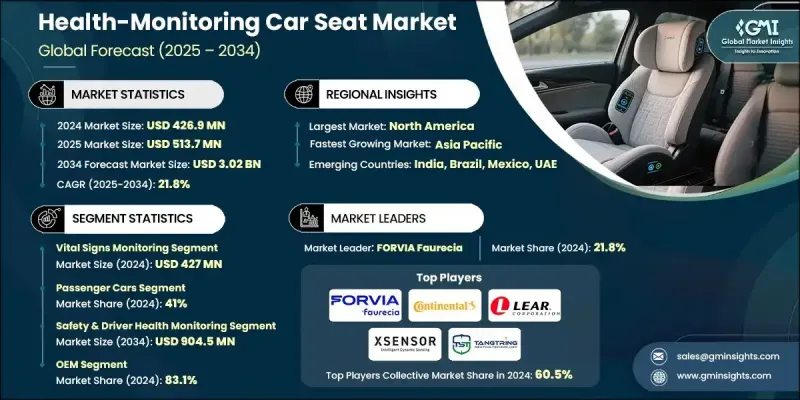
개인의 건강과 웰빙에 대한 관심 증가가 헬스 모니터링 기술을 탑재한 스마트 카시트 수요를 견인하고 있습니다. 소비자는 활력 징후, 피로, 스트레스를 추적하는 안전 기능을 점점 더 중시하고 있으며, 자동차 제조업체는 생체 인증 센서와 AI 탑재 웰빙 시스템을 통합하도록 촉구되고 있습니다. 웨어러블 전극, 센서, 인공지능의 진보에 의해 승무원의 심박수, 호흡, 자세의 리얼타임 모니터링이 가능하게 되어, 예측적인 건강 경보, 개인화된 쾌적성, 운전 안전성의 향상을 실현하고 있습니다. 수량 기준으로 시장 규모는 2024년 32만 2천대 이상에서 2030년까지 85만 6천대로 확대될 것으로 예측됩니다. 차량의 연결성과 자율주행화가 진행되고 있는 가운데, 차내 헬스 모니터링은 승무원의 건강 상태를 지속적으로 추적해, 예방적 안전 대책을 지원하는 중요한 차별화 요소로서 대두하고 있습니다.
| 시장 범위 | |
|---|---|
| 시작 연도 | 2024년 |
| 예측 기간 | 2025-2034년 |
| 시작 가치 | 4억 2,690만 달러 |
| 예측 금액 | 30억 2,000만 달러 |
| CAGR | 21.8% |
바이탈 사인 모니터링 부문은 2024년 4억 2,700만 달러 시장 규모를 기록했으며, 2034년까지 연평균 복합 성장률(CAGR) 21.3%를 나타낼 전망입니다. 이 부문은 시트에 내장된 정전용량식 심전도 센서로 심박수, 혈압, 호흡을 측정하여 안정적이고 안정적인 신호를 제공합니다. 규제 요건과 운전자의 건강에 대한 소비자의 의식이 증가함에 따라 상용차 함대와 고급 자동차 제조업체들 사이에서 특히 인기가 높아지고 있습니다.
승용차 부문은 2024년 41%의 점유율을 차지했습니다. SUV나 세단에 있어서, 바이탈 사인·자세·피로를 감시해, 리얼타임 경보와 커스터마이즈 가능한 쾌적성을 제공하는 AI 탑재 시트 시스템의 채용이 증가하고 있기 때문입니다.
2024년 미국의 헬스 모니터링 카시트 시장은 7,280만 달러와 85.4%의 점유율을 차지했습니다. 미국 자동차 제조업체는 특히 고급 자동차 부문에서 헬스 모니터링 기술의 통합을 이끌고 추진하고 있습니다. 상업용 운전자의 건강에 초점을 맞춘 규제 체계는 함대 사업에서 이러한 시스템의 채택을 더욱 촉진하고 탑승자의 안전과 건강을 촉진합니다.
세계 헬스 모니터링 카시트 시장의 주요 기업으로는 Tantring Seating Technology, ZF Friedrichshafen AG, Visteon Corporation, Continental AG, NOVELDA, Robert Bosch GmbH, FORVIA Faurecia, Lear, Yanfeng, XSENSOR Technology 등이 있습니다. 헬스 모니터링 카시트 시장의 기업은 시장에서의 존재감을 강화하고 비계를 확장하기 위해 몇 가지 전략을 채택하고 있습니다. 센서의 정밀도, AI 구동 분석, 시트의 쾌적성 기능을 강화하기 위한 연구개발에 투자하고 있습니다. 자동차 제조업체와 건강 기술 제공업체와의 제휴로 첨단 모니터링 시스템의 혁신과 통합이 가속화되고 있습니다. 기업은 안전성과 사용자 경험을 개선하는 맞춤형 예측 가능한 웰빙 기능을 통해 제품 차별화에 주력하고 있습니다.
자주 묻는 질문
목차
제1장 조사 방법
- 시장 범위와 정의
- 조사 설계
- 조사 접근
- 데이터 수집 방법
- 데이터 마이닝의 출처
- 세계
- 지역별/국가별
- 기본 추정치와 계산
- 기준연도 계산
- 시장 추정에서의 주요 동향
- 1차 조사 및 검증
- 1차 정보
- 예측
- 조사의 전제조건과 제한 사항
제2장 주요 요약
제3장 업계 인사이트
- 생태계 분석
- 공급자의 상황
- 이익률 분석
- 비용 구조
- 각 단계에서의 부가가치
- 밸류체인에 영향을 주는 요인
- 파괴적 혁신
- 업계에 미치는 영향요인
- 성장 촉진요인
- 높아지는 건강 의식
- 센서 및 AI의 기술적 진보
- 규제 및 안전 기준
- 커넥티드카 및 자율주행차의 성장
- 개인화된 차내 경험에 대한 소비자 수요 증가
- 업계의 잠재적 위험 및 과제
- 도입 비용의 높이
- 데이터 프라이버시 및 보안에 대한 우려 사항
- 시장 기회
- 웨어러블 기기 및 건강 앱과의 제휴
- 전기차 및 고급차 시장에서의 확대
- AI 구동형 예측 의료 분석
- 신흥 시장과 도시화
- 성장 촉진요인
- 성장 가능성 분석
- 규제 상황
- Porter's Five Forces 분석
- PESTEL 분석
- 기술과 혁신 동향
- 현행 기술
- 신흥기술
- 특허 분석
- 가격 동향 분석
- 구성 요소별
- 지역별
- 코스트 내역 분석
- 생산 통계
- 생산 거점
- 소비 거점
- 수출과 수입
- 지속가능성과 환경적 측면
- 지속가능한 실천
- 폐기물 감축 전략
- 생산에 있어서 에너지 효율
- 환경에 배려한 대처
- 탄소발자국에 관한 고려 사항
- 장래의 동향
- 주요 시장 동향과 변화 요인
- 비용 편익 분석 및 투자 이익률 모델
- 총소유비용분석
- 투자이익률(ROI)의 산출
- 비용 절감 로드맵(15-20% 감소, -2030년)
- 시장 부문별 가치 제안
- 사용자 체험과 인체공학
- 인체공학에 기초한 설계상의 고려 사항
- 사용자 수용 및 도입 장벽
- 문화적·지역적인 기호
- 액세서빌러티와 유니버설 디자인
- 미래 전망과 기술 로드맵
- 기술 진화 로드맵(2025-2035년)
- 신흥 용도과 이용 사례
- 자율주행 차량과의 통합
- 5G 및 엣지 컴퓨팅의 영향
제4장 경쟁 구도
- 서론
- 기업의 시장 점유율 분석
- 북미
- 유럽
- 아시아태평양
- 라틴아메리카
- 중동 및 아프리카
- 주요 시장 기업의 경쟁 분석
- 경쟁 포지셔닝 매트릭스
- 전략적 전망 매트릭스
- 주요 뉴스와 대처
- 인수 및 합병
- 파트너십 및 협력
- 신제품 발매
- 사업 확장 계획과 자금 조달
제5장 시장 추계·예측 : 기능별(2021-2034년)
- 주요 동향
- 생체 신호 모니터링
- 자세 및 좌석 압력 모니터링
- 피로 및 졸음 감지
- 생체 인식 센싱
- 열 및 탑승자 쾌적도 센싱
- 다중 매개변수 및 통합 센싱
제6장 시장 추계·예측 : 차량별(2021-2034년)
- 주요 동향
- 승용차
- 해치백
- 세단
- SUV
- 상용차
- LCV
- MCV
- HCV
- 전기자동차
- BEV
- PHEV
- FCEV
제7장 시장 추계·예측 : 판매 채널별(2021-2034년)
- 주요 동향
- OEM
- 애프터마켓
제8장 시장 추계·예측 : 용도별(2021-2034년)
- 주요 동향
- 안전 및 운전자 건강 모니터링
- 편의성 및 인체공학 개선
- 웰니스 및 예방 건강 관리
- 차량 운전자 모니터링
- 기타
제9장 시장 추계·예측 : 지역별(2021-2034년)
- 주요 동향
- 북미
- 미국
- 캐나다
- 유럽
- 독일
- 영국
- 프랑스
- 이탈리아
- 스페인
- 북유럽 국가
- 네덜란드
- 러시아
- 아시아태평양
- 중국
- 인도
- 일본
- ANZ
- 싱가포르
- 태국
- 베트남
- 한국
- 라틴아메리카
- 브라질
- 멕시코
- 아르헨티나
- 중동 및 아프리카
- 남아프리카
- 사우디아라비아
- 아랍에미리트(UAE)
제10장 기업 프로파일
- 세계의 기업
- Continental AG
- Denso Corporation
- FORVIA(Faurecia)
- Lear
- Magna International Inc.
- Robert Bosch GmbH
- Valeo SA
- ZF Friedrichshafen AG
- 지역 기업
- Aptiv PLC
- Autoliv AB
- Gentex Corporation
- HARMAN International(Samsung)
- Hyundai Mobis
- Infineon Technologies AG
- Joyson Safety Systems
- NOVELDA
- Tangtring Seating Technology Inc.
- Visteon Corporation
- XSENSOR Technology
- Yanfeng
- Technology Specialists(Components/Sensors)
- NXP Semiconductors
- Sensirion AG
- STMicroelectronics
- TDK Corporation
- TE Connectivity
- Texas Instruments
- 신흥기업/스타트업
- Comfort Motion Global
- ContinUse Biometrics
- Neteera Technologies
The Global Health-Monitoring Car Seat Market was valued at USD 426.9 million in 2024 and is estimated to grow at a CAGR of 21.8% to reach USD 3.02 billion by 2034.
The rising focus on personal health and wellness is driving the demand for smart automotive seats equipped with health-monitoring technologies. Consumers are increasingly prioritizing safety features that track vital signs, fatigue, and stress, encouraging automakers to integrate biometric sensors and AI-enabled wellness systems. Advances in wearable electrodes, sensors, and artificial intelligence now enable real-time monitoring of occupants' heart rate, respiration, and posture, allowing predictive health alerts, personalized comfort, and enhanced driving safety. In terms of units, the market is expected to expand from over 322K in 2024 to 856K by 2030. As vehicles become more connected and autonomous, in-cabin health monitoring is emerging as a key differentiator, enabling continuous tracking of occupant wellbeing and supporting proactive safety measures.
| Market Scope | |
|---|---|
| Start Year | 2024 |
| Forecast Year | 2025-2034 |
| Start Value | $426.9 Million |
| Forecast Value | $3.02 Billion |
| CAGR | 21.8% |
The vital signs monitoring segment generated USD 427 million in 2024 and will grow at a CAGR of 21.3% through 2034. This segment captures heart rate, blood pressure, and respiration via capacitive ECG sensors embedded in the seat, delivering reliable and consistent signals. It is particularly popular among commercial fleets and high-end vehicle manufacturers, driven by regulatory requirements and growing consumer awareness of driver health.
The passenger cars segment held a share of 41% in 2024, as SUVs and sedans increasingly incorporate AI-enabled seat systems that monitor vital signs, posture, and fatigue, providing real-time alerts and customizable comfort.
U.S. Health-Monitoring Car Seat Market held 85.4% share in 2024, valued at USD 72.8 million. US automakers are spearheading the integration of health-monitoring technologies, particularly in premium vehicle segments. Regulatory frameworks focusing on commercial driver health further encourage the adoption of such systems in fleet operations, promoting occupant safety and well-being.
Key players in the Global Health-Monitoring Car Seat Market include Tangtring Seating Technology, ZF Friedrichshafen AG, Visteon Corporation, Continental AG, NOVELDA, Robert Bosch GmbH, FORVIA Faurecia, Lear, Yanfeng, and XSENSOR Technology. Companies in the health-monitoring car seat market are adopting several strategies to strengthen their market presence and expand their foothold. They are investing in research and development to enhance sensor accuracy, AI-driven analytics, and seat comfort features. Collaborations with automakers and health technology providers accelerate innovation and integration of advanced monitoring systems. Firms are focusing on product differentiation through customizable and predictive wellness features that enhance safety and user experience.
Table of Contents
Chapter 1 Methodology
- 1.1 Market scope and definition
- 1.2 Research design
- 1.2.1 Research approach
- 1.2.2 Data collection methods
- 1.3 Data mining sources
- 1.3.1 Global
- 1.3.2 Regional/Country
- 1.4 Base estimates and calculations
- 1.4.1 Base year calculation
- 1.4.2 Key trends for market estimation
- 1.5 Primary research and validation
- 1.5.1 Primary sources
- 1.6 Forecast
- 1.7 Research assumptions and limitations
Chapter 2 Executive Summary
- 2.1 Industry 3600 synopsis, 2021 - 2034
- 2.2 Key market trends
- 2.2.1 Feature
- 2.2.2 Vehicle
- 2.2.3 Sales channel
- 2.2.4 Application
- 2.2.5 Regional
- 2.3 TAM Analysis, 2025-2034
- 2.4 CXO perspectives: Strategic imperatives
- 2.4.1 Executive decision points
- 2.4.2 Critical success factors
- 2.5 Future outlook and strategic recommendations
Chapter 3 Industry Insights
- 3.1 Industry ecosystem analysis
- 3.1.1 Supplier landscape
- 3.1.2 Profit margin analysis
- 3.1.3 Cost structure
- 3.1.4 Value addition at each stage
- 3.1.5 Factor affecting the value chain
- 3.1.6 Disruptions
- 3.2 Industry impact forces
- 3.2.1 Growth drivers
- 3.2.1.1 Rising health awareness
- 3.2.1.2 Technological advancements in sensors and ai
- 3.2.1.3 Regulatory and safety standards
- 3.2.1.4 Connected and autonomous vehicle growth
- 3.2.1.5 Increasing consumer demand for personalized in-cabin experience
- 3.2.2 Industry pitfalls and challenges
- 3.2.2.1 High implementation cost
- 3.2.2.2 Data privacy and security concerns
- 3.2.3 Market opportunities
- 3.2.3.1 Integration with wearables and health apps
- 3.2.3.2 Expansion in electric and premium vehicles
- 3.2.3.3 Ai-driven predictive health analytics
- 3.2.3.4 Emerging markets and urbanization
- 3.2.1 Growth drivers
- 3.3 Growth potential analysis
- 3.4 Regulatory landscape
- 3.4.1 North America
- 3.4.2 Europe
- 3.4.3 Asia Pacific
- 3.4.4 Latin America
- 3.4.5 Middle east and Africa
- 3.5 Porter's analysis
- 3.6 PESTEL analysis
- 3.7 Technology and Innovation landscape
- 3.7.1 Current technology
- 3.7.2 Emerging technology
- 3.8 Patent analysis
- 3.9 Price Trends Analysis
- 3.9.1 By component
- 3.9.2 By region
- 3.10 Cost Breakdown Analysis
- 3.11 Production statistics
- 3.11.1 Production hubs
- 3.11.2 Consumption hubs
- 3.11.3 Export and import
- 3.12 Sustainability and Environmental Aspects
- 3.12.1 Sustainable Practices
- 3.12.2 Waste Reduction Strategies
- 3.12.3 Energy Efficiency in Production
- 3.12.4 Eco-friendly Initiatives
- 3.12.5 Carbon Footprint Considerations
- 3.13 Future trends
- 3.14 Major market trends and disruptions
- 3.15 Cost-benefit analysis & roi models
- 3.15.1 Total cost of ownership analysis
- 3.15.2 Return on investment calculations
- 3.15.3 Cost reduction roadmap(15-20% decline by 2030)
- 3.15.4 Value proposition by market segment
- 3.16 User experience & human factors
- 3.16.1 Ergonomic design considerations
- 3.16.2 User acceptance & adoption barriers
- 3.16.3 Cultural & regional preferences
- 3.16.4 Accessibility & universal design
- 3.17 Future outlook & technology roadmap
- 3.17.1 Technology evolution roadmap (2025-2035)
- 3.17.2 Emerging applications & use cases
- 3.17.3 Integration with autonomous vehicles
- 3.17.4. 5 G & edge computing impact
Chapter 4 Competitive Landscape, 2024
- 4.1 Introduction
- 4.2 Company market share analysis
- 4.2.1 North America
- 4.2.2 Europe
- 4.2.3 Asia Pacific
- 4.2.4 LATAM
- 4.2.5 MEA
- 4.3 Competitive analysis of major market players
- 4.4 Competitive positioning matrix
- 4.5 Strategic outlook matrix
- 4.6 Key news and initiatives
- 4.6.1 Mergers & acquisitions
- 4.6.2 Partnerships & collaborations
- 4.6.3 New Product Launches
- 4.6.4 Expansion Plans and funding
Chapter 5 Market Estimates & Forecast, By Feature, 2021 - 2034 ($Mn, Units)
- 5.1 Key trends
- 5.2 Vital signs monitoring
- 5.3 Posture/seat-pressure monitoring
- 5.4 Fatigue/drowsiness detection
- 5.5 Biometric sensing
- 5.6 Thermal / occupant comfort sensing
- 5.7 Multi-parameter / integrated sensing
Chapter 6 Market Estimates & Forecast, By Vehicle, 2021 - 2034 ($Mn, Units)
- 6.1 Key trends
- 6.2 Passenger cars
- 6.2.1 Hatchback
- 6.2.2 Sedan
- 6.2.3 SUV
- 6.3 Commercial vehicles
- 6.3.1 LCV
- 6.3.2 MCV
- 6.3.3 HCV
- 6.4 Electric vehicle
- 6.4.1 BEV
- 6.4.2 PHEV
- 6.4.3 FCEV
Chapter 7 Market Estimates & Forecast, By Sales channel 2021 - 2034 ($Mn, Units)
- 7.1 Key trends
- 7.2 OEM
- 7.3 Aftermarket
Chapter 8 Market Estimates & Forecast, By Application, 2021 - 2034 ($Mn, Units)
- 8.1 Key trends
- 8.1.1 Safety & driver health monitoring
- 8.1.2 Comfort & ergonomics enhancement
- 8.1.3 Wellness / preventive health
- 8.1.4 Fleet driver monitoring
- 8.1.5 Others
Chapter 9 Market Estimates & Forecast, By Region, 2021 - 2034 ($Mn, Units)
- 9.1 Key trends
- 9.2 North America
- 9.2.1 US
- 9.2.2 Canada
- 9.3 Europe
- 9.3.1 Germany
- 9.3.2 UK
- 9.3.3 France
- 9.3.4 Italy
- 9.3.5 Spain
- 9.3.6 Nordics
- 9.3.7 Netherlands
- 9.3.8 Russia
- 9.4 Asia Pacific
- 9.4.1 China
- 9.4.2 India
- 9.4.3 Japan
- 9.4.4 ANZ
- 9.4.5 Singapore
- 9.4.6 Thailand
- 9.4.7 Vietnam
- 9.4.8 South Korea
- 9.5 Latin America
- 9.5.1 Brazil
- 9.5.2 Mexico
- 9.5.3 Argentina
- 9.6 MEA
- 9.6.1 South Africa
- 9.6.2 Saudi Arabia
- 9.6.3 UAE
Chapter 10 Company Profiles
- 10.1 Global Players
- 10.1.1 Continental AG
- 10.1.2 Denso Corporation
- 10.1.3 FORVIA (Faurecia)
- 10.1.4 Lear
- 10.1.5 Magna International Inc.
- 10.1.6 Robert Bosch GmbH
- 10.1.7 Valeo SA
- 10.1.8 ZF Friedrichshafen AG
- 10.2 Regional players
- 10.2.1 Aptiv PLC
- 10.2.2 Autoliv AB
- 10.2.3 Gentex Corporation
- 10.2.4 HARMAN International (Samsung)
- 10.2.5 Hyundai Mobis
- 10.2.6 Infineon Technologies AG
- 10.2.7 Joyson Safety Systems
- 10.2.8 NOVELDA
- 10.2.9 Tangtring Seating Technology Inc.
- 10.2.10 Visteon Corporation
- 10.2.11 XSENSOR Technology
- 10.2.12 Yanfeng
- 10.3 Technology Specialists (Components / Sensors)
- 10.3.1 NXP Semiconductors
- 10.3.2 Sensirion AG
- 10.3.3 STMicroelectronics
- 10.3.4 TDK Corporation
- 10.3.5 TE Connectivity
- 10.3.6 Texas Instruments
- 10.4 Emerging Players / Startups
- 10.4.1 Comfort Motion Global
- 10.4.2 ContinUse Biometrics
- 10.4.3 Neteera Technologies