|
시장보고서
상품코드
1876573
의약품 재이용 시장 기회, 성장 촉진요인, 업계 동향 분석 및 예측(2025-2034년)Drug Repurposing Market Opportunity, Growth Drivers, Industry Trend Analysis, and Forecast 2025 - 2034 |
||||||

세계의 의약품 재이용 시장은 2024년 326억 달러로 평가되었으며, 2034년까지 연평균 복합 성장률(CAGR) 4.7%를 나타내 511억 달러에 이를 것으로 예측됩니다.

이 확장은 암, 알츠하이머병, 희귀유전성 질환 등의 만성적이고 복잡한 질환의 유병률 상승에 견인되어 보다 빠르고 비용 효과적인 치료 솔루션에 대한 수요를 창출하고 있습니다. 약물 재사용은 특히 상업적 인센티브가 낮기 때문에 전통적인 연구 개발이 제한된 질병에서 치료에 신속하게 액세스할 수 있습니다. 공지된 안전성 및 약리학적 프로파일을 갖는 화합물을 활용함으로써, 리포지셔닝은 초기 단계의 임상시험을 생략하고, 개발 기간을 단축하고, 규제 당국의 승인을 가속화합니다. 이 접근법은 투자 회수를 가속화하는 제약 회사에 특히 매력적입니다. 약물 리포지셔닝은 승인, 제조 중단 또는 개발 중단된 약물을 포함한 기존 의약품의 새로운 치료 용도를 발견하여 의약품 개발의 전반적인 시간과 비용을 줄이는 동시에 여러 질병 영역에 걸친 치료 옵션을 확대합니다.
| 시장 범위 | |
|---|---|
| 시작 연도 | 2024년 |
| 예측 연도 | 2025-2034년 |
| 시작 가치 | 326억 달러 |
| 예측 금액 | 511억 달러 |
| CAGR | 4.7% |
저분자 부문은 2024년에 67.5%의 점유율을 차지했고, 2034년까지 338억 달러에 이르며, CAGR 4.5%를 나타낼 것으로 예측됩니다. 저분자 의약품은 확립된 약동학, 안전성 데이터 및 제조 공정을 갖고 있기 때문에 재사용에 이상적인 후보가 됩니다. 기존 임상 데이터를 활용하여 대규모 시험의 필요성을 줄일 수 있으며, FDA의 505(b)(2) 등의 규제 경로를 통해 과거의 증거를 참조함으로써 신속한 승인이 가능합니다.
경구 약물 부문은 2024년에 184억 달러 시장 규모를 창출했습니다. 경구 제형은 종양학, 대사 질환, 감염, 중추 신경계 질환 등 광범위한 치료 영역에서 널리 적용 가능합니다. 그것의 다양성과 잘 이해된 약동학은 재사용에서 선호되는 선택이 되고, 광범위한 임상 적 유용성과 상업적 매력을 제공합니다.
북미의 의약품 재이용 시장은 2024년에 48.2%의 점유율을 차지하며 미국이 주도했습니다. 미국은 약물 재사용을 지원하는 견고한 규제 체제의 혜택을 받고 있습니다. FDA의 505(b)(2) 경로를 통해 기업은 신규 적응증에서 기존의 안전성 및 유효성 데이터를 참조할 수 있어 개발 기간과 비용을 대폭 절감할 수 있습니다. 이 규제 유연성은 제약 기업과 생명 공학 기업 모두 재사용 전략에 많은 투자를 촉구하고 혁신을 촉진하고 시장 성장을 가속화하고 있습니다.
세계의 의약품 재이용 시장에서 주요 기업로서 Boehringer Ingelheim, Eli Lilly and Company, Amgen, AbbVie, Novartis, Pharnext, GlaxoSmithKline, Schwarz Pharma, Recursion Pharmaceuticals, Revolution Medicines, Cyclica, Pfizer, Melior Discovery, Sanofi, Valence Discovery 등을 들 수 있습니다. 의약품 재이용 시장의 각 회사는 시장에서의 존재감을 강화하고 사업 기반을 확대하기 위해 여러 전략을 채용하고 있습니다. 기존의약품의 새로운 치료용도를 특정하고 임상시험의 효율성을 최적화하기 위해 연구개발에 많은 투자를 하고 있습니다. 생명 공학 기업, 학술 기관 및 연구 조직과의 전략적 제휴 및 파트너십은 재사용 화합물의 발견과 검증을 가속화하는 데 도움이 됩니다.
자주 묻는 질문
목차
제1장 조사 방법과 범위
제2장 주요 요약
제3장 업계 인사이트
- 생태계 분석
- 공급자의 상황
- 각 단계에서의 부가가치
- 밸류체인에 영향을 주는 요인
- 업계에 미치는 영향요인
- 성장 촉진요인
- 만성질환 및 희소질환의 유병률 증가
- 약제 재이용의 비용 효율성과 시간 효율성
- AI 구동형 플랫폼의 통합
- 미충족 의료 수요와 의약품 부족
- 업계의 잠재적 위험 및 과제
- 특허 끊어진 의약품에 대한 인센티브 부족
- 책임과 안전에 대한 우려
- 시장 기회
- 비용 효과적인 치료법에 대한 수요 증가
- 희소질환 및 고민할 수 없는 질환으로의 진출
- 성장 촉진요인
- 성장 가능성 분석
- 규제 상황
- 북미
- 유럽
- 아시아태평양
- 기술 동향
- 현재의 기술 동향
- 신흥기술
- 향후 시장 동향
- 가격 분석
- 임상시험 분석
- Porter's Five Forces 분석
- PESTEL 분석
제4장 경쟁 구도
- 서론
- 기업의 시장 점유율 분석
- 세계
- 북미
- 유럽
- 기업 매트릭스 분석
- 주요 시장 기업의 경쟁 분석
- 경쟁 포지셔닝 매트릭스
- 주요 발전
- 인수 및 합병
- 제휴 및 협력 관계
- 신제품 발매
- 확장 계획
제5장 시장 추계·예측 : 약제 유형별(2021-2034년)
- 주요 동향
- 소분자 의약품
- 바이오의약품
제6장 시장 추계·예측 : 치료 영역별(2021-2034년)
- 주요 동향
- 종양학
- 신경학 및 중추신경계(CNS) 장애
- 감염성 질환
- 심혈관 질환
- 대사 장애
- 기타 치료 영역
제7장 시장 추계·예측 : 투여 경로별(2021-2034년)
- 주요 동향
- 경구 투여
- 정맥 주사
- 기타 투여 경로
제8장 시장 추계·예측 : 최종 용도별(2021-2034년)
- 주요 동향
- 제약 및 바이오제약 기업
- 계약 연구 기관(CRO)
- 기타 최종 용도
제9장 시장 추계·예측 : 지역별(2021-2034년)
- 주요 동향
- 북미
- 미국
- 캐나다
- 유럽
- 독일
- 영국
- 프랑스
- 스페인
- 이탈리아
- 네덜란드
- 아시아태평양
- 중국
- 일본
- 인도
- 호주
- 한국
- 라틴아메리카
- 브라질
- 멕시코
- 아르헨티나
- 중동 및 아프리카
- 남아프리카
- 사우디아라비아
- 아랍에미리트(UAE)
제10장 기업 프로파일
- AbbVie
- Amgen
- Boehringer Ingelheim
- Cyclica
- Eli Lilly and Company
- GlaxoSmithKline
- Melior Discovery
- Novartis
- Pfizer
- Pharnext
- Recursion Pharmaceuticals
- Revolution Medicines
- Sanofi
- Schwarz Pharma
- Valence Discovery
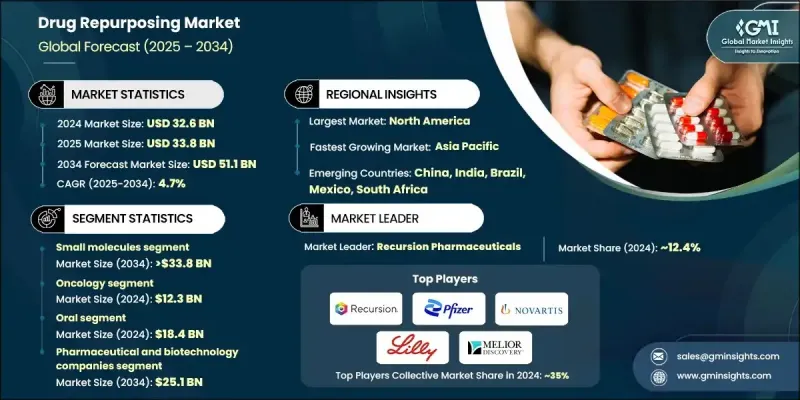
The Global Drug Repurposing Market was valued at USD 32.6 billion in 2024 and is estimated to grow at a CAGR of 4.7% to reach USD 51.1 billion by 2034.
The expansion is driven by the rising prevalence of chronic and complex diseases such as cancer, Alzheimer's, and rare genetic disorders, which are creating demand for faster and more cost-effective therapeutic solutions. Drug repurposing enables quicker access to treatments, particularly for conditions where traditional R&D is limited due to low commercial incentives. By leveraging compounds with known safety and pharmacological profiles, repurposing bypasses early-stage trials, shortens development timelines, and accelerates regulatory approvals. This approach is particularly appealing to pharmaceutical firms seeking quicker returns on investment. Drug repurposing involves discovering new therapeutic applications for existing medications, including approved, discontinued, or abandoned drugs, reducing the overall time and cost of drug development while expanding treatment options across multiple disease areas.
| Market Scope | |
|---|---|
| Start Year | 2024 |
| Forecast Year | 2025-2034 |
| Start Value | $32.6 Billion |
| Forecast Value | $51.1 Billion |
| CAGR | 4.7% |
The small molecules segment held 67.5% share in 2024 and is expected to reach USD 33.8 billion by 2034, growing at a CAGR of 4.5%. Small molecules are ideal candidates for repurposing due to their established pharmacokinetics, safety data, and manufacturing processes. Existing clinical data can be leveraged to reduce the need for extensive trials, while regulatory pathways, such as the FDA's 505(b)(2), allow for faster approval by referencing prior evidence.
The oral drug segment generated USD 18.4 billion in 2024. Oral formulations are widely applicable across therapeutic areas, including oncology, metabolic, infectious, and CNS disorders. Their versatility and well-understood pharmacokinetics make them a preferred choice for repurposing, offering broad clinical utility and commercial appeal.
North America Drug Repurposing Market accounted for 48.2% share in 2024, led by the U.S., which benefits from a robust regulatory framework supporting drug repurposing. The FDA's 505(b)(2) pathway enables companies to reference existing safety and efficacy data for new indications, significantly reducing development time and costs. This regulatory flexibility has encouraged both pharmaceutical and biotech firms to invest heavily in repurposing strategies, fostering innovation and accelerating market growth.
Key players operating in the Global Drug Repurposing Market include Boehringer Ingelheim, Eli Lilly and Company, Amgen, AbbVie, Novartis, Pharnext, GlaxoSmithKline, Schwarz Pharma, Recursion Pharmaceuticals, Revolution Medicines, Cyclica, Pfizer, Melior Discovery, Sanofi, and Valence Discovery. Companies in the drug repurposing market are adopting multiple strategies to strengthen their market presence and expand their footprint. They are heavily investing in research and development to identify new therapeutic applications for existing drugs and optimize clinical trial efficiency. Strategic collaborations and partnerships with biotech firms, academic institutions, and research organizations help accelerate the discovery and validation of repurposed compounds.
Table of Contents
Chapter 1 Methodology and Scope
- 1.1 Market scope and definition
- 1.2 Research design
- 1.2.1 Research approach
- 1.2.2 Data collection methods
- 1.3 Data mining sources
- 1.3.1 Global
- 1.3.2 Regional/Country
- 1.4 Base estimates and calculations
- 1.4.1 Base year calculation
- 1.4.2 Key trends for market estimation
- 1.5 Primary research and validation
- 1.5.1 Primary sources
- 1.6 Forecast model
- 1.7 Research assumptions and limitations
Chapter 2 Executive Summary
- 2.1 Industry 3600 synopsis
- 2.2 Key market trends
- 2.2.1 Regional trends
- 2.2.2 Drug type trends
- 2.2.3 Therapeutic area trends
- 2.2.4 Route of administration trends
- 2.2.5 End use trends
- 2.3 CXO perspectives: Strategic imperatives
- 2.3.1 Key decision points for industry executives
- 2.3.2 Critical success factors for market players
- 2.4 Future outlook and strategic recommendations
Chapter 3 Industry Insights
- 3.1 Industry ecosystem analysis
- 3.1.1 Supplier landscape
- 3.1.2 Value addition at each stage
- 3.1.3 Factors affecting the value chain
- 3.2 Industry impact forces
- 3.2.1 Growth drivers
- 3.2.1.1 Rising prevalence of chronic and rare diseases
- 3.2.1.2 Cost and time efficiency of drug repurposing
- 3.2.1.3 Integration of AI-driven platforms
- 3.2.1.4 Unmet medical needs and drug shortages
- 3.2.2 Industry pitfalls and challenges
- 3.2.2.1 Lack of incentives for off-patent drugs
- 3.2.2.2 Liability and safety concerns
- 3.2.3 Market opportunities
- 3.2.3.1 Growing demand for cost-effective therapies
- 3.2.3.2 Expansion into rare and neglected diseases
- 3.2.1 Growth drivers
- 3.3 Growth potential analysis
- 3.4 Regulatory landscape
- 3.4.1 North America
- 3.4.2 Europe
- 3.4.3 Asia Pacific
- 3.5 Technology landscape
- 3.5.1 Current technological trends
- 3.5.2 Emerging technologies
- 3.6 Future market trends
- 3.7 Pricing analysis
- 3.8 Clinical trial analysis
- 3.9 Porter's analysis
- 3.10 PESTEL analysis
Chapter 4 Competitive Landscape, 2024
- 4.1 Introduction
- 4.2 Company market share analysis
- 4.2.1 Global
- 4.2.2 North America
- 4.2.3 Europe
- 4.3 Company matrix analysis
- 4.4 Competitive analysis of major market players
- 4.5 Competitive positioning matrix
- 4.6 Key developments
- 4.6.1 Merger and acquisition
- 4.6.2 Partnership and collaboration
- 4.6.3 New product launches
- 4.6.4 Expansion plans
Chapter 5 Market Estimates and Forecast, By Drug Type, 2021 - 2034 ($ Mn)
- 5.1 Key trends
- 5.2 Small molecules
- 5.3 Biologics
Chapter 6 Market Estimates and Forecast, By Therapeutic Area, 2021 - 2034 ($ Mn)
- 6.1 Key trends
- 6.2 Oncology
- 6.3 Neurology and CNS disorders
- 6.4 Infectious diseases
- 6.5 Cardiovascular diseases
- 6.6 Metabolic disorders
- 6.7 Other therapeutic areas
Chapter 7 Market Estimates and Forecast, By Route of Administration, 2021 - 2034 ($ Mn)
- 7.1 Key trends
- 7.2 Oral
- 7.3 Intravenous
- 7.4 Other routes of administration
Chapter 8 Market Estimates and Forecast, By End Use, 2021 - 2034 ($ Mn)
- 8.1 Key trends
- 8.2 Pharmaceutical and biopharmaceutical companies
- 8.3 Contract Research Organization (CROs)
- 8.4 Other end use
Chapter 9 Market Estimates and Forecast, By Region, 2021 - 2034 ($ Mn)
- 9.1 Key trends
- 9.2 North America
- 9.2.1 U.S.
- 9.2.2 Canada
- 9.3 Europe
- 9.3.1 Germany
- 9.3.2 UK
- 9.3.3 France
- 9.3.4 Spain
- 9.3.5 Italy
- 9.3.6 Netherlands
- 9.4 Asia Pacific
- 9.4.1 China
- 9.4.2 Japan
- 9.4.3 India
- 9.4.4 Australia
- 9.4.5 South Korea
- 9.5 Latin America
- 9.5.1 Brazil
- 9.5.2 Mexico
- 9.5.3 Argentina
- 9.6 Middle East and Africa
- 9.6.1 South Africa
- 9.6.2 Saudi Arabia
- 9.6.3 UAE
Chapter 10 Company Profiles
- 10.1 AbbVie
- 10.2 Amgen
- 10.3 Boehringer Ingelheim
- 10.4 Cyclica
- 10.5 Eli Lilly and Company
- 10.6 GlaxoSmithKline
- 10.7 Melior Discovery
- 10.8 Novartis
- 10.9 Pfizer
- 10.10 Pharnext
- 10.11 Recursion Pharmaceuticals
- 10.12 Revolution Medicines
- 10.13 Sanofi
- 10.14 Schwarz Pharma
- 10.15 Valence Discovery