|
시장보고서
상품코드
1876607
수직축 풍력 터빈(VAWT) 시장 : 시장 기회, 성장 요인, 업계 동향 분석 및 예측(2025-2034년)Vertical Wind Turbine Market Opportunity, Growth Drivers, Industry Trend Analysis, and Forecast 2025 - 2034 |
||||||

세계의 수직축 풍력 터빈 시장은 2024년에 13억 5,000만 달러로 평가되었고, 2034년까지 연평균 복합 성장률(CAGR) 24.9%로 성장할 전망이며, 134억 7,000만 달러에 이를 것으로 예측되고 있습니다.

수직축 풍력 터빈(VAWT)에 대한 관심 증가는 다양한 풍황과 지형 조건에 적합한 지속 가능하고 분산형 에너지 시스템으로의 추진에 의해 뒷받침됩니다. 이러한 터빈은 난류와 풍향의 변화가 심한 환경에서도 효과적으로 기능하기 때문에 해안, 도시, 기복이 있는 지형에 최적입니다. 분산형 발전 네트워크의 도입 확대 및 컴팩트한 재생에너지 솔루션에 대한 선호도 증가는 주택, 상업용 및 하이브리드 그리드 설치의 도입을 촉진하고 있습니다. 개발도상국에서는 필요한 공간이 작고 정숙성이 뛰어나 밀집 지역 및 공업 지역에 대한 적응성이 높기 때문에 현저한 관심이 나타났습니다. 공기역학, 첨단 복합재료, 현대적인 전력전자의 지속적인 혁신으로 터빈의 신뢰성과 출력이 지속적으로 향상되고 있습니다. 새로운 수직축 터빈 설계는 토크 발생 능력 향상, 내구성 강화, 저풍속 환경 하에서의 성능 개선에 중점을 두고 있습니다. IoT 기반의 감시 및 예지 보전 솔루션의 통합에 의해 운용 비용 절감을 도모하는 한편, 복수의 설계 원리를 조합한 하이브리드 수직축 터빈 시스템의 대두에 의해 다양한 풍속 범위에서의 효율성이 확대되어 분산형 및 하이브리드 에너지 네트워크에서의 수직축 풍력 터빈의 역할이 강화되고 있습니다.
| 시장 범위 | |
|---|---|
| 시작 연도 | 2024년 |
| 예측 연도 | 2025-2034년 |
| 시작 시 가치 | 13억 5,000만 달러 |
| 예측 금액 | 134억 7,000만 달러 |
| CAGR | 24.9% |
10kW 부문은 2024년에 57.3%의 점유율을 차지하였고, 2034년까지 연평균 복합 성장률(CAGR) 25.5%로 성장할 것으로 예측됩니다. 이 용량 범위는 소음 제한 및 공간 제약으로 인해 수직 설계가 유리한 소형 주택 및 소규모 상업 시설에서 특히 매력적입니다. 이러한 10kW 유닛은 설치의 간소화, 허가 취득의 용이함, 인프라 비용의 저감을 실현하고, 도입 확대를 계속적으로 추진하고 있습니다. 생산 비용 저하, 효율성 향상, 유리한 넷 미터링 시책에 뒷받침되는 주택용 재생에너지 솔루션의 보급 확대가 시장 성장을 가속하고 있습니다.
드래그형 사보니우스 부문은 14.1%의 점유율을 차지했으며, 2034년까지 25.5%의 연평균 복합 성장률(CAGR)로 성장할 전망입니다. 설치가 간편하고 대규모의 기초 공사가 불필요하기 때문에 저풍속 지역, 도시, 오프 그리드 용도로의 인기가 높아지고 있습니다. 비틀림 블레이드나 다단 로터 구성을 이용한 이러한 터빈의 지속적인 재설계에 의해 자기 시동 능력과 토크 발생이 향상되어 다양한 환경에서의 채용 확대를 촉진하고 있습니다.
아시아태평양의 수직축 풍력 터빈 시장은 주로 중국, 인도, 동남아시아 시장으로 견인되어 2034년까지 연평균 복합 성장률(CAGR) 28.5%로 확대될 전망입니다. 이 성장은 가속화된 도시화, 증가하는 에너지 안보 우선 순위, 적극적인 재생에너지 시책의 영향을 받습니다. 중국의 경쟁력 있는 제조 비용 및 국내 혁신은 지역 및 세계 산업 발전을 지원합니다. 한편, 인도가 분산형 발전과 농촌 전화에 주력하고 있는 것은 소규모 커뮤니티에서 수직축 풍력 터빈의 도입을 위한 새로운 성장 경로를 창출하고 있습니다.
세계의 수직축 풍력 터빈 시장 동향을 형성하는 주요 기업으로는 윈드하베스트 인터내셔널, 어반 그린 에너지, 플라워 터빈스, 라이즈 에너지, 윈드 스파이어 에너지, V-Air, 우 인드사이드 프로덕션, 에올로스 윈드 에너지, 하이-VAWT 기술, 발트젠, 시트 왈르, 월윈드 윈드 터빈스, 아버윈드, 마리아 파워 등을 들 수 있습니다. 수직축 풍력 터빈 시장에서 사업을 전개하는 기업은 시장 점유율 확대를 위해 기술 혁신, 전략적 제휴, 지리적 확대에 적극적으로 주력하고 있습니다. 많은 기업들이 에너지 포착 효율 및 신뢰성 향상을 위해 고급 공기역학 모델링, 경량 복합재료, 차세대 파워 일렉트로닉스에 대한 투자를 진행하고 있습니다. 신재생에너지 개발업체, 정부기관, 스마트시티계획 담당자와의 전략적 제휴는 제품 보급 범위의 확대에 기여하고 있습니다. 제조업체는 또한 주거용, 상업용 및 하이브리드 그리드 용도를 수용하기 위해 모듈식 확장 가능한 설계를 선호합니다.
자주 묻는 질문
목차
제1장 조사 방법 및 범위
제2장 주요 요약
제3장 업계 인사이트
- 업계의 생태계
- 규제 상황
- 수직축 풍력 터빈 프로젝트
- 운영
- 계획중
- 업계에 미치는 영향요인
- 성장 촉진요인
- 업계의 잠재적 위험 및 과제
- 성장 가능성 분석
- Porter's Five Forces 분석
- PESTEL 분석
제4장 경쟁 구도
- 서문
- 기업의 시장 점유율 분석 : 지역별
- 북미
- 유럽
- 아시아태평양
- 중동 및 아프리카
- 라틴아메리카
- 전략적 대시보드
- 전략적 이니셔티브
- 기업 벤치마킹
- 혁신 및 기술 동향
제5장 시장 규모 및 예측 : 터빈 정격별(2021-2034년)
- 주요 동향
- 10kW 미만
- 10kW-200kW
- 200kW 초과-1MW
- 1MW 초과
제6장 시장 규모 및 예측 : 접속 방식별(2021-2034년)
- 주요 동향
- 계통연계형
- 독립형
- 하이브리드
제7장 시장 규모 및 예측 : 설비별(2021-2034년)
- 주요 동향
- 온쇼어
- 오프쇼어
제8장 시장 규모 및 예측 : 제품 유형별(2021-2034년)
- 주요 동향
- 다리우스식
- 드래그형 사보니우스
- 하이브리드
제9장 시장 규모 및 예측 : 용도별(2021-2034년)
- 주요 동향
- 주택용
- 상업 및 산업용
- 유틸리티
제10장 시장 규모 및 예측 : 지역별(2021-2034년)
- 주요 동향
- 북미
- 미국
- 캐나다
- 멕시코
- 유럽
- 스위스
- 스웨덴
- 프랑스
- 영국
- 핀란드
- 아시아태평양
- 중국
- 인도
- 일본
- 호주
- 중동 및 아프리카
- 아랍에미리트(UAE)
- 남아프리카
- 라틴아메리카
- 브라질
제11장 기업 프로파일
- ArborWind
- Aeolos Wind Energy
- Hi-VAWT Technology
- Flower Turbines
- Ryse Energy
- SeaTwirl
- Mariah Power
- Urban Green Energy
- Whirlwind Wind Turbines
- Wind Harvest International
- Windside Production
- Windspire Energy
- V-Air
- Vertogen
The Global Vertical Wind Turbine Market was valued at USD 1.35 billion in 2024 and is estimated to grow at a CAGR of 24.9% to reach USD 13.47 billion by 2034.
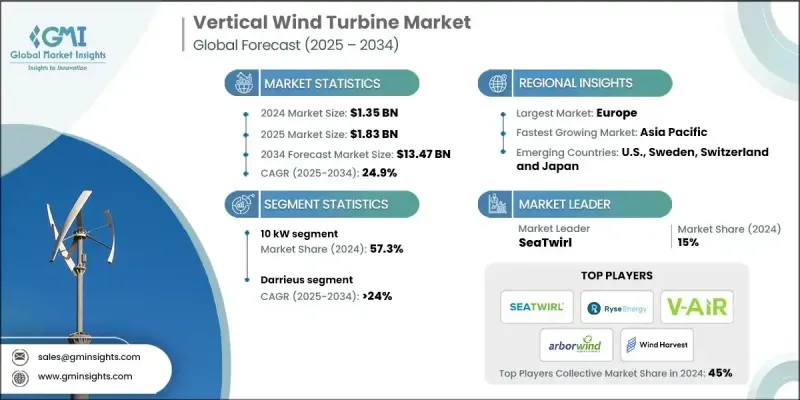
Growing interest in vertical-axis wind turbines (VAWTs) is being fueled by the push toward sustainable and decentralized energy systems suitable for various wind and terrain conditions. These turbines perform effectively in turbulent or shifting wind directions, making them well-suited for coastal, urban, and uneven landscapes. Expanding deployment across distributed power generation networks and the increasing preference for compact renewable solutions are driving installations across residential, commercial, and hybrid grid setups. Developing economies are showing notable interest due to smaller space needs, quieter operations, and adaptability to dense or industrial areas. Ongoing innovation in aerodynamics, advanced composite materials, and modern power electronics continues to enhance turbine reliability and output. Novel vertical turbine designs are focusing on improved torque generation, higher durability, and better performance in low-wind environments. The integration of IoT-based monitoring and predictive maintenance solutions is helping reduce operational costs, while the rise of hybrid vertical turbine systems combining multiple design principles-broadens efficiency across varying wind ranges, reinforcing the role of VAWTs in decentralized and hybrid energy networks.
| Market Scope | |
|---|---|
| Start Year | 2024 |
| Forecast Year | 2025-2034 |
| Start Value | $1.35 Billion |
| Forecast Value | $13.47 Billion |
| CAGR | 24.9% |
The 10 kW segment held a 57.3% share in 2024 and is forecasted to grow at a 25.5% CAGR through 2034. This capacity range is particularly attractive for compact residential and small-scale commercial setups where noise limits and space constraints make vertical designs advantageous. These 10 kW units offer simplified installation, minimal permitting challenges, and lower infrastructure expenses, which continue to boost their adoption. Falling production costs, greater efficiency levels, and wider acceptance of residential renewable solutions supported by favorable net metering initiatives are fostering market expansion.
The drag-type Savonius segment accounted for a 14.1% share and is expected to register a 25.5% CAGR through 2034. Its popularity is increasing across low-wind, urban, and off-grid applications due to simple installation needs and the absence of large foundation requirements. Ongoing reengineering of these turbines using twisted blades and multi-stage rotor configurations has enhanced self-start capabilities and torque generation, driving broader adoption in diverse environments.
Asia Pacific Vertical Wind Turbine Market will grow at a CAGR of 28.5% by 2034, primarily led by markets across China, India, and Southeast Asia. This expansion is influenced by accelerated urbanization, rising energy security priorities, and proactive renewable energy initiatives. Competitive manufacturing costs and domestic innovation within China are supporting both regional and global industry development. Meanwhile, India's focus on distributed power generation and rural electrification continues to create new growth pathways for VAWT deployment across smaller communities.
Key players shaping the Global Vertical Wind Turbine Market landscape include WindHarvest International, Urban Green Energy, Flower Turbines, Ryse Energy, Windspire Energy, V-Air, Windside Production, Aeolos Wind Energy, Hi-VAWT Technology, Vertogen, SeaTwirl, Whirlwind Wind Turbines, ArborWind, and Mariah Power. Companies operating in the Vertical Wind Turbine Market are actively focusing on technological innovation, strategic collaborations, and geographic expansion to enhance market share. Many are investing in advanced aerodynamic modeling, lightweight composite materials, and next-generation power electronics to improve energy capture efficiency and reliability. Strategic alliances with renewable energy developers, government bodies, and smart city planners are helping expand product reach. Manufacturers are also prioritizing modular and scalable designs to cater to residential, commercial, and hybrid grid applications.
Table of Contents
Chapter 1 Methodology & Scope
- 1.1 Research design
- 1.1.1 Research approach
- 1.1.2 Data collection methods
- 1.1.3 Base estimates and calculations
- 1.1.4 Base year calculation
- 1.1.5 Key trends for market estimates
- 1.2 Forecast model
- 1.3 Primary research & validation
- 1.3.1 Primary sources
- 1.4 Data mining sources
- 1.5 Market definitions
Chapter 2 Executive Summary
- 2.1 Industry 3600 synopsis, 2021 - 2034
- 2.2 Business trends
- 2.3 Turbine rating trends
- 2.4 Connectivity trends
- 2.5 Installation trends
- 2.6 Product type trends
- 2.7 Application trends
- 2.8 Regional trends
Chapter 3 Industry Insights
- 3.1 Industry ecosystem
- 3.2 Regulatory landscape
- 3.3 Vertical wind turbine projects
- 3.3.1 Operational
- 3.3.2 Planned
- 3.4 Industry impact forces
- 3.4.1 Growth drivers
- 3.4.2 Industry pitfalls & challenges
- 3.5 Growth potential analysis
- 3.6 Porter's analysis
- 3.6.1 Bargaining power of suppliers
- 3.6.2 Bargaining power of buyers
- 3.6.3 Threat of new entrants
- 3.6.4 Threat of substitutes
- 3.7 PESTEL analysis
Chapter 4 Competitive landscape, 2025
- 4.1 Introduction
- 4.2 Company market share analysis, by region, 2024
- 4.2.1 North America
- 4.2.2 Europe
- 4.2.3 Asia Pacific
- 4.2.4 Middle East & Africa
- 4.2.5 Latin America
- 4.3 Strategic dashboard
- 4.4 Strategic initiatives
- 4.5 Company benchmarking
- 4.6 Innovation & technology landscape
Chapter 5 Market Size and Forecast, By Turbine rating, 2021 - 2034 (USD Million & MW)
- 5.1 Key trends
- 5.2 < 10 kW
- 5.3 10 kW - 200 kW
- 5.4 >200 kW - 1 MW
- 5.5 > 1 MW
Chapter 6 Market Size and Forecast, By Connectivity, 2021 - 2034 (USD Million & MW)
- 6.1 Key trends
- 6.2 Grid connected
- 6.3 Standalone
- 6.4 Hybrid
Chapter 7 Market Size and Forecast, By Installation, 2021 - 2034 (USD Million & MW)
- 7.1 Key trends
- 7.2 Onshore
- 7.3 Offshore
Chapter 8 Market Size and Forecast, By Product Type, 2021 - 2034 (USD Million & MW)
- 8.1 Key trends
- 8.2 Darrieus
- 8.3 Drag type Savonius
- 8.4 Hybrid
Chapter 9 Market Size and Forecast, By Application, 2021 - 2034 (USD Million & MW)
- 9.1 Key trends
- 9.2 Residential
- 9.3 Commercial and Industrial
- 9.4 Utility
Chapter 10 Market Size and Forecast, By Region, 2021 - 2034 (USD Million & MW)
- 10.1 Key trends
- 10.2 North America
- 10.2.1 U.S.
- 10.2.2 Canada
- 10.2.3 Mexico
- 10.3 Europe
- 10.3.1 Switzerland
- 10.3.2 Sweden
- 10.3.3 France
- 10.3.4 UK
- 10.3.5 Finland
- 10.4 Asia Pacific
- 10.4.1 China
- 10.4.2 India
- 10.4.3 Japan
- 10.4.4 Australia
- 10.5 Middle East & Africa
- 10.5.1 UAE
- 10.5.2 South Africa
- 10.6 Latin America
- 10.6.1 Brazil
Chapter 11 Company Profiles
- 11.1 ArborWind
- 11.2 Aeolos Wind Energy
- 11.3 Hi-VAWT Technology
- 11.4 Flower Turbines
- 11.5 Ryse Energy
- 11.6 SeaTwirl
- 11.7 Mariah Power
- 11.8 Urban Green Energy
- 11.9 Whirlwind Wind Turbines
- 11.10 Wind Harvest International
- 11.11 Windside Production
- 11.12 Windspire Energy
- 11.13 V-Air
- 11.14 Vertogen