

|
시장보고서
상품코드
1885801
육류 제품별 단백질 가수분해물 시장 : 시장 기회, 성장 요인, 업계 동향 분석 및 예측(2025-2034년)Meat by-product Protein Hydrolysates Market Opportunity, Growth Drivers, Industry Trend Analysis, and Forecast 2025 - 2034 |
||||||

세계의 육류 제품별 단백질 가수분해물 시장은 2024년 42억 달러로 평가되었고, 2034년까지 연평균 복합 성장률(CAGR) 7.6%로 성장할 전망이며, 89억 달러에 달할 것으로 예측되고 있습니다.
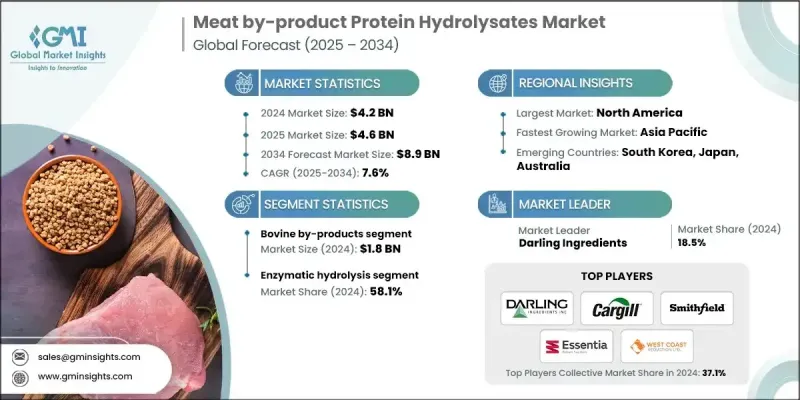
이러한 가수분해물은 뼈, 깃털, 내장 등의 동물 제품별을 효소 분해하여 얻어지는 생물 활성 펩티드입니다. 뛰어난 소화성, 높은 생체이용률, 동물영양에 있어서의 기능적 이점에 의해 종래의 단백질원을 대신하는 옵션으로서 채용이 진행되고 있습니다. 세계 각국에서 폐기물 감축과 자원 효율화가 추진되고 있는 가운데, 지속가능한 단백질 솔루션에 대한 수요 증가가 시장을 더욱 뒷받침하고 있습니다. 육류 제품별을 단백질 가수분해물로 변환하는 것은 폐기물 감축으로 이어질 뿐만 아니라 비용 효율적인 고품질 사료 첨가물을 제공하며, 세계의 지속가능성 목표에 부합하는 노력입니다. 특히 유럽 등 지역에서는 폐기물 이용 최적화에 중점을 둔 규제 우대 조치가 시장 확대를 직접 지원하고 있습니다. 계속 성장하는 반려동물 먹이 및 가축 사료 분야에서 동물의 건강 및 영양에 대한 관심이 증가함에 따라 수요가 계속 증가하고 있습니다. 북미는 선진적인 제조 인프라, 강력한 규제 지원, 높은 채용률로 현재 시장을 독점하고 있지만, 아시아태평양은 육류 소비 증가, 도시화, 지속 가능한 동물 영양에 대한 관심 증가에 견인되어 가장 빠르게 성장하고 있는 시장입니다.
| 시장 범위 | |
|---|---|
| 시작 연도 | 2024년 |
| 예측 기간 | 2025-2034년 |
| 시작 시 가치 | 42억 달러 |
| 예측 금액 | 89억 달러 |
| CAGR | 7.6% |
2024년 소 유래 제품별은 18억 달러 시장 규모를 창출해 시장에서 주도적인 지위를 유지했습니다. 이러한 원료는 풍부하고 단백질이 풍부하며, 고기 제품별 단백질 가수분해물의 제조에 있어서 비용 효율적이고 신뢰성이 높은 원료를 제공합니다. 그 영양 프로파일은 성장과 면역 건강을 지원하기 때문에 사료 및 수산 양식 용도 분야에서 인기가 있습니다. 추출 및 가수분해 기술의 진보는 소 유래 원료로부터의 가공을 간소화하고 시장에서의 지위를 더욱 강화했습니다.
효소 가수분해 부문은 2024년에 58.1%의 점유율을 차지했습니다. 이 접근법은 표적화된 기능적 특성을 가진 고품질의 생체이용성 단백질 가수분해물을 생산하기 때문에 선호됩니다. 효소는 단백질을 선택적으로 분해하고 소화성 및 생물학적 활성을 향상시킨 분획을 생성하는 동시에 화학 잔류물을 최소화하기 때문에 공정은 보다 안전하고 친환경적입니다. 그 결과, 효소 가수분해는 천연 및 유기 사료 제품의 배합에 있어서 높게 평가되고 있습니다.
북미의 육류 제품별 단백질 가수분해물 시장은 2025-2034년 연평균 복합 성장률(CAGR) 7.7%로 성장할 것으로 예측됩니다. 환경 보전과 지속 가능한 농업 실천을 촉진하는 사료 원료에 대한 수요가 높아지고 있습니다. 소비자의 의식 향상에 따라 업계 관계자는 책임있는 축산을 중시하고 있습니다. 천연 유래로 생분해성, 그리고 지속 가능한 단백질 가수분해물의 인기가 높아지고 있습니다. 효소 가수분해, 발효, 바이오테크놀러지의 진보 등 기술 혁신에 의해 제품의 품질과 안전성이 향상되는 동시에 생산 비용이 절감되고 있습니다.
자주 묻는 질문
목차
제1장 조사 방법 및 범위
제2장 주요 요약
제3장 업계 인사이트
- 생태계 분석
- 공급자의 상황
- 이익률
- 각 단계에서의 부가가치
- 밸류체인에 영향을 주는 요인
- 혁신
- 업계에 미치는 영향요인
- 성장 촉진요인
- 지속가능한 단백질원에 대한 수요 증가
- 식품 가공에 있어서 순환형 경제의 도입
- 성장을 계속하는 반려동물 식품 및 동물 사료 산업
- 업계의 잠재적 위험 및 과제
- 품질 표준화의 과제
- 공급망의 혼란에 대한 취약성
- 시장 기회
- 대체 단백질 밸류체인과의 통합
- 신흥의 생물활성 펩티드 용도 분야
- 성장 촉진요인
- 성장 가능성 분석
- 규제 상황
- 북미
- 유럽
- 아시아태평양
- 라틴아메리카
- 중동 및 아프리카
- Porter's Five Forces 분석
- PESTEL 분석
- 기술 및 혁신 동향
- 현재의 기술 동향
- 신흥 기술
- 가격 동향
- 지역별
- 소스별
- 장래 시장 동향
- 특허 동향
- 무역 통계(HS코드)(주 : 무역 통계는 주요 국가만 제공)
- 주요 수입국
- 주요 수출국
- 지속가능성 및 환경면
- 지속가능한 대처
- 폐기물 감축 전략
- 생산에 있어서 에너지 효율
- 환경에 배려한 대처
- 탄소발자국 고려
제4장 경쟁 구도
- 서문
- 기업의 시장 점유율 분석
- 지역별
- 북미
- 유럽
- 아시아태평양
- 라틴아메리카
- 중동 및 아프리카
- 지역별
- 기업 매트릭스 분석
- 주요 시장 기업의 경쟁 분석
- 경쟁 포지셔닝 매트릭스
- 주요 발전
- 합병 및 인수
- 제휴 및 협업
- 신제품 발매
- 확대 계획
제5장 시장 추계 및 예측 : 공급원별(2021-2034년)
- 주요 동향
- 소 유래 제품별
- 돼지 제품별
- 가금 제품별
- 기타
제6장 시장 추계 및 예측 : 프로세스별(2021-2034년)
- 주요 동향
- 효소 가수분해
- 화학적 가수분해
- 미생물 발효
제7장 시장 추계 및 예측 : 용도별(2021-2034년)
- 주요 동향
- 음식
- 풍미 증강제
- 단백질 강화제
- 기타
- 사료
- 반려동물 식품
- 가축 사료
- 기타
- 임상영양
- 스포츠 영양
- 영유아 영양
- 영양보조식품
- 기타
제8장 시장 추계 및 예측 : 지역별(2021-2034년)
- 주요 동향
- 북미
- 미국
- 캐나다
- 유럽
- 독일
- 영국
- 프랑스
- 스페인
- 이탈리아
- 기타 유럽
- 아시아태평양
- 중국
- 인도
- 일본
- 호주
- 한국
- 기타 아시아태평양
- 라틴아메리카
- 브라질
- 멕시코
- 아르헨티나
- 기타 라틴아메리카
- 중동 및 아프리카
- 사우디아라비아
- 남아프리카
- 아랍에미리트(UAE)
- 기타 중동 및 아프리카
제9장 기업 프로파일
- Cargill
- Darling Ingredients
- Essentia Protein Solutions
- Hormel Foods Corporation
- National Beef Packing Company
- Novonesis
- Sanimax
- Smithfield Foods Inc
- Titan Biotech
- West Coast Reduction Ltd
The Global Meat by-product Protein Hydrolysates Market was valued at USD 4.2 billion in 2024 and is estimated to grow at a CAGR of 7.6% to reach USD 8.9 billion by 2034.
These hydrolysates are bioactive peptides derived from the enzymatic breakdown of animal by-products such as bones, feathers, and offal. Their exceptional digestibility, high bioavailability, and functional benefits in animal nutrition are driving their adoption as an alternative to traditional protein sources. Rising demand for sustainable protein solutions is further boosting the market, as governments worldwide promote waste reduction and resource efficiency. Transforming meat by-products into protein hydrolysates not only reduces waste but also offers a cost-effective, high-quality feed additive, aligning with global sustainability goals. Regulatory incentives, particularly in regions like Europe, are focused on optimizing waste usage, directly supporting market expansion. Increasing attention to animal health and nutrition in the growing pet food and livestock feed sectors continues to fuel demand. North America currently dominates the market due to advanced manufacturing infrastructure, robust regulatory support, and high adoption rates, while the Asia-Pacific region is the fastest-growing market, driven by rising meat consumption, urbanization, and a growing focus on sustainable animal nutrition.
| Market Scope | |
|---|---|
| Start Year | 2024 |
| Forecast Year | 2025-2034 |
| Start Value | $4.2 Billion |
| Forecast Value | $8.9 Billion |
| CAGR | 7.6% |
In 2024, the bovine by-products generated USD 1.8 billion, maintaining a dominant position in the market. These sources are abundant and protein-rich, offering a cost-effective and reliable raw material for producing meat by-product protein hydrolysates. Their nutritional profile supports growth and immune health, making them popular in animal feed and aquaculture applications. Advances in extraction and hydrolysis techniques have simplified processing from bovine sources, further strengthening their market position.
The enzymatic hydrolysis segment accounted for a 58.1% share in 2024. This method is preferred because it produces high-quality, bioavailable protein hydrolysates with targeted functional properties. Enzymes selectively break down proteins into fractions with enhanced digestibility and bioactivity while minimizing chemical residues, making the process safer and more environmentally friendly. As a result, enzymatic hydrolysis is highly valued in formulating natural and organic animal feed products.
North America Meat by-product Protein Hydrolysates Market is expected to grow at a CAGR of 7.7% between 2025 and 2034. Demand is rising for feed ingredients that promote environmental conservation and sustainable farming practices. Awareness among consumers is increasing, and industry players are emphasizing responsible animal husbandry. Natural, biodegradable, and sustainable protein hydrolysates are gaining popularity. Technological innovations, including enzymatic hydrolysis, fermentation, and biotechnology advancements, are enhancing product quality and safety while reducing production costs.
Key players in the Global Meat by-product Protein Hydrolysates Market include Titan Biotech, West Coast Reduction Ltd, Cargill, Hormel Foods Corporation, Essentia Protein Solutions, Smithfield Foods Inc, Novonesis, National Beef Packing Company, Sanimax, and Darling Ingredients. Companies in the Meat by-product Protein Hydrolysates Market are adopting strategies to strengthen their market presence through technological innovation, expanding production capacities, and investing in R&D to improve hydrolysate quality. Strategic partnerships and mergers allow them to extend distribution networks and reach emerging markets. Focused efforts on sustainability, such as utilizing waste products and developing environmentally friendly processing methods, enhance brand credibility.
Table of Contents
Chapter 1 Methodology & Scope
- 1.1 Market scope and definition
- 1.2 Research design
- 1.2.1 Research approach
- 1.2.2 Data collection methods
- 1.3 Data mining sources
- 1.3.1 Global
- 1.3.2 Regional/Country
- 1.4 Base estimates and calculations
- 1.4.1 Base year calculation
- 1.4.2 Key trends for market estimation
- 1.5 Primary research and validation
- 1.5.1 Primary sources
- 1.6 Forecast model
- 1.7 Research assumptions and limitations
Chapter 2 Executive Summary
- 2.1 Industry 360° synopsis
- 2.2 Key market trends
- 2.2.1 Source trends
- 2.2.2 Process trends
- 2.2.3 Application trends
- 2.2.4 Regional trends
- 2.3 TAM Analysis, 2025-2034
- 2.4 CXO perspectives: strategic imperatives
- 2.4.1 Executive decision points
- 2.4.2 Critical success factors
- 2.5 Future outlook and strategic recommendations
Chapter 3 Industry Insights
- 3.1 Industry ecosystem analysis
- 3.1.1 Supplier landscape
- 3.1.2 Profit margin
- 3.1.3 Value addition at each stage
- 3.1.4 Factor affecting the value chain
- 3.1.5 Disruptions
- 3.2 Industry impact forces
- 3.2.1 Growth drivers
- 3.2.1.1 Rising demand for sustainable protein sources
- 3.2.1.2 Circular economy implementation in food processing
- 3.2.1.3 Growing pet food & animal feed industries
- 3.2.2 Industry pitfalls and challenges
- 3.2.2.1 Quality standardization challenges
- 3.2.2.2 Supply chain disruption vulnerabilities
- 3.2.3 Market opportunities
- 3.2.3.1 Integration with alternative protein value chains
- 3.2.3.2 Emerging bioactive peptide applications
- 3.2.1 Growth drivers
- 3.3 Growth potential analysis
- 3.4 Regulatory landscape
- 3.4.1 North America
- 3.4.2 Europe
- 3.4.3 Asia Pacific
- 3.4.4 Latin America
- 3.4.5 Middle East & Africa
- 3.5 Porter's analysis
- 3.6 PESTEL analysis
- 3.7 Technology and Innovation landscape
- 3.7.1 Current technological trends
- 3.7.2 Emerging technologies
- 3.8 Price trends
- 3.8.1 By region
- 3.8.2 By source
- 3.9 Future market trends
- 3.10 Patent landscape
- 3.11 Trade statistics (HS code) ( Note: the trade statistics will be provided for key countries only)
- 3.11.1 Major importing countries
- 3.11.2 Major exporting countries
- 3.12 Sustainability and environmental aspects
- 3.12.1 Sustainable practices
- 3.12.2 Waste reduction strategies
- 3.12.3 Energy efficiency in production
- 3.12.4 Eco-friendly initiatives
- 3.13 Carbon footprint consideration
Chapter 4 Competitive Landscape, 2024
- 4.1 Introduction
- 4.2 Company market share analysis
- 4.2.1 By region
- 4.2.1.1 North America
- 4.2.1.2 Europe
- 4.2.1.3 Asia Pacific
- 4.2.1.4 LATAM
- 4.2.1.5 MEA
- 4.2.1 By region
- 4.3 Company matrix analysis
- 4.4 Competitive analysis of major market players
- 4.5 Competitive positioning matrix
- 4.6 Key developments
- 4.6.1 Mergers & acquisitions
- 4.6.2 Partnerships & collaborations
- 4.6.3 New product launches
- 4.6.4 Expansion plans
Chapter 5 Market Estimates and Forecast, By Source, 2021-2034 (USD Billion) (Kilo Tons)
- 5.1 Key trends
- 5.2 Bovine by-products
- 5.3 Porcine by-products
- 5.4 Poultry by-products
- 5.5 Others
Chapter 6 Market Estimates and Forecast, By Process, 2021-2034 (USD Billion) (Kilo Tons)
- 6.1 Key trends
- 6.2 Enzymatic hydrolysis
- 6.3 Chemical hydrolysis
- 6.4 Microbial fermentation
Chapter 7 Market Estimates and Forecast, By Application, 2021-2034 (USD Billion) (Kilo Tons)
- 7.1 Key trends
- 7.2 Food & beverage
- 7.2.1 Flavor enhancers
- 7.2.2 Protein fortifiers
- 7.2.3 Others
- 7.3 Animal feed
- 7.3.1 Pet food
- 7.3.2 Livestock feed
- 7.3.3 Others
- 7.4 Clinical nutrition
- 7.5 Sports nutrition
- 7.6 Infant nutrition
- 7.7 Dietary supplements
- 7.8 Others
Chapter 8 Market Estimates and Forecast, By Region, 2021-2034 (USD Billion) (Kilo Tons)
- 8.1 Key trends
- 8.2 North America
- 8.2.1 U.S.
- 8.2.2 Canada
- 8.3 Europe
- 8.3.1 Germany
- 8.3.2 UK
- 8.3.3 France
- 8.3.4 Spain
- 8.3.5 Italy
- 8.3.6 Rest of Europe
- 8.4 Asia Pacific
- 8.4.1 China
- 8.4.2 India
- 8.4.3 Japan
- 8.4.4 Australia
- 8.4.5 South Korea
- 8.4.6 Rest of Asia Pacific
- 8.5 Latin America
- 8.5.1 Brazil
- 8.5.2 Mexico
- 8.5.3 Argentina
- 8.5.4 Rest of Latin America
- 8.6 Middle East and Africa
- 8.6.1 Saudi Arabia
- 8.6.2 South Africa
- 8.6.3 UAE
- 8.6.4 Rest of Middle East and Africa
Chapter 9 Company Profiles
- 9.1 Cargill
- 9.2 Darling Ingredients
- 9.3 Essentia Protein Solutions
- 9.4 Hormel Foods Corporation
- 9.5 National Beef Packing Company
- 9.6 Novonesis
- 9.7 Sanimax
- 9.8 Smithfield Foods Inc
- 9.9 Titan Biotech
- 9.10 West Coast Reduction Ltd


