|
시장보고서
상품코드
1885839
석유계 바이오연료 시장 : 시장 기회, 성장 요인, 업계 동향 분석 및 예측(2025-2034년)Oil Based Biofuel Market Opportunity, Growth Drivers, Industry Trend Analysis, and Forecast 2025 - 2034 |
||||||

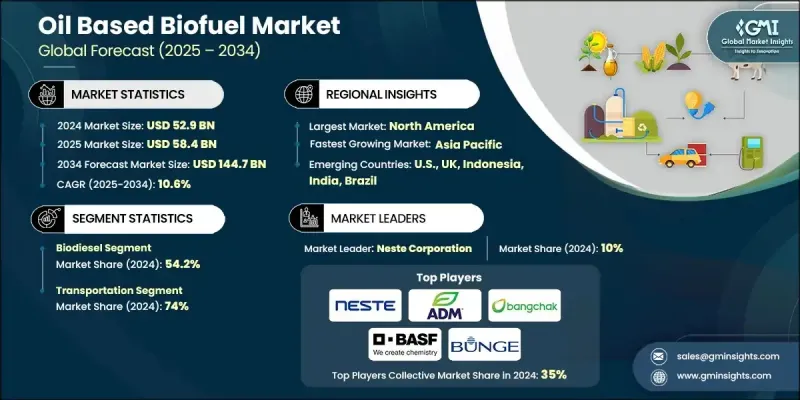
세계의 석유계 바이오연료 시장은 2024년 529억 달러로 평가되었고, 2034년까지 연평균 복합 성장률(CAGR) 10.6%로 성장할 전망이며, 1,447억 달러에 이를 것으로 예측됩니다.
운송 부문의 탈탄소화에 대한 구속력 있는 약속은 대형 도로 시스템, 항공 및 해운 사업에서 재생 가능 연료에 대한 수요를 가속화하고 있습니다. 각국 정부는 바이오연료를 공식적으로 통합한 저탄소 연료 기준과 신재생 에너지 목표를 실시하여 생산자 및 구매자에게 상업적인 확실성을 강화하고 있습니다. 이 정책은 장기적인 위험 감소를 지원하고 재생가능한 연료 생산을 위한 정유 공장의 전환을 촉진하고, 신기술이 확대됨에 따라 사업자가 즉각적인 배출 감소를 보장하는 데 도움이 됩니다. 미국에서는 갱신된 신재생 연료 기준이 수요 형성의 핵심 역할을 계속하고 연간 연료량 기준을 설정함과 동시에 증류용 옥수수유, 사용후 식용유, 대두유 등 원료에 대한 투자를 지원하고 있습니다. 정의된 경로 승인 및 수명 주기 임계값은 산업 발전을 위한 추가 지침을 제공하며, 구조화된 규정 준수 및 신용 제도는 원료 시장의 변동에도 불구하고 프로젝트의 재무적 지속가능성을 보장합니다.
| 시장 범위 | |
|---|---|
| 시작 연도 | 2024년 |
| 예측 연도 | 2025-2034년 |
| 시작 시 가치 | 529억 달러 |
| 예측 금액 | 1,447억 달러 |
| CAGR | 10.6% |
바이오디젤 부문은 2024년에 54.2%의 점유율을 차지했으며, 2034년까지 연평균 복합 성장률(CAGR) 9.9%로 성장할 것으로 예측됩니다. 주요 시장에서의 혼합 비율 요건 강화는 예측 가능한 기준선 소비를 지속적으로 구축하고 있으며, 바이오 디젤을 국가 연료 전략의 신뢰할 수 있는 구성 요소로 삼고 있습니다. 혼합 규칙의 지속적인 조정은 정책을 지역 운송 공급망 전반에서 확실한 수요로 전환하고 있습니다.
운송 부문은 2024년에 74%의 점유율을 차지했으며, 2034년까지 연평균 복합 성장률(CAGR) 10%로 성장할 것으로 예측됩니다. 재생가능한 대체 연료로 디젤 대체를 장려하는 국가 지침은 수소화 처리 식물성 오일과 지방산 메틸 에스테르 혼합 연료 수요를 지속적으로 자극하고 있습니다. 이 동향은 화물 운송 사업, 대중 교통 시스템, 지자체 차량의 규제 준수를 지원하는 동시에 기존 석유에 대한 의존도를 줄입니다.
미국의 석유계 바이오연료 시장은 2024년에 93%의 점유율을 차지했으며, 175억 달러 규모를 창출했습니다. 연방과 주 규제 시스템이 협력하여 재생 가능 디젤 및 폐유계 연료의 신용 가치를 높여 생산 규모 확대에 대한 강력한 인센티브를 창출하고 있습니다. 주 수준의 프로그램은 낮은 배출 연료에 대한 우대 조치를 지속하고 프로젝트 개발 및 장기 규제 준수를 강화하고 있습니다.
자주 묻는 질문
목차
제1장 조사 방법 및 범위
제2장 주요 요약
제3장 업계 인사이트
- 생태계 분석
- 규제 상황
- 업계에 미치는 영향요인
- 성장 촉진요인
- 업계의 잠재적 위험 및 과제
- 성장 가능성 분석
- Porter's Five Forces 분석
- PESTEL 분석
- 새로운 기회 및 동향
- 디지털화 및 IoT 통합
- 신흥 시장 진출
제4장 경쟁 구도
- 서문
- 기업의 시장 점유율 분석
- 북미
- 유럽
- 아시아태평양
- 중동 및 아프리카
- 라틴아메리카
- 전략적 노력
- 경쟁 벤치마킹
- 전략적 대시보드
- 혁신 및 기술 동향
제5장 시장 규모 및 예측 : 연료별(2021-2034년)
- 주요 동향
- 바이오디젤
- HVO
- Sostenible Aviation Fuel(지속 가능한 항공 연료)
- 기타
제6장 시장 규모 및 예측 : 용도별(2021-2034년)
- 주요 동향
- 수송
- 항공 분야
- 기타
제7장 시장 규모 및 예측 : 지역별(2021-2034년)
- 주요 동향
- 북미
- 미국
- 캐나다
- 멕시코
- 유럽
- 독일
- 영국
- 이탈리아
- 프랑스
- 스페인
- 아시아태평양
- 중국
- 호주
- 인도
- 인도네시아
- 한국
- 중동 및 아프리카
- 사우디아라비아
- 남아프리카
- 라틴아메리카
- 브라질
- 아르헨티나
제8장 기업 프로파일
- ADM
- Bangchak Corporation Public Company Limited
- BASF
- Bunge Limited
- Chevron Renewable Energy Group
- Cargill Incorporated
- Eni SpA
- ExxonMobil Corporation
- Greenergy International Ltd.
- Gushan Environmental Energy
- Louis Dreyfus Company(LDC)
- Marathon Petroleum Corporation
- Neste Corporation
- POET LLC
- Shell plc
- Targray
- TotalEnergies
- Valero Energy Corporation
- Verbio Vereinigte BioEnergie AG
- Wilmar International Limited
- Zilor
The Global Oil Based Biofuel Market was valued at USD 52.9 billion in 2024 and is estimated to grow at a CAGR of 10.6% to reach USD 144.7 billion by 2034.
Binding transportation decarbonization commitments are accelerating demand for renewable fuels across heavy road systems, aviation, and marine operations. Governments are implementing low-carbon fuel standards and renewable energy targets that formally incorporate biofuels, reinforcing commercial certainty for producers and offtakers. This policy supports reducing long-term risk, encourages refinery conversions toward renewable fuel production, and helps operators secure immediate emissions reductions while emerging technologies scale. In the United States, updated renewable fuel standards continue to play a central role in shaping demand, establishing annual fuel volume criteria, and supporting investment in feedstocks such as distillers' corn oil, used cooking oil, and soybean oil. Defined pathway approvals and lifecycle thresholds provide further guidance for industry development, while structured compliance and credit systems enable projects to remain financially viable despite fluctuations in feedstock markets.
| Market Scope | |
|---|---|
| Start Year | 2024 |
| Forecast Year | 2025-2034 |
| Start Value | $52.9 billion |
| Forecast Value | $144.7 billion |
| CAGR | 10.6% |
The biodiesel segment accounted for a 54.2% share in 2024 and is expected to grow at a CAGR of 9.9% through 2034. Strengthening blend requirements in core markets continues to build predictable baseline consumption, making biodiesel a dependable component of national fuel strategies. Ongoing adjustments to blending rules translate policy into guaranteed demand across regional transportation supply chains.
The transportation segment held a 74% share in 2024 and is forecast to grow at a 10% CAGR by 2034. National directives encouraging diesel substitution with renewable alternatives continue to stimulate demand for hydrotreated vegetable oil and Fatty Acid Methyl Ester blends. This trend supports compliance across freight operations, transit systems, and municipal fleets while reducing reliance on conventional petroleum.
United States Oil Based Biofuel Market held a 93% share in 2024, generating USD 17.5 billion. Combined federal and state regulatory systems are enhancing credit value for renewable diesel and waste-oil-based fuels, creating strong incentives for production scale-up. State-level programs continue to reward low-emission fuels, reinforcing project development and long-term compliance.
Key companies shaping the Oil Based Biofuel Market include Verbio Vereinigte BioEnergie AG, Marathon Petroleum Corporation, Cargill Incorporated, TotalEnergies, ExxonMobil Corporation, Shell plc, ADM, Targray, Zilor, Bunge Limited, Greenergy International Ltd., Chevron Renewable Energy Group, Eni S.p.A., Gushan Environmental Energy, BASF, Louis Dreyfus Company (LDC), POET LLC, Bangchak Corporation Public Company Limited, Valero Energy Corporation, and Wilmar International Limited. Leading players in the Oil Based Biofuel Market are strengthening their competitive presence through investments in flexible refining technologies, expanded feedstock sourcing, and long-term offtake agreements. Companies are diversifying supply chains by securing access to waste-derived oils and agricultural inputs to reduce exposure to price volatility. Many are upgrading hydrotreating capacity to boost renewable diesel output and improving lifecycle emissions performance to capture regulatory incentives. Strategic partnerships with logistics operators and fuel distributors help scale market penetration, while regional expansions and advanced compliance strategies ensure resilience in fluctuating policy environments.
Table of Contents
Chapter 1 Methodology & Scope
- 1.1 Research design
- 1.2 Base estimates & calculations
- 1.3 Forecast calculation
- 1.4 Data sources
- 1.4.1 Primary
- 1.4.2 Secondary
- 1.4.2.1 Paid
- 1.4.2.2 Public
- 1.5 Market definitions
Chapter 2 Executive Summary
- 2.1 Industry synopsis, 2021 - 2034
- 2.1.1 Business trends
- 2.1.2 Fuel trends
- 2.1.3 Application trends
- 2.1.4 Regional trends
Chapter 3 Industry Insights
- 3.1 Industry ecosystem analysis
- 3.2 Regulatory landscape
- 3.3 Industry impact forces
- 3.3.1 Growth drivers
- 3.3.2 Industry pitfalls & challenges
- 3.4 Growth potential analysis
- 3.5 Porter's analysis
- 3.5.1 Bargaining power of suppliers
- 3.5.2 Bargaining power of buyers
- 3.5.3 Threat of new entrants
- 3.5.4 Threat of substitutes
- 3.6 PESTEL analysis
- 3.6.1 Political factors
- 3.6.2 Economic factors
- 3.6.3 Social factors
- 3.6.4 Technology factors
- 3.6.5 Environmental factors
- 3.6.6 Legal factors
- 3.7 Emerging opportunities & trends
- 3.7.1 Digitalization and IoT integration
- 3.7.2 Emerging market penetration
Chapter 4 Competitive landscape, 2025
- 4.1 Introduction
- 4.2 Company market share analysis, 2024
- 4.2.1 North America
- 4.2.2 Europe
- 4.2.3 Asia Pacific
- 4.2.4 Middle East & Africa
- 4.2.5 Latin America
- 4.3 Strategic initiatives
- 4.4 Competitive benchmarking
- 4.5 Strategic dashboard
- 4.6 Innovation & technology landscape
Chapter 5 Market Size and Forecast, By Fuel, 2021 - 2034 (USD Million, Mtoe)
- 5.1 Key trends
- 5.2 Biodiesel
- 5.3 HVO
- 5.4 SAF
- 5.5 Others
Chapter 6 Market Size and Forecast, By Application, 2021 - 2034 (USD Million, Mtoe)
- 6.1 Key trends
- 6.2 Transportation
- 6.3 Aviation
- 6.4 Others
Chapter 7 Market Size and Forecast, By Region, 2021 - 2034 (USD Million, Mtoe)
- 7.1 Key trends
- 7.2 North America
- 7.2.1 U.S.
- 7.2.2 Canada
- 7.2.3 Mexico
- 7.3 Europe
- 7.3.1 Germany
- 7.3.2 UK
- 7.3.3 Italy
- 7.3.4 France
- 7.3.5 Spain
- 7.4 Asia Pacific
- 7.4.1 China
- 7.4.2 Australia
- 7.4.3 India
- 7.4.4 Indonesia
- 7.4.5 South Korea
- 7.5 Middle East & Africa
- 7.5.1 Saudi Arabia
- 7.5.2 South Africa
- 7.6 Latin America
- 7.6.1 Brazil
- 7.6.2 Argentina
Chapter 8 Company Profiles
- 8.1 ADM
- 8.2 Bangchak Corporation Public Company Limited
- 8.3 BASF
- 8.4 Bunge Limited
- 8.5 Chevron Renewable Energy Group
- 8.6 Cargill Incorporated
- 8.7 Eni S.p.A.
- 8.8 ExxonMobil Corporation
- 8.9 Greenergy International Ltd.
- 8.10 Gushan Environmental Energy
- 8.11 Louis Dreyfus Company (LDC)
- 8.12 Marathon Petroleum Corporation
- 8.13 Neste Corporation
- 8.14 POET LLC
- 8.15 Shell plc
- 8.16 Targray
- 8.17 TotalEnergies
- 8.18 Valero Energy Corporation
- 8.19 Verbio Vereinigte BioEnergie AG
- 8.20 Wilmar International Limited
- 8.21 Zilor