
|
시장보고서
상품코드
1885847
스마트 병원용 침대 시장 : 시장 기회, 성장 요인, 업계 동향 분석 및 예측(2025-2034년)Smart Hospital Beds Market Opportunity, Growth Drivers, Industry Trend Analysis, and Forecast 2025 - 2034 |
||||||

세계의 스마트 병원용 침대 시장은 2024년에 5억 2,370만 달러로 평가되었고, 2034년까지 연평균 복합 성장률(CAGR) 7.3%로 성장할 전망이며, 10억 달러에 이를 것으로 예측됩니다.
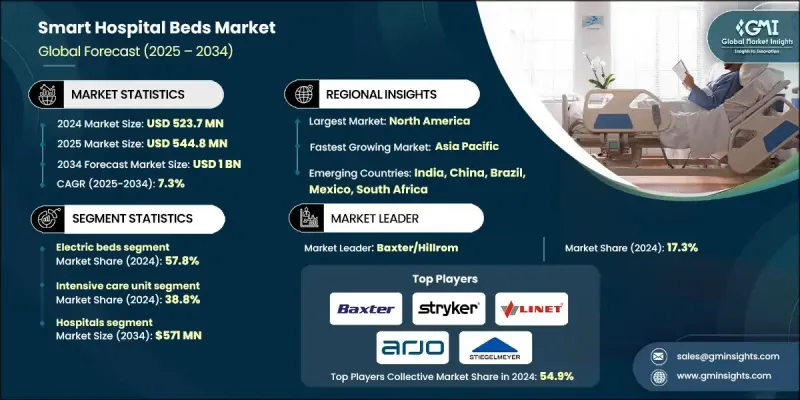
시장 확대의 배경으로는 환자 중심의 케어에 대한 주목 증가, 병원 자동화, IoT 및 AI 기술의 통합이 포함됩니다. 병원과 장기 요양 시설에서는 환자의 안전성 향상, 임상 워크플로우의 효율화, 건강 상태 악화의 조기 조기 발견을 지원하는 솔루션의 도입이 우선되고 있습니다. 만성 질환 증가, 노화, 집중 치료 및 장기 요양이 필요한 환자 증가로 센서와 연결 기능을 갖춘 고급 침대 수요가 증가하고 있습니다. IoMT(의료기기인터넷)의 통합, AI를 활용한 모니터링, 클라우드 기반의 분석 등의 기술적 진보에 의해 의료 제공업체는 데이터에 근거한 의사 결정을 실시해, 치료의 정밀도를 향상시킬 수 있게 되었습니다. 또한, 디지털화된 병원 생태계로의 전환과, 특히 신흥 지역의 의료 현대화를 지원하는 정부의 이니셔티브가 세계 스마트 침대의 도입을 뒷받침하고 있습니다.
| 시장 범위 | |
|---|---|
| 시작 연도 | 2024년 |
| 예측 기간 | 2025-2034년 |
| 시작 시 가치 | 5억 2,370만 달러 |
| 예측 금액 | 10억 달러 |
| CAGR | 7.3% |
반전동식 침대 부문은 2024년에 1억 4,500만 달러 시장 규모를 기록하였고, 2025-2034년 CAGR 7.2%로 성장할 것으로 예측됩니다. 이 침대는 전동 기능 및 수동 조정 기능을 결합하여 부분적인 자동화를 실현하고 있습니다. 병원이나 재택 케어 제공업체는 환자의 쾌적성을 유지하면서 비용 효율이 뛰어난 점에서 이 부문에 매력을 느끼고 있습니다. 세미 전동 침대는 머리와 발 부분의 전동 위치 조정이 가능하지만 전체 높이 조정은 수동으로 유지되므로 예산을 고려한 중간 규모 시설에 적합합니다.
집중치료실(ICU) 부문은 2024년에 38.8%의 점유율을 차지했으며, 2034년까지 4억 800만 달러에 이를 것으로 예측됩니다. ICU 부문이 지배적인 이유는 지속적인 환자 모니터링과 신속한 대응 능력이 이러한 환경에서 매우 중요하기 때문입니다. ICU용 스마트 베드는 생체 신호 추적, 환자 움직임 감지, 바닥 어긋남 예방을 가능하게 하는 통합 센서로 환자의 안전성을 크게 향상시킵니다. 심각한 질병 증가, 수술 후 관리 수요, 세계 ICU 입원 환자 증가가 주요 성장 요인입니다. IoT 지원 연결성 및 AI 기반 예측 분석을 통해 의료진은 환자의 원격 모니터링, 치료 계획 최적화, 대응 시간 단축이 가능합니다.
북미의 스마트 병원용 침대 시장은 2024년 35.3%의 점유율을 차지했습니다. 이 지역의 이점은 성숙한 의료 인프라, 첨단 의료 기술의 높은 도입률, 지속적인 모니터링 및 개인화된 치료가 필요한 만성 질환을 가진 노인 인구 증가로 인한 것입니다.
자주 묻는 질문
목차
제1장 조사 방법 및 범위
제2장 주요 요약
제3장 업계 인사이트
- 생태계 분석
- 업계에 미치는 영향요인
- 성장 촉진요인
- 고령화 인구 증가 및 만성 질환의 부담 증가
- 병원 인프라에서 IoT와 AI의 통합
- 환자 안전 및 케어 효율에 대한 주목의 향상
- 재택치료 및 원격 의료 서비스의 확대
- 업계의 잠재적 위험 및 과제
- 높은 초기 도입 및 유지 관리 비용
- 상호 운용성 및 통합에 관한 과제
- 시장 기회
- 무선 및 클라우드 접속형 스마트 침대의 등장
- AI를 활용한 예측형 환자 모니터링
- 성장 촉진요인
- 성장 가능성 분석
- 규제 상황
- 북미
- 유럽
- 기술 동향
- 현재의 기술 동향
- IoT 대응 및 접속형 침대
- AI를 활용한 환자 모니터링
- 인체 공학을 기반으로 한 자동 포지셔닝 시스템
- 신흥 기술 및 그 영향
- 무선 및 클라우드 접속 대응 침대
- 병원 정보 시스템(HIS/EHR)과의 통합
- 원격 의료 및 원격 환자 관리 솔루션
- 현재의 기술 동향
- 장래 시장 동향
- 예측 및 예방 의료 솔루션의 도입
- 스마트 베드 기능에 있어서 연구 개발 강화
- 신흥 시장 진출
- 가격 분석
- 투자 및 자금 조달 환경
- Porter's Five Forces 분석
- PESTEL 분석
제4장 경쟁 구도
- 서문
- 기업 매트릭스 분석
- 기업의 시장 점유율 분석
- 세계
- 북미
- 유럽
- 경쟁 포지셔닝 매트릭스
- 주요 시장 기업의 경쟁 분석
- 주요 발전
- 합병 및 인수
- 제휴 및 협업
- 신제품 발매
- 확대 계획
제5장 시장 추계 및 예측 : 제품 유형별(2021-2034년)
- 주요 동향
- 전동 침대
- 세미 전동 침대
- 무선 침대
제6장 시장 추계 및 예측 : 용도별(2021-2034년)
- 주요 동향
- 집중 치료실
- 내과 및 외과(일반 병동)
- 장기 요양
- 기타 용도
제7장 시장 추계 및 예측 : 최종 용도별(2021-2034년)
- 주요 동향
- 병원
- 외래 진료 센터
- 기타 최종 용도
제8장 시장 추계 및 예측 : 지역별(2021-2034년)
- 주요 동향
- 북미
- 미국
- 캐나다
- 유럽
- 독일
- 영국
- 프랑스
- 스페인
- 이탈리아
- 네덜란드
- 아시아태평양
- 중국
- 일본
- 인도
- 호주
- 한국
- 라틴아메리카
- 브라질
- 멕시코
- 아르헨티나
- 중동 및 아프리카
- 남아프리카
- 사우디아라비아
- 아랍에미리트(UAE)
제9장 기업 프로파일
- Arjo
- Baxter/Hillrom
- Betten Malsch
- Drive DeVilbiss
- Famed
- Favero Health Projects
- Invacare
- Joerns Healthcare
- LINET
- Malvestio
- Paramount Bed
- Pardo
- Stiegelmeyer
- Stryker
The Global Smart Hospital Beds Market was valued at USD 523.7 million in 2024 and is estimated to grow at a CAGR of 7.3% to reach USD 1 billion by 2034.
The market expansion is fueled by the rising focus on patient-centered care, hospital automation, and the integration of IoT and AI technologies. Hospitals and long-term care facilities are increasingly prioritizing solutions that enhance patient safety, streamline clinical workflows, and support early detection of health deterioration. The prevalence of chronic illnesses, an aging population, and a higher number of patients requiring intensive or long-term care are driving the need for advanced beds equipped with sensors and connectivity features. Technological advancements, including IoMT integration, AI-powered monitoring, and cloud-based analytics, allow healthcare providers to make data-driven decisions and improve treatment precision. Furthermore, the shift toward digitalized hospital ecosystems and government initiatives supporting healthcare modernization, particularly in emerging regions, is bolstering smart bed adoption worldwide.
| Market Scope | |
|---|---|
| Start Year | 2024 |
| Forecast Year | 2025-2034 |
| Start Value | $523.7 Million |
| Forecast Value | $1 Billion |
| CAGR | 7.3% |
The semi-electric beds segment generated USD 145 million in 2024 and is expected to grow at a CAGR of 7.2% from 2025 to 2034. These beds provide partial automation by combining electric motorized functions with manual adjustments. Hospitals and home care providers are attracted to this segment for its cost efficiency while maintaining patient comfort. Semi-electric beds allow motorized positioning of head and foot sections, while overall height adjustments remain manual, making them suitable for mid-sized facilities with budget considerations.
The intensive care unit (ICU) segment held a 38.8% share in 2024 and is projected to reach USD 408 million through 2034. The ICU segment dominates because continuous patient monitoring and rapid response capabilities are critical in these settings. Smart beds in ICUs feature integrated sensors to track vital signs, detect patient movement, and prevent bedsores, significantly improving patient safety. The rising prevalence of critical illnesses, post-operative care demands, and increasing ICU admissions globally are major growth drivers. IoT-enabled connectivity and AI-based predictive analytics allow healthcare staff to remotely monitor patients, optimize treatment plans, and reduce response times.
North America Smart Hospital Beds Market held 35.3% share in 2024. The region's dominance is attributed to a mature healthcare infrastructure, high adoption of advanced medical technologies, and a growing geriatric population with chronic health conditions requiring continuous monitoring and personalized care.
Leading players operating in the Smart Hospital Beds Market include Arjo, Baxter/Hillrom, Betten Malsch, Drive DeVilbiss, Famed, Favero Health Projects, Invacare, Joerns Healthcare, LINET, Malvestio, Paramount Bed, Pardo, Stiegelmeyer, and Stryker. Companies in the Smart Hospital Beds Market are strengthening their foothold through product innovation, integrating IoT, AI, and cloud-based monitoring into bed systems to enhance functionality, patient comfort, and clinical efficiency. Strategic partnerships with hospitals, healthcare providers, and technology firms enable tailored solutions and faster market penetration. Geographic expansion into emerging regions helps companies tap into rising healthcare infrastructure investments. Firms are also focusing on cost optimization by offering semi-electric and modular designs for mid-sized facilities while maintaining quality standards.
Table of Contents
Chapter 1 Methodology and Scope
- 1.1 Market scope and definitions
- 1.2 Research design
- 1.2.1 Research approach
- 1.2.2 Data collection methods
- 1.3 Data mining sources
- 1.3.1 Global
- 1.3.2 Regional/country
- 1.4 Base estimates and calculations
- 1.4.1 Base year calculation
- 1.4.2 Key trends for market estimation
- 1.5 Primary research and validation
- 1.5.1 Primary sources
- 1.6 Forecast model
- 1.7 Research assumptions and limitations
Chapter 2 Executive Summary
- 2.1 Industry 3600 synopsis
- 2.2 Key market trends
- 2.2.1 Regional trends
- 2.2.2 Product type trends
- 2.2.3 Application trends
- 2.2.4 End use trends
- 2.3 CXO perspectives: Strategic imperatives
- 2.3.1 Key decision points for industry executives
- 2.3.2 Critical success factors for market players
- 2.4 Future outlook and strategic recommendations
Chapter 3 Industry Insights
- 3.1 Industry ecosystem analysis
- 3.2 Industry impact forces
- 3.2.1 Growth drivers
- 3.2.1.1 Rising geriatric population and chronic disease burden
- 3.2.1.2 Integration of IoT and AI in hospital infrastructure
- 3.2.1.3 Growing focus on patient safety and care efficiency
- 3.2.1.4 Expansion of home healthcare and telehealth services
- 3.2.2 Industry pitfalls and challenges
- 3.2.2.1 High initial procurement and maintenance costs
- 3.2.2.2 Interoperability and integration challenges
- 3.2.3 Market opportunities
- 3.2.3.1 Emergence of wireless and cloud-connected smart beds
- 3.2.3.2 AI-powered predictive patient monitoring
- 3.2.1 Growth drivers
- 3.3 Growth potential analysis
- 3.4 Regulatory landscape
- 3.4.1 North America
- 3.4.2 Europe
- 3.5 Technology landscape
- 3.5.1 Current technological trends
- 3.5.1.1 IoT-enabled and connected beds
- 3.5.1.2 AI-powered patient monitoring
- 3.5.1.3 Ergonomic and automated positioning systems
- 3.5.2 Emerging technologies and their impacts
- 3.5.2.1 Wireless and cloud-connected beds
- 3.5.2.2 Integration with hospital information systems (HIS/EHR)
- 3.5.2.3 Telehealth and remote patient care solutions
- 3.5.1 Current technological trends
- 3.6 Future market trends
- 3.6.1 Adoption of predictive and preventive care solutions
- 3.6.2 Increased R&D in smart bed features
- 3.6.3 Expansion into emerging markets
- 3.7 Pricing analysis
- 3.8 Investment and funding landscape
- 3.9 Porter's analysis
- 3.10 PESTEL analysis
Chapter 4 Competitive Landscape, 2024
- 4.1 Introduction
- 4.2 Company matrix analysis
- 4.3 Company market share analysis
- 4.3.1 Global
- 4.3.2 North America
- 4.3.3 Europe
- 4.4 Competitive positioning matrix
- 4.5 Competitive analysis of major market players
- 4.6 Key developments
- 4.6.1 Mergers & acquisitions
- 4.6.2 Partnerships & collaborations
- 4.6.3 New product launches
- 4.6.4 Expansion plans
Chapter 5 Market Estimates and Forecast, By Product Type, 2021 - 2034 ($ Mn)
- 5.1 Key trends
- 5.2 Electric beds
- 5.3 Semi-electric beds
- 5.4 Wireless beds
Chapter 6 Market Estimates and Forecast, By Application, 2021 - 2034 ($ Mn)
- 6.1 Key trends
- 6.2 Intensive care unit
- 6.3 Med-surg (General wards)
- 6.4 Long term care
- 6.5 Other applications
Chapter 7 Market Estimates and Forecast, By End Use, 2021 - 2034 ($ Mn)
- 7.1 Key trends
- 7.2 Hospitals
- 7.3 Ambulatory care centres
- 7.4 Other End use
Chapter 8 Market Estimates and Forecast, By Region, 2021 - 2034 ($ Mn)
- 8.1 Key trends
- 8.2 North America
- 8.2.1 U.S.
- 8.2.2 Canada
- 8.3 Europe
- 8.3.1 Germany
- 8.3.2 UK
- 8.3.3 France
- 8.3.4 Spain
- 8.3.5 Italy
- 8.3.6 Netherlands
- 8.4 Asia Pacific
- 8.4.1 China
- 8.4.2 Japan
- 8.4.3 India
- 8.4.4 Australia
- 8.4.5 South Korea
- 8.5 Latin America
- 8.5.1 Brazil
- 8.5.2 Mexico
- 8.5.3 Argentina
- 8.6 Middle East and Africa
- 8.6.1 South Africa
- 8.6.2 Saudi Arabia
- 8.6.3 UAE
Chapter 9 Company Profiles
- 9.1 Arjo
- 9.2 Baxter/Hillrom
- 9.3 Betten Malsch
- 9.4 Drive DeVilbiss
- 9.5 Famed
- 9.6 Favero Health Projects
- 9.7 Invacare
- 9.8 Joerns Healthcare
- 9.9 LINET
- 9.10 Malvestio
- 9.11 Paramount Bed
- 9.12 Pardo
- 9.13 Stiegelmeyer
- 9.14 Stryker