|
시장보고서
상품코드
1885853
소고기 단백질 가수분해물 시장 : 시장 기회, 성장 요인, 업계 동향 분석 및 예측(2025-2034년)Beef Protein Hydrolysates Market Opportunity, Growth Drivers, Industry Trend Analysis, and Forecast 2025 - 2034 |
||||||

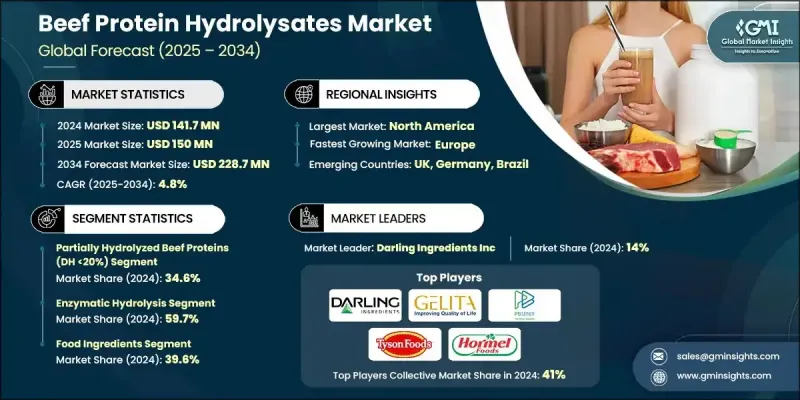
세계의 소고기 단백질 가수분해물 시장은 2024년에 1억 4,170만 달러로 평가되었고, 2034년까지 연평균 복합 성장률(CAGR) 4.8%로 성장할 전망이며, 2억 2,870만 달러에 달할 것으로 예측되고 있습니다.
펩티드 추출 기술, 발효 관리, 분석 프로파일링의 진보에 의해 보다 높은 정밀도와 균일성, 검증이 끝난 생물 활성 성분 함유량을 갖춘 소고기 단백질 가수분해물의 생산이 가능해지고 있습니다. 크로마토그래피 기술과 통합형 멀티오믹스 기술의 향상은 규제 요건을 충족하면서 표준화를 지원하고 있습니다. 동시에 디지털 영양 플랫폼에서는 가수분해물에 기초한 지식을 개인별 식사 계획에 도입하기 시작하고 있습니다. 이러한 과학적 혁신, 맞춤 영양 관리, 클린 라벨 지향의 융합으로 인간과 동물의 건강 분야에서의 채용이 가속화되고 있습니다. 본 원료의 신속한 흡수성, 높은 소화성, 우수한 아미노산 프로파일은 스포츠 영양, 기능성 식품, 동물사료 용도에 있어서 가치 있는 것입니다. 제조업체는 이러한 특성을 활용해, 대두나 유제품 등의 기존 단백질원과 비교해, 개량된 관능 특성, 강화된 영양 성능, 알레르겐 프리의 특성을 갖춘 가수분해물을 개발하고 있습니다.
| 시장 범위 | |
|---|---|
| 시작 연도 | 2024년 |
| 예측 연도 | 2025-2034년 |
| 시작 시 가치 | 1억 4,170만 달러 |
| 예측 금액 | 2억 2,870만 달러 |
| CAGR | 4.8% |
가수분해도 20%를 특징으로 하는 부분 가수분해 쇠고기 단백질은 2024년에 34.6%의 점유율을 차지하였고, 2034년까지 연평균 복합 성장률(CAGR) 4.4%로 성장할 것으로 예측됩니다. 그 용도 확대는 풍미나 식감을 손상시키지 않고 소화 서포트 효과를 제공하는 배합에 관련되어 있어, 소비자에게 있어서 바람직한 관능 특성을 가지는 경도의 가수분해를 필요로 하는 일반적인 건강 식품, 소아용 영양 식품, 기능성 식품 제품에 최적입니다.
효소 가수분해 부문은 2024년에 59.7%의 점유율을 차지하였으며, 2025-2034년 CAGR 4.6%로 성장할 것으로 예측됩니다. 이 방법은 표적 펩티드 구조의 생성 능력, 클린 라벨의 무결성 유지 및 높은 생물학적 활성의 제공이 가능하기 때문에 여전히 주류입니다. 저온처리에 의해 영양가가 유지되고, 항산화 작용, 대사 촉진 효과, 항균 작용 등의 유익한 기능 특성이 강화되므로 프리미엄 기능성 식품, 스포츠 영양, 임상 용도, 개별화 영양 솔루션에 필수적입니다.
유럽의 소고기 단백질 가수분해물 시장은 2024년 4,290만 달러 규모에 이르렀습니다. 소화성, 깨끗한 라벨에 대한 호의적인 인식, 불필요한 첨가물이 없는 고품질 단백질 공급원을 중시하는 특수 식이요법에 대한 적합성으로 인해 유럽 소비자와 제조업체가 지지합니다.
자주 묻는 질문
목차
제1장 조사 방법 및 범위
제2장 주요 요약
제3장 업계 인사이트
- 생태계 분석
- 공급자의 상황
- 이익률
- 각 단계에서의 부가가치
- 밸류체인에 영향을 주는 요인
- 혁신
- 업계에 미치는 영향요인
- 성장 촉진요인
- 클린 라벨 단백질 원료에 대한 수요 증가
- 지속 가능한 육류 가공에 주목의 고조
- 영양 보조 식품 및 기능성 식품 용도 확대
- 업계의 잠재적 위험 및 과제
- BSE/TSE의 안전성 우려 및 규제 상의 제한
- 높은 가공 비용 및 기술적 복잡성
- 시장 기회
- 건강 용도를 목적으로 한 생물 활성 펩타이드의 개발
- 사료 및 반려동물 식품 분야에서의 사업 확대
- 성장 촉진요인
- 성장 가능성 분석
- 규제 상황
- 북미
- 유럽
- 아시아태평양
- 라틴아메리카
- 중동 및 아프리카
- Porter's Five Forces 분석
- PESTEL 분석
- 가격 동향
- 지역별
- 제품 유형별
- 장래 시장 동향
- 기술 및 혁신 동향
- 현재의 기술 동향
- 신흥 기술
- 특허 상황
- 무역 통계(HS코드)(참고 : 무역 통계는 주요 국가에서만 제공됨)
- 주요 수입국
- 주요 수출국
- 지속가능성 및 환경면
- 지속가능한 대처
- 폐기물 감축 전략
- 생산에 있어서의 에너지 효율
- 환경에 배려한 대처
- 탄소발자국 고려
제4장 경쟁 구도
- 서문
- 기업의 시장 점유율 분석
- 지역별
- 북미
- 유럽
- 아시아태평양
- 라틴아메리카
- 중동 및 아프리카
- 지역별
- 기업 매트릭스 분석
- 주요 시장 기업의 경쟁 분석
- 경쟁 포지셔닝 매트릭스
- 주요 발전
- 합병 및 인수
- 제휴 및 협업
- 신제품 발매
- 사업 확대 계획
제5장 시장 추계 및 예측 : 제품 유형별(2021-2034년)
- 주요 동향
- 부분 가수분해 쇠고기 단백질(Dh < 20%)
- 중간 정도 가수분해 쇠고기 단백질(Dh 20-60%)
- 고도 가수분해 쇠고기 단백질(Dh > 60%)
- 쇠고기 콜라겐 펩타이드(분자량 < 3 KdA)
제6장 시장 추계 및 예측 : 제조 공정별(2021-2034년)
- 주요 동향
- 효소 가수분해
- 알칼라제 베이스의 가공
- 프로타멕스 기반 가공
- 파파인 베이스의 가공
- 화학적 가수분해
- 산 가수분해법
- 알칼리 가수분해법
- 열가수분해
- 고압 처리
- 마이크로파 보조 가수분해
- 하이브리드 가공 기술
- 효소 화학 복합법
- 순차 처리 접근
제7장 시장 추계 및 예측 : 최종 용도 분류(2021-2034년)
- 주요 동향
- 식품 원료
- 풍미 증강제 및 미각 조정제
- 단백질 강화 및 영양 강화
- 가공육 제품
- 제빵 및 과자류 용도
- 사료 및 반려동물 식품
- 가축 사료 첨가물
- 수산 양식용 사료 용도
- 반려동물 식품 기호성 향상제
- 특수 동물 영양
- 뉴트라슈티컬 및 영양보조식품
- 스포츠 영양 제품
- 임상 영양 용도
- 관절의 건강과 가동성을 지원하는 보충 교재
- 혈당 조절 및 대사 건강
- 화장품 및 퍼스널케어
- 안티 에이징 처방
- 피부 건강 용도
- 헤어 케어 제품
- 상처 치유 및 의료 용도
제8장 시장 추계 및 예측 : 지역별(2021-2034년)
- 주요 동향
- 북미
- 미국
- 캐나다
- 유럽
- 독일
- 영국
- 프랑스
- 스페인
- 이탈리아
- 기타 유럽
- 아시아태평양
- 중국
- 인도
- 일본
- 호주
- 한국
- 기타 아시아태평양
- 라틴아메리카
- 브라질
- 멕시코
- 아르헨티나
- 기타 라틴아메리카
- 중동 및 아프리카
- 사우디아라비아
- 남아프리카
- 아랍에미리트(UAE)
- 기타 중동 및 아프리카
제9장 기업 프로파일
- Darling Ingredients Inc
- Gelita AG
- Tessenderlo Group(PB Leiner)
- Tyson Foods Inc
- Hormel Foods Corporation
- Rousselot(Darling Ingredients)
- Sonac(Darling Ingredients)
- CTH(Darling Ingredients)
- Smithfield Foods Inc
- Specialty Protein Processors
- Bioactive Peptide Developers
- Sustainable Processing Companies
- Regional Feed Ingredient Suppliers
- Emerging Technology Companies
- Contract Manufacturing Organizations
The Global Beef Protein Hydrolysates Market was valued at USD 141.7 million in 2024 and is estimated to grow at a CAGR of 4.8% to reach USD 228.7 million by 2034.
Advancements in peptide extraction, fermentation management, and analytical profiling are enabling the production of beef-derived hydrolysates with greater precision, consistency, and verified bioactive content. Improvements in chromatography and integrated multi-omics technologies support standardization while meeting regulatory expectations. At the same time, digital nutrition platforms are beginning to incorporate hydrolysate-based insights into personalized dietary plans. This merging of scientific innovation, individualized nutrition, and clean-label preference is accelerating adoption across both human and animal health sectors. The ingredient's rapid absorption, high digestibility, and strong amino acid profile make it valuable for sports nutrition, functional foods, and animal feed applications. Manufacturers are leveraging these attributes to develop hydrolysates with improved sensory qualities, enhanced nutritional performance, and allergen-free positioning compared to traditional protein sources like soy or dairy.
| Market Scope | |
|---|---|
| Start Year | 2024 |
| Forecast Year | 2025-2034 |
| Start Value | $141.7 Million |
| Forecast Value | $228.7 Million |
| CAGR | 4.8% |
The partially hydrolyzed beef proteins, characterized by a degree of hydrolysis of 20%, accounted for a 34.6% share in 2024 and are expected to grow at a CAGR of 4.4% through 2034. Their expanding use is tied to formulations that provide supportive digestive benefits without compromising flavor or texture, which makes them well-suited for general wellness, pediatric nutrition, and functional food products requiring mild hydrolysis with consumer-friendly sensory characteristics.
The enzymatic hydrolysis segment held a 59.7% share in 2024 and is projected to grow at a CAGR of 4.6% from 2025 to 2034. This approach remains dominant due to its capacity to produce targeted peptide structures, maintain clean-label integrity, and deliver high bioactivity. Its low-temperature processing helps preserve nutritional value and enhance beneficial functional properties, including antioxidant, metabolic, and antimicrobial effects, making it essential for premium functional foods, sports nutrition, clinical applications, and personalized dietary solutions.
Europe Beef Protein Hydrolysates Market generated USD 42.9 million in 2024, owing to the shifting toward advanced nutraceuticals and functional ingredients. Beef protein hydrolysates appeal to European consumers and manufacturers because of their digestibility, favorable clean-label perception, and suitability for specialized diets that emphasize high-quality protein sources without unwanted additives.
Major companies operating in the Beef Protein Hydrolysates Market include Darling Ingredients Inc., Gelita AG, Tessenderlo Group (PB Leiner), Tyson Foods Inc., Hormel Foods Corporation, Rousselot (Darling Ingredients), Sonac (Darling Ingredients), CTH (Darling Ingredients), Smithfield Foods Inc., Specialty Protein Processors, Bioactive Peptide Developers, Sustainable Processing Companies, Regional Feed Ingredient Suppliers, Emerging Technology Companies, and Contract Manufacturing Organizations. Companies active in the Beef Protein Hydrolysates Market adopt a variety of strategies to reinforce their competitive positioning. Many are investing heavily in advanced enzymatic technologies to develop more refined peptide profiles with enhanced functional benefits. Expanding production capacity through upgraded processing facilities supports rising global demand and improves supply-chain resilience. Firms are also aligning product portfolios with clean-label and allergen-free trends, ensuring transparency and meeting consumer expectations.
Table of Contents
Chapter 1 Methodology & Scope
- 1.1 Market scope and definition
- 1.2 Research design
- 1.2.1 Research approach
- 1.2.2 Data collection methods
- 1.3 Data mining sources
- 1.3.1 Global
- 1.3.2 Regional/Country
- 1.4 Base estimates and calculations
- 1.4.1 Base year calculation
- 1.4.2 Key trends for market estimation
- 1.5 Primary research and validation
- 1.5.1 Primary sources
- 1.6 Forecast model
- 1.7 Research assumptions and limitations
Chapter 2 Executive Summary
- 2.1 Industry 360° synopsis
- 2.2 Key market trends
- 2.2.1 Regional
- 2.2.2 Product type
- 2.2.3 Manufacturing Process
- 2.2.4 Application
- 2.3 TAM Analysis, 2025-2034
- 2.4 CXO perspectives: Strategic imperatives
- 2.4.1 Executive decision points
- 2.4.2 Critical success factors
- 2.5 Future Outlook and Strategic Recommendations
Chapter 3 Industry Insights
- 3.1 Industry ecosystem analysis
- 3.1.1 Supplier landscape
- 3.1.2 Profit margin
- 3.1.3 Value addition at each stage
- 3.1.4 Factor affecting the value chain
- 3.1.5 Disruptions
- 3.2 Industry impact forces
- 3.2.1 Growth drivers
- 3.2.1.1 Growing demand for clean label protein ingredients
- 3.2.1.2 Increasing focus on sustainable meat processing
- 3.2.1.3 Rising nutraceutical & functional food applications
- 3.2.2 Industry pitfalls and challenges
- 3.2.2.1 BSE/TSE safety concerns & regulatory restrictions
- 3.2.2.2 High processing costs & technical complexity
- 3.2.3 Market opportunities
- 3.2.3.1 Bioactive peptide development for health applications
- 3.2.3.2 Expansion in animal feed & pet food segments
- 3.2.1 Growth drivers
- 3.3 Growth potential analysis
- 3.4 Regulatory landscape
- 3.4.1 North America
- 3.4.2 Europe
- 3.4.3 Asia Pacific
- 3.4.4 Latin America
- 3.4.5 Middle East & Africa
- 3.5 Porter's analysis
- 3.6 PESTEL analysis
- 3.7 Price trends
- 3.7.1 By region
- 3.7.2 By product type
- 3.8 Future market trends
- 3.9 Technology and Innovation landscape
- 3.9.1 Current technological trends
- 3.9.2 Emerging technologies
- 3.10 Patent Landscape
- 3.11 Trade statistics (HS code) ( Note: the trade statistics will be provided for key countries only)
- 3.11.1 Major importing countries
- 3.11.2 Major exporting countries
- 3.12 Sustainability and environmental aspects
- 3.12.1 Sustainable practices
- 3.12.2 Waste reduction strategies
- 3.12.3 Energy efficiency in production
- 3.12.4 Eco-friendly initiatives
- 3.13 Carbon footprint consideration
Chapter 4 Competitive Landscape, 2024
- 4.1 Introduction
- 4.2 Company market share analysis
- 4.2.1 By region
- 4.2.1.1 North America
- 4.2.1.2 Europe
- 4.2.1.3 Asia Pacific
- 4.2.1.4 LATAM
- 4.2.1.5 MEA
- 4.2.1 By region
- 4.3 Company matrix analysis
- 4.4 Competitive analysis of major market players
- 4.5 Competitive positioning matrix
- 4.6 Key developments
- 4.6.1 Mergers & acquisitions
- 4.6.2 Partnerships & collaborations
- 4.6.3 New Product Launches
- 4.6.4 Expansion Plans
Chapter 5 Market Estimates and Forecast, By Product Type, 2021-2034 (USD Million) (Kilo Tons)
- 5.1 Key trends
- 5.2 Partially hydrolyzed beef proteins (Dh <20%)
- 5.3 Moderately hydrolyzed beef proteins (Dh 20-60%)
- 5.4 Extensively hydrolyzed beef proteins (Dh >60%)
- 5.5 Beef collagen peptides (molecular weight <3 Kda)
Chapter 6 Market Estimates and Forecast, By Manufacturing Process, 2021-2034 (USD Million) (Kilo Tons)
- 6.1 Key trends
- 6.2 Enzymatic hydrolysis
- 6.2.1 Alcalase-based processing
- 6.2.2 Protamex-based processing
- 6.2.3 Papain-based processing
- 6.3 Chemical hydrolysis
- 6.3.1 Acid hydrolysis methods
- 6.3.2 Alkaline hydrolysis methods
- 6.4 Thermal hydrolysis
- 6.4.1 High pressure processing
- 6.4.2 Microwave-assisted hydrolysis
- 6.5 Hybrid processing technologies
- 6.5.1 Combined enzymatic-chemical methods
- 6.5.2 Sequential processing approaches
Chapter 7 Market Estimates and Forecast, By End Use Application, 2021-2034 (USD Million) (Kilo Tons)
- 7.1 Key trends
- 7.2 Food ingredients
- 7.2.1 Flavor enhancers & taste modulators
- 7.2.2 Protein fortification & nutritional enhancement
- 7.2.3 Processed meat products
- 7.2.4 Bakery & confectionery applications
- 7.3 Animal feed & pet food
- 7.3.1 Livestock feed supplements
- 7.3.2 Aquaculture feed applications
- 7.3.3 Pet food palatability enhancers
- 7.3.4 Specialty animal nutrition
- 7.4 Nutraceutical & dietary supplements
- 7.4.1 Sports nutrition products
- 7.4.2 Clinical nutrition applications
- 7.4.3 Joint health & mobility supplements
- 7.4.4 Glucose control & metabolic health
- 7.5 Cosmetics & personal care
- 7.5.1 Anti-aging formulations
- 7.5.2 Skin health applications
- 7.5.3 Hair care products
- 7.5.4 Wound healing & biomedical uses
Chapter 8 Market Estimates and Forecast, By Region, 2021-2034 (USD Million) (Kilo Tons)
- 8.1 Key trends
- 8.2 North America
- 8.2.1 U.S.
- 8.2.2 Canada
- 8.3 Europe
- 8.3.1 Germany
- 8.3.2 UK
- 8.3.3 France
- 8.3.4 Spain
- 8.3.5 Italy
- 8.3.6 Rest of Europe
- 8.4 Asia Pacific
- 8.4.1 China
- 8.4.2 India
- 8.4.3 Japan
- 8.4.4 Australia
- 8.4.5 South Korea
- 8.4.6 Rest of Asia Pacific
- 8.5 Latin America
- 8.5.1 Brazil
- 8.5.2 Mexico
- 8.5.3 Argentina
- 8.5.4 Rest of Latin America
- 8.6 Middle East and Africa
- 8.6.1 Saudi Arabia
- 8.6.2 South Africa
- 8.6.3 UAE
- 8.6.4 Rest of Middle East and Africa
Chapter 9 Company Profiles
- 9.1 Darling Ingredients Inc
- 9.2 Gelita AG
- 9.3 Tessenderlo Group (PB Leiner)
- 9.4 Tyson Foods Inc
- 9.5 Hormel Foods Corporation
- 9.6 Rousselot (Darling Ingredients)
- 9.7 Sonac (Darling Ingredients)
- 9.8 CTH (Darling Ingredients)
- 9.9 Smithfield Foods Inc
- 9.10 Specialty Protein Processors
- 9.11 Bioactive Peptide Developers
- 9.12 Sustainable Processing Companies
- 9.13 Regional Feed Ingredient Suppliers
- 9.14 Emerging Technology Companies
- 9.15 Contract Manufacturing Organizations