
|
시장보고서
상품코드
1885863
팬 모터 시장 : 시장 기회, 성장 요인, 업계 동향 분석 및 예측(2025-2034년)Fan Motors Market Opportunity, Growth Drivers, Industry Trend Analysis, and Forecast 2025 - 2034 |
||||||

세계의 팬 모터 시장은 2024년 324억 달러로 평가되었고, 2034년까지 연평균 복합 성장률(CAGR) 6.3%로 성장할 전망이며, 595억 달러에 이를 것으로 예측됩니다.

업계는 계속 성장하고 있지만 비용에 민감한 구매자와 관련된 도전에 여전히 직면하고 있습니다. 특히 신흥 지역에서는 소규모 제조업체가 성능을 저하시키지 않고 저가격을 유지하는 압력 하에서 조업하고 있습니다. 정부의 규제 강화와 소비자의 기대가 높아짐에 따라 지속가능한 기술의 채용이 가속화되고 있는 가운데, 팬 모터 수요는 꾸준히 에너지 절약 모델로 이행하고 있습니다. 유럽 연합(EU)의 에너지 지령은 전기 모터 설계 전반에서 고효율 기준에 대한 노력을 강화하고 있습니다. 동시에 소비자가 정음성을 중시하는 가전제품을 선호하는 경향이 강해지는 가운데 소음 저감은 제품의 중요한 우선순위가 되고 있습니다. 제조업체는 성능 및 내구성을 유지하면서 이러한 기대에 부응하기 위해 첨단 엔지니어링 기술에 주력하고 있습니다.
| 시장 범위 | |
|---|---|
| 시작 연도 | 2024년 |
| 예측 연도 | 2025-2034년 |
| 시작 시 가치 | 324억 달러 |
| 예측 금액 | 595억 달러 |
| CAGR | 6.3% |
2024년 교류 모터 부문은 214억 달러 시장 규모를 창출했습니다. 이 모터는 합리적인 가격, 내구성 및 다양한 운영 적응성에서 가장 널리 사용되는 유형으로 계속되고 있습니다. 초기 비용이 낮고 유지 보수 요구 사항도 적기 때문에 대규모 용도 분야에서 계속 지배적인 지위를 차지합니다.
산업 분야는 2024년에 37.4%의 점유율을 차지했으며, 가장 영향력 있는 최종 용도 카테고리가 되었습니다. 산업 활동에서는 환기, 냉각, 공기 처리, 생산 공정에 팬과 모터가 필수적이며, 이는 상당한 전력 소비로 이어지고 있습니다. 최적화된 에너지 사용이 직접 운영 비용 절감에 기여하는 산업 환경에서 고효율 모터 기술이 필수적입니다.
미국 팬 모터 시장은 2024년 74.3%의 점유율을 차지했습니다. 이 지역의 기업들은 효율성 향상과 자원 소비 절감을 목표로 하는 첨단 모터 기술에 대한 투자를 확대하고 있습니다. 업계 단체도 제조 업체가 세계의 효율 기준에 대응하고 고객의 환경 배려형 솔루션에 대한 선호가 높아지는 가운데 지속 가능한 모터 설계의 중요성이 증가하고 있다는 점을 계속 강조하고 있습니다.
자주 묻는 질문
목차
제1장 조사 방법 및 범위
제2장 주요 요약
제3장 업계 인사이트
- 생태계 분석
- 공급자의 상황
- 이익률
- 각 단계에서의 부가가치
- 밸류체인에 영향을 주는 요인
- 업계에 미치는 영향요인
- 성장 촉진요인
- 에너지 절약 가전 수요 증가
- 기술적 진보
- 스마트 홈 디바이스의 성장
- 업계의 잠재적 위험 및 과제
- 비용면에서의 우려
- 소비자 기호의 변화
- 기회
- 지속가능성에 대한 수요 증가
- AI 분야에서의 기술적 진보
- 성장 촉진요인
- 성장 가능성 분석
- 장래 시장 동향
- 기술 및 혁신 동향
- 현재의 기술 동향
- 신흥 기술
- 가격 동향
- 지역별
- 유형별
- 규제 상황
- 규격 및 컴플라이언스 요건
- 지역별 규제 프레임워크
- 인증기준
- 무역 통계
- 주요 수입국
- 주요 수출국
- 리스크 평가 및 경감책
- 갭 분석
- Porter's Five Forces 분석
- PESTEL 분석
제4장 경쟁 구도
- 서문
- 기업의 시장 점유율 분석
- 지역별
- 기업 매트릭스 분석
- 주요 시장 기업의 경쟁 분석
- 경쟁 포지셔닝 매트릭스
- 주요 발전
- 합병 및 인수
- 제휴 및 협업
- 신제품 발매
- 확대 계획
제5장 시장 추계 및 예측 : 유형별(2021-2034년)
- 직류 모터
- 교류 전동기
- EC모터
제6장 시장 추계 및 예측 : 정격 출력별(2021-2034년)
- 소형 모터(0.5마력 미만)
- 중형 모터(0.5-5마력)
- 대형 모터(5마력을 넘는 것)
제7장 시장 추계 및 예측 : 용도별(2021-2034년)
- HVAC
- 자동차
- 산업용
- 전자기기 냉각
- 가전제품
제8장 시장 추계 및 예측 : 유통 채널별(2021-2034년)
- 직접 판매
- 간접 판매
제9장 시장 추계 및 예측 : 지역별(2021-2034년)
- 주요
- 북미
- 미국
- 캐나다
- 유럽
- 독일
- 영국
- 프랑스
- 스페인
- 이탈리아
- 아시아태평양
- 중국
- 일본
- 인도
- 호주
- 한국
- 라틴아메리카
- 브라질
- 멕시코
- 아르헨티나
- 중동 및 아프리카
- 남아프리카
- 사우디아라비아
- 아랍에미리트(UAE)
제10장 기업 프로파일
- Ametek
- Emerson Electric
- ebm-papst
- Fantech
- Johnson Electric
- Mitsumi Electric
- Nidec
- New York Blower
- Orion Fans
- Revcor
- Sanyo Denki
- Sunon
- TECO Westinghouse
- Toshiba
- ZIEHL-ABEGG
The Global Fan Motors Market was valued at USD 32.4 billion in 2024 and is estimated to grow at a CAGR of 6.3% to reach USD 59.5 billion by 2034.
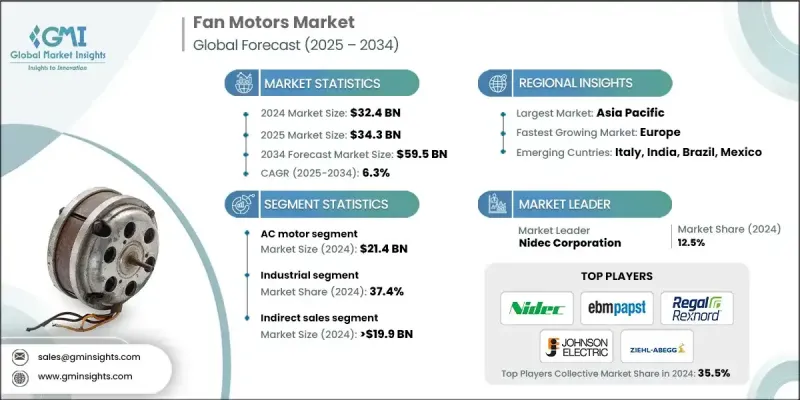
While the industry continues to grow, it still faces challenges tied to cost-sensitive buyers, particularly in emerging regions where smaller manufacturers operate under pressure to keep prices low without compromising on performance. Demand for fan motors has steadily shifted toward energy-efficient models as tighter government policies and growing consumer expectations accelerate the adoption of sustainable technologies. The European Union's energy directives have also intensified the push toward higher efficiency standards across electric motor designs. At the same time, noise reduction has become a defining product priority, as consumers increasingly favor quieter appliances. Manufacturers are focusing on advanced engineering techniques to meet these expectations while maintaining performance and durability.
| Market Scope | |
|---|---|
| Start Year | 2024 |
| Forecast Year | 2025-2034 |
| Start Value | $32.4 Billion |
| Forecast Value | $59.5 Billion |
| CAGR | 6.3% |
The AC motor segment generated USD 21.4 billion in 2024. These motors remain the most used type due to their affordability, durability, and broad operational versatility. They continue to dominate large-scale applications because of their lower initial cost and reduced maintenance requirements.
The industrial sector held a 37.4% share in 2024, making it the most influential end-use category. Industrial operations rely heavily on fans and motors for ventilation, cooling, air handling, and production processes, leading to substantial electricity consumption. High-efficiency motor technologies have become essential across industrial environments, where optimized energy use directly supports lower operating costs.
U.S. Fan Motors Market held 74.3% share in 2024. Companies across the region are increasingly directing investments toward advanced motor technologies designed to enhance efficiency and reduce resource consumption. Industry organizations also continue to highlight the rising prioritization of sustainable motor designs as manufacturers respond to global efficiency standards and customers' growing preference for environmentally conscious solutions.
Major players active in the Global Fan Motors Market include Ametek, Emerson Electric, ebm papst, Fantech, Johnson Electric, Mitsumi Electric, Nidec, New York Blower, Orion Fans, Revcor, Sanyo Denki, Sunon, TECO Westinghouse, Toshiba, and ZIEHL-ABEGG. Companies in the fan motors industry are strengthening their competitive positions by accelerating the development of high-efficiency motors that comply with tightening energy regulations across global markets. Many are expanding their portfolios with low-noise, compact, and digitally controlled motor solutions tailored to both industrial and residential applications. Investments in automation, smart manufacturing, and optimized supply chain systems are enabling firms to reduce production costs while improving product quality. Several manufacturers are also focusing on long-term sustainability by incorporating recyclable materials, reducing carbon footprints, and designing motors with enhanced lifecycle efficiency.
Table of Contents
Chapter 1 Methodology & Scope
- 1.1 Market scope and definition
- 1.2 Research design
- 1.2.1 Research approach
- 1.2.2 Data collection methods
- 1.3 Data mining sources
- 1.3.1 Global
- 1.3.2 Regional/Country
- 1.4 Base estimates and calculations
- 1.4.1 Base year calculation
- 1.4.2 Key trends for market estimation
- 1.5 Primary research and validation
- 1.5.1 Primary sources
- 1.6 Forecast model
- 1.7 Research assumptions and limitations
Chapter 2 Executive Summary
- 2.1 Industry 360° synopsis
- 2.2 Key market trends
- 2.2.1 Regional
- 2.2.2 Type
- 2.2.3 Power Rating
- 2.2.4 Application
- 2.2.5 Distribution channel
- 2.3 CXO perspectives: Strategic imperatives
- 2.3.1 Key decision points for industry executives
- 2.3.2 Critical success factors for market players
- 2.4 Future outlook and strategic recommendations
Chapter 3 Industry Insights
- 3.1 Industry ecosystem analysis
- 3.1.1 Supplier landscape
- 3.1.2 Profit margin
- 3.1.3 Value addition at each stage
- 3.1.4 Factor affecting the value chain
- 3.2 Industry impact forces
- 3.2.1 Growth drivers
- 3.2.1.1 Rising demand for energy efficient appliances
- 3.2.1.2 Technological advancements
- 3.2.1.3 Growth of smart home devices
- 3.2.2 Industry pitfalls & challenges
- 3.2.2.1 Cost concerns
- 3.2.2.2 Shift in consumer preferences
- 3.2.3 Opportunities
- 3.2.3.1 Rising demand for sustainability
- 3.2.3.2 Technological advancements in AI
- 3.2.1 Growth drivers
- 3.3 Growth potential analysis
- 3.4 Future market trends
- 3.5 Technology and innovation landscape
- 3.5.1 Current technological trends
- 3.5.2 Emerging technologies
- 3.6 Price trends
- 3.6.1 By Region
- 3.6.2 By Type
- 3.7 Regulatory landscape
- 3.7.1 Standards and compliance requirements
- 3.7.2 Regional regulatory frameworks
- 3.7.3 Certification standards
- 3.8 Trade statistics
- 3.8.1 Major importing countries
- 3.8.2 Major exporting countries
- 3.9 Risk assessment and mitigation
- 3.10 Gap Analysis
- 3.11 Porter's analysis
- 3.12 PESTEL analysis
Chapter 4 Competitive Landscape, 2024
- 4.1 Introduction
- 4.2 Company market share analysis
- 4.2.1 By region
- 4.2.1.1 North America
- 4.2.1.2 Europe
- 4.2.1.3 Asia Pacific
- 4.2.1.4 Latin America
- 4.2.1.5 Middle East and Africa
- 4.2.1 By region
- 4.3 Company matrix analysis
- 4.4 Competitive analysis of major market players
- 4.5 Competitive positioning matrix
- 4.6 Key developments
- 4.6.1 Mergers & acquisitions
- 4.6.2 Partnerships & collaborations
- 4.6.3 New product launches
- 4.6.4 Expansion plans
Chapter 5 Market Estimates & Forecast, By Type, 2021-2034 (USD Billion) (Million Units)
- 5.1 DC Motors
- 5.2 AC Motors
- 5.3 EC Motors
Chapter 6 Market Estimates & Forecast, By Power Ratings, 2021-2034 (USD Million) (Million Units)
- 6.1 Small Motors (Less than 0.5 HP)
- 6.2 Medium Motors (Between 0.5 and 5 HP)
- 6.3 Large Motors (Greater than 5 HP)
Chapter 7 Market Estimates & Forecast, By Application, 2021-2034 (USD Million) (Million Units)
- 7.1 HVAC
- 7.2 Automotive
- 7.3 Industrial
- 7.4 Electronics cooling
- 7.5 Appliances
Chapter 8 Market Estimates & Forecast, By Distribution channel, 2021-2034 (USD Million) (Million Units)
- 8.1 Direct
- 8.2 Indirect
Chapter 9 Market Estimates & Forecast, By Region, 2021-2034 (USD Million) (Million Units)
- 9.1 Key
- 9.2 North America
- 9.2.1 U.S.
- 9.2.2 Canada
- 9.3 Europe
- 9.3.1 Germany
- 9.3.2 UK
- 9.3.3 France
- 9.3.4 Spain
- 9.3.5 Italy
- 9.4 Asia Pacific
- 9.4.1 China
- 9.4.2 Japan
- 9.4.3 India
- 9.4.4 Australia
- 9.4.5 South Korea
- 9.5 Latin America
- 9.5.1 Brazil
- 9.5.2 Mexico
- 9.5.3 Argentina
- 9.6 MEA
- 9.6.1 South Africa
- 9.6.2 Saudi Arabia
- 9.6.3 UAE
Chapter 10 Company Profiles
- 10.1 Ametek
- 10.2 Emerson Electric
- 10.3 ebm-papst
- 10.4 Fantech
- 10.5 Johnson Electric
- 10.6 Mitsumi Electric
- 10.7 Nidec
- 10.8 New York Blower
- 10.9 Orion Fans
- 10.10 Revcor
- 10.11 Sanyo Denki
- 10.12 Sunon
- 10.13 TECO Westinghouse
- 10.14 Toshiba
- 10.15 ZIEHL-ABEGG