|
시장보고서
상품코드
1885892
전자 폐기물 재활용 시장 : 기회, 성장 요인, 업계 동향 분석 및 예측(2025-2034년)Electronic Waste Recycling Market Opportunity, Growth Drivers, Industry Trend Analysis, and Forecast 2025 - 2034 |
||||||

세계의 전자 폐기물 재활용 시장은 2024년 701억 달러로 평가되었고, 2034년까지 연평균 복합 성장률(CAGR)은 13.5%를 나타낼 것으로 예측되며 2,519억 달러로 성장할 전망입니다.
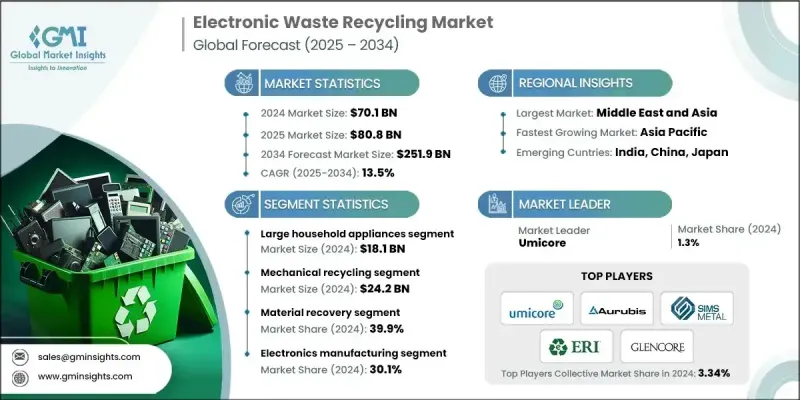
이 시장에는 폐기된 전자 제품에서 추출한 귀중한 자원의 수집, 처리 및 회수에 관여하는 기관들이 포함됩니다. 해당 품목은 소비자 가전제품부터 가전제품 및 배터리에 이르기까지 다양하며, 재활용 공정은 환경 보호, 폐기물 감소, 플라스틱, 구리, 금, 알루미늄 등의 자원 재순환을 지원합니다. 이 산업은 기기 분해, 재료 분류, 자원 회수, 책임 있는 폐기물 처리 등 여러 단계를 포괄하며, 모두 지속가능성 원칙과 규제 기준에 부합합니다. 전 세계 전자제품 사용량은 지속적으로 증가하여 첨단적이고 효율적인 재활용 방법에 대한 필요성을 부추기고 있습니다. 여러 지역의 정부들은 부적절한 폐기 관행을 제한하고 합법적인 재활용 노력을 지원하기 위해 규제 체계를 강화하고 있습니다. 기업과 소비자들이 전자 폐기물의 환경적 영향에 대한 인식을 높임에 따라 공식 재활용 프로그램 참여는 지속적으로 증가하고 있습니다. 또한 회수된 자원의 경제적 가치는 폐기물 관리 및 회수 기업들에게 강력한 경제적 유인을 제공합니다.
| 시장 범위 | |
|---|---|
| 시작 연도 | 2024년 |
| 예측 연도 | 2025-2034년 |
| 시작 가치 | 701억 달러 |
| 예측 가치 | 2,519억 달러 |
| CAGR | 13.5% |
대형 가전제품 부문은 2024년 181억 달러를 창출했습니다. 이 부문의 우위는 빈번한 제품 교체 주기와 환경 친화적 폐기 솔루션에 대한 선호도 증가에 힘입었습니다. IT 및 통신 장비 부문은 기기 교체 주기의 가속화와 지속적인 기술 업그레이드로 인해 상당량의 재사용 가능 자재를 발생시키며 그 뒤를 바짝 쫓고 있습니다.
기계적 재활용 부문은 2024년 242억 달러 규모를 기록했습니다. 이 방법은 다양한 전자제품에서 금속과 플라스틱을 효율적으로 대규모로 회수하는 데 기여합니다. 수중금속공학적 처리 방식은 친환경 추출 방식으로 고순도 금속을 생산할 수 있어 주목받고 있으며, 고온 처리를 통해 복합 폐기물 흐름을 처리하는 열금속공학적 방식 역시 여전히 중요한 선택지로 남아있습니다.
미국의 전자 폐기물 재활용 시장은 2024년 141억 달러로 평가되었습니다. 북미 지역의 성장은 폐기물 처리에 대한 정부의 엄격한 정책과 기업의 지속가능성 약속에 힘입고 있습니다. 기술의 높은 채택률은 노트북, 서버, 모바일 기기 및 관련 장비의 폐기 주기를 가속화하여 재활용 용량에 대한 수요를 증가시킵니다. 구형 전자제품에서 희토류 원소, 금, 은 등의 금속을 회수함으로써 얻는 환경적 및 재정적 이점에 대한 인식 제고 역시 시장 확장에 기여하고 있습니다.
자주 묻는 질문
목차
제1장 조사 방법과 범위
제2장 주요 요약
제3장 업계 인사이트
- 생태계 분석
- 공급자의 상황
- 이익률
- 각 단계의 부가가치
- 밸류체인에 영향을 주는 요인
- 혁신
- 업계에 미치는 영향요인
- 성장 촉진요인
- 증가하는 전자 폐기물의 발생량
- 높아지는 환경 의식
- 가치 있는 재료 회수
- 업계의 잠재적 위험 및 과제
- 높은 초기 투자 비용
- 복잡한 제품 구성
- 시장 기회
- 기술적 진보
- 전기차 배터리 전용 재활용 기술 개발
- 순환형 경제 이니셔티브와의 통합
- 성장 촉진요인
- 성장 가능성 분석
- 규제 상황
- 북미
- 유럽
- 아시아태평양
- 라틴아메리카
- 중동 및 아프리카
- Porter's Five Forces 분석
- PESTEL 분석
- 기술과 혁신 동향
- 현재의 기술 동향
- 신흥기술
- 가격 동향
- 지역별
- 제품 유형별
- 장래 시장 동향
- 기술과 혁신 동향
- 현재의 기술 동향
- 신흥기술
- 특허 동향
- 무역 통계(HS코드)(참고 : 무역 통계는 주요 국가에서만 제공됨)
- 주요 수입국
- 주요 수출국
- 지속가능성과 환경면
- 지속가능한 대처
- 폐기물 감축 전략
- 생산의 에너지 효율
- 환경에 배려한 대처
- 탄소발자국 고려
제4장 경쟁 구도
- 소개
- 기업의 시장 점유율 분석
- 지역별
- 북미
- 유럽
- 아시아태평양
- 라틴아메리카
- 중동 및 아프리카
- 지역별
- 기업 매트릭스 분석
- 주요 시장 기업의 경쟁 분석
- 경쟁 포지셔닝 매트릭스
- 주요 발전
- 합병 및 인수
- 제휴 및 협업
- 신제품 발매
- 확대 계획
제5장 시장 추계 및 예측 : 제품 유형별(2021-2034년)
- 주요 동향
- 대형 가전제품
- 소형 가전제품
- IT 및 통신 기기
- 소비자 가전
- 조명기기
- 전기자동차 배터리
제6장 시장 추계 및 예측 : 기술별(2021-2034년)
- 주요 동향
- 기계적 재활용
- 습식 야금 처리
- 고온 처리
- 수동 분해
- 고급 선별 기술
제7장 시장 추계 및 예측 : 용도별(2021-2034년)
- 주요 동향
- 재료 회수
- 귀금속 회수
- 희토류 원소 추출
- 비귀금속 회수
- 부품 재생
- 시험 및 수리 공정
- 재판매 시장 분석
- 안전한 폐기 처리
- 유해물질 관리
- 매립지 전환 전략
- 2차 원료의 생산
- 고순도 금속의 생산
- 제조 통합
- 에너지 회수
- 폐기물 에너지화
- 비재생 가능 분획의 관리
제8장 시장 추계 및 예측 : 최종 이용 산업별(2021-2034년)
- 주요 동향
- 전자기기 제조
- 금속가공 및 제련
- 폐기물 관리 서비스
- 정부 및 지방자치단체
- 법인 및 상업
- 자동차 산업
제9장 시장 추계 및 예측 : 지역별(2021-2034년)
- 주요 동향
- 북미
- 미국
- 캐나다
- 멕시코
- 유럽
- 독일
- 영국
- 프랑스
- 스페인
- 이탈리아
- 기타 유럽
- 아시아태평양
- 중국
- 인도
- 일본
- 호주
- 한국
- 기타 아시아태평양
- 라틴아메리카
- 브라질
- 멕시코
- 아르헨티나
- 기타 라틴아메리카
- 중동 및 아프리카
- 사우디아라비아
- 남아프리카
- 아랍에미리트(UAE)
- 기타 중동 및 아프리카
제10장 기업 프로파일
- American Battery Technology Company
- Aurubis
- Boliden
- Electronic Recyclers International
- Glencore Recycling
- Redwood Materials
- Retriev Technologies
- Sims Metal Management
- Stena Metall
- TES(Technology, Environment &Services)
- Umicore
- Veolia
The Global Electronic Waste Recycling Market was valued at USD 70.1 billion in 2024 and is estimated to grow at a CAGR of 13.5% to reach USD 251.9 billion by 2034.
The market includes organizations involved in the collection, treatment, and recovery of valuable materials extracted from discarded electronic products. These items range from consumer electronics to appliances and batteries, and the recycling process supports environmental protection, waste reduction, and the recirculation of resources such as plastics, copper, gold, and aluminum. The industry encompasses several stages, including breakdown of devices, material sorting, resource recovery, and responsible waste handling, all aligned with sustainability principles and regulatory standards. Global electronics usage continues to rise, fueling the need for advanced and efficient recycling methods. Governments across multiple regions are strengthening their regulatory frameworks to limit improper disposal practices and support legitimate recycling efforts. As businesses and consumers become more aware of the environmental impact of e-waste, participation in formal recycling programs continues to climb. Additionally, the financial value of reclaimed resources presents a strong economic incentive for waste management and recovery companies.
| Market Scope | |
|---|---|
| Start Year | 2024 |
| Forecast Year | 2025-2034 |
| Start Value | $70.1 Billion |
| Forecast Value | $251.9 Billion |
| CAGR | 13.5% |
The large household appliances segment generated USD 18.1 billion in 2024. Their dominance is supported by frequent product replacement cycles and a growing preference for environmentally responsible disposal solutions. IT and telecommunications equipment follow closely, driven by rapid device turnover and constant technological upgrades that generate significant volumes of reusable materials.
The mechanical recycling segment reached USD 24.2 billion in 2024. This method supports efficient, large-scale recovery of metals and plastics from a broad range of electronic products. Hydrometallurgical processing is gaining momentum due to its ability to produce high-purity metal outputs through eco-friendly extraction methods, while pyrometallurgical processing remains an important choice for handling complex waste streams through high-temperature treatment.
U.S. Electronic Waste Recycling Market was valued at USD 14.1 billion in 2024. Growth in North America is supported by stringent government policies on waste disposal and corporate commitments to sustainability. High adoption rates of technology result in accelerated disposal cycles for laptops, servers, mobile devices, and related equipment, thereby increasing the demand for recycling capacity. Rising awareness of the environmental and financial benefits associated with recovering metals such as rare earth elements, gold, and silver from outdated electronics further contributes to market expansion.
Major companies participating in the Electronic Waste Recycling Market include American Battery Technology Company, Aurubis, Boliden, Electronic Recyclers International, Glencore Recycling, Redwood Materials, Retriev Technologies, Sims Metal Management, Stena Metall, TES (Technology, Environment & Services), Umicore, and Veolia. Companies in this market are strengthening their competitive positions by expanding processing capacity and investing in advanced recycling technologies that improve material recovery rates. Many organizations are integrating automation and AI-driven sorting systems to boost operational efficiency and reduce contamination during the recycling process. Firms are also securing long-term supply agreements with manufacturers, retailers, and municipalities to ensure steady input volumes. Product innovation focuses on developing cleaner, more energy-efficient extraction methods capable of reclaiming high-value metals from complex electronic waste.
Table of Contents
Chapter 1 Methodology & Scope
- 1.1 Market scope and definition
- 1.2 Research design
- 1.2.1 Research approach
- 1.2.2 Data collection methods
- 1.3 Data mining sources
- 1.3.1 Global
- 1.3.2 Regional/Country
- 1.4 Base estimates and calculations
- 1.4.1 Base year calculation
- 1.4.2 Key trends for market estimation
- 1.5 Primary research and validation
- 1.5.1 Primary sources
- 1.6 Forecast model
- 1.7 Research assumptions and limitations
Chapter 2 Executive Summary
- 2.1 Industry 360° synopsis
- 2.2 Key market trends
- 2.2.1 Product type
- 2.2.2 Technology
- 2.2.3 Application
- 2.2.4 End Use industry
- 2.2.5 Regional
- 2.3 TAM Analysis, 2025-2034
- 2.4 CXO perspectives: Strategic imperatives
- 2.4.1 Executive decision points
- 2.4.2 Critical success factors
- 2.5 Future outlook and strategic recommendations
Chapter 3 Industry Insights
- 3.1 Industry ecosystem analysis
- 3.1.1 Supplier landscape
- 3.1.2 Profit margin
- 3.1.3 Value addition at each stage
- 3.1.4 Factor affecting the value chain
- 3.1.5 Disruptions
- 3.2 Industry impact forces
- 3.2.1 Growth drivers
- 3.2.1.1 Rising e-waste generation
- 3.2.1.2 Growing environmental awareness
- 3.2.1.3 Valuable material recovery
- 3.2.2 Industry pitfalls and challenges
- 3.2.2.1 High initial investment
- 3.2.2.2 Complex product composition
- 3.2.3 Market opportunities
- 3.2.3.1 Technological advancements
- 3.2.3.2 Development of specialized recycling for EV batteries
- 3.2.3.3 Integration with circular economy initiatives
- 3.2.1 Growth drivers
- 3.3 Growth potential analysis
- 3.4 Regulatory landscape
- 3.4.1 North America
- 3.4.2 Europe
- 3.4.3 Asia Pacific
- 3.4.4 Latin America
- 3.4.5 Middle East & Africa
- 3.5 Porter's analysis
- 3.6 PESTEL analysis
- 3.7 Technology and innovation landscape
- 3.7.1 Current technological trends
- 3.7.2 Emerging technologies
- 3.8 Price trends
- 3.8.1 By region
- 3.8.2 By product type
- 3.9 Future market trends
- 3.10 Technology and innovation landscape
- 3.10.1 Current technological trends
- 3.10.2 Emerging technologies
- 3.11 Patent landscape
- 3.12 Trade statistics (HS code) ( Note: the trade statistics will be provided for key countries only)
- 3.12.1 Major importing countries
- 3.12.2 Major exporting countries
- 3.13 Sustainability and environmental aspects
- 3.13.1 Sustainable practices
- 3.13.2 Waste reduction strategies
- 3.13.3 Energy efficiency in production
- 3.13.4 Eco-friendly initiatives
- 3.14 Carbon footprint consideration
Chapter 4 Competitive Landscape, 2024
- 4.1 Introduction
- 4.2 Company market share analysis
- 4.2.1 By region
- 4.2.1.1 North America
- 4.2.1.2 Europe
- 4.2.1.3 Asia Pacific
- 4.2.1.4 LATAM
- 4.2.1.5 MEA
- 4.2.1 By region
- 4.3 Company matrix analysis
- 4.4 Competitive analysis of major market players
- 4.5 Competitive positioning matrix
- 4.6 Key developments
- 4.6.1 Mergers & acquisitions
- 4.6.2 Partnerships & collaborations
- 4.6.3 New product launches
- 4.6.4 Expansion plans
Chapter 5 Market Estimates and Forecast, By Product Type, 2021-2034 (USD Billion) (Kilo Tons)
- 5.1 Key trends
- 5.2 Large household appliances
- 5.3 Small household appliances
- 5.4 IT & telecommunications equipment
- 5.5 Consumer electronics
- 5.6 Lighting equipment
- 5.7 Electric vehicle batteries
Chapter 6 Market Estimates and Forecast, By Technology, 2021-2034 (USD Billion) (Kilo Tons)
- 6.1 Key trends
- 6.2 Mechanical recycling
- 6.3 Hydrometallurgical processing
- 6.4 Pyrometallurgical processing
- 6.5 Manual disassembly
- 6.6 Advanced sorting technologies
Chapter 7 Market Estimates and Forecast, By Application, 2021-2034 (USD Billion) (Kilo Tons)
- 7.1 Key trends
- 7.2 Material recovery
- 7.2.1 Precious metals recovery
- 7.2.2 Rare earth elements extraction
- 7.2.3 Base metals recovery
- 7.3 Component refurbishment
- 7.3.1 Testing & repair processes
- 7.3.2 Resale market analysis
- 7.4 Safe disposal
- 7.4.1 Hazardous substance management
- 7.4.2 Landfill diversion strategies
- 7.5 Secondary raw material production
- 7.5.1 High-purity metal production
- 7.5.2 Manufacturing integration
- 7.6 Energy recovery
- 7.6.1 Waste-to-energy
- 7.6.2 Non-recyclable fraction management
Chapter 8 Market Estimates and Forecast, By End Use Industry, 2021-2034 (USD Billion) (Kilo Tons)
- 8.1 Key trends
- 8.2 Electronics manufacturing
- 8.3 Metal processing & smelting
- 8.4 Waste management services
- 8.5 Government & municipalities
- 8.6 Corporate/commercial
- 8.7 Automotive industry
Chapter 9 Market Estimates and Forecast, By Region, 2021-2034 (USD Billion) (Kilo Tons)
- 9.1 Key trends
- 9.2 North America
- 9.2.1 U.S.
- 9.2.2 Canada
- 9.2.3 Mexico
- 9.3 Europe
- 9.3.1 Germany
- 9.3.2 UK
- 9.3.3 France
- 9.3.4 Spain
- 9.3.5 Italy
- 9.3.6 Rest of Europe
- 9.4 Asia Pacific
- 9.4.1 China
- 9.4.2 India
- 9.4.3 Japan
- 9.4.4 Australia
- 9.4.5 South Korea
- 9.4.6 Rest of Asia Pacific
- 9.5 Latin America
- 9.5.1 Brazil
- 9.5.2 Mexico
- 9.5.3 Argentina
- 9.5.4 Rest of Latin America
- 9.6 Middle East and Africa
- 9.6.1 Saudi Arabia
- 9.6.2 South Africa
- 9.6.3 UAE
- 9.6.4 Rest of Middle East and Africa
Chapter 10 Company Profiles
- 10.1 American Battery Technology Company
- 10.2 Aurubis
- 10.3 Boliden
- 10.4 Electronic Recyclers International
- 10.5 Glencore Recycling
- 10.6 Redwood Materials
- 10.7 Retriev Technologies
- 10.8 Sims Metal Management
- 10.9 Stena Metall
- 10.10 TES (Technology, Environment & Services)
- 10.11 Umicore
- 10.12 Veolia