



|
시장보고서
상품코드
1885899
식물성 해산물 원료 시장 : 기회, 성장 요인, 업계 동향 분석 및 예측(2025-2034년)Plant-Based Seafood Ingredients Market Opportunity, Growth Drivers, Industry Trend Analysis, and Forecast 2025 - 2034 |
||||||

세계의 식물성 해산물 원료 시장은 2024년에 4,370만 달러로 평가되었고, 2034년까지 연평균 복합 성장률(CAGR)은 23%를 나타낼 것으로 예측되며 3억 6,930만 달러로 성장할 전망입니다.

이러한 수요 급증은 지속 가능하고 윤리적이며 건강을 중시하는 식품에 대한 소비자들의 선호도가 높아지고 있음을 반영합니다. 식물성 해산물 대체품은 과도한 어획, 해양 오염, 기후 변화에 대한 우려를 해소하면서도 기존 해산물의 맛, 식감, 외관을 거의 완벽하게 재현할 수 있다는 점에서 주목받고 있습니다. 소비자들은 콜레스테롤 수치 감소, 심혈관 건강 개선, 체중 관리 등 식물성 식단의 건강상의 이점을 점점 더 인식하고 있습니다. 이러한 원료의 주요 용도는 전통 수산물의 지속가능하고 영양가 있는 대체재로, 확대되는 비건, 채식주의자, 플렉시테리언(flexitarian) 인구층을 대상으로 합니다. 해당 원료는 수산물 유사 제품, 즉석식, 스낵, 기능성 식품 생산에 활용되어 식품 제조업체가 환경적 영향을 줄이면서도 소비자가 원하는 감각적 품질을 제공할 수 있게 합니다.
| 시장 범위 | |
|---|---|
| 시작 연도 | 2024년 |
| 예측 연도 | 2025-2034년 |
| 시작 가치 | 4,370만 달러 |
| 예측 가치 | 3억 6,930만 달러 |
| CAGR | 23% |
콩류 기반 원료 부문은 높은 단백질 함량, 다용도성 및 환경적 이점으로 2024년 45%의 점유율을 차지했습니다. 건강과 환경을 중시하는 소비자를 위해 해산물 질감과 풍미를 재현하기 위해 대두, 완두콩, 병아리콩 기반물이 점점 더 많이 사용되고 있습니다. 가공 기술 발전은 해산물 응용을 위한 기능성을 향상시키고 있습니다.
단백질 원료 부문은 2024년 40.2% 점유율을 기록했으며, 영양 성분과 기능적 특성을 개선하는 식물 기반 단백질에 중점을 두고 있습니다. 단백질 추출 및 가공 기술 혁신으로 맛과 식감이 크게 개선되었으며, 클린 라벨 및 알레르기 유발 물질 무첨가 트렌드가 제품 개발을 지속적으로 주도하고 있습니다.
북미의 식물성 해산물 원료 시장은 2024년에 42.3%의 점유율을 차지하고, 2034년까지 연평균 복합 성장률(CAGR)은23.1%를 나타낼 전망입니다. 미국의 시장은 2024년에 1,480만 달러로 평가되었습니다. 이 지역의 성장은 건강을 중시하는 소비자, 지속가능성 문제, 윤리적 고려사항에 의해 주도됩니다. 식물성 단백질 추출 및 발효 기술의 발전으로 진정한 맛과 식감을 지닌 해산물 대체품 개발이 가능해졌습니다. 유리한 규제 환경과 소매 및 식품 서비스 부문의 제품 출시 증가도 시장 성장에 추가 동력을 제공하고 있습니다.
자주 묻는 질문
목차
제1장 조사 방법과 범위
제2장 주요 요약
제3장 업계 인사이트
- 생태계 분석
- 공급자의 상황
- 이익률
- 각 단계의 부가가치
- 밸류체인에 영향을 주는 요인
- 혁신
- 업계에 미치는 영향요인
- 성장 촉진요인
- 업계의 잠재적 위험 및 과제
- 시장 기회
- 성장 가능성 분석
- 규제 상황
- 북미
- 유럽
- 아시아태평양
- 라틴아메리카
- 중동 및 아프리카
- Porter's Five Forces 분석
- PESTEL 분석
- 가격 동향
- 지역별
- 제품 카테고리별
- 장래 시장 동향
- 기술과 혁신 동향
- 현재의 기술 동향
- 신흥기술
- 특허 상황
- 무역 통계(HS코드)(참고 : 무역 통계는 주요 국가에서만 제공됨)
- 주요 수입국
- 주요 수출국
- 지속가능성과 환경면
- 지속가능한 대처
- 폐기물 감축 전략
- 생산의 에너지 효율
- 환경에 배려한 대처
- 탄소발자국 고려
제4장 경쟁 구도
- 소개
- 기업의 시장 점유율 분석
- 지역별
- 북미
- 유럽
- 아시아태평양
- 라틴아메리카
- 중동 및 아프리카
- 지역별
- 기업 매트릭스 분석
- 주요 시장 기업의 경쟁 분석
- 경쟁 포지셔닝 매트릭스
- 주요 발전
- 합병 및 인수
- 제휴 및 협업
- 신제품 발매
- 사업 확대 계획
제5장 시장 추계 및 예측 : 원료별(2021-2034년)
- 주요 동향
- 콩류 기반 원료
- 곡물 및 콩류 기반 원료
- 해초 및 조류 기반 원료
- 기타
제6장 시장 추계 및 예측 : 원료 유형별(2021-2034년)
- 주요 동향
- 단백질 원료
- 완두콩 단백질
- 콩 단백질
- 밀 글루텐
- 수용성 다당류 및 증점제
- 카라기난
- 알긴산염
- 한천
- 곤약 글루코만난
- 기타 수용성 다당류
- 향미 원료
- 효모 추출물
- 해초 조미료 및 추출물
- 식물성 우마미 및 천연 향료
- 유지류
- 조류유(오메가 3)
- 미생물 기반 유지(정밀 발효)
- 식물성 기름(캐놀라유, 코코넛유, 해바라기유)
- 기능성 첨가물
- 전분류
- 식이섬유(셀룰로오스, 감귤류, 아마, 치아)
- 천연 착색료(피코빌리 단백질, 야채 농축물)
제7장 시장 추계 및 예측 : 기능성별(2021-2034년)
- 주요 동향
- 단백질 및 영양 강화
- 식감 및 구조 형성
- 풍미 및 맛 향상
- 결합 및 겔화
- 색상 및 외관
- 기타
제8장 시장 추계 및 예측 : 최종 용도별(2021-2034년)
- 주요 동향
- 식품 제조업체(B2B)
- 외식산업 및 레스토랑
- 소매 브랜드
제9장 시장 추계 및 예측 : 지역별(2021-2034년)
- 주요 동향
- 북미
- 미국
- 캐나다
- 유럽
- 독일
- 영국
- 프랑스
- 스페인
- 이탈리아
- 기타 유럽
- 아시아태평양
- 중국
- 인도
- 일본
- 호주
- 한국
- 기타 아시아태평양
- 라틴아메리카
- 브라질
- 멕시코
- 아르헨티나
- 기타 라틴아메리카
- 중동 및 아프리카
- 사우디아라비아
- 남아프리카
- 아랍에미리트(UAE)
- 기타 중동 및 아프리카
제10장 기업 프로파일
- AGT Foods &Ingredients
- Algama Foods
- Angel Yeast Co., Ltd.
- BENEO GmbH(Sudzucker Group)
- Bunge Limited
- Cargill, Incorporated
- CP Kelco(JM Huber Corporation)
- dsm-firmenich
- FMC Corporation(BioPolymer Division)
- Ingredion Incorporated
- Kalys(MERIDIS Group)
- Mara Renewables Corporation
- MGP Ingredients, Inc.
- Paleo(formerly Miruku)
- Roquette Freres
The Global Plant-Based Seafood Ingredients Market was valued at USD 43.7 million in 2024 and is estimated to grow at a CAGR of 23% to reach USD 369.3 million by 2034.
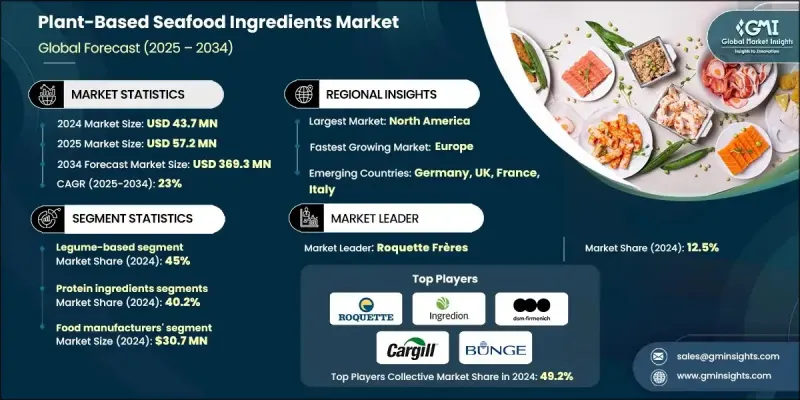
The surge in demand reflects consumers' growing preference for sustainable, ethical, and health-conscious foods. Plant-based seafood alternatives are gaining traction due to their ability to closely replicate conventional seafood in taste, texture, and appearance, while addressing concerns about overfishing, marine pollution, and climate change. Consumers are increasingly aware of the health advantages of plant-based diets, including lower cholesterol levels, improved cardiovascular health, and weight management. The primary application of these ingredients is to provide a sustainable and nutritious substitute for traditional seafood, catering to the expanding vegan, vegetarian, and flexitarian populations. These ingredients are utilized in the production of seafood analogs, ready-to-eat meals, snacks, and functional food products, enabling food manufacturers to reduce environmental impact while delivering the sensory qualities consumers desire.
| Market Scope | |
|---|---|
| Start Year | 2024 |
| Forecast Year | 2025-2034 |
| Start Value | $43.7 Million |
| Forecast Value | $369.3 Million |
| CAGR | 23% |
The legume-based ingredients segment held a 45% share in 2024, due to their high protein content, versatility, and environmental benefits. Soy, pea, and chickpea derivatives are increasingly used to replicate seafood textures and flavors for health-conscious and eco-aware consumers. Processing advancements are enhancing their functionality for seafood applications.
The protein ingredients segment held 40.2% share in 2024, focusing on plant-derived proteins that improve nutritional content and functional properties. Innovations in protein extraction and processing have significantly improved taste and texture, while clean-label and allergen-free trends continue to drive product development.
North America Plant-Based Seafood Ingredients Market held a 42.3% share in 2024 and is expected to grow at a 23.1% CAGR through 2034, with the U.S. market valued at USD 14.8 million in 2024. Growth in this region is driven by health-conscious consumers, sustainability concerns, and ethical considerations. Technological advancements in plant protein extraction and fermentation have enabled the creation of seafood alternatives with authentic taste and texture. Additional market momentum comes from favorable regulations and increased product launches across retail and food service sectors.
Key players in the Plant-Based Seafood Ingredients Market include Cargill, Incorporated; DSM-Firmenich; Ingredion Incorporated; Bunge Limited; CP Kelco (J.M. Huber Corporation); Roquette Freres; AGT Foods & Ingredients; Angel Yeast Co., Ltd.; Mara Renewables Corporation; Paleo (formerly Miruku); BENEO GmbH (Sudzucker Group); FMC Corporation (BioPolymer Division); Kalys (MERIDIS Group); and Algama Foods. Leading companies in the Plant-Based Seafood Ingredients Market are adopting strategies such as expanding product portfolios, investing in R&D for texture and taste improvements, forming partnerships with foodservice and retail brands, and leveraging sustainable and clean-label claims. They are also focusing on geographic expansion, strategic collaborations, and technological innovations in protein extraction and fermentation processes to strengthen market presence and appeal to environmentally conscious and health-focused consumers.
Table of Contents
Chapter 1 Methodology & Scope
- 1.1 Market scope and definition
- 1.2 Research design
- 1.2.1 Research approach
- 1.2.2 Data collection methods
- 1.3 Data mining sources
- 1.3.1 Global
- 1.3.2 Regional/Country
- 1.4 Base estimates and calculations
- 1.4.1 Base year calculation
- 1.4.2 Key trends for market estimation
- 1.5 Primary research and validation
- 1.5.1 Primary sources
- 1.6 Forecast model
- 1.7 Research assumptions and limitations
Chapter 2 Executive Summary
- 2.1 Industry 360° synopsis
- 2.2 Key market trends
- 2.2.1 Regional
- 2.2.2 Source
- 2.2.3 Ingredient type
- 2.2.4 Functionality
- 2.2.5 End Use
- 2.3 TAM Analysis, 2025-2034
- 2.4 CXO perspectives: Strategic imperatives
- 2.4.1 Executive decision points
- 2.4.2 Critical success factors
- 2.5 Future Outlook and Strategic Recommendations
Chapter 3 Industry Insights
- 3.1 Industry ecosystem analysis
- 3.1.1 Supplier landscape
- 3.1.2 Profit margin
- 3.1.3 Value addition at each stage
- 3.1.4 Factor affecting the value chain
- 3.1.5 Disruptions
- 3.2 Industry impact forces
- 3.2.1 Growth drivers
- 3.2.2 Industry pitfalls and challenges
- 3.2.3 Market opportunities
- 3.3 Growth potential analysis
- 3.4 Regulatory landscape
- 3.4.1 North America
- 3.4.2 Europe
- 3.4.3 Asia Pacific
- 3.4.4 Latin America
- 3.4.5 Middle East & Africa
- 3.5 Porter's analysis
- 3.6 PESTEL analysis
- 3.7 Price trends
- 3.7.1 By region
- 3.7.2 By product category
- 3.8 Future market trends
- 3.9 Technology and Innovation landscape
- 3.9.1 Current technological trends
- 3.9.2 Emerging technologies
- 3.10 Patent Landscape
- 3.11 Trade statistics (HS code) ( Note: the trade statistics will be provided for key countries only)
- 3.11.1 Major importing countries
- 3.11.2 Major exporting countries
- 3.12 Sustainability and environmental aspects
- 3.12.1 Sustainable practices
- 3.12.2 Waste reduction strategies
- 3.12.3 Energy efficiency in production
- 3.12.4 Eco-friendly initiatives
- 3.13 Carbon footprint consideration
Chapter 4 Competitive Landscape, 2024
- 4.1 Introduction
- 4.2 Company market share analysis
- 4.2.1 By region
- 4.2.1.1 North America
- 4.2.1.2 Europe
- 4.2.1.3 Asia Pacific
- 4.2.1.4 LATAM
- 4.2.1.5 MEA
- 4.2.1 By region
- 4.3 Company matrix analysis
- 4.4 Competitive analysis of major market players
- 4.5 Competitive positioning matrix
- 4.6 Key developments
- 4.6.1 Mergers & acquisitions
- 4.6.2 Partnerships & collaborations
- 4.6.3 New Product Launches
- 4.6.4 Expansion Plans
Chapter 5 Market Estimates and Forecast, By Source, 2021-2034 (USD Million & Kilo Tons)
- 5.1 Key trends
- 5.2 Legume-based ingredients
- 5.3 Cereal & grain-based ingredients
- 5.4 Seaweed & algae-based ingredients
- 5.5 Others
Chapter 6 Market Estimates and Forecast, By Ingredient Type, 2021-2034 (USD Million & Kilo Tons)
- 6.1 Key trends
- 6.2 Protein ingredients
- 6.2.1 Pea protein
- 6.2.2 Soy protein
- 6.2.3 Wheat gluten
- 6.3 Hydrocolloids & texturizing agents
- 6.3.1 Carrageenan
- 6.3.2 Alginate
- 6.3.3 Agar
- 6.3.4 Konjac glucomannan
- 6.3.5 Other hydrocolloids
- 6.4 Flavoring ingredients
- 6.4.1 Yeast extract
- 6.4.2 Seaweed seasoning & extracts
- 6.4.3 Vegetable umami & natural flavors
- 6.5 Oils & fats
- 6.5.1 Algal oil (omega-3)
- 6.5.2 Microbial oils (precision fermentation)
- 6.5.3 Plant oils (canola, coconut, sunflower)
- 6.6 Functional additives
- 6.6.1 Starches
- 6.6.2 Fibers (cellulose, citrus, flax, chia)
- 6.6.3 Natural colorants (phycobiliproteins, vegetable concentrates)
Chapter 7 Market Estimates and Forecast, By Functionality, 2021-2034 (USD Million & Kilo Tons)
- 7.1 Key trend
- 7.2 Protein & nutrition enhancement
- 7.3 Texture & structure formation
- 7.4 Flavor & taste enhancement
- 7.5 Binding & gelation
- 7.6 Color & appearance
- 7.7 Others
Chapter 8 Market Estimates and Forecast, By End Use, 2021-2034 (USD Million & Kilo Tons)
- 8.1 Key trends
- 8.2 Food manufacturers (B2B)
- 8.3 Foodservice & restaurants
- 8.4 Retail brands
Chapter 9 Market Estimates and Forecast, By Region, 2021-2034 (USD Million & Kilo Tons)
- 9.1 Key trends
- 9.2 North America
- 9.2.1 U.S.
- 9.2.2 Canada
- 9.3 Europe
- 9.3.1 Germany
- 9.3.2 UK
- 9.3.3 France
- 9.3.4 Spain
- 9.3.5 Italy
- 9.3.6 Rest of Europe
- 9.4 Asia Pacific
- 9.4.1 China
- 9.4.2 India
- 9.4.3 Japan
- 9.4.4 Australia
- 9.4.5 South Korea
- 9.4.6 Rest of Asia Pacific
- 9.5 Latin America
- 9.5.1 Brazil
- 9.5.2 Mexico
- 9.5.3 Argentina
- 9.5.4 Rest of Latin America
- 9.6 Middle East and Africa
- 9.6.1 Saudi Arabia
- 9.6.2 South Africa
- 9.6.3 UAE
- 9.6.4 Rest of Middle East and Africa
Chapter 10 Company Profiles
- 10.1 AGT Foods & Ingredients
- 10.2 Algama Foods
- 10.3 Angel Yeast Co., Ltd.
- 10.4 BENEO GmbH (Sudzucker Group)
- 10.5 Bunge Limited
- 10.6 Cargill, Incorporated
- 10.7 CP Kelco (J.M. Huber Corporation)
- 10.8 dsm-firmenich
- 10.9 FMC Corporation (BioPolymer Division)
- 10.10 Ingredion Incorporated
- 10.11 Kalys (MERIDIS Group)
- 10.12 Mara Renewables Corporation
- 10.13 MGP Ingredients, Inc.
- 10.14 Paleo (formerly Miruku)
- 10.15 Roquette Freres

(주말 및 공휴일 제외)
