

|
시장보고서
상품코드
1885919
이비인후과(ENT) 의료기기 시장 : 기회, 성장 요인, 업계 동향 분석 및 예측(2025-2034년)ENT Devices Market Opportunity, Growth Drivers, Industry Trend Analysis, and Forecast 2025 - 2034 |
||||||

세계의 이비인후과 의료기기 시장은 2024년에 222억 달러로 평가되었고, 2034년까지 연평균 복합 성장률(CAGR)은 5.6%로 성장해 383억 달러에 달할 것으로 예측되고 있습니다.
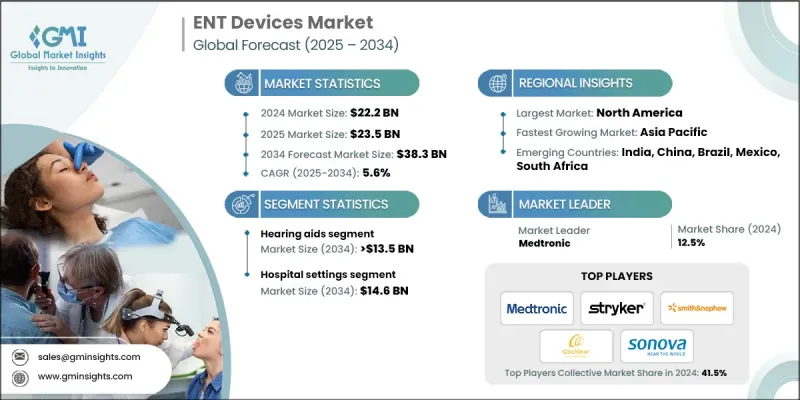
이 같은 성장은 이비인후과 질환 유병률 증가, 고령 인구 확대, 최소 침습적 시술 수요 증가에 힘입은 것입니다. 해당 시장은 의료 서비스 제공자, 생명과학 기업, 보험사, 기술 기업에 환자 치료, 규제 준수, 운영 효율성 향상을 위한 혁신적 솔루션을 제공합니다. 주요 제품으로는 내시경 시스템, 인공와우, 최소 침습적 수술 도구, 진단 기기, 시술 정밀도, 질환 관리, 전반적 삶의 질 향상을 위해 설계된 디지털 이비인후과 플랫폼 등이 있습니다. 전 세계 고령화 인구는 청력 손실, 만성 부비동염, 균형 장애 발생률 증가에 기여하여 이비인후과적 개입 필요성을 높이고 있습니다. 도시화와 생활 방식 변화 역시 호흡기 및 알레르기 질환 발생률 증가로 이어져 환자 기반을 확대하고 있습니다. 회복 기간 단축, 합병증 위험 감소, 결과 개선으로 인해 의료진과 환자들은 점차 최소 침습적 기법을 선호하게 되어 전문 이비인후과 기기에 대한 수요를 촉진하고 있습니다.
| 시장 범위 | |
|---|---|
| 시작 연도 | 2024년 |
| 예측 기간 | 2025-2034년 |
| 시작 금액 | 222억 달러 |
| 예측 금액 | 383억 달러 |
| CAGR | 5.6% |
보청기 부문은 2024년 37.5%의 점유율을 기록했습니다. 고령층의 청력 손실 증가와 디지털 및 AI 기반 보청기를 포함한 기술 발전이 성장을 주도하고 있습니다. 이 부문에는 귀 뒤 착용형(BTE), 수신기 귀 내/수신기 외이도 내(RITE/RIC), 완전 외이도 내/비 가시형 외이도 내(CIC/IIC), 귀 내 착용형(ITE), 외이도 내 착용형(ITC) 기기가 포함됩니다. 청각 건강에 대한 인식 제고와 첨단 및 기존 보청기에 대한 수요 증가로 병원, 클리닉, 가정 간호 환경 전반에서 채택이 확대되고 있습니다.
진단용 이비인후과 의료기기 부문은 2024년 58억 달러를 기록했으며, 2025년부터 2034년까지 연평균 복합 성장률(CAGR) 6.2%로 성장할 것으로 전망됩니다. 여기에는 경성 및 유연 내시경, 청력 검사 기기, 로봇 보조 내시경이 포함됩니다. 이비인후과 질환의 조기 발견 및 정확한 진단에 대한 수요 증가가 해당 부문의 성장을 촉진하고 있습니다.
북미의 이비인후과 의료기기 시장은 2024년 38.6%의 점유율을 차지했습니다. 시장 지배력은 확립된 의료 인프라, 첨단 의료 기술 도입, 높은 의료 지출에 의해 뒷받침됩니다. 만성 부비동염, 청력 손실, 수면 무호흡증과 같은 이비인후과 질환 사례 증가로 정교한 진단 및 치료 기기에 대한 수요가 증가하고 있습니다. 고해상도 내시경, 로봇 수술 시스템, AI 기반 진단 도구 등 기술 혁신은 시술 정확도와 효율성을 향상시켜 병원, 외래 수술 센터, 클리닉에서의 도입을 촉진하고 있습니다.
자주 묻는 질문
목차
제1장 조사 방법과 범위
제2장 주요 요약
제3장 업계 인사이트
- 생태계 분석
- 업계에 미치는 영향요인
- 성장 촉진요인
- 전 세계적으로 증가하는 이비인후과 질환 유병률
- 고령화 인구 증가
- 이비인후과 기기의 기술 발전
- 최소 침습적 이비인후과 시술에 대한 수요 증가
- 업계의 잠재적 위험 및 과제
- 높은 시술 및 기기 비용
- 세계의 사회적 편견
- 시장 기회
- AI 진단의 통합
- 원격 이비인후과 진료 증가
- 성장 촉진요인
- 성장 가능성 분석
- 규제 상황
- 북미
- 유럽
- 아시아태평양
- 라틴아메리카, 중동 및 아프리카
- 기술 동향
- 현재의 기술 동향
- 최소 침습 이비인후과 수술 기기 및 내시경 시스템 성장
- 원격 이비인후과 진료 및 원격 진단을 가능하게 하는 디지털 이비인후과 플랫폼
- 환자의 편의성을 고려한 청각 임플란트 및 휴대형 청각 진단 기기
- 신흥기술
- AI를 활용한 이비인후과 진단 및 예측적 질환 관리
- 웨어러블하고 연결 가능한 청각 및 밸런스 기능 기기
- 적응 치료와 개별화 요법 모드를 갖춘 스마트 이비인후과 기기
- 현재의 기술 동향
- 갭 분석
- Porter's Five Forces 분석
- PESTEL 분석
- 장래 시장 동향
- AI 통합형 이비인후과 기기의 확대(질환 조기 발견과 맞춤형 치료 계획 책정용)
- 환자 중심의 케어를 실현하는 원격 이비인후과 플랫폼 및 원격 모니터링 솔루션의 도입 확대
- 시술 효율성 및 환자 순응도 향상을 위한 최소 침습적, 스마트, 웨어러블 이비인후과 기기 성장
제4장 경쟁 구도
- 소개
- 기업 매트릭스 분석
- 기업의 시장 점유율 분석
- 세계
- 북미
- 유럽
- 아시아태평양
- 라틴아메리카, 중동 및 아프리카
- 경쟁 포지셔닝 매트릭스
- 주요 시장 기업의 경쟁 분석
- 주요 발전
- 합병 및 인수
- 제휴 및 협업
- 신제품 발매
- 확대 계획
제5장 시장 추계 및 예측 : 기기 유형별(2021-2034년)
- 주요 동향
- 보청기
- 귀 뒤 착용형(BTE)
- 수신기 귀 내/수신기 외이도 내(RITE/RIC)
- 완전 외이도 내/비 가시형 외이도 내(CIC/IIC)
- 귀 내 착용형(ITE)
- 외이도 내 착용형(ITC)
- 진단용 이비인후과(ENT) 의료기기
- 경성 내시경
- 후두경
- 비경
- 이과용 내시경
- 연성 내시경
- 청력 스크리닝 기기
- 로봇 지원 내시경
- 경성 내시경
- 수술용 이비인후과(ENT) 기기
- 부비강 확장 기기
- 전동 수술 기구
- 이과용 드릴 바
- 고주파 핸드피스
- 이비인후과 수동기구
- 고막 튜브
- 비강 충전 기기
- 청각 임플란트
- 인공 내이
- 뼈 고정식 보청 시스템
- 청각뇌간 임플란트
- 중이 임플란트
- 음성 보철 기기
- 코 스프린트
- 외비용 스프린트
- 내비용 스프린트
제6장 시장 추계 및 예측 : 최종 용도별(2021-2034년)
- 주요 동향
- 병원
- 외래수술센터(ASC)
- 이비인후과 클리닉
- 재택치료
제7장 시장 추계 및 예측 : 지역별(2021-2034년)
- 주요 동향
- 북미
- 미국
- 캐나다
- 유럽
- 독일
- 영국
- 프랑스
- 스페인
- 이탈리아
- 네덜란드
- 아시아태평양
- 중국
- 일본
- 인도
- 호주
- 한국
- 라틴아메리카
- 브라질
- 멕시코
- 아르헨티나
- 중동 및 아프리카
- 남아프리카
- 사우디아라비아
- 아랍에미리트(UAE)
제8장 기업 프로파일
- Atos Medical
- Boston Scientific
- Cochlear
- DeSoutter Medical
- Johnson & Johnson(Ethicon)
- Lumenis
- Medtronic
- Meril Life Sciences
- Narang Medical
- Nouvag
- Olympus
- Smith &Nephew
- Sonova
- Stryker
- Vega Medical
- Welch Allyn(Hillrom)
- WestCMR
- Zimmer Biomet
The Global ENT Devices Market was valued at USD 22.2 billion in 2024 and is estimated to grow at a CAGR of 5.6% to reach USD 38.3 billion by 2034.
Growth is driven by the rising prevalence of ENT disorders, an expanding geriatric population, and increasing demand for minimally invasive procedures. The market offers innovative solutions to healthcare providers, life science companies, payers, and technology firms to improve patient care, regulatory adherence, and operational efficiency. Key offerings include endoscopy systems, hearing implants, minimally invasive surgical tools, diagnostic devices, and digital ENT platforms designed to enhance procedural precision, disease management, and overall quality of life. The global aging population is contributing to higher incidences of hearing loss, chronic sinusitis, and balance disorders, increasing the need for ENT interventions. Urbanization and lifestyle changes are also leading to higher rates of respiratory and allergic conditions, expanding the patient base. Clinicians and patients increasingly prefer minimally invasive techniques due to shorter recovery times, lower complication risks, and improved outcomes, driving the demand for specialized ENT devices.
| Market Scope | |
|---|---|
| Start Year | 2024 |
| Forecast Year | 2025-2034 |
| Start Value | $22.2 Billion |
| Forecast Value | $38.3 Billion |
| CAGR | 5.6% |
The hearing aids segment held a 37.5% share in 2024. Growth is fueled by the rising prevalence of hearing loss among the elderly and technological advancements, including digital and AI-enabled hearing aids. This segment includes behind-the-ear (BTE), receiver-in-ear/receiver-in-canal (RITE/RIC), completely-in-canal/invisible-in-canal (CIC/IIC), in-the-ear (ITE), and in-the-canal (ITC) devices. Increasing awareness of hearing health and the demand for advanced and conventional hearing devices are driving adoption across hospitals, clinics, and home care settings.
The diagnostic ENT devices segment generated USD 5.8 billion in 2024 and is projected to grow at a CAGR of 6.2% from 2025 to 2034. It includes rigid and flexible endoscopes, hearing screening devices, and robot-assisted endoscopes. Rising demand for early detection and accurate diagnosis of ENT disorders is fueling growth in this segment.
North America ENT Devices Market held 38.6% share in 2024. Market dominance is supported by a well-established healthcare infrastructure, adoption of advanced medical technologies, and high healthcare expenditure. Increasing cases of ENT disorders such as chronic sinusitis, hearing loss, and sleep apnea are boosting demand for sophisticated diagnostic and treatment devices. Technological innovations, including high-definition endoscopes, robotic surgical systems, and AI-powered diagnostic tools, improve procedural accuracy and efficiency, driving adoption in hospitals, ambulatory surgical centers, and clinics.
Key players in the ENT Devices Market include Medtronic, DeSoutter Medical, Zimmer Biomet, Boston Scientific, Stryker, Johnson & Johnson (Ethicon), Welch Allyn (Hillrom), Sonova, Lumenis, Atos Medical, Narang Medical, Olympus, Smith & Nephew, Nouvag, Vega Medical, and WestCMR. Companies in the ENT devices market are employing multiple strategies to strengthen their position and expand their footprint. They are investing heavily in research and development to introduce innovative and technologically advanced products. Strategic partnerships, collaborations, and acquisitions help broaden geographic presence and distribution networks. Companies are also focusing on expanding product portfolios with digital, AI-enabled, and minimally invasive solutions to meet diverse patient needs. Emphasis on regulatory compliance, quality certifications, and sustainability initiatives enhances credibility.
Table of Contents
Chapter 1 Methodology and Scope
- 1.1 Market scope and definitions
- 1.2 Research design
- 1.2.1 Research approach
- 1.2.2 Data collection methods
- 1.3 Data mining sources
- 1.3.1 Global
- 1.3.2 Regional/country
- 1.4 Base estimates and calculations
- 1.4.1 Base year calculation
- 1.4.2 Key trends for market estimation
- 1.5 Primary research and validation
- 1.5.1 Primary sources
- 1.6 Forecast model
- 1.7 Research assumptions and limitations
Chapter 2 Executive Summary
- 2.1 Industry 3600 synopsis
- 2.2 Key market trends
- 2.2.1 Regional trends
- 2.2.2 Product type trends
- 2.2.3 End use trends
- 2.3 CXO perspectives: Strategic imperatives
- 2.3.1 Key decision points for industry executives
- 2.3.2 Critical success factors for market players
- 2.4 Future outlook and strategic recommendations
Chapter 3 Industry Insights
- 3.1 Industry ecosystem analysis
- 3.2 Industry impact forces
- 3.2.1 Growth drivers
- 3.2.1.1 Growing prevalence of ENT disorders globally
- 3.2.1.2 Increasing geriatric population
- 3.2.1.3 Technological advancements in the ENT devices
- 3.2.1.4 Rising demand for minimally invasive ENT procedures
- 3.2.2 Industry pitfalls and challenges
- 3.2.2.1 High procedure and instruments cost
- 3.2.2.2 Social stigma across the globe
- 3.2.3 Market opportunities
- 3.2.3.1 Integration of AI diagnostics
- 3.2.3.2 Rising tele-ENT consultations
- 3.2.1 Growth drivers
- 3.3 Growth potential analysis
- 3.4 Regulatory landscape
- 3.4.1 North America
- 3.4.2 Europe
- 3.4.3 Asia Pacific
- 3.4.4 LAMEA
- 3.5 Technology landscape
- 3.5.1 Current technological trends
- 3.5.1.1 Growth of minimally invasive ENT surgical instruments and endoscopic systems
- 3.5.1.2 Digital ENT platforms enabling tele-ENT consultations and remote diagnostics
- 3.5.1.3 Patient-friendly hearing implants and portable audiology devices
- 3.5.2 Emerging technologies
- 3.5.2.1 AI-powered ENT diagnostics and predictive disease management
- 3.5.2.2 Wearable and connected hearing and balance devices
- 3.5.2.3 Smart ENT devices with adaptive treatment and personalized therapy modes
- 3.5.1 Current technological trends
- 3.6 Gap analysis
- 3.7 Porter's analysis
- 3.8 PESTEL analysis
- 3.9 Future market trends
- 3.9.1 Expansion of AI-integrated ENT devices for early disease detection and personalized treatment planning
- 3.9.2 Increased adoption of tele-ENT platforms and remote monitoring solutions for patient-centric care
- 3.9.3 Growth of minimally invasive, smart, and wearable ENT devices enhancing procedural efficiency and patient compliance
Chapter 4 Competitive Landscape, 2024
- 4.1 Introduction
- 4.2 Company matrix analysis
- 4.3 Company market share analysis
- 4.3.1 Global
- 4.3.2 North America
- 4.3.3 Europe
- 4.3.4 Asia Pacific
- 4.3.5 LAMEA
- 4.4 Competitive positioning matrix
- 4.5 Competitive analysis of major market players
- 4.6 Key developments
- 4.6.1 Mergers & acquisitions
- 4.6.2 Partnerships & collaborations
- 4.6.3 New product launch
- 4.6.4 Expansion plans
Chapter 5 Market Estimates and Forecast, By Device Type, 2021 - 2034 ($ Mn)
- 5.1 Key trends
- 5.2 Hearing aids
- 5.2.1 Behind-the-ear (BTE)
- 5.2.2 Receiver in the ear/receiver in canal (RITE/RIC)
- 5.2.3 Completely-in-the-canal/Invisible-in-canal (CIC/IIC)
- 5.2.4 In-the-ear (ITE)
- 5.2.5 In-the-canal (ITC)
- 5.3 Diagnostic ear, nose, and throat (ENT) devices
- 5.3.1 Rigid endoscopes
- 5.3.1.1 Laryngoscopes
- 5.3.1.2 Rhinoscopes
- 5.3.1.3 Otological endoscopes
- 5.3.2 Flexible endoscopes
- 5.3.3 Hearing screening devices
- 5.3.4 Robot assisted endoscopes
- 5.3.1 Rigid endoscopes
- 5.4 Surgical ear, nose, and throat (ENT) devices
- 5.4.1 Sinus dilation devices
- 5.4.2 Powered surgical instrument
- 5.4.3 Otological drill burrs
- 5.4.4 Radiofrequency handpieces
- 5.4.5 ENT hand instruments
- 5.4.6 Tympanostomy tubes
- 5.4.7 Nasal packing devices
- 5.5 Hearing implants
- 5.5.1 Cochlear implants
- 5.5.2 Bone anchored hearing system
- 5.5.3 Auditory brainstem implants
- 5.5.4 Middle ear implants
- 5.6 Voice prosthesis devices
- 5.7 Nasal splints
- 5.7.1 External nasal splints
- 5.7.2 Internal nasal splints
Chapter 6 Market Estimates and Forecast, By End Use, 2021 - 2034 ($ Mn)
- 6.1 Key trends
- 6.2 Hospitals
- 6.3 Ambulatory surgical centers
- 6.4 ENT clinics
- 6.5 Homecare
Chapter 7 Market Estimates and Forecast, By Region, 2021 - 2034 ($ Mn)
- 7.1 Key trends
- 7.2 North America
- 7.2.1 U.S.
- 7.2.2 Canada
- 7.3 Europe
- 7.3.1 Germany
- 7.3.2 UK
- 7.3.3 France
- 7.3.4 Spain
- 7.3.5 Italy
- 7.3.6 Netherlands
- 7.4 Asia Pacific
- 7.4.1 China
- 7.4.2 Japan
- 7.4.3 India
- 7.4.4 Australia
- 7.4.5 South Korea
- 7.5 Latin America
- 7.5.1 Brazil
- 7.5.2 Mexico
- 7.5.3 Argentina
- 7.6 Middle East and Africa
- 7.6.1 South Africa
- 7.6.2 Saudi Arabia
- 7.6.3 UAE
Chapter 8 Company Profiles
- 8.1 Atos Medical
- 8.2 Boston Scientific
- 8.3 Cochlear
- 8.4 DeSoutter Medical
- 8.5 Johnson & Johnson (Ethicon)
- 8.6 Lumenis
- 8.7 Medtronic
- 8.8 Meril Life Sciences
- 8.9 Narang Medical
- 8.10 Nouvag
- 8.11 Olympus
- 8.12 Smith & Nephew
- 8.13 Sonova
- 8.14 Stryker
- 8.15 Vega Medical
- 8.16 Welch Allyn (Hillrom)
- 8.17 WestCMR
- 8.18 Zimmer Biomet


