|
시장보고서
상품코드
1892749
폴리옥시메틸렌 시장 기회, 성장요인, 업계 동향 분석 및 예측(2026-2035년)Polyoxymethylene Market Opportunity, Growth Drivers, Industry Trend Analysis, and Forecast 2026 - 2035 |
||||||

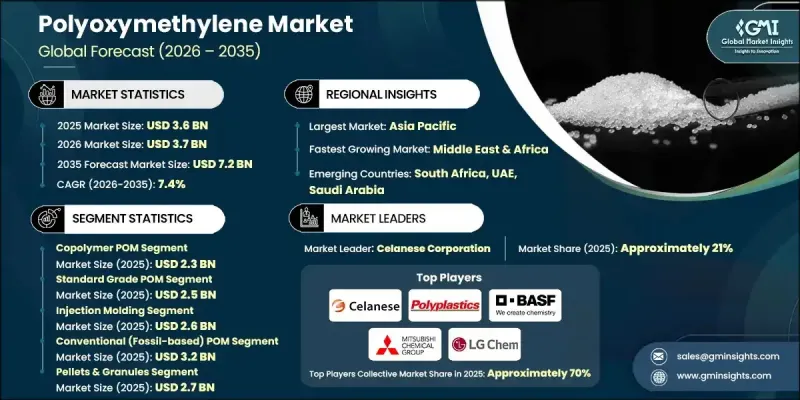
세계의 폴리옥시메틸렌 시장은 2025년에 36억 달러로 평가되었고, 2035년까지 연평균 복합 성장률(CAGR) 7.4%로 성장하여 72억 달러에 이를 것으로 예측됩니다.
폴리옥시메틸렌(POM)은 경량, 고강도, 내구성이 뛰어난 소재에 대한 수요가 증가하고 있는 자동차 분야를 중심으로 괄목할만한 성장을 이루고 있습니다. 그 특성은 기어, 클립, 커넥터 등 정밀 자동차 부품 제조에 최적이며, 자동차 제조업체의 연비 향상과 차량 경량화 목표 달성을 돕고 있습니다. 세계 자동차 생산의 지속적인 성장으로 시장은 더욱 강화되고 있습니다. 또한, 가전기기 및 가전 부문도 시장 확대에 기여하고 있습니다. POM의 치수 안정성, 우수한 전기 절연성, 내마모성은 POM이 내부 부품, 커넥터, 하우징의 소재로 선호되는 이유입니다. 소형, 고성능 전자제품에 대한 수요가 증가함에 따라 제조업체들은 엄격한 품질 및 안전 기준을 충족하기 위해 POM에 대한 의존도를 높이고 있으며, 이는 생산량과 수익의 성장을 가속하고 있습니다.
| 시장 범위 | |
|---|---|
| 개시 연도 | 2025년 |
| 예측 연도 | 2026-2035년 |
| 개시 연도 시장 규모 | 36억 달러 |
| 예측 금액 | 72억 달러 |
| CAGR | 7.4% |
공중합체 POM 부문은 2025년 23억 달러에 달할 것으로 예상되며, 2026년부터 2035년까지 연평균 7.5%의 성장률을 보일 것으로 예측됩니다. 우수한 내화학성과 열 안정성으로 유명한 공중합체 POM은 의료기기, 가전제품 등 가혹한 환경에 노출되는 제품에 널리 사용되고 있습니다. 이 부문을 통해 제조업체는 다양한 산업 분야의 특수한 성능 요구 사항을 충족시킬 수 있습니다.
표준 등급 POM 부문은 2025년 25억 달러로 평가되었고, 2026년부터 2035년까지 연평균 7.1%의 성장률을 보일 것으로 예측됩니다. 표준 및 강화 등급은 주로 일반 엔지니어링 용도에 사용되며, 내충격성 개선 등급은 강화된 인성과 응력 저항을 제공하여 특정 산업 요구를 충족시킵니다.
북미 폴리옥시메틸렌 시장은 2025년 6억 4,000만 달러 규모를 기록할 것으로 예측됩니다. 이 지역의 POM 채택은 자동차, 전자제품, 산업기계 부문 수요에 의해 주도되고 있습니다. 첨단 POM 기반 제조 기술을 통해 가볍고 내구성이 뛰어난 정밀 부품을 생산할 수 있으며, 자동화 및 재료 효율성에 대한 투자로 시장 확대가 더욱 가속화되고 있습니다.
자주 묻는 질문
목차
제1장 조사 방법
- 시장 범위와 정의
- 조사 설계
- 조사 접근
- 데이터 수집 방법
- 데이터 마이닝 소스
- 세계
- 지역별/국가별
- 기본 추정치와 계산
- 기준연도 계산
- 시장 추정 주요 동향
- 1차 조사와 검증
- 1차 정보
- 예측 모델
- 조사의 전제조건과 제한 사항
제2장 주요 요약
제3장 업계 인사이트
- 생태계 분석
- 공급업체 상황
- 이익률
- 각 단계별 부가가치
- 밸류체인에 영향을 미치는 요인
- 파괴적 변화
- 업계에 대한 영향요인
- 성장 촉진요인
- 업계의 잠재적 리스크&과제
- 시장 기회
- 성장 가능성 분석
- 규제 상황
- 북미
- 유럽
- 아시아태평양
- 라틴아메리카
- 중동 및 아프리카
- Porter's Five Forces 분석
- PESTEL 분석
- 가격 동향
- 지역별
- 유형별
- 향후 시장 동향
- 기술과 혁신 동향
- 현재 기술 동향
- 신기술
- 특허 상황
- 무역 통계(주 : 무역 통계는 주요 국가에 한해 제공됩니다)
- 주요 수입국
- 주요 수출국
- 지속가능성과 환경면
- 지속가능한 실천
- 폐기물 감축 전략
- 생산 에너지 효율
- 친환경 이니셔티브
- 탄소발자국에 관한 고려사항
제4장 경쟁 구도
- 서론
- 기업의 시장 점유율 분석
- 지역별
- 북미
- 유럽
- 아시아태평양
- 라틴아메리카
- 중동 및 아프리카
- 지역별
- 기업 매트릭스 분석
- 주요 시장 기업의 경쟁 분석
- 경쟁 포지셔닝 매트릭스
- 주요 발전
- 인수합병(M&A)
- 제휴 및 협업
- 신제품 발매
- 사업 확대 계획
제5장 시장 추산 및 예측 : 유형별, 2022-2035
- 주요 동향
- 호모폴리머 POM
- 공중합체 POM
제6장 시장 추산 및 예측 : 등급별, 2022-2035
- 주요 동향
- 표준 등급 POM
- 강화 등급 POM
- 유리섬유 강화 폴리아세탈(POM)
- 그라스 비드 충전 폴리아세탈(POM)
- 광물 복합 POM
- 탄소섬유 강화 POM
- 내충격 등급 POM
- 의료용 등급 POM
- 자외선 안정화 등급 POM
- 기타 등급
제7장 시장 추산 및 예측 : 가공 방법별, 2022-2035
- 주요 동향
- 사출 성형
- 압출 성형
- 블로우 성형
- 압축 성형
- 회전 성형
- 금속 사출성형(MIM)
제8장 시장 추산 및 예측 : 원료 유형별, 2022-2035
- 주요 동향
- 기존(화석 유래) 폴리옥시메틸렌(POM)
- 바이오 POM(ECO-B)
- 저탄소 폴리 아크릴로니트릴 수지(ECO-C)
- 재생재 함유 폴리아세탈 수지
- 기타
제9장 시장 추산 및 예측 : 형태별, 2022-2035
- 주요 동향
- 펠릿 및 과립
- 로드
- 시트
- 필름
- 개요
- 성형 부품
제10장 시장 추산 및 예측 : 최종 이용 산업별, 2022-2035
- 주요 동향
- 자동차 산업
- 내장 시스템
- 외장 시스템
- 파워트레인 및 엔진룸 내
- 연료 시스템
- 안전 시스템
- 서스펜션 시스템
- 배터리 시스템(전기자동차용)
- 의료 및 헬스케어 산업
- 약물전달 기기
- 진단 기기
- 외과용 기구
- 유체 처리 시스템
- 전기 및 전자 산업
- 커넥터
- 스위치
- 하우징 및 인클루저
- 정밀 부품
- 소비재 산업
- 가전제품
- 전동공구
- 수공구
- 완구
- 가구
- 퍼스널케어
- 스포츠 용품
- 산업기계 산업
- 톱니바퀴 및 전동 부품
- 베어링 및 부싱
- 컨베이어 시스템
- 펌프 부품
- 배관 및 건축업계
- 배관 기구
- 수도 시스템
- 건축 철물
- 기타 최종 이용 산업
제11장 시장 추산 및 예측 : 지역별, 2022-2035
- 주요 동향
- 북미
- 미국
- 캐나다
- 유럽
- 독일
- 영국
- 프랑스
- 이탈리아
- 스페인
- 기타 유럽
- 아시아태평양
- 중국
- 인도
- 일본
- 호주
- 한국
- 기타 아시아태평양
- 라틴아메리카
- 브라질
- 멕시코
- 아르헨티나
- 기타 라틴아메리카
- 중동 및 아프리카
- 사우디아라비아
- 남아프리카공화국
- 아랍에미리트(UAE)
- 기타 중동 및 아프리카
제12장 기업 개요
- Celanese Corporation
- Polyplastics Co., Ltd.
- BASF SE
- Mitsubishi Chemical Group of companies
- LG Chem
- Formosa Plastics Corporation
- Asahi Kasei Corporation
- SABIC
- LyondellBasell Industries
- Daicel Corporation
- Kolon Plastics, Inc.
- Ensinger GmbH
- RTP Company
- Yunnan Yuntianhua
- Henan Energy Group Co., Ltd.
- Shanghai Bluestar POM
- Ticona(Celanese brand)
- PTM Engineering Plastics
The Global Polyoxymethylene Market was valued at USD 3.6 billion in 2025 and is estimated to grow at a CAGR of 7.4% to reach USD 7.2 billion by 2035.
POM has witnessed significant growth, primarily driven by the automotive sector, where demand for lightweight, high-strength, and durable materials is rising. Its properties make it ideal for producing precision car components such as gears, clips, and connectors, supporting automakers' goals of enhancing fuel efficiency and reducing vehicle weight. The market is further strengthened by consistent growth in automotive production globally. Additionally, the consumer electronics and appliances segment contributes to market expansion. POM's dimensional stability, excellent electrical insulation, and resistance to wear make it a preferred choice for internal components, connectors, and housings. As the demand for compact, high-performance electronic products increases, manufacturers increasingly rely on POM to meet stringent quality and safety standards, boosting production and revenue growth.
| Market Scope | |
|---|---|
| Start Year | 2025 |
| Forecast Year | 2026-2035 |
| Start Value | $3.6 Billion |
| Forecast Value | $7.2 Billion |
| CAGR | 7.4% |
The copolymer POM segment reached USD 2.3 billion in 2025 and is expected to grow at a CAGR of 7.5% between 2026 and 2035. Copolymer POM, known for its superior chemical resistance and thermal stability, is widely used in products exposed to harsh conditions, including medical and consumer appliances. This segment allows manufacturers to cater to specialized performance requirements across diverse industries.
The standard grade POM segment was valued at USD 2.5 billion in 2025 and is anticipated to grow at a CAGR of 7.1% from 2026 to 2035. Standard and reinforced grades are primarily used in general engineering applications, while impact-modified grades offer enhanced toughness and stress resistance, addressing specific industrial needs.
North America Polyoxymethylene Market generated USD 640 million in 2025. The region's POM adoption is driven by demand in the automotive, electronics, and industrial machinery sectors. Advanced POM-based manufacturing enables the production of lightweight, durable, and precision components, and investments in automation and material efficiency further support market expansion.
Key players in the Global Polyoxymethylene Market include Celanese Corporation, Polyplastics Co., Ltd., BASF SE, Mitsubishi Chemical Group, LG Chem, and others. Companies in the Global Polyoxymethylene Market are implementing multiple strategies to strengthen their position and expand their market footprint. They are investing heavily in research and development to create customized grades with enhanced chemical, thermal, and mechanical properties. Strategic collaborations with automotive, electronics, and industrial machinery manufacturers ensure long-term supply contracts and promote the adoption of high-performance POM products. Expanding production capacity in key regions reduces lead times and supports local demand. Firms are also integrating sustainability initiatives, such as energy-efficient manufacturing and recycling programs, to meet environmental standards.
Table of Contents
Chapter 1 Methodology
- 1.1 Market scope and definition
- 1.2 Research design
- 1.2.1 Research approach
- 1.2.2 Data collection methods
- 1.3 Data mining sources
- 1.3.1 Global
- 1.3.2 Regional/Country
- 1.4 Base estimates and calculations
- 1.4.1 Base year calculation
- 1.4.2 Key trends for market estimation
- 1.5 Primary research and validation
- 1.5.1 Primary sources
- 1.6 Forecast model
- 1.7 Research assumptions and limitations
Chapter 2 Executive Summary
- 2.1 Industry 3600 synopsis
- 2.2 Key market trends
- 2.2.1 Regional
- 2.2.2 Type
- 2.2.3 Grade
- 2.2.4 Processing Method
- 2.2.5 Feedstock Type
- 2.2.6 Form
- 2.2.7 End Use Industry
- 2.3 TAM Analysis, 2026-2035
- 2.4 CXO perspectives: Strategic imperatives
- 2.4.1 Executive decision points
- 2.4.2 Critical success factors
- 2.5 Future Outlook and Strategic Recommendations
Chapter 3 Industry Insights
- 3.1 Industry ecosystem analysis
- 3.1.1 Supplier Landscape
- 3.1.2 Profit Margin
- 3.1.3 Value addition at each stage
- 3.1.4 Factor affecting the value chain
- 3.1.5 Disruptions
- 3.2 Industry impact forces
- 3.2.1 Growth drivers
- 3.2.2 Industry pitfalls and challenges
- 3.2.3 Market opportunities
- 3.3 Growth potential analysis
- 3.4 Regulatory landscape
- 3.4.1 North America
- 3.4.2 Europe
- 3.4.3 Asia Pacific
- 3.4.4 Latin America
- 3.4.5 Middle East & Africa
- 3.5 Porter's analysis
- 3.6 PESTEL analysis
- 3.7 Price trends
- 3.7.1 By region
- 3.7.2 By type
- 3.8 Future market trends
- 3.9 Technology and Innovation landscape
- 3.9.1 Current technological trends
- 3.9.2 Emerging technologies
- 3.10 Patent Landscape
- 3.11 Trade statistics (Note: the trade statistics will be provided for key countries only)
- 3.11.1 Major importing countries
- 3.11.2 Major exporting countries
- 3.12 Sustainability and Environmental Aspects
- 3.12.1 Sustainable Practices
- 3.12.2 Waste Reduction Strategies
- 3.12.3 Energy Efficiency in Production
- 3.12.4 Eco-friendly Initiatives
- 3.13 Carbon Footprint Considerations
Chapter 4 Competitive Landscape, 2025
- 4.1 Introduction
- 4.2 Company market share analysis
- 4.2.1 By region
- 4.2.1.1 North America
- 4.2.1.2 Europe
- 4.2.1.3 Asia Pacific
- 4.2.1.4 LATAM
- 4.2.1.5 MEA
- 4.2.1 By region
- 4.3 Company matrix analysis
- 4.4 Competitive analysis of major market players
- 4.5 Competitive positioning matrix
- 4.6 Key developments
- 4.6.1 Mergers & acquisitions
- 4.6.2 Partnerships & collaborations
- 4.6.3 New Product Launches
- 4.6.4 Expansion Plans
Chapter 5 Market Estimates and Forecast, By Type, 2022 - 2035 (USD Billion, Kilo Tons)
- 5.1 Key trends
- 5.2 Homopolymer POM
- 5.3 Copolymer POM
Chapter 6 Market Estimates and Forecast, By Grade, 2022 - 2035 (USD Billion, Kilo Tons)
- 6.1 Key trends
- 6.2 Standard Grade POM
- 6.3 Reinforced Grade POM
- 6.3.1 Glass Fiber Reinforced POM
- 6.3.2 Glass Bead Filled POM
- 6.3.3 Mineral Coupled POM
- 6.3.4 Carbon Fiber Reinforced POM
- 6.4 Impact Modified Grade POM
- 6.5 Medical Grade POM
- 6.6 UV Stabilized Grade POM
- 6.7 Other Grades
Chapter 7 Market Estimates and Forecast, By Processing Method, 2022 - 2035 (USD Billion, Kilo Tons)
- 7.1 Key trends
- 7.2 Injection Molding
- 7.3 Extrusion
- 7.4 Blow Molding
- 7.5 Compression Molding
- 7.6 Rotational Molding
- 7.7 Metal Injection Molding (MIM)
Chapter 8 Market Estimates and Forecast, By Feedstock Type, 2022 - 2035 (USD Billion, Kilo Tons)
- 8.1 Key trends
- 8.2 Conventional (Fossil-based) POM
- 8.3 Bio-based POM (ECO-B)
- 8.4 Low-Carbon POM (ECO-C)
- 8.5 Recycled Content POM
- 8.6 Others
Chapter 9 Market Estimates and Forecast, By Form, 2022 - 2035 (USD Billion, Kilo Tons)
- 9.1 Key trends
- 9.2 Pellets & Granules
- 9.3 Rods
- 9.4 Sheets
- 9.5 Films
- 9.6 Profiles
- 9.7 Molded Parts
Chapter 10 Market Estimates and Forecast, By End Use Industry, 2022 - 2035 (USD Billion, Kilo Tons)
- 10.1 Key trends
- 10.2 Automotive industry
- 10.2.1 Interior systems
- 10.2.2 Exterior systems
- 10.2.3 Powertrain & under-the-hood
- 10.2.4 Fuel systems
- 10.2.5 Safety systems
- 10.2.6 Suspension systems
- 10.2.7 Battery systems (EV applications)
- 10.3 Medical & healthcare industry
- 10.3.1 Drug delivery devices
- 10.3.2 Diagnostic devices
- 10.3.3 Surgical instruments
- 10.3.4 Fluid handling systems
- 10.4 Electrical & electronics industry
- 10.4.1 Connectors
- 10.4.2 Switches
- 10.4.3 Housings & enclosures
- 10.4.4 Precision components
- 10.5 Consumer goods industry
- 10.5.1 Appliances
- 10.5.2 Power tools
- 10.5.3 Hand tools
- 10.5.4 Toys
- 10.5.5 Furniture
- 10.5.6 Personal care
- 10.5.7 Sports equipment
- 10.6 Industrial machinery industry
- 10.6.1 Gears & transmission components
- 10.6.2 Bearings & bushings
- 10.6.3 Conveyor systems
- 10.6.4 Pump components
- 10.7 Plumbing & building industry
- 10.7.1 Plumbing fixtures
- 10.7.2 Water systems
- 10.7.3 Building hardware
- 10.8 Other end use industries
Chapter 11 Market Estimates and Forecast, By Region, 2022 - 2035 (USD Billion, Kilo Tons)
- 11.1 Key trends
- 11.2 North America
- 11.2.1 U.S.
- 11.2.2 Canada
- 11.3 Europe
- 11.3.1 Germany
- 11.3.2 UK
- 11.3.3 France
- 11.3.4 Italy
- 11.3.5 Spain
- 11.3.6 Rest of Europe
- 11.4 Asia Pacific
- 11.4.1 China
- 11.4.2 India
- 11.4.3 Japan
- 11.4.4 Australia
- 11.4.5 South Korea
- 11.4.6 Rest of Asia Pacific
- 11.5 Latin America
- 11.5.1 Brazil
- 11.5.2 Mexico
- 11.5.3 Argentina
- 11.5.4 Rest of Latin America
- 11.6 Middle East & Africa
- 11.6.1 Saudi Arabia
- 11.6.2 South Africa
- 11.6.3 UAE
- 11.6.4 Rest of Middle East & Africa
Chapter 12 Company Profiles
- 12.1 Celanese Corporation
- 12.2 Polyplastics Co., Ltd.
- 12.3 BASF SE
- 12.4 Mitsubishi Chemical Group of companies
- 12.5 LG Chem
- 12.6 Formosa Plastics Corporation
- 12.7 Asahi Kasei Corporation
- 12.8 SABIC
- 12.9 LyondellBasell Industries
- 12.10 Daicel Corporation
- 12.11 Kolon Plastics, Inc.
- 12.12 Ensinger GmbH
- 12.13 RTP Company
- 12.14 Yunnan Yuntianhua
- 12.15 Henan Energy Group Co., Ltd.
- 12.16 Shanghai Bluestar POM
- 12.17 Ticona (Celanese brand)
- 12.18 PTM Engineering Plastics